
What Can World Models Tell Us About Peak
What Can World Models Tell Us About Peak Oil Supply and Global Warming? François E. Cellier Department of Computer Science ETH Zurich Switzerland February 9, 2009 © Prof. Dr. François E. Cellier Start of Presentation
The Chain Letter I • Let us consider the model of a simple chain letter. • The following rules are set to govern this (artificial) model: v A chain letter is received with two addresses on it, the address of the sender, and the address of the sender’s sender. v After receiving the letter, a recipient sends $1 to the sender’s sender. He or she then sends the letter on to 10 other people, again with two addresses, his (or her) own as the new sender, and the sender’s address as the new sender’s sender. v The letter is only mailed within the U. S. v Every recipient answers the letter exactly once. When a recipient receives the same letter for a second or subsequent time, he (or she) simply throws it away. February 9, 2009 © Prof. Dr. François E. Cellier Start of Presentation
The Chain Letter II • Special rules are needed to provide initial conditions. v The originator sends the letter to 10 people without sending money to anyone. v If a recipient receives the letter with only one address (the sender’s address), he or she sends the letter on to 10 other people with two addresses (his or her own as the sender, and that of the originator as the sender’s sender). No money is paid to anyone in this case. • Every sender has 100 receiver’s receivers, thus is expected to make $100. • Except for the first 11, who don’t pay anything, every sender pays exactly $1. • Hence this is a wonderful (and totally illegal!) way of making money out of thin air. February 9, 2009 © Prof. Dr. François E. Cellier Start of Presentation
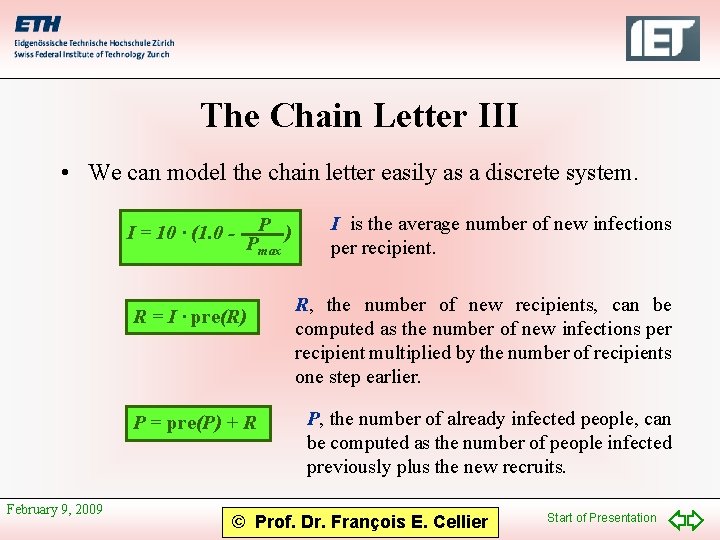
The Chain Letter III • We can model the chain letter easily as a discrete system. I = 10 · (1. 0 - P ) Pmax R = I · pre(R) P = pre(P) + R February 9, 2009 I is the average number of new infections per recipient. R, the number of new recipients, can be computed as the number of new infections per recipient multiplied by the number of recipients one step earlier. P, the number of already infected people, can be computed as the number of people infected previously plus the new recruits. © Prof. Dr. François E. Cellier Start of Presentation
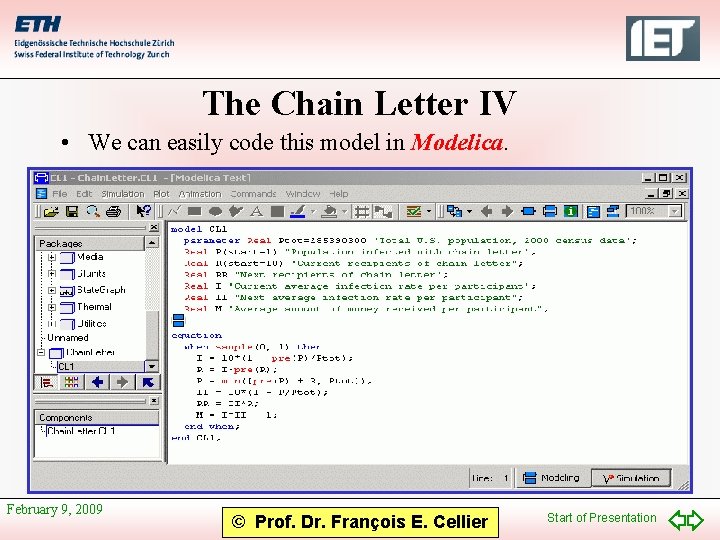
The Chain Letter IV • We can easily code this model in Modelica. February 9, 2009 © Prof. Dr. François E. Cellier Start of Presentation
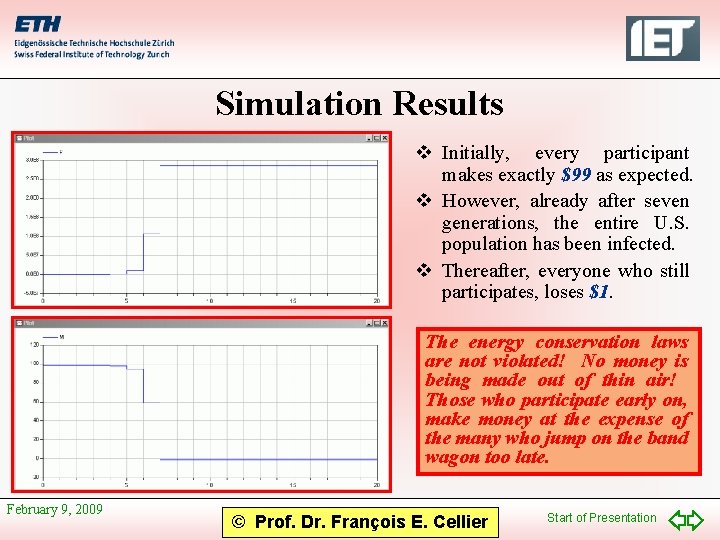
Simulation Results v Initially, every participant makes exactly $99 as expected. v However, already after seven generations, the entire U. S. population has been infected. v Thereafter, everyone who still participates, loses $1. The energy conservation laws are not violated! No money is being made out of thin air! Those who participate early on, make money at the expense of the many who jump on the band wagon too late. February 9, 2009 © Prof. Dr. François E. Cellier Start of Presentation
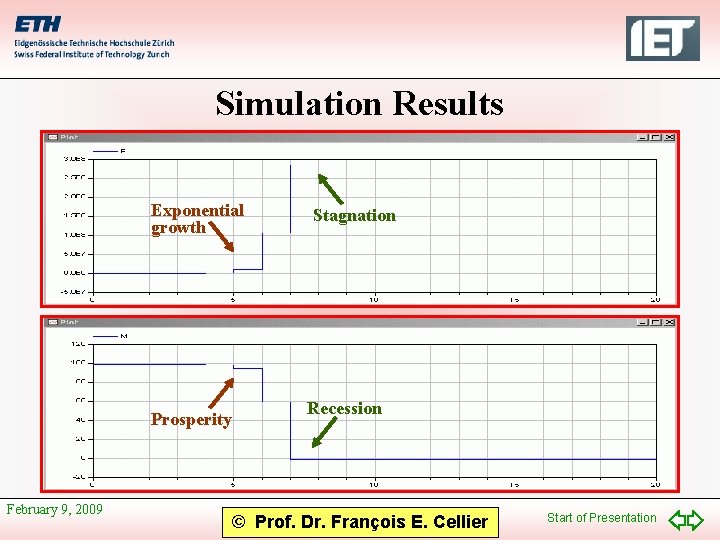
Simulation Results Exponential growth Prosperity February 9, 2009 Stagnation Recession © Prof. Dr. François E. Cellier Start of Presentation
Exponential Growth and Ponzi Schemes • Mailing out chain letters is illegal, when done by individuals. • Unfortunately, our entire economy is based on the chain letter principle, which in economic circles is usually referred to as a Ponzi scheme. • Madoff failed, not because he was doing something out of the ordinary. He failed, because his Ponzi scheme was reaching its Limits to Growth. February 9, 2009 © Prof. Dr. François E. Cellier Start of Presentation
Social Security is a Ponzi Scheme • When I pay social security taxes, my money is not being saved to guarantee retirement benefits for myself. • The money is being spent immediately to pay out retirement benefits to those who are eligible to receive such benefits right now. • Social security remains solvent as long as we can guarantee continued exponential growth of our population. • When the population reaches its limits to growth, social security becomes insolvent, because it’s a Ponzi scheme. February 9, 2009 © Prof. Dr. François E. Cellier Start of Presentation
Our Banking System is a Ponzi Scheme • When I deposit money in a bank account, I expect a fixed interest rate, i. e. , my money is supposed to grow exponentially. • In order to pay the promised interest on my deposit, the bank must re-invest my money in another scheme that makes it grow exponentially at a faster rate. • This scheme works, until our economy reaches its limits to growth. • At that time, our banks become insolvent, because they represent one colossal Ponzi scheme. February 9, 2009 © Prof. Dr. François E. Cellier Start of Presentation
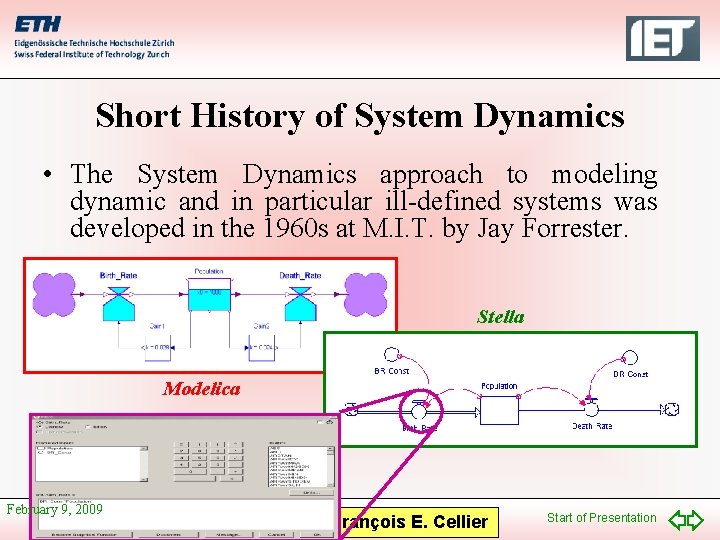
Short History of System Dynamics • The System Dynamics approach to modeling dynamic and in particular ill-defined systems was developed in the 1960 s at M. I. T. by Jay Forrester. Stella Modelica February 9, 2009 © Prof. Dr. François E. Cellier Start of Presentation
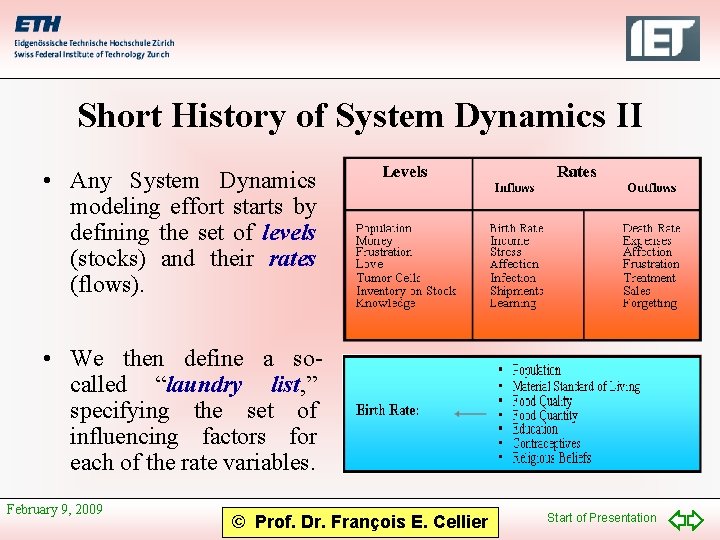
Short History of System Dynamics II • Any System Dynamics modeling effort starts by defining the set of levels (stocks) and their rates (flows). • We then define a socalled “laundry list, ” specifying the set of influencing factors for each of the rate variables. February 9, 2009 © Prof. Dr. François E. Cellier Start of Presentation
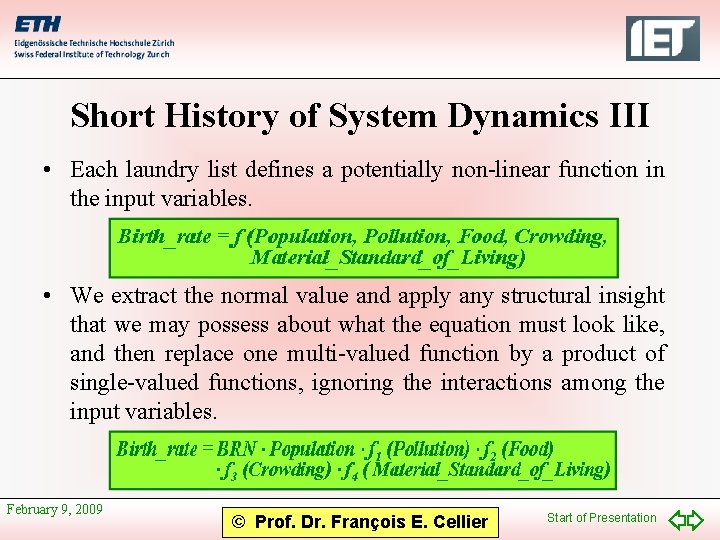
Short History of System Dynamics III • Each laundry list defines a potentially non-linear function in the input variables. • We extract the normal value and apply any structural insight that we may possess about what the equation must look like, and then replace one multi-valued function by a product of single-valued functions, ignoring the interactions among the input variables. February 9, 2009 © Prof. Dr. François E. Cellier Start of Presentation
![Forrester’s World 2 Model [1971] February 9, 2009 © Prof. Dr. François E. Cellier](http://slidetodoc.com/presentation_image_h2/6de902d2a889c1caa2cc4d25fc636f82/image-14.jpg "Forrester’s World 2 Model [1971] February 9, 2009 © Prof. Dr. François E. Cellier")
Forrester’s World 2 Model [1971] February 9, 2009 © Prof. Dr. François E. Cellier Start of Presentation
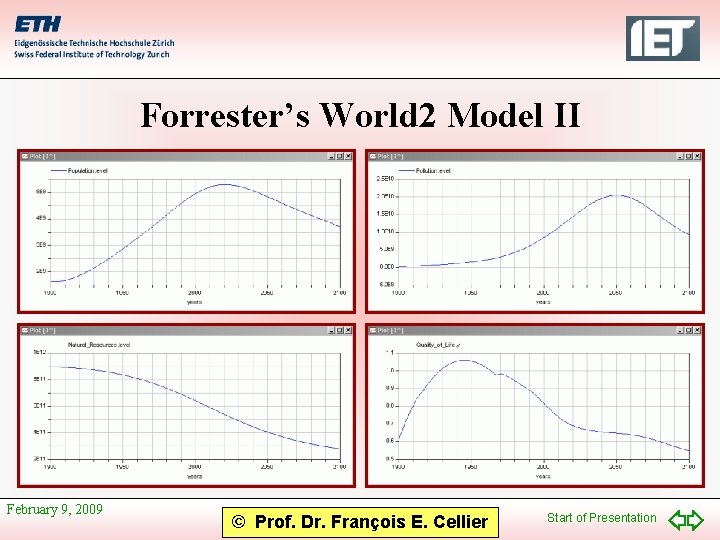
Forrester’s World 2 Model II February 9, 2009 © Prof. Dr. François E. Cellier Start of Presentation
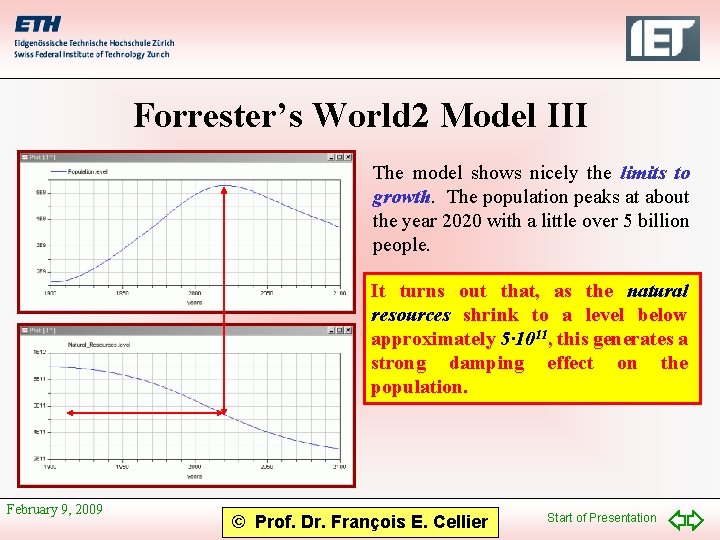
Forrester’s World 2 Model III The model shows nicely the limits to growth. The population peaks at about the year 2020 with a little over 5 billion people. It turns out that, as the natural resources shrink to a level below approximately 5· 1011, this generates a strong damping effect on the population. February 9, 2009 © Prof. Dr. François E. Cellier Start of Presentation
![Meadows’ World 3 Model [1972] • One year after Forrester, Meadows (also from M.](http://slidetodoc.com/presentation_image_h2/6de902d2a889c1caa2cc4d25fc636f82/image-17.jpg "Meadows’ World 3 Model [1972] • One year after Forrester, Meadows (also from M.")
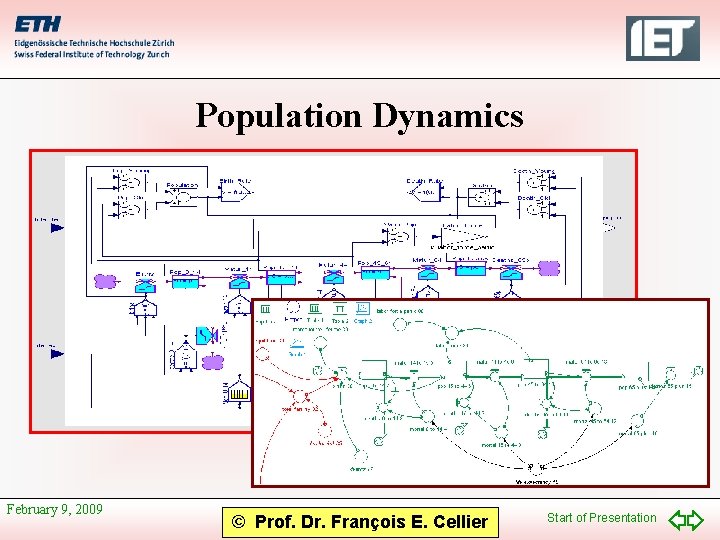
Meadows’ World 3 Model [1972] • One year after Forrester, Meadows (also from M. I. T. ) published his own world model that he coined World 3. • The World 3 model is considerably more complex than the earlier World 2 model. It no longer fits on a single screen. • Contrary to Forrester, Meadows didn’t publish the equations governing his model in his book: Limits to Growth. He only published the simulation results obtained from his model. • He published the model itself in a separate book: Dynamics of Growth in a Finite World. That book appeared two years later. • Meadows’ model is considerably more sound than Forrester’s model, and consequently, it can answer more questions in a more reliable fashion. February 9, 2009 © Prof. Dr. François E. Cellier Start of Presentation
Population Dynamics February 9, 2009 © Prof. Dr. François E. Cellier Start of Presentation
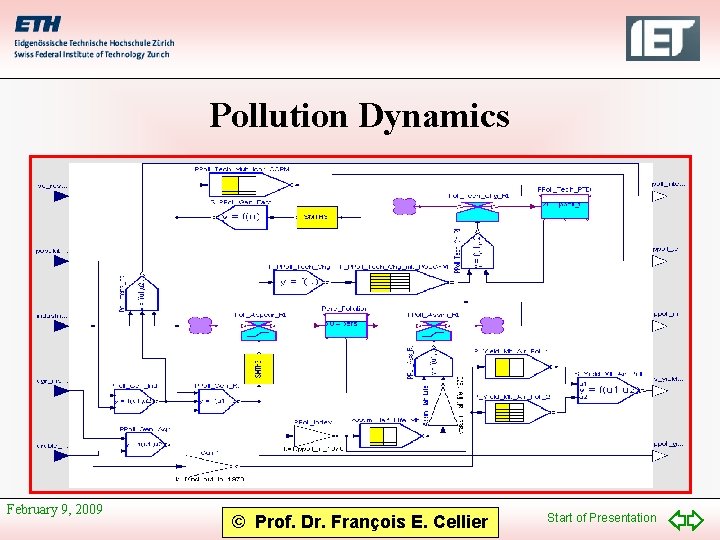
Pollution Dynamics February 9, 2009 © Prof. Dr. François E. Cellier Start of Presentation
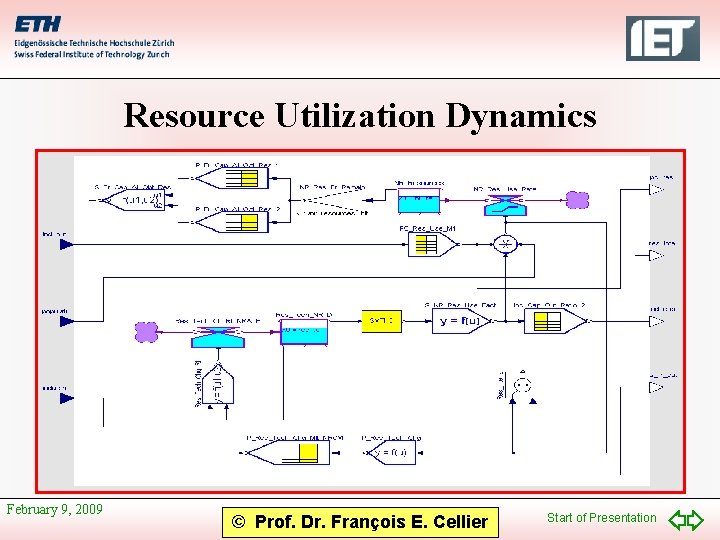
Resource Utilization Dynamics February 9, 2009 © Prof. Dr. François E. Cellier Start of Presentation
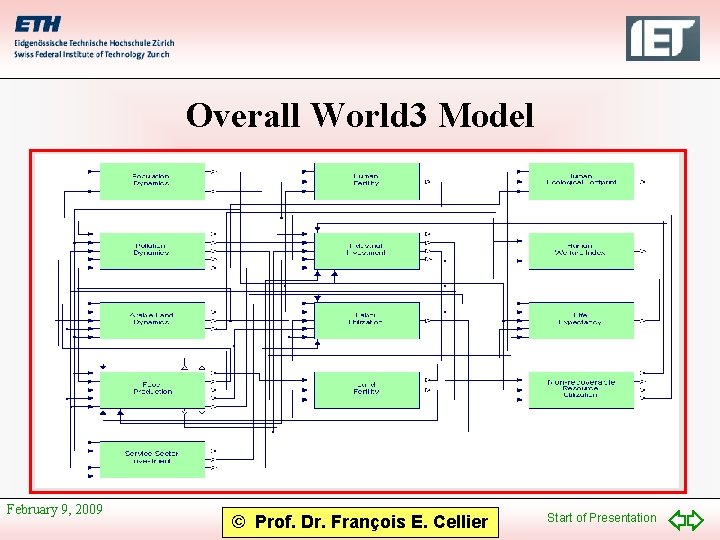
Overall World 3 Model February 9, 2009 © Prof. Dr. François E. Cellier Start of Presentation
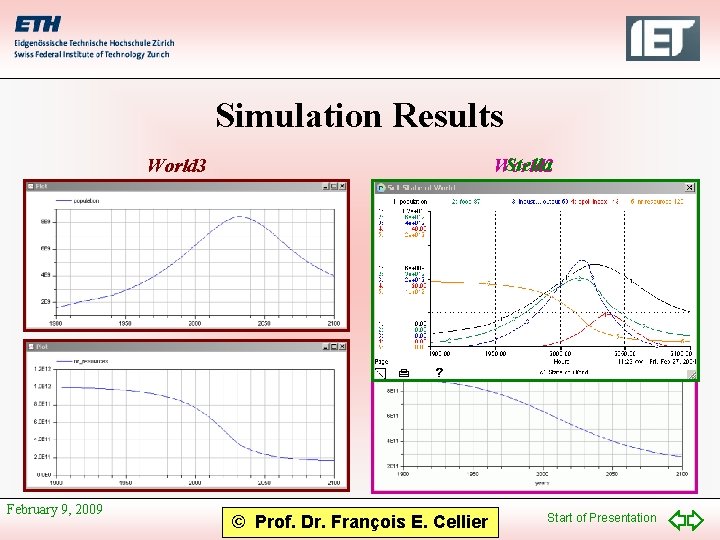
Simulation Results Stella World 2 World 3 February 9, 2009 © Prof. Dr. François E. Cellier Start of Presentation
Analysis of Simulation Results • Although World 2 and World 3 use a completely different set of state variables with different interactions between them, the results are almost identical. • The simulation results don’t seem to be very sensitive to the selection of state variables and interactions in the model. • This essentially is bad news in the given situation. • Meadows published three versions of his model: in 1972, in 1992, and in 2004 (based on simulations of 2002). • The revised versions added a few components, but the primary difference between them is the year, interventions take place. It makes no sense to optimize over the past. • As time progresses, the window of opportunity for affecting the outcome is shrinking. February 9, 2009 © Prof. Dr. François E. Cellier Start of Presentation
Different Scenarios • Both in World 2 and World 3, the limits to growth are initially caused by resource depletion. • Meadows (like Forrester before him) proposed to lift that limit by assuming that there are more resources available than earlier thought. • In both models, the limits to growth are now caused by excessive pollution. • Both models show that excessive pollution is much worse than resource depletion. It leads to massive die-off. • Hence measures are proposed to limit the amount of pollutants generated. Now the limits to growth are caused by food scarcity. February 9, 2009 © Prof. Dr. François E. Cellier Start of Presentation
Reactions • Both World Dynamics and Limits to Growth received immediately lots of attention. Both books were sold millions of times and were translated into many languages. • Because of the attention that these books had found, and because the message wasn’t palatable, lobbyists quickly started denouncing the results. These were essentially the same agents that today denounce climate change. • The methods were defamed as pseudo-science, and the authors were both ridiculed and vilified. • The defamation campaign turned out to be utterly successful. Forrester and Meadows were shunned by “serious” scientists for many years, and their message was buried. No public funding was henceforth made available for research relating to global dynamics. February 9, 2009 © Prof. Dr. François E. Cellier Start of Presentation
Sustainability • All indicators point to the assumption that we are already now consuming the remaining resources of this planet at a pace faster than the planet is able to re-grow them for us. • Our material standard of living is no longer sustainable. • In such a situation, it doesn’t help to relieve a limiting factor. Doing so will make the situation only worse. • In order to prevent the worst-case scenario, we’ll have to reduce our consumption down to a sustainable level. • The faster we do so, the better we’ll be off in the long run. • Unfortunately, there is no indication that this is what we are actually doing, or even, what we might be willing to consider doing. February 9, 2009 © Prof. Dr. François E. Cellier Start of Presentation
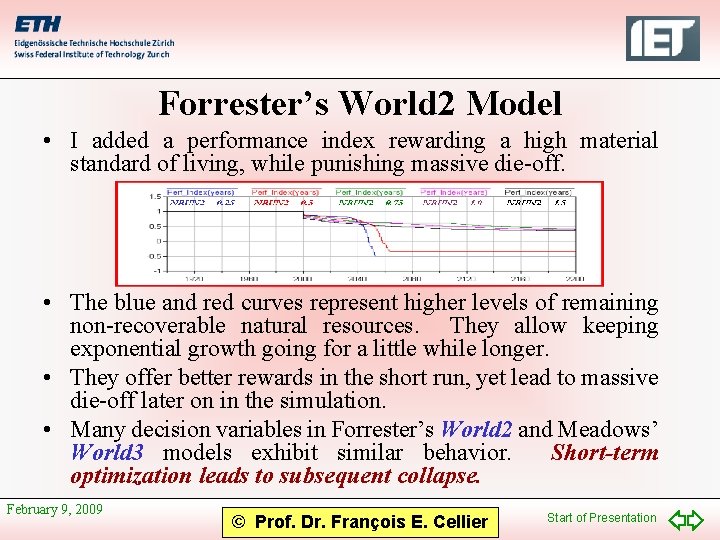
Forrester’s World 2 Model • I added a performance index rewarding a high material standard of living, while punishing massive die-off. • The blue and red curves represent higher levels of remaining non-recoverable natural resources. They allow keeping exponential growth going for a little while longer. • They offer better rewards in the short run, yet lead to massive die-off later on in the simulation. • Many decision variables in Forrester’s World 2 and Meadows’ World 3 models exhibit similar behavior. Short-term optimization leads to subsequent collapse. February 9, 2009 © Prof. Dr. François E. Cellier Start of Presentation
Lessons Learnt • The most important question that the world models ought to answer is: When is the world coming out of exponential growth? • The world models are fairly consistent in their answer to this question: It happens right about now. • Different quantities, such as different forms of fuels, minerals, drinking water, and food peak at different times, but they all peak essentially within one or two generations. • This is the direct consequence of exponential growth running up against the limitations of a finite resource, namely our planet. February 9, 2009 © Prof. Dr. François E. Cellier Start of Presentation
![Peak Oil [USGS] February 9, 2009 © Prof. Dr. François E. Cellier Start of](http://slidetodoc.com/presentation_image_h2/6de902d2a889c1caa2cc4d25fc636f82/image-29.jpg "Peak Oil [USGS] February 9, 2009 © Prof. Dr. François E. Cellier Start of")
Peak Oil [USGS] February 9, 2009 © Prof. Dr. François E. Cellier Start of Presentation
![Peak Oil [BP] February 9, 2009 © Prof. Dr. François E. Cellier ? Start](http://slidetodoc.com/presentation_image_h2/6de902d2a889c1caa2cc4d25fc636f82/image-30.jpg "Peak Oil [BP] February 9, 2009 © Prof. Dr. François E. Cellier ? Start")
Peak Oil [BP] February 9, 2009 © Prof. Dr. François E. Cellier ? Start of Presentation
![New Oil Discovery [USGS] • The new discoveries can be predicted quite well. They](http://slidetodoc.com/presentation_image_h2/6de902d2a889c1caa2cc4d25fc636f82/image-31.jpg "New Oil Discovery [USGS] • The new discoveries can be predicted quite well. They")
New Oil Discovery [USGS] • The new discoveries can be predicted quite well. They follow an exponential decay curve. • Integrating this curve over time generates the curve of total previous discoveries, which is an s-shaped curve similar to the infections of the chain letter. This allows to estimate the total amount of oil in the ground. February 9, 2009 © Prof. Dr. François E. Cellier Start of Presentation
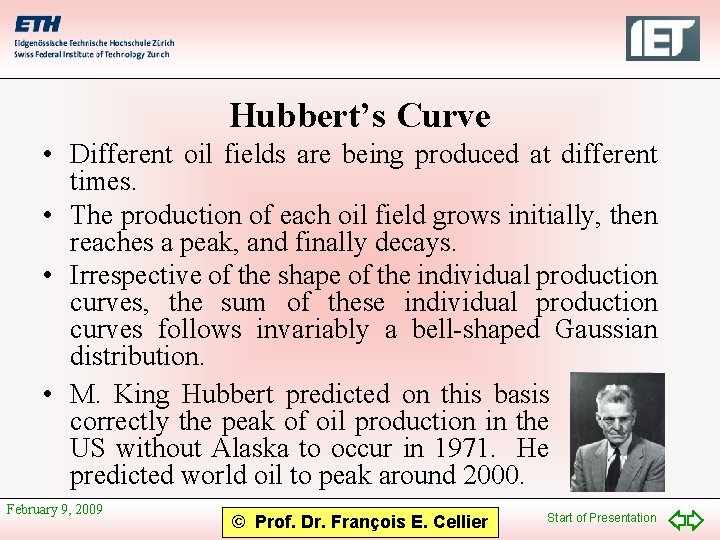
Hubbert’s Curve • Different oil fields are being produced at different times. • The production of each oil field grows initially, then reaches a peak, and finally decays. • Irrespective of the shape of the individual production curves, the sum of these individual production curves follows invariably a bell-shaped Gaussian distribution. • M. King Hubbert predicted on this basis correctly the peak of oil production in the US without Alaska to occur in 1971. He predicted world oil to peak around 2000. February 9, 2009 © Prof. Dr. François E. Cellier Start of Presentation
The Curse of Shrinking EROEI • As oil becomes more scarce, its price will rise. • Consequently, deposits that were previously not economical to produce, suddenly become profitable. • Doesn’t this solve the Peak Oil problem? • Unfortunately, it doesn’t. These deposits were previously not economical to produce … because they cost more money –and energy– to produce. • The EROEI (Energy Returned On Energy Invested) measures, how much oil needs to be burned in order to produce one new barrel of oil. • Unfortunately, the EROEI of oil is rapidly shrinking. February 9, 2009 © Prof. Dr. François E. Cellier Start of Presentation
![The EROEI of Oil [C. Hall] February 9, 2009 © Prof. Dr. François E.](http://slidetodoc.com/presentation_image_h2/6de902d2a889c1caa2cc4d25fc636f82/image-34.jpg "The EROEI of Oil [C. Hall] February 9, 2009 © Prof. Dr. François E.")
The EROEI of Oil [C. Hall] February 9, 2009 © Prof. Dr. François E. Cellier Start of Presentation
The EROEI of Oil is Shrinking Fast • Tar sands and oil shale were hitherto not profitable to produce, because their EROEI is low (around 5). • Once the EROEI of an energy source falls below 1. 0, it makes little sense to produce it. • If the EROEI of all energy sources falls below a value of about 5, our industrial civilization is doomed [C. Hall]. • The EROEI of oil is shrinking fast. It has already shrunk by approximately a factor of 10. It is currently somewhere around 10. These are estimates as exact numbers are unavailable. February 9, 2009 © Prof. Dr. François E. Cellier Start of Presentation
![Energy and Economy Diagram [C. Hall] February 9, 2009 © Prof. Dr. François E.](http://slidetodoc.com/presentation_image_h2/6de902d2a889c1caa2cc4d25fc636f82/image-36.jpg "Energy and Economy Diagram [C. Hall] February 9, 2009 © Prof. Dr. François E.")
Energy and Economy Diagram [C. Hall] February 9, 2009 © Prof. Dr. François E. Cellier Start of Presentation
![Energy and Economy Diagram [C. Hall] February 9, 2009 © Prof. Dr. François E.](http://slidetodoc.com/presentation_image_h2/6de902d2a889c1caa2cc4d25fc636f82/image-37.jpg "Energy and Economy Diagram [C. Hall] February 9, 2009 © Prof. Dr. François E.")
Energy and Economy Diagram [C. Hall] February 9, 2009 © Prof. Dr. François E. Cellier Start of Presentation
![Energy and Economy Diagram [C. Hall] February 9, 2009 © Prof. Dr. François E.](http://slidetodoc.com/presentation_image_h2/6de902d2a889c1caa2cc4d25fc636f82/image-38.jpg "Energy and Economy Diagram [C. Hall] February 9, 2009 © Prof. Dr. François E.")
Energy and Economy Diagram [C. Hall] February 9, 2009 © Prof. Dr. François E. Cellier Start of Presentation
![Energy and Economy Diagram [C. Hall] February 9, 2009 © Prof. Dr. François E.](http://slidetodoc.com/presentation_image_h2/6de902d2a889c1caa2cc4d25fc636f82/image-39.jpg "Energy and Economy Diagram [C. Hall] February 9, 2009 © Prof. Dr. François E.")
Energy and Economy Diagram [C. Hall] February 9, 2009 © Prof. Dr. François E. Cellier Start of Presentation
![Energy and Economy Diagram [C. Hall] February 9, 2009 © Prof. Dr. François E.](http://slidetodoc.com/presentation_image_h2/6de902d2a889c1caa2cc4d25fc636f82/image-40.jpg "Energy and Economy Diagram [C. Hall] February 9, 2009 © Prof. Dr. François E.")
Energy and Economy Diagram [C. Hall] February 9, 2009 © Prof. Dr. François E. Cellier Start of Presentation
![Energy and Economy Diagram [C. Hall] February 9, 2009 © Prof. Dr. François E.](http://slidetodoc.com/presentation_image_h2/6de902d2a889c1caa2cc4d25fc636f82/image-41.jpg "Energy and Economy Diagram [C. Hall] February 9, 2009 © Prof. Dr. François E.")
Energy and Economy Diagram [C. Hall] February 9, 2009 © Prof. Dr. François E. Cellier Start of Presentation
![Energy and Economy Diagram [C. Hall] February 9, 2009 © Prof. Dr. François E.](http://slidetodoc.com/presentation_image_h2/6de902d2a889c1caa2cc4d25fc636f82/image-42.jpg "Energy and Economy Diagram [C. Hall] February 9, 2009 © Prof. Dr. François E.")
Energy and Economy Diagram [C. Hall] February 9, 2009 © Prof. Dr. François E. Cellier Start of Presentation
What Does This Mean I? • Due to shrinking EROEI, we need more and more energy to drive our economy. • As we move down the back slope of Hubbert’s curve, energy becomes more expensive, and we need to invest a larger percentage of our generated wealth into the production of energy. • Since we need to feed ourselves, less and less money is available for discretionary spending. • According to Hall’s model, discretionary spending will reach 0 around the year 2050. After that time, we need all of our wealth, just to feed ourselves. February 9, 2009 © Prof. Dr. François E. Cellier Start of Presentation
What Does This Mean II? • By 2050, we are living in a subsistence economy. • The industrial society is essentially over. • However, the resulting subsistence economy is highly inefficient, because there are far too many people living on the planet. • We need huge energy resources just to keep everyone fed. • If the amount available for discretionary spending turns negative, this means that we can no longer feed everyone in spite of our best efforts. • This is when the die-off begins. February 9, 2009 © Prof. Dr. François E. Cellier Start of Presentation
How Much Oil/Gas Do We Still Have I? • Oil reached worldwide its plateau around 2004. • According to our best estimates, oil will stay on the plateau roughly until 2012. • Thereafter, we’ll be on the downward slope of Hubbert’s curve. • The reduction in oil production will be progressive. • It will take very few years, in spite of demand destruction, until demand for the commodity can no longer be met by supply. • At that time, oil will become very expensive, and not everyone will be able to get it. February 9, 2009 © Prof. Dr. François E. Cellier Start of Presentation
How Much Oil/Gas Do We Still Have II? • The producer nations will satisfy their own demand first. • Therefore, oil export will shrink faster than oil production. • Nations that rely heavily on oil imports will be in big trouble. • Gas is predicted to peak about 14 years after oil. • Thus, gas will be available for a little while longer. • However, gas is not as easily transportable as oil, and therefore, gas may not be available everywhere. February 9, 2009 © Prof. Dr. François E. Cellier Start of Presentation
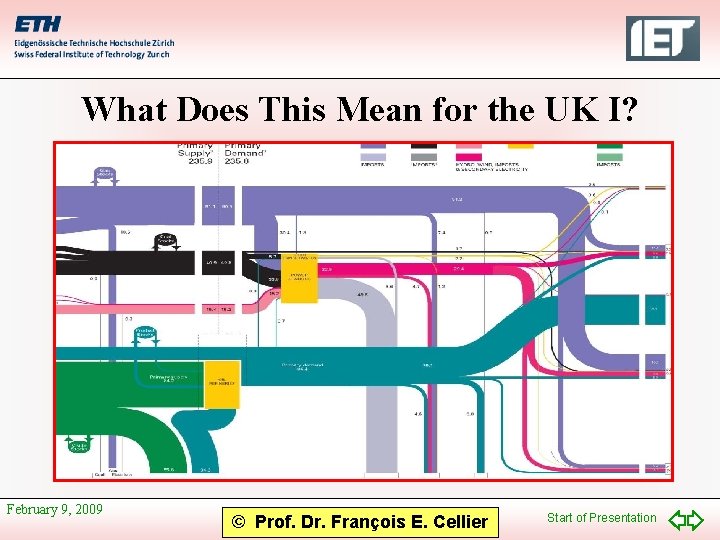
What Does This Mean for the UK I? February 9, 2009 © Prof. Dr. François E. Cellier Start of Presentation
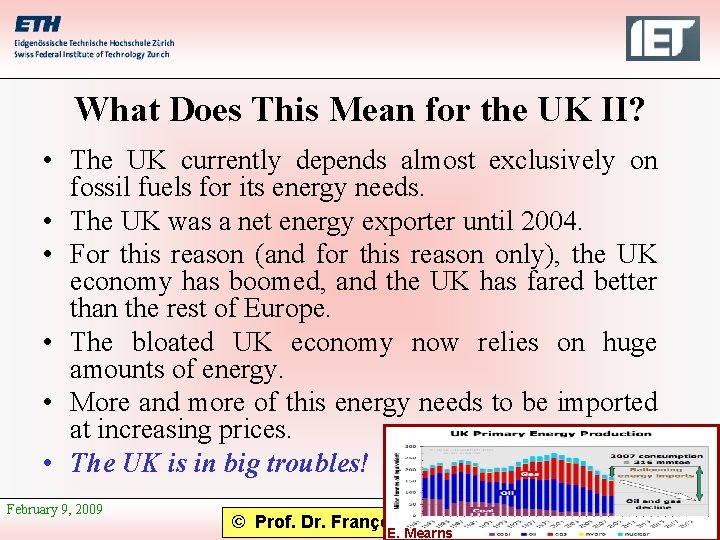
What Does This Mean for the UK II? • The UK currently depends almost exclusively on fossil fuels for its energy needs. • The UK was a net energy exporter until 2004. • For this reason (and for this reason only), the UK economy has boomed, and the UK has fared better than the rest of Europe. • The bloated UK economy now relies on huge amounts of energy. • More and more of this energy needs to be imported at increasing prices. • The UK is in big troubles! February 9, 2009 © Prof. Dr. François E. Cellier E. Mearns Start of Presentation
What Can the UK Do I? • The UK needs to get away from its fossil fuel addiction as quickly as possible. • Different alternative energy sources should be pursued simultaneously and in parallel. • This includes in particular a new generation of nuclear power stations as well as rapid development of wind energy. • Yet, in spite of its best efforts, it will be impossible for the UK to replace its current fossil fuel use in its entirety by alternate sources of energy in time before the fossil fuel will run out. February 9, 2009 © Prof. Dr. François E. Cellier Start of Presentation
What Can the UK Do II? • The cheapest and most cost effective way of dealing with the problem is through energy savings. • The UK needs to invest in technology for energy savings, in particular better thermal insulation of private homes, and more efficient transportation systems. • This can in part be accomplished by tax incentives, but also requires regulatory efforts. • In particular, building permits for both new buildings and renovations of existing buildings should only be granted, if the builder can show that 20% of the investment is being used on improving the energy efficiency of the building. February 9, 2009 © Prof. Dr. François E. Cellier Start of Presentation
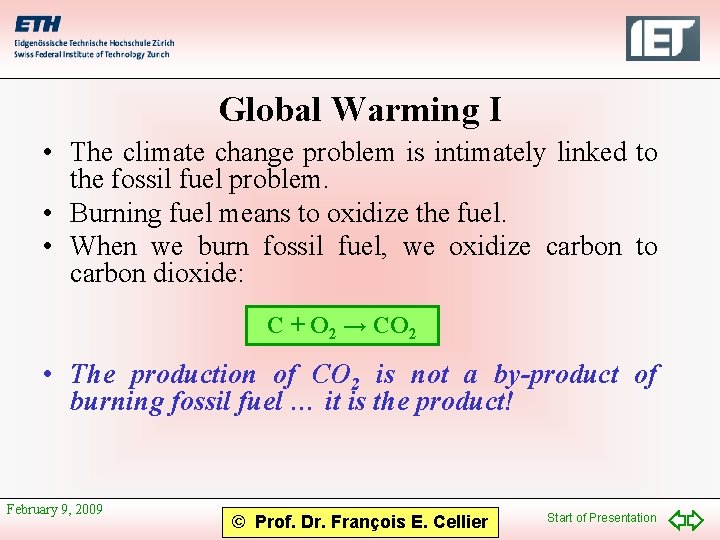
Global Warming I • The climate change problem is intimately linked to the fossil fuel problem. • Burning fuel means to oxidize the fuel. • When we burn fossil fuel, we oxidize carbon to carbon dioxide: C + O 2 → CO 2 • The production of CO 2 is not a by-product of burning fossil fuel … it is the product! February 9, 2009 © Prof. Dr. François E. Cellier Start of Presentation
Global Warming II • For this reason, by knowing how much oil, gas, and coal we can still produce, we can calculate accurately, how much CO 2 we shall emit into the atmosphere by burning it. • By burning the producible remaining conventional oil and gas, we emit enough CO 2 into the atmosphere to raise the average temperature on this planet by about 3 -5 degrees. • Burning the producible remaining coal may result in the extinction of the human race. • The average temperature during the last ice age was only 4 -8 degrees below the current temperature. February 9, 2009 © Prof. Dr. François E. Cellier Start of Presentation
Climate Zones • Our planet knows four climate zones: polar, moderate, sub-tropical, and tropical. • A warmer planet means that the polar zone will shrink. The moderate and sub-tropical zones will move closer to the poles and therefore shrink in size. • The tropical belt will increase in size. • The four zones are created by wind patterns. • The rotation of the planet causes friction in the air. The air closer to the poles thereby gets accelerated, producing Westerly winds, whereas the air over the tropics gets decelerated, producing Easterly winds. • The sub-tropical zone in between has little wind. February 9, 2009 © Prof. Dr. François E. Cellier Start of Presentation
A Warmer Planet is a Drier Planet I • Water evaporates over the oceans, making the air more humid. • As the wind carries the humid air to the colder land masses, the air cools down, the dew point sinks, and it starts raining. • The sub-tropical belts are dry due to lack of wind. • The polar zones are dry due to low temperature. • As the planet heats up, more water evaporates, making the air over the oceans more humid and therefore heavier. • As the total kinetic energy of the planet remains the same, air flow slows down, and there is less wind. February 9, 2009 © Prof. Dr. François E. Cellier Start of Presentation
A Warmer Planet is a Drier Planet II • Because of the decreased wind, the humid air is carried more slowly to the land masses. • Rainfall increases close to the coastal lines exposed to the wind, but very little rainfall can be observed further inland. • Hence the desert areas will grow. • Less food can consequently be produced. • Ireland Scotland will probably see more rain. London will see less. • This is not just a theory. This same pattern has been observed 150 million years ago during the Permian. February 9, 2009 © Prof. Dr. François E. Cellier Start of Presentation
What Should We Do I? • The burning of all remaining producible oil and gas is in all likelihood inevitable. • Hence we’ll probably have to live with a 3 -5 degree raise in temperature. It won’t be pretty! • We need to avoid at all cost burning the remaining coal. This requires intergovernmental regulatory efforts. • The developed nations will need to help the developing nations catch up at least to some extent. Otherwise, they won’t play ball. February 9, 2009 © Prof. Dr. François E. Cellier Start of Presentation
What Should We Do II? • Carbon capture and sequestration (CCS) is probably a pipe dream. • The amount of CO 2 produced is simply too large to store it anywhere. • As the world becomes energy starved, it won’t accept the reduction in efficiency caused by CCS techniques, and consequently, the coal will be burned once we get it out of the ground. • We need to develop alternative sources of energy fast enough so that burning coal becomes less of a necessity. February 9, 2009 © Prof. Dr. François E. Cellier Start of Presentation
It Doesn’t Look Good • • Mankind is addicted to exponential growth. Addictions don’t feel bad. They feel good. People don’t stop their addictions until they hit bottom. Can we afford to wait with changing our ways until the world lies in tatters? February 9, 2009 © Prof. Dr. François E. Cellier Start of Presentation
- Slides: 58