
What can we learn from quasar spectra on
- Slides: 17
What can we learn from quasar spectra on the high-redshift Universe? Simona Gallerani (Osservatorio Astronomico di Roma) In collaboration with: T. Choudhury, P. Dayal, X. Fan, A. Ferrara, A. Maselli, R. Maiolino, R. Salvaterra 21 th July 2009 Roman Young Researchers Meeting
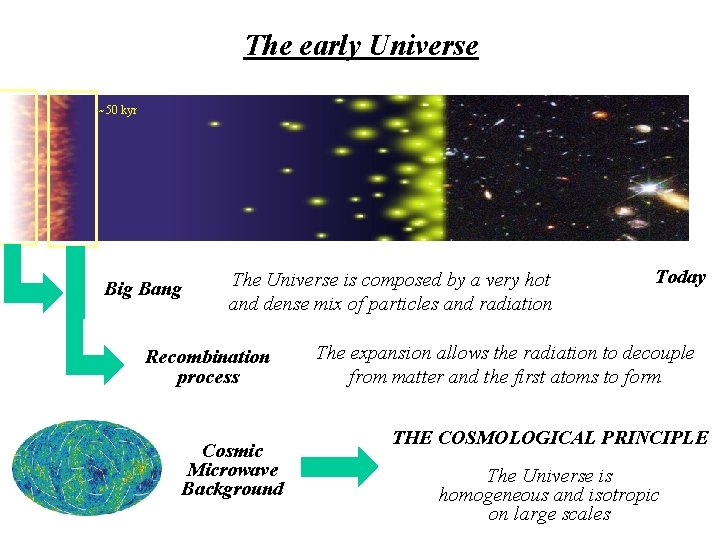
The early Universe ~50 kyr Big Bang The Universe is composed by a very hot and dense mix of particles and radiation Recombination process Cosmic Microwave Background Today The expansion allows the radiation to decouple from matter and the first atoms to form THE COSMOLOGICAL PRINCIPLE The Universe is homogeneous and isotropic on large scales
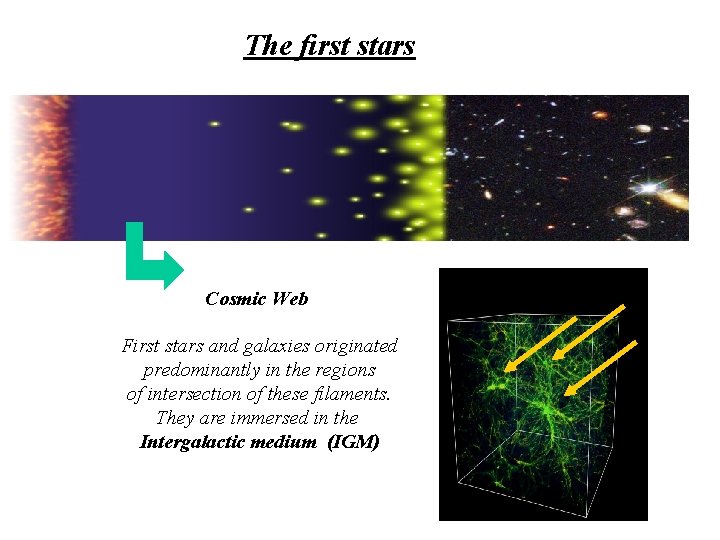
The first stars Cosmic Web First stars and galaxies originated predominantly in the regions of intersection of these filaments. They are immersed in the Intergalactic medium (IGM)
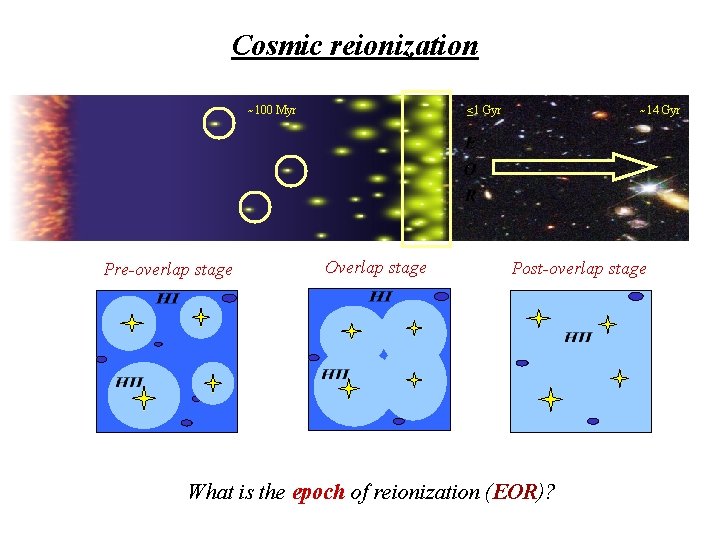
Cosmic reionization ~100 Myr Pre-overlap stage ≤ 1 Gyr Overlap stage ~14 Gyr Post-overlap stage What is the epoch of reionization (EOR)?
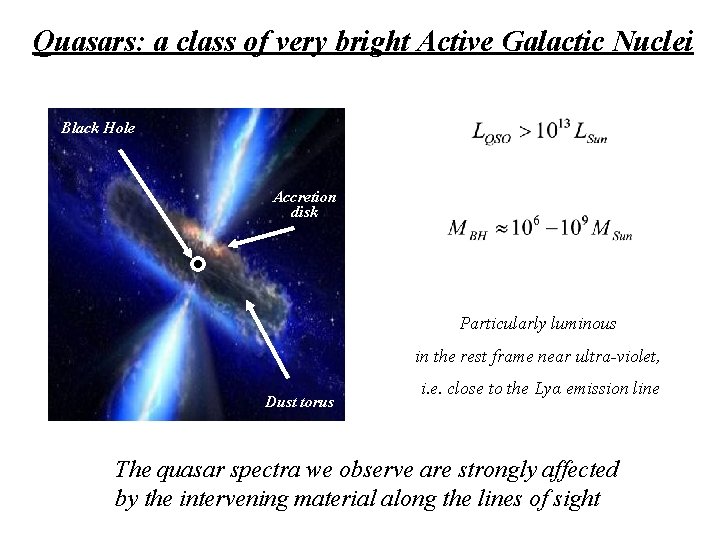
Quasars: a class of very bright Active Galactic Nuclei Black Hole Accretion disk Particularly luminous in the rest frame near ultra-violet, Dust torus i. e. close to the Lyα emission line The quasar spectra we observe are strongly affected by the intervening material along the lines of sight
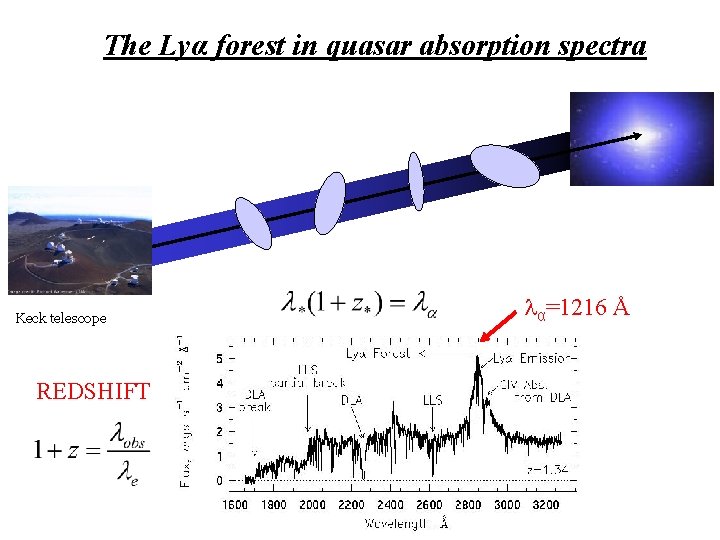
The Lyα forest in quasar absorption spectra Keck telescope REDSHIFT α=1216 Å
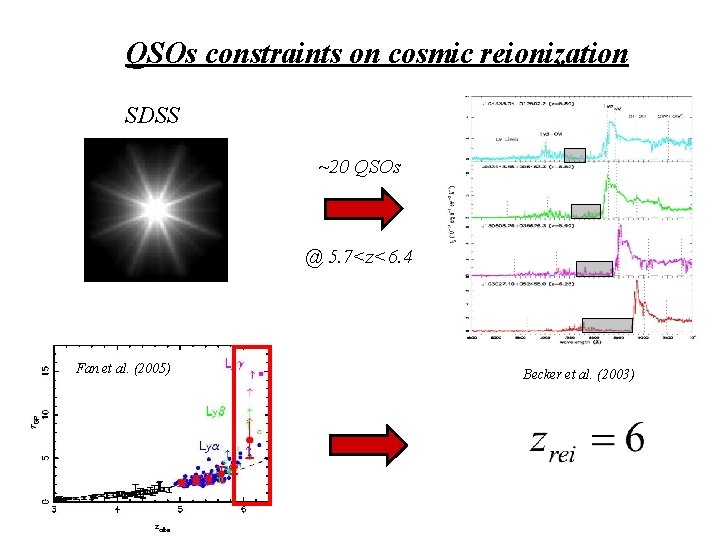
QSOs constraints on cosmic reionization SDSS ~20 QSOs @ 5. 7<z<6. 4 Fan et al. (2005) Becker et al. (2003)
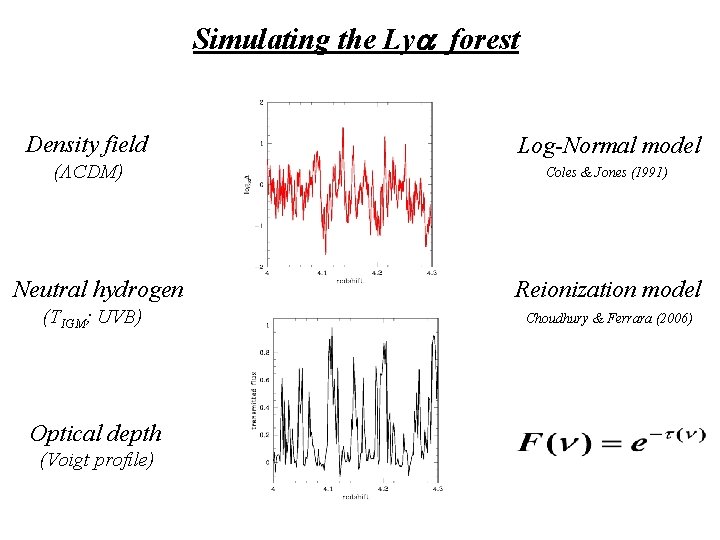
Simulating the Ly forest Density field Log-Normal model (ΛCDM) Coles & Jones (1991) Neutral hydrogen (TIGM; UVB) Optical depth (Voigt profile) Reionization model Choudhury & Ferrara (2006)
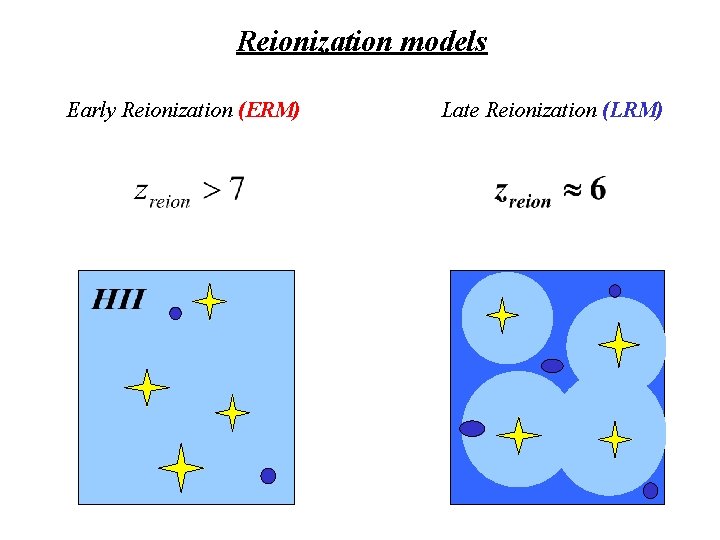
Reionization models Early Reionization (ERM) Late Reionization (LRM)
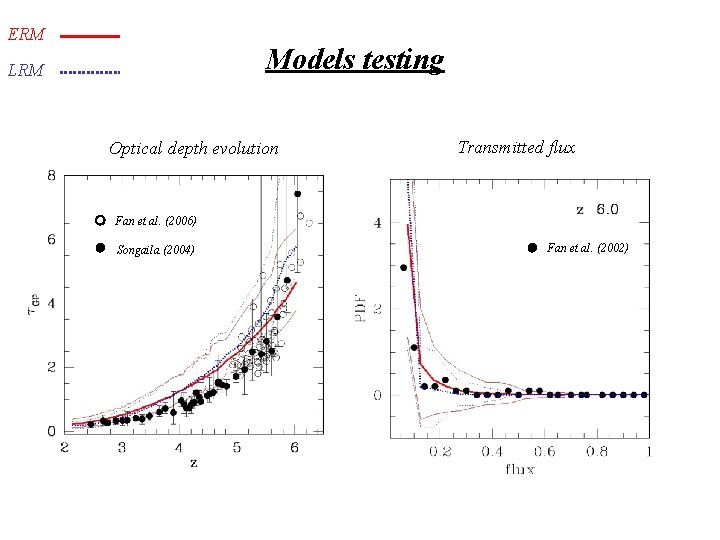
ERM Models testing LRM Optical depth evolution Transmitted flux Fan et al. (2006) Songaila (2004) Fan et al. (2002)
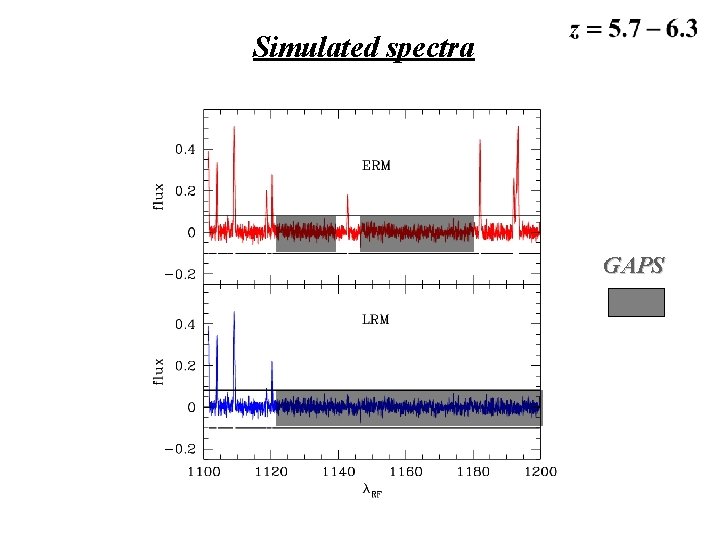
Simulated spectra GAPS
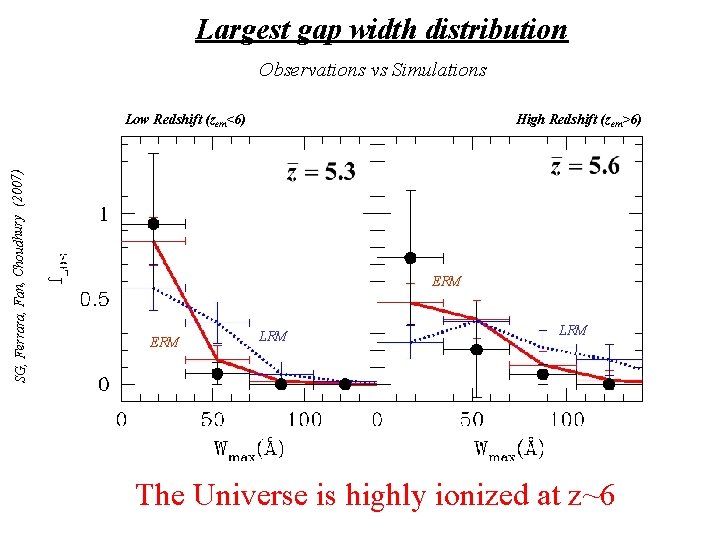
Largest gap width distribution Observations vs Simulations SG, Ferrara, Fan, Choudhury (2007) Low Redshift (zem<6) High Redshift (zem>6) ERM LRM The Universe is highly ionized at z~6
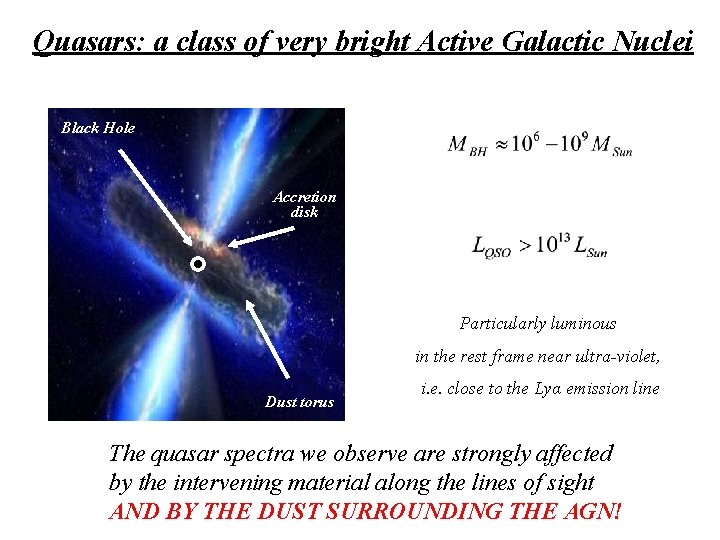
Quasars: a class of very bright Active Galactic Nuclei Black Hole Accretion disk Particularly luminous in the rest frame near ultra-violet, Dust torus i. e. close to the Lyα emission line The quasar spectra we observe are strongly affected by the intervening material along the lines of sight AND BY THE DUST SURROUNDING THE AGN!
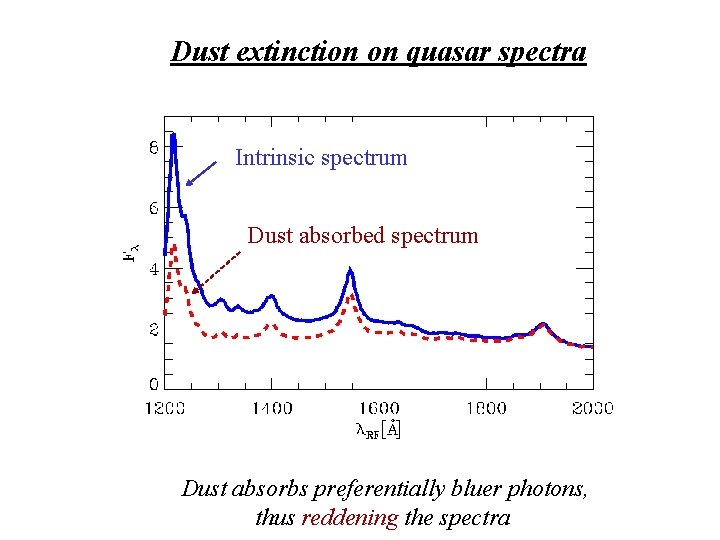
Dust extinction on quasar spectra Intrinsic spectrum Dust absorbed spectrum Dust absorbs preferentially bluer photons, thus reddening the spectra
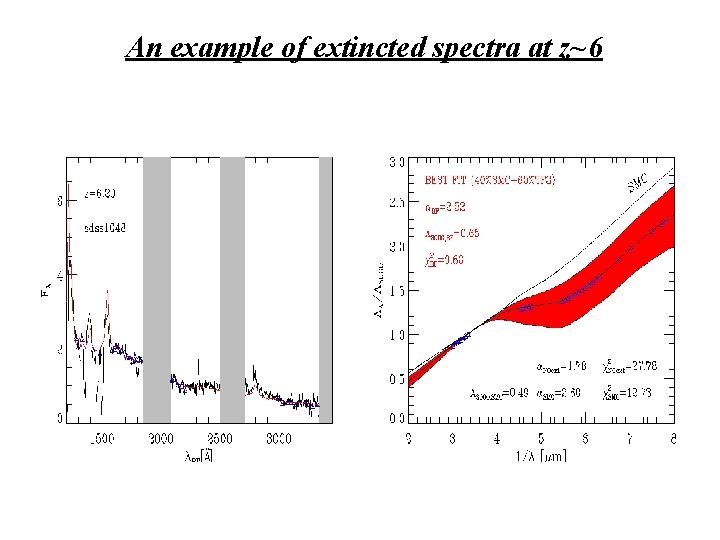
An example of extincted spectra at z~6
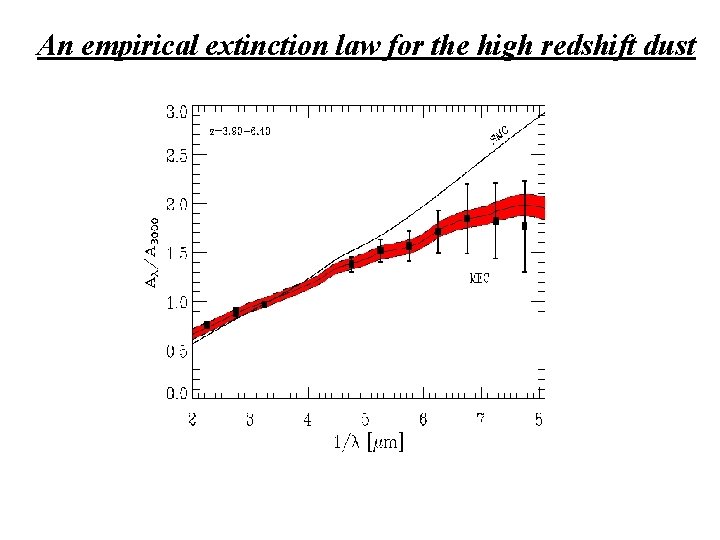
An empirical extinction law for the high redshift dust
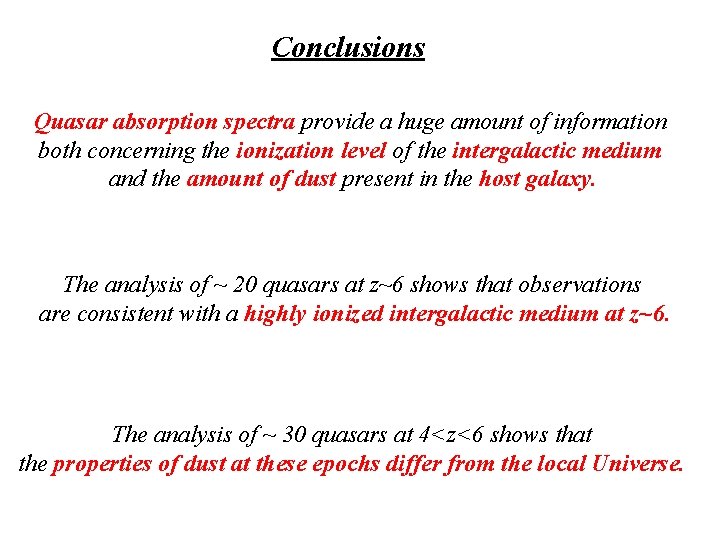
Conclusions Quasar absorption spectra provide a huge amount of information both concerning the ionization level of the intergalactic medium and the amount of dust present in the host galaxy. The analysis of ~ 20 quasars at z~6 shows that observations are consistent with a highly ionized intergalactic medium at z~6. The analysis of ~ 30 quasars at 4<z<6 shows that the properties of dust at these epochs differ from the local Universe.