
What can systems thinking and methods teach us

- Slides: 44
What can systems thinking and methods teach us about community health? The case of COVID-19 Dave Zelinka, Ph. D, EIT Mortenson Center for Global Engineering
a bit about me ➔ education ◆ BS environmental and ecological engineering (Purdue University) ◆ MS environmental and sustainability engineering (CU Denver) ◆ MS global engineering (CU Boulder) ◆ Ph. D civil systems engineering (CU Boulder) ➔ research and work ◆ Sustainable Development Goals (SDGs) & the nexus approach ◆ complex systems focusing in system dynamics ◆ applied complexity science ◆ bridging disciplines through systems thinking ◆ sustainable development, conflict, corruption, & transboundary issues ◆ life-cycle analysis & anthropogenic metabolism ◆ qualitative system dynamics and grounded theory ◆ data science & deep learning (new) ◆ renewable energy and climate change
contents one | THE EVOLUTION OF SCIENTIFIC PHILOSOPHY two | SYSTEMS THINKING three | COMPLEX SYSTEMS SCIENCE four | SYSTEM DYNAMICS OF COVID-19
| one | THE EVOLUTION OF SCIENTIFIC PHILOSOPHY
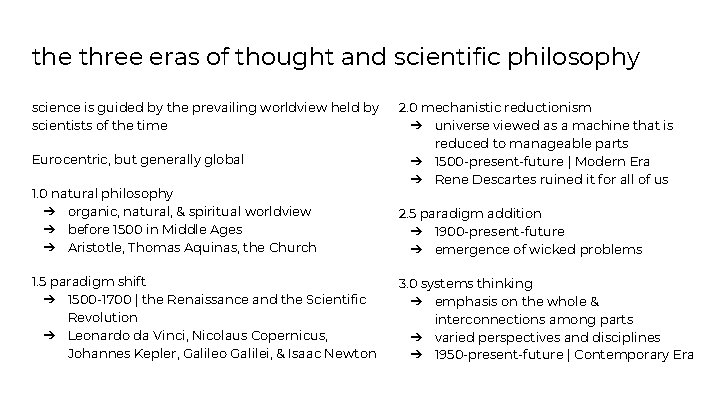
the three eras of thought and scientific philosophy science is guided by the prevailing worldview held by scientists of the time Eurocentric, but generally global 1. 0 natural philosophy ➔ organic, natural, & spiritual worldview ➔ before 1500 in Middle Ages ➔ Aristotle, Thomas Aquinas, the Church 1. 5 paradigm shift ➔ 1500 -1700 | the Renaissance and the Scientific Revolution ➔ Leonardo da Vinci, Nicolaus Copernicus, Johannes Kepler, Galileo Galilei, & Isaac Newton 2. 0 mechanistic reductionism ➔ universe viewed as a machine that is reduced to manageable parts ➔ 1500 -present-future | Modern Era ➔ Rene Descartes ruined it for all of us 2. 5 paradigm addition ➔ 1900 -present-future ➔ emergence of wicked problems 3. 0 systems thinking ➔ emphasis on the whole & interconnections among parts ➔ varied perspectives and disciplines ➔ 1950 -present-future | Contemporary Era
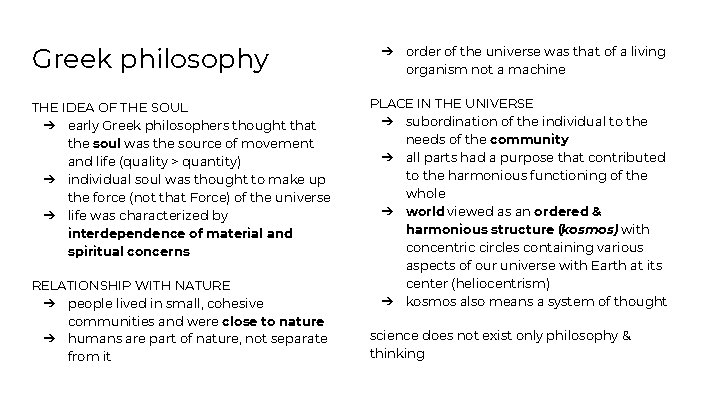
Greek philosophy THE IDEA OF THE SOUL ➔ early Greek philosophers thought that the soul was the source of movement and life (quality > quantity) ➔ individual soul was thought to make up the force (not that Force) of the universe ➔ life was characterized by interdependence of material and spiritual concerns RELATIONSHIP WITH NATURE ➔ people lived in small, cohesive communities and were close to nature ➔ humans are part of nature, not separate from it ➔ order of the universe was that of a living organism not a machine PLACE IN THE UNIVERSE ➔ subordination of the individual to the needs of the community ➔ all parts had a purpose that contributed to the harmonious functioning of the whole ➔ world viewed as an ordered & harmonious structure (kosmos) with concentric circles containing various aspects of our universe with Earth at its center (heliocentrism) ➔ kosmos also means a system of thought science does not exist only philosophy & thinking
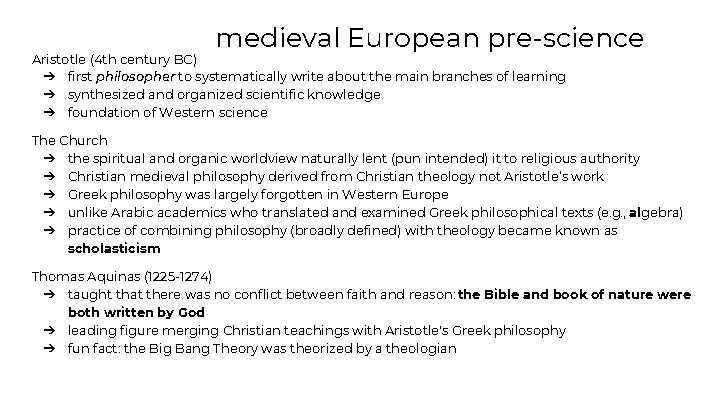
medieval European pre-science Aristotle (4 th century BC) ➔ first philosopher to systematically write about the main branches of learning ➔ synthesized and organized scientific knowledge ➔ foundation of Western science The Church ➔ the spiritual and organic worldview naturally lent (pun intended) it to religious authority ➔ Christian medieval philosophy derived from Christian theology not Aristotle’s work ➔ Greek philosophy was largely forgotten in Western Europe ➔ unlike Arabic academics who translated and examined Greek philosophical texts (e. g. , algebra) ➔ practice of combining philosophy (broadly defined) with theology became known as scholasticism Thomas Aquinas (1225 -1274) ➔ taught that there was no conflict between faith and reason: the Bible and book of nature were both written by God ➔ leading figure merging Christian teachings with Aristotle's Greek philosophy ➔ fun fact: the Big Bang Theory was theorized by a theologian
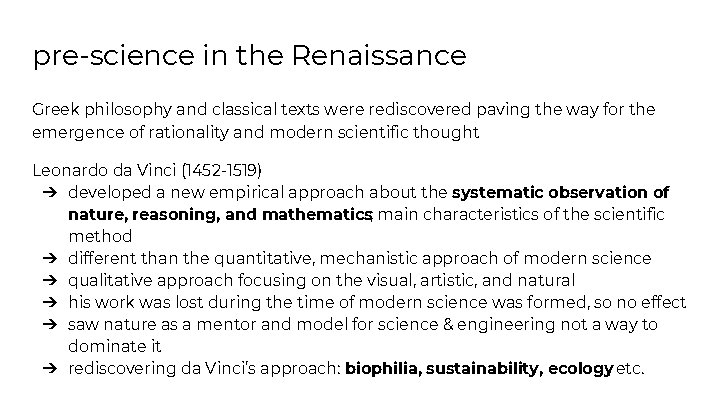
pre-science in the Renaissance Greek philosophy and classical texts were rediscovered paving the way for the emergence of rationality and modern scientific thought Leonardo da Vinci (1452 -1519) ➔ developed a new empirical approach about the systematic observation of nature, reasoning, and mathematics; main characteristics of the scientific method ➔ different than the quantitative, mechanistic approach of modern science ➔ qualitative approach focusing on the visual, artistic, and natural ➔ his work was lost during the time of modern science was formed, so no effect ➔ saw nature as a mentor and model for science & engineering not a way to dominate it ➔ rediscovering da Vinci’s approach: biophilia, sustainability, ecology, etc.
Scientific Revolution Nicolaus Copernicus (1473 -1543) ➔ heliocentrism (On the Revolution of Celestial Spheres) ➔ started to separate religion from science ➔ and therefore, natural view of the cosmos Johannes Kepler (1571 -1630) ➔ empirical laws of planetary motion ➔ mechanistic, mathematical, & quantitative Galileo Galilei (1564 -1642) ➔ like da Vinci, combined scientific experimentation with mathematics ➔ goal was to describe nature quantitatively ➔ other qualitative properties were merely subjective and not useful for because they could not be measured or quantified “Galileo’s program offers us a dead world: Out go sight, sound, taste, touch, and smell, and along with them have since gone esthetic and ethical sensibility, values, quality, soul, consciousness, spirit. Experience as such is cast out of the realm of scientific discourse, Hardly anything has changed our world more during the past four hundred years than Galileo's audacious program. We had to destroy the world in theory before we could destroy it in practice. ” psychiatrist, R. D. Laing
Scientific Revolution: mechanistic reductionism Francis Bacon (1596 -1650) ➔ formalized Galileo’s approach ➔ focused on scientific experimentation, empiricism, & inductive reasoning ➔ induction required studying the specific parts of nature; broad generalizations from specific observations ➔ father of the Scientific Method ➔ his writings shifted the worldview to the mechanistic universe ➔ humankind should control & dominate nature
Scientific Revolution: mechanistic reductionism Rene Descartes (1596 -1650) ➔ the anathema of systems thinkers ➔ universe was a machine with no soul ➔ caused detachment from nature ➔ how did that affect the environment ➔ universe inherently mathematical: language of nature is mathematics ➔ science is synonymous with math ➔ mathematics guided his philosophy
Scientific Revolution: mechanistic reductionism ➔ Descartes created the analytical method: break up problems into manageable pieces and arrange them in a logical order ➔ A Discourse on the Method of Correctly Conducting One’s Reason and Seeking Truth in the Sciences ➔ scientific work but a philosophy classic - scientific approach to thinking ➔ also, “I think therefore I am” and Cartesian coordinates (my third favorite coordinate system behind complex and polar) ➔ “overemphasis on the Cartesian method has led to fragmentation that is characteristic of both our general thinking and our academic disciplines, and to the widespread attitude of reductionism in science - the belief that all aspects of complex phenomena can be understood by reducing them to their smallest constituent parts (Capra & Luisi, 2016). ”
Scientific Revolution: mechanistic reductionism Isaac Newton (1642 -1727) ➔ Descartes only outlined the concept ➔ Newton finalized it ➔ developed a grand synthesis of the works of the previous scientific philosophers ➔ mathematical formulation of the mechanistic model of the universe ➔ Mathematical Principles of Natural Philosophy ➔ his work in calculus, optics, and the laws of motion and gravity made huge strides while quarantining himself to escape the Bubonic Plague of 1665/6 Annus Mirabilis, or the “Year of Wonders’ etymology of science ➔ skei from Proto-Indo-European: to cut, split ➔ scire from Latin: to know; to separate one thing from another, to distinguish (probably) ➔ also, “experiential knowledge” & “collective human knowledge” ➔ used to be called philosophy in 16/17 cent. ➔ definition gets more familiar after
| two | SYSTEMS THINKING
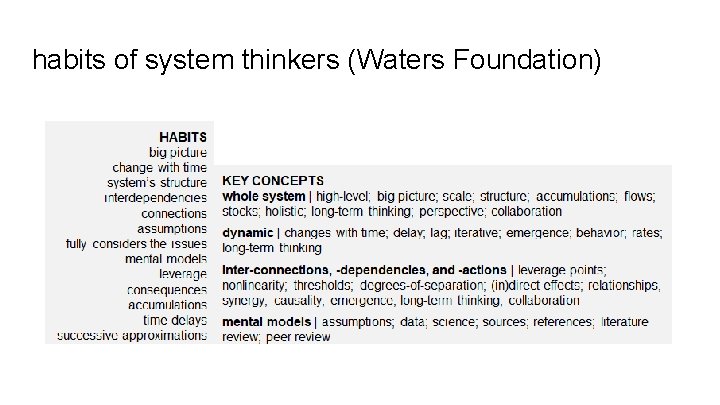
habits of system thinkers (Waters Foundation)
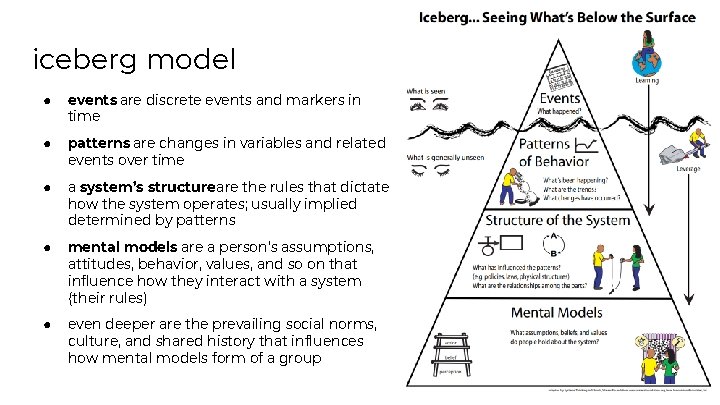
iceberg model ● events are discrete events and markers in time ● patterns are changes in variables and related events over time ● a system’s structure are the rules that dictate how the system operates; usually implied determined by patterns ● mental models are a person’s assumptions, attitudes, behavior, values, and so on that influence how they interact with a system (their rules) ● even deeper are the prevailing social norms, culture, and shared history that influences how mental models form of a group
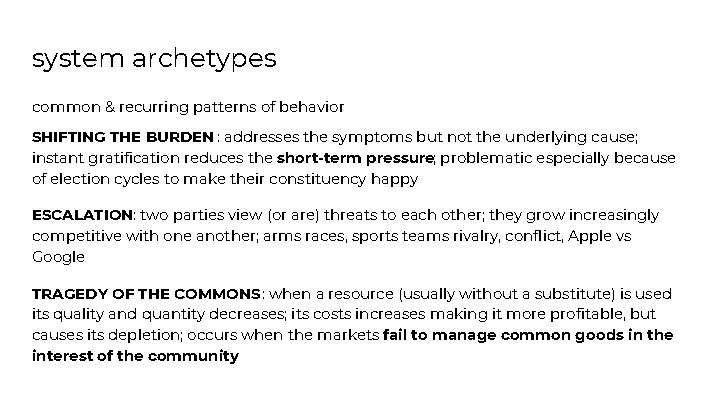
system archetypes common & recurring patterns of behavior SHIFTING THE BURDEN : addresses the symptoms but not the underlying cause; instant gratification reduces the short-term pressure; problematic especially because of election cycles to make their constituency happy ESCALATION: two parties view (or are) threats to each other; they grow increasingly competitive with one another; arms races, sports teams rivalry, conflict, Apple vs Google TRAGEDY OF THE COMMONS: when a resource (usually without a substitute) is used its quality and quantity decreases; its costs increases making it more profitable, but causes its depletion; occurs when the markets fail to manage common goods in the interest of the community
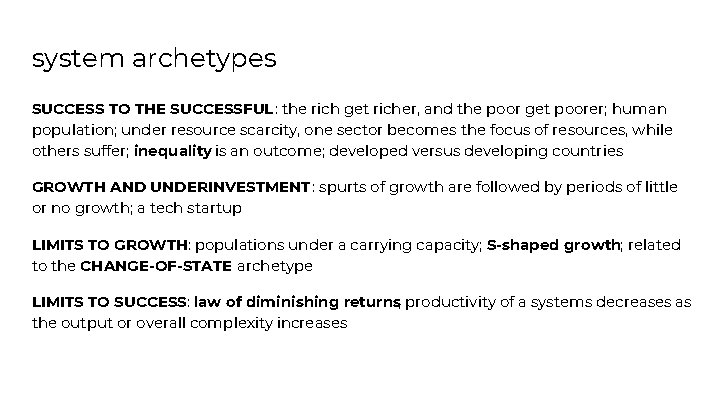
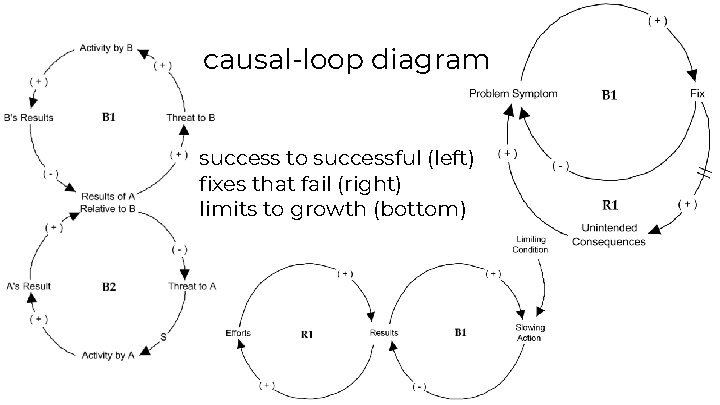
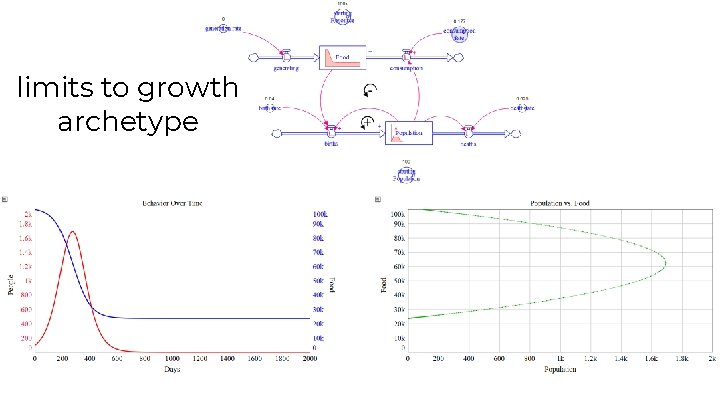
system archetypes SUCCESS TO THE SUCCESSFUL: the rich get richer, and the poor get poorer; human population; under resource scarcity, one sector becomes the focus of resources, while others suffer; inequality is an outcome; developed versus developing countries GROWTH AND UNDERINVESTMENT : spurts of growth are followed by periods of little or no growth; a tech startup LIMITS TO GROWTH: populations under a carrying capacity; S-shaped growth; related to the CHANGE-OF-STATE archetype LIMITS TO SUCCESS: law of diminishing returns; productivity of a systems decreases as the output or overall complexity increases
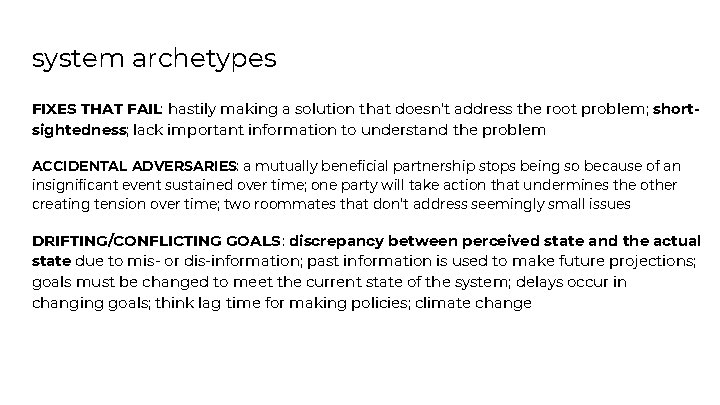
system archetypes FIXES THAT FAIL: hastily making a solution that doesn’t address the root problem; shortsightedness; lack important information to understand the problem ACCIDENTAL ADVERSARIES: a mutually beneficial partnership stops being so because of an insignificant event sustained over time; one party will take action that undermines the other creating tension over time; two roommates that don’t address seemingly small issues DRIFTING/CONFLICTING GOALS: discrepancy between perceived state and the actual state due to mis- or dis-information; past information is used to make future projections; goals must be changed to meet the current state of the system; delays occur in changing goals; think lag time for making policies; climate change
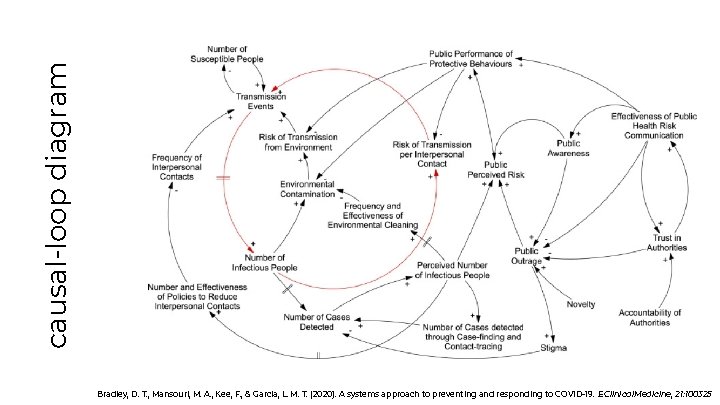
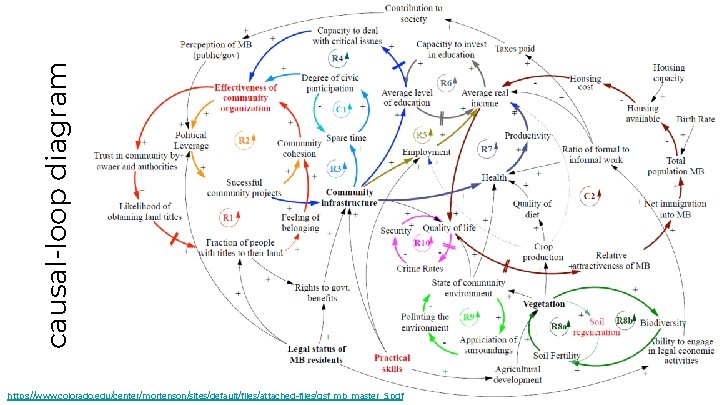
causal-loop diagram success to successful (left) fixes that fail (right) limits to growth (bottom)
causal-loop diagram Bradley, D. T. , Mansouri, M. A. , Kee, F. , & Garcia, L. M. T. (2020). A systems approach to preventing and responding to COVID-19. EClinical. Medicine, 21: 100325
causal-loop diagram https: //www. colorado. edu/center/mortenson/sites/default/files/attached-files/gsf_mb_master_5. pdf
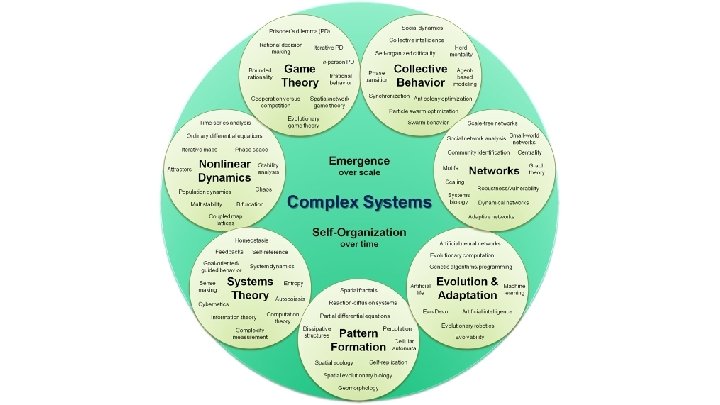
| three | COMPLEX SYSTEMS SCIENCE
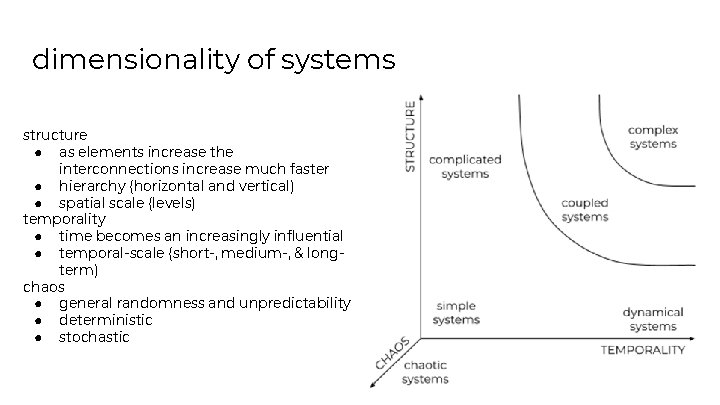
dimensionality of systems structure ● as elements increase the interconnections increase much faster ● hierarchy (horizontal and vertical) ● spatial scale (levels) temporality ● time becomes an increasingly influential ● temporal-scale (short-, medium-, & longterm) chaos ● general randomness and unpredictability ● deterministic ● stochastic
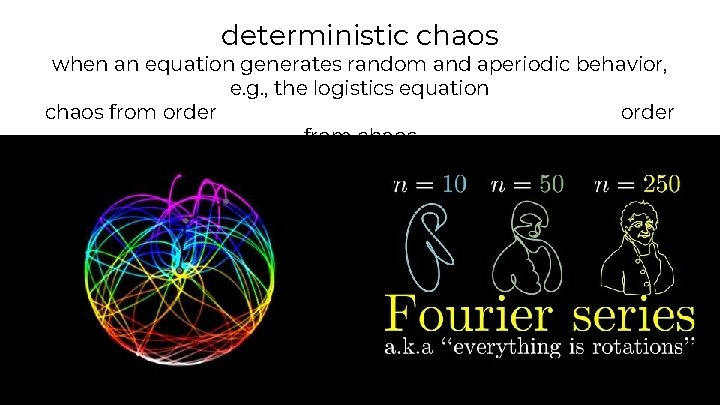
deterministic chaos when an equation generates random and aperiodic behavior, e. g. , the logistics equation chaos from order from chaos
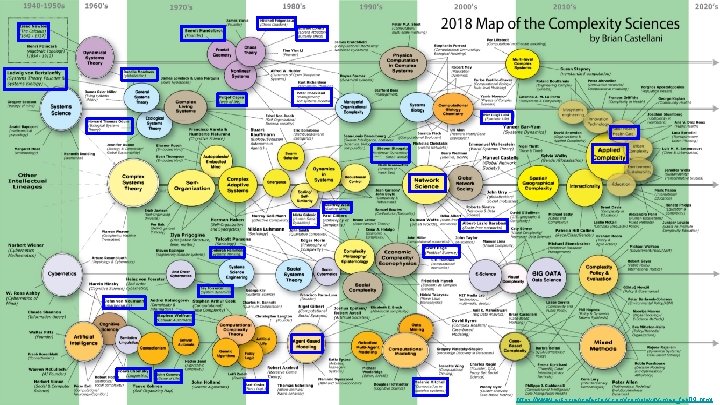
https: //www. art-sciencefactory. com/complexity-map_feb 09. html
| four | SYSTEM DYNAMICS & COVID-19: METACONCEPT OF DIFFUSION
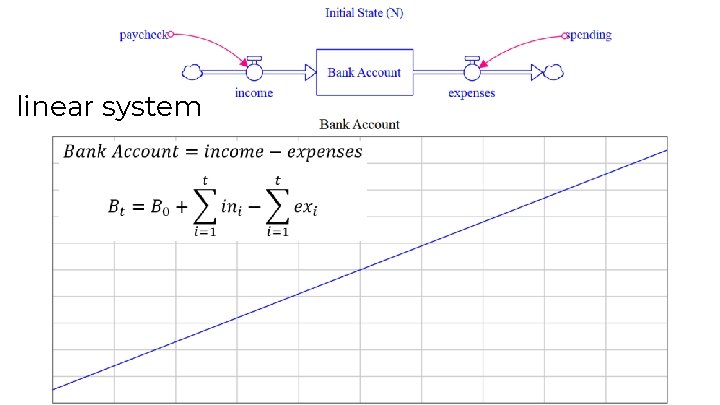
linear system
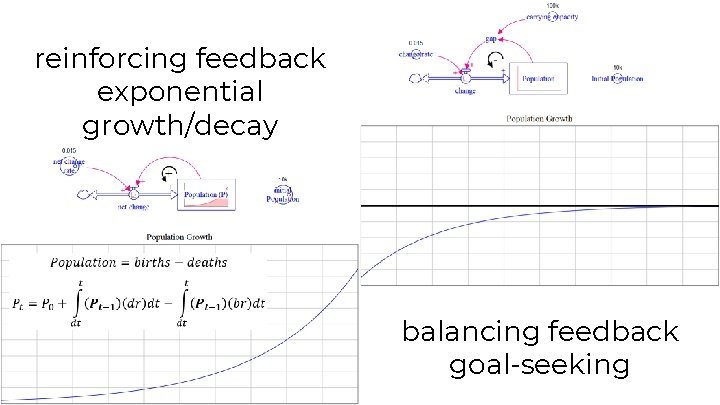
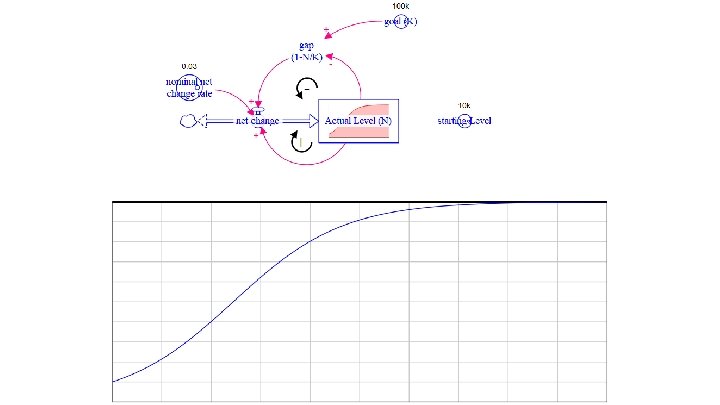
reinforcing feedback exponential growth/decay balancing feedback goal-seeking
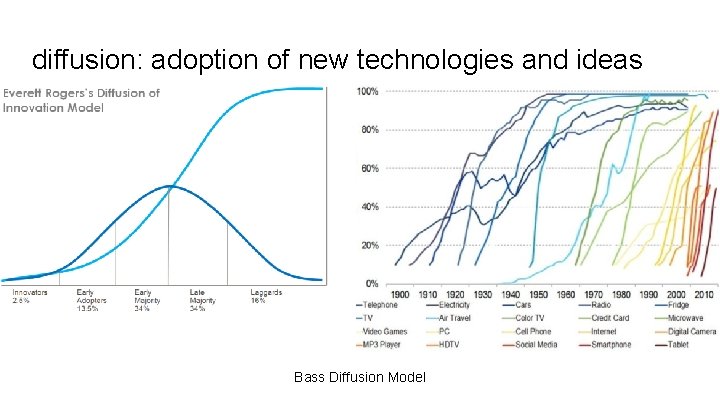
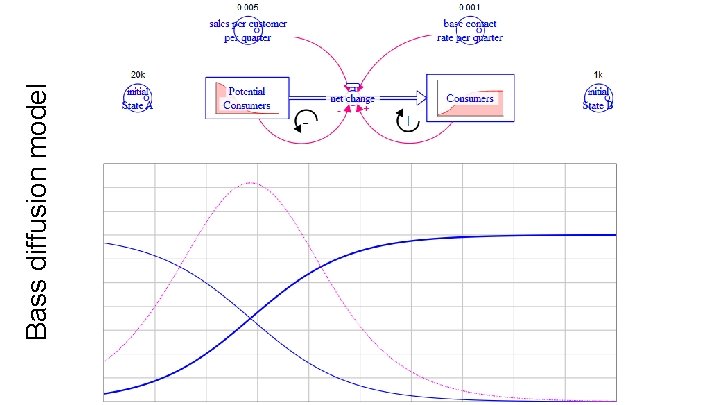
diffusion: adoption of new technologies and ideas Bass Diffusion Model
Bass diffusion model
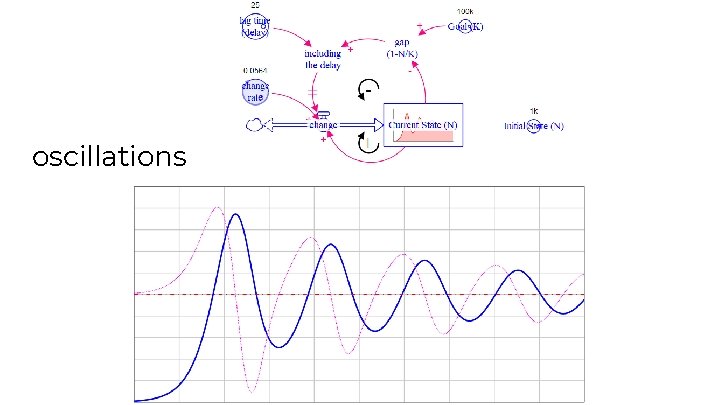
oscillations
limits to growth archetype
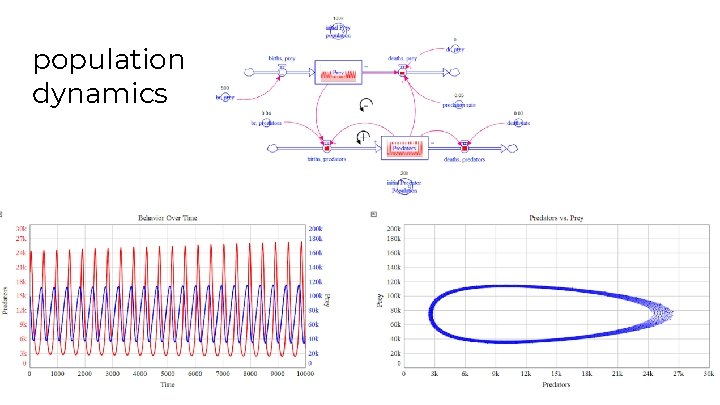
population dynamics
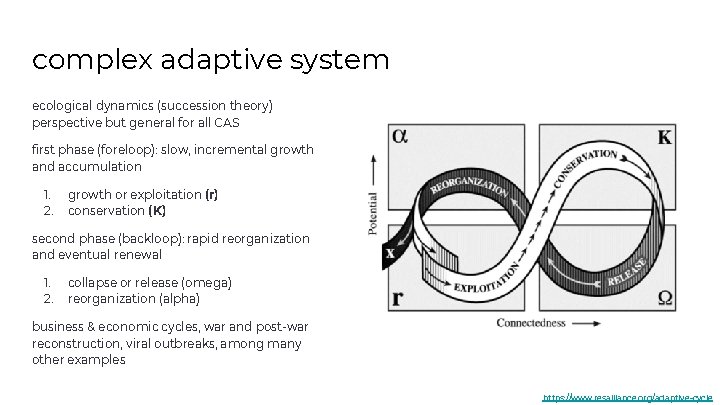
complex adaptive system ecological dynamics (succession theory) perspective but general for all CAS first phase (foreloop): slow, incremental growth and accumulation 1. 2. growth or exploitation (r) conservation (K) second phase (backloop): rapid reorganization and eventual renewal 1. 2. collapse or release (omega) reorganization (alpha) business & economic cycles, war and post-war reconstruction, viral outbreaks, among many other examples https: //www. resalliance. org/adaptive-cycle
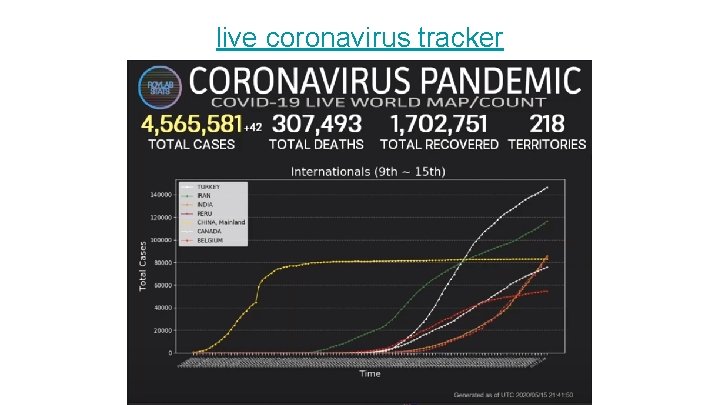
live coronavirus tracker
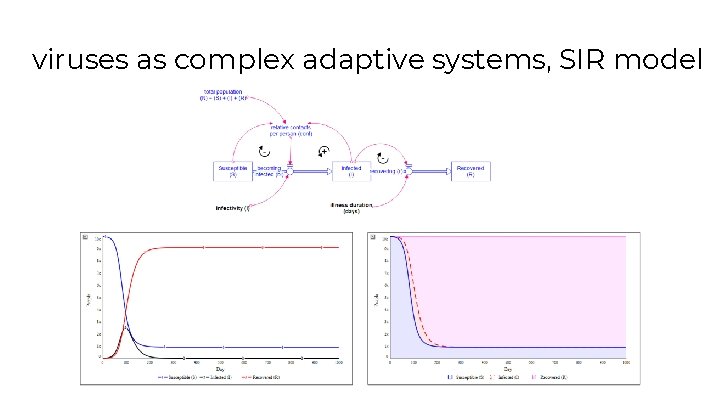
viruses as complex adaptive systems, SIR model
viruses as complex adaptive systems, Influenza
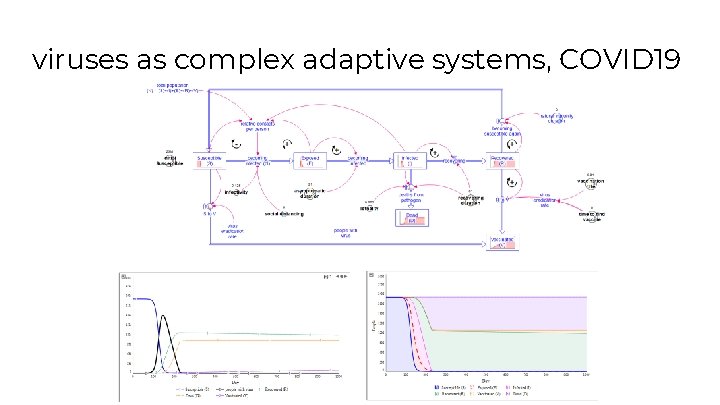
viruses as complex adaptive systems, COVID 19
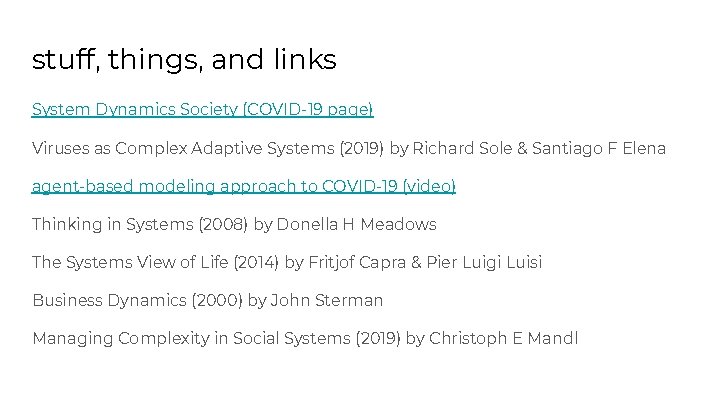
stuff, things, and links System Dynamics Society (COVID-19 page) Viruses as Complex Adaptive Systems (2019) by Richard Sole & Santiago F Elena agent-based modeling approach to COVID-19 (video) Thinking in Systems (2008) by Donella H Meadows The Systems View of Life (2014) by Fritjof Capra & Pier Luigi Luisi Business Dynamics (2000) by John Sterman Managing Complexity in Social Systems (2019) by Christoph E Mandl
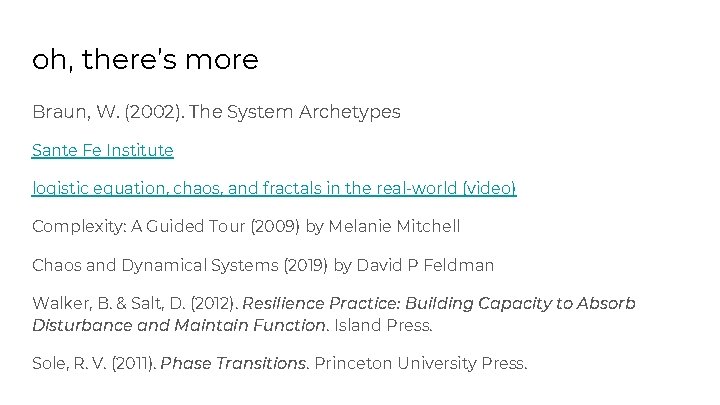
oh, there’s more Braun, W. (2002). The System Archetypes Sante Fe Institute logistic equation, chaos, and fractals in the real-world (video) Complexity: A Guided Tour (2009) by Melanie Mitchell Chaos and Dynamical Systems (2019) by David P Feldman Walker, B. & Salt, D. (2012). Resilience Practice: Building Capacity to Absorb Disturbance and Maintain Function. Island Press. Sole, R. V. (2011). Phase Transitions. Princeton University Press.
questions