
What Can Go Wrong in Cleaning Disinfection Sterilization


- Slides: 41
What Can Go Wrong in Cleaning, Disinfection & Sterilization? TSICP October 2006 Barbara Moody, RN, CIC Director Infection Control Denton Regional Medical Center
and how would you know?
Objectives l Describe at least one infection associated with each: improper cleaning, disinfection & sterilization l Identify > 3 indicators that could implicate inadequate processing. l List 3 methods for investigating possible processing failures.
Background 118, 000 citations for HAI due to disinfectant failure 299, 000 citations for Infections due to disinfectant failure l Septic shock in healthy host due to Ochrobactrum antropi from contamination during reconstitution l Hepatitis B spread to 6 from improper sterilization l Mycobacterium abscessus outbreak post-acupuncture; towels & hot pack covers possible source 2006 l Poor sterilization instruments results in Infection outbreak, Paris l 40 years of Disinfectant failure: M. abscessus Infection caused by contam. Benzalkonium Chloride (skin antiseptic before intra-articular injections) l l
Basic principles l Hosp. Environment visibly clean, free from dust, soil l Equipment used for >1 pt must be cleaned, disinfected or sterilized between patients l Established procedures must be used for clean & soiled linen, food hygiene & pest control l All staff must be educated & trained in prevention of HAI (& competency updated)
Baseline Info *Things you know Definitions: l Antisepsis: (Skin only) l Cleaning; pre-cleaning l Spaulding classification system l Disinfection: Low-med-High levels (environment only) concentration – dilution MSDS l High level disinfection: (HLD: testing, duration of use - documentation l Sterilization: Steam, EO, Plasma l Biological indicators l Documentation
…WMD Weapons of Microbe Destruction… The l Weapons: Manual cleaning; automated processors, disinfectants, Sterilants l Microbes: fungi, bacteria, viruses, spores, prions l Destruction methods: Chemicals, Steam Gas (EO), H 202 Plasma, Irradiation
Environmental Cleaning Yes Virginia, the Environment does matter in the prevention of infection ! MRSA outbreak continued & increased x 21 mos. until doubled cleaning hours, assigned cleaning of equipment & environment = end of outbreak MRSA ICU outbreak after disinfectant changed: U Wisc. ID residents, Epidemiologist demonstrated room cleaning to Housekeeping. Hskpg. Returned demonstration = Outbreak ended. ( techniques not disinfectant )
Legal aspects: Headlines re failure of disinfection, sterilization, etc l $200 million suit – Toronto: non-sterile equipment used on patients l End Hospital Secrecy & Save Lives! l Improper sterilization cited in 400 Va biopsy exams!
Disinfectant contamination Intrinsic contamination possible Phenolic solutions Benzalkonium chloride Other “Quats” l Extrinsic contamination frequent Most detergent/disinfectants Quats – especially Alcohol – bacillus spores l l
Environment – Non-critical l No contact with mucous membranes or non-intact skin l Contaminated with microbes: (fungi, bacteria, lipid viruses) l Examples: door knobs, surfaces, counters, shelves, bedpans, beds, rails, ekg leads, walls, bathrooms
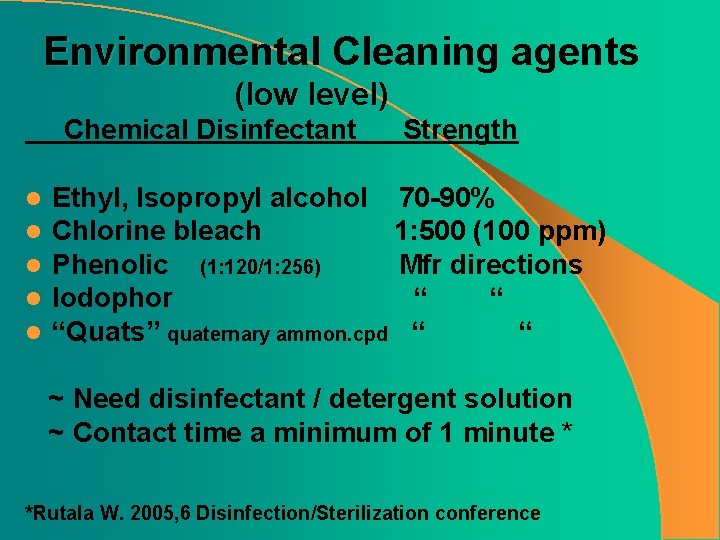
Environmental Cleaning agents (low level) Chemical Disinfectant l l l Strength Ethyl, Isopropyl alcohol 70 -90% Chlorine bleach 1: 500 (100 ppm) Phenolic (1: 120/1: 256) Mfr directions Iodophor “ “ “Quats” quaternary ammon. cpd “ “ ~ Need disinfectant / detergent solution ~ Contact time a minimum of 1 minute * *Rutala W. 2005, 6 Disinfection/Sterilization conference
When to check cleaning ? (Cluster of HAI patient infections) Patients in same room as previous case(s) Pathogen easily spread in environment (dry): MRSA, VRE, C. difficile l Check: ~ product - New product? ~ procedure - Change in procedure? ~ staff training - New Staff? - Initial training - Competency ~ actual practice- Observe l ~ population - Shift or increase l l
Examples of Improper / inadequate cleaning l Under-dilution disinfectant: -Too concentrated COMMON - Outbreak pseudomonas – SICU l Over-dilution disinfectant = rare OCCASIONAL: Automated disinfectant dispensing equipment l l Inadequate application/ contaminated sol. FREQUENT: Spray bottles for application, quick spray, dry wipe, insufficient contact time. Bucket system, re=dipping used cloth in solution
Problems Pre- Cleaning instruments l Wrong product l Misunderstanding label or type product “wrong assumptions” l Failure to rinse organic matter promptly l Incorrect dilution (Over -, under -) l Inadequate soak time l Failure of disinfectant to reach all crevices
Storage Contamination l Packaging incorrect, inadequate, integrity compromised: penetrated by heat, moisture, dust l External shipping cartons contaminated remove before contents stored internally l Storage racks must have solid bottom shelf (potential for mop water contamination)
What to look for: Show me (or tell me) How do you dilute X ? ? automatic, have demonstration ? manual? Need handy measuring devices How should the solution look ? What color is the solution supposed to be? How applied? When cloths / mops changed?
Device-associated infections l Automated reprocessors l Bronchoscopes l Depth electrodes l Electrosurgical units l Endoscopes l Laryngoscope blades l Transducers l Rectal/vaginal probes
Device assoc. infections cont’d l Electronic l EKG thermometers leads l Tonometers l Cardioplegic solution/ice machine l Surgical instruments l Powered instruments l BP Cuffs
Powered instrument Issues l Difficult to clean, penetration w/ organic matter likely l Mfrs directions re switch position key l Changing sterilization parameters ~ Contact Mfr. annually re changed recommendations esp. duration steriliz.
Endoscopes: The IC issues l Narrow lumen l Complex inside parts* l Easily damaged l Manual pre-cleaning essential l Frequent repairs necessary l Surface integrity essential l Special connectors to AER a MUST !
Endoscopes: issues cont’d l Mechanical failure l Faulty design l Poor manufacturing quality l Adverse effects of materials l Improper maintenance l User error l Compromised sterility
Endoscopes & Bronchoscopes l GI endoscopy infections – > 300 published cases - 70% Salmonella, Pseudomonas - C. difficile – Scope: colonization l Bronchoscopy infections - >90 published cases - M. tb, atypical mycobacterium, pseudomonas Spach et al; Ann Int. Med 1993: Weber D J Gastrointest Dis. 2002
What’s wrong with …………… l Nurse cleaning GI endoscope in sink in Endopatient procedure room: Long cotton tipped swabs 1. Phisohex 2. povidone-Iodine 3. Septisol l Rinsed, blew powered air into it Dried it on a towel next to the sink Placed it in a large, long drawer
Assessing Endoscope Processing l “Show me…. ” Show me the steps in processing a scope l Look at everything. Ask, ask, ask l Every solution & test strips need both date opened & expiration date l Check / Ask re every device, cleaning brushes etc. whether reusable or single use. l Review log & testing data, especially dates during regular staff’s vacations
Rinsing after HLD Endoscopes: l Rinse immediately after patient use l After HLD soak, water flush, alcohol flush
Endoscope contamination l Inadequate channel cleaning l Lack of proper connectors for channels l Improper methods: (Time exposure, some channels non-perfused, over-diluted solution) Failure to follow recommended disinfection procedures l Flaws in design of endoscopes & AER’s l Lack of proper training, competency , etc. l
Disinfection of Endoscope l l l User: Rinse inside & outside immediately after use Mechanically clean with water & enzyme Must HLD/sterilize-immerse scopes, fill channels Rinse (final) sterile, filtered or tap followed by alcohol Dry with forced air Store: hang to prevent pooling. (off floor) l NEVER store in original case!!
Findings that “prick’ up your “EPI-EARS l Unusual gram-negatives in Bronch washes (>2 same one) or duplicate other sites (Urines, surgical wounds, etc) l >1 atypical mycobacteria (same species) from same sites
Initial Steps to Investigate #1: Notify lab to SAVE THE ISOLATES! (give a time frame…several weeks, lab to discuss w/IC before discarding)
Check your usual incidence of_____ l Check to see how many of X____ the facility has had in the past 1 -2 years: Frequency Sites Source of culture (aspirated, surgical excision, etc)
#3 Investigation l Formulate an initial hypothesis: Key factor is whether the patients are clinically ill or pseudo-infection possible
Single vs Clusters SSI l Single SSI cases, different pathogens: frequently patient source, possible aseptic breach Clusters of single pathogen often common source: contaminated source or aseptic breach
Sterilization problems l l l l Inadequate pre-cleaning Improper sterilization parameters Personnel not trained sufficiently to recognize seriousness of > parameter failure Packaging inadequate Inadequate sterilizer maintenance Regulations do not assess the efficacy of a cleaning prcess No easy or objective method to measure cleanliness of a internal parts of a device
Sterilization problems l Failure to meet parameters l Biological failure; next test ok l Biological failure; episodic, intermittent l Bowie Dick test uneven, not clear failure
Assessing sterilizing practice ~“Show me…. . ” (HIGHLY EFFECTIVE METHOD) ~ Review graphs, charts & monitoring records ~ Check pre-sterilizing cleaning processes ~ Examine additives to washer/disinfectors l Instrument “milk” preparation, use, shelf life, etc ~
Sterilizer practice assessment cont’d ~ Assess sterilizer loading, drying, emptying ~ Assess proximity soiled instruments to clean ~ Check inst. cleaning tools (brushes, hoses, etc) ~ Clean & Dirty areas separated by walls/closed doors ~ Procedures readily available (tray/container loading, power instrument handling, etc) ~ Check packaging: appropriate for type sterilizer?
Maintenance issue Sterilizer cleaning: Check procedure, frequency l Responsibility? l Agent used ? l Documentation? l Preventive Maintenance Log Look for repeated problems l Check the repairs listed l Repair person credentials l
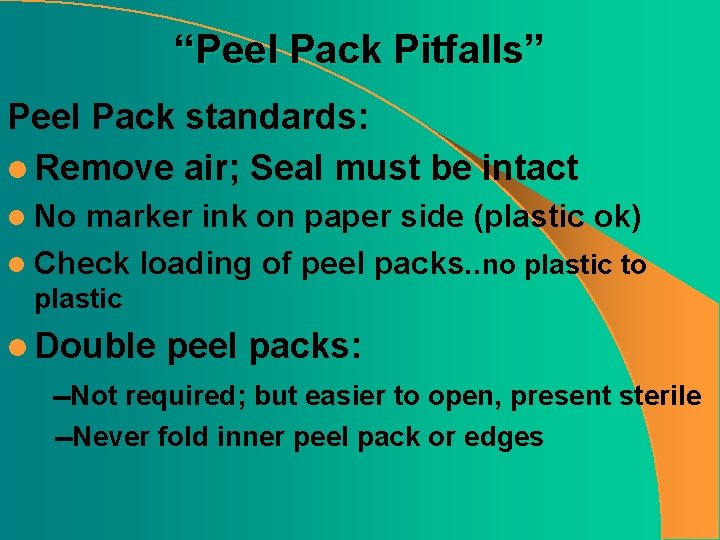
“Peel Pack Pitfalls” Peel Pack standards: l Remove air; Seal must be intact l No marker ink on paper side (plastic ok) l Check loading of peel packs. . no plastic to plastic l Double peel packs: --Not required; but easier to open, present sterile --Never fold inner peel pack or edges
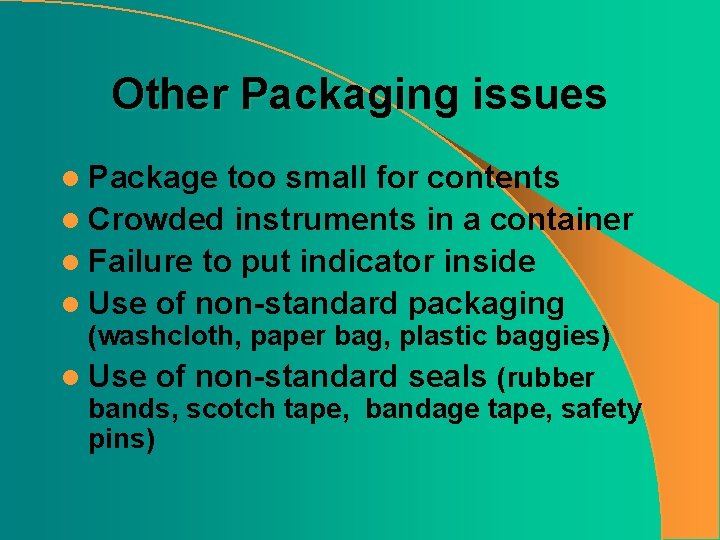
Other Packaging issues l Package too small for contents l Crowded instruments in a container l Failure to put indicator inside l Use of non-standard packaging (washcloth, paper bag, plastic baggies) l Use of non-standard seals (rubber bands, scotch tape, bandage tape, safety pins)
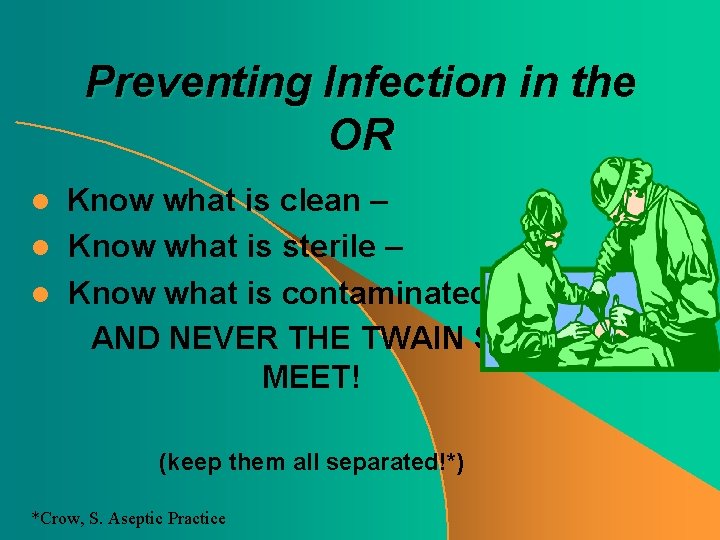
Preventing Infection in the OR Know what is clean – l Know what is sterile – l Know what is contaminated…… AND NEVER THE TWAIN SHALL MEET! l (keep them all separated!*) *Crow, S. Aseptic Practice