
What arenes Arenes are aromatic hydrocarbons that contain
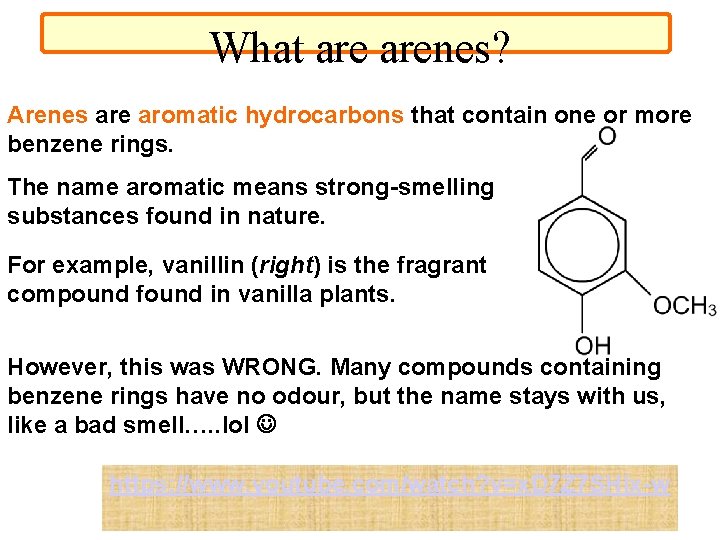
What arenes? Arenes are aromatic hydrocarbons that contain one or more benzene rings. The name aromatic means strong-smelling substances found in nature. For example, vanillin (right) is the fragrant compound found in vanilla plants. However, this was WRONG. Many compounds containing benzene rings have no odour, but the name stays with us, like a bad smell…. . lol https: //www. youtube. com/watch? v=x. D 7 Z 7 SHix-w
L. O. Arenes or Aromatic compounds - understand draw the bonding in benzene - understand using thermochemical evidence, the additional stability conferred by the structure - understand be able to explain why the structure causes benzene to undergo electrophilic reactions - understand the mechanism of nitration and the importance of nitration in synthesis - understand Friedel-Crafts acylation and its importance is synthesis
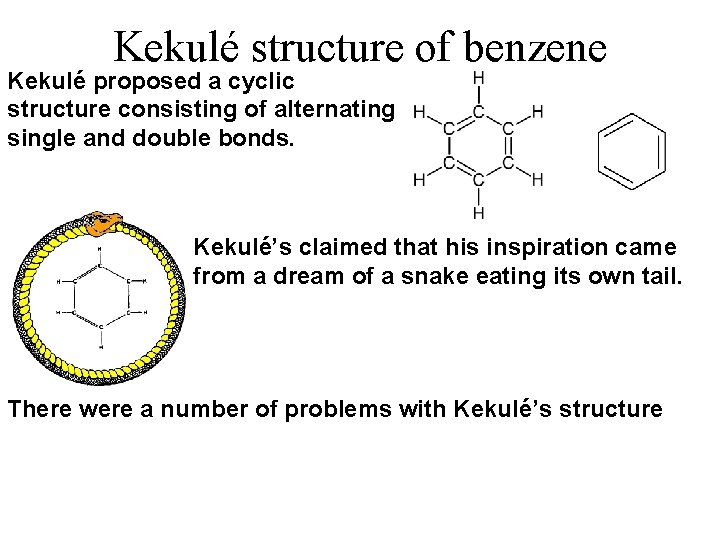
Kekulé structure of benzene Kekulé proposed a cyclic structure consisting of alternating single and double bonds. Kekulé’s claimed that his inspiration came from a dream of a snake eating its own tail. There were a number of problems with Kekulé’s structure
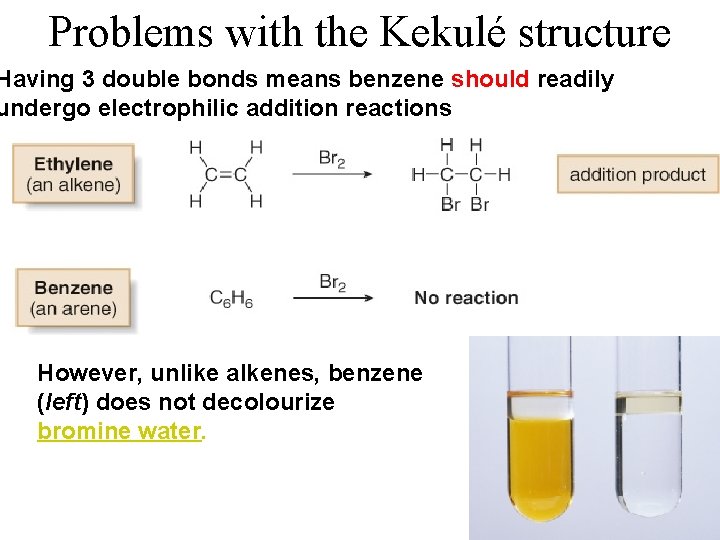
Problems with the Kekulé structure Having 3 double bonds means benzene should readily undergo electrophilic addition reactions However, unlike alkenes, benzene (left) does not decolourize bromine water.
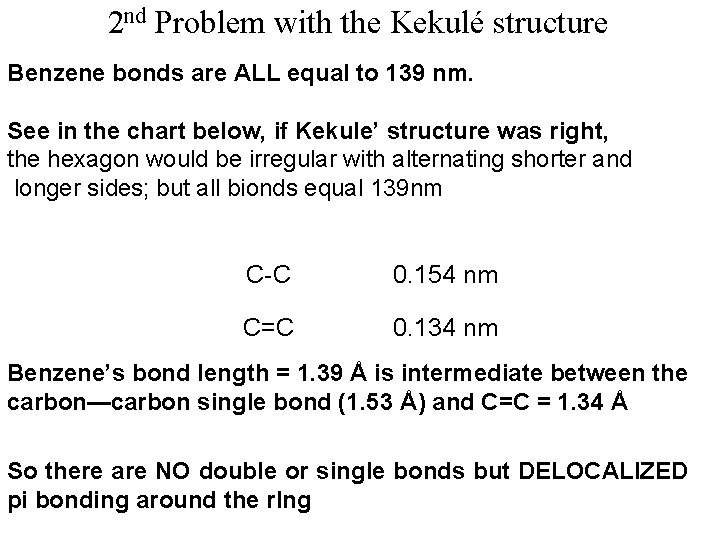
2 nd Problem with the Kekulé structure Benzene bonds are ALL equal to 139 nm. See in the chart below, if Kekule’ structure was right, the hexagon would be irregular with alternating shorter and longer sides; but all bionds equal 139 nm C-C 0. 154 nm C=C 0. 134 nm Benzene’s bond length = 1. 39 Å is intermediate between the carbon—carbon single bond (1. 53 Å) and C=C = 1. 34 Å So there are NO double or single bonds but DELOCALIZED pi bonding around the r. Ing
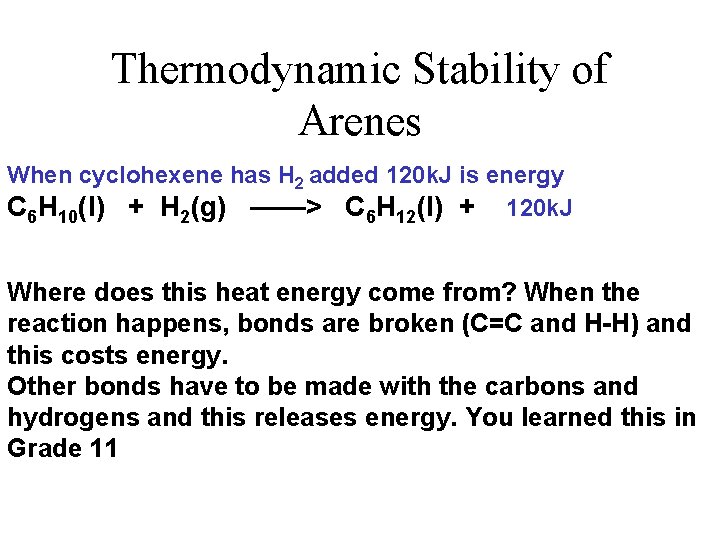
Thermodynamic Stability of Arenes When cyclohexene has H 2 added 120 k. J is energy C 6 H 10(l) + H 2(g) ——> C 6 H 12(l) + 120 k. J Where does this heat energy come from? When the reaction happens, bonds are broken (C=C and H-H) and this costs energy. Other bonds have to be made with the carbons and hydrogens and this releases energy. You learned this in Grade 11
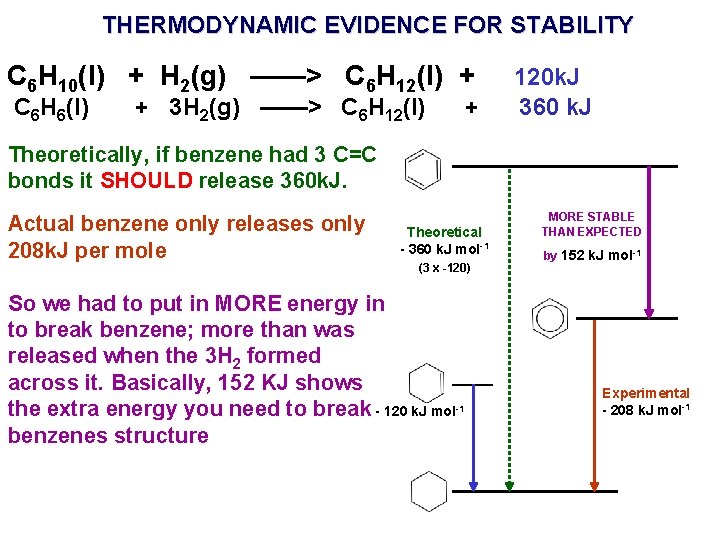
THERMODYNAMIC EVIDENCE FOR STABILITY C 6 H 10(l) + H 2(g) ——> C 6 H 12(l) + C 6 H 6(l) + 3 H 2(g) ——> C 6 H 12(l) + 120 k. J 360 k. J Theoretically, if benzene had 3 C=C bonds it SHOULD release 360 k. J. Actual benzene only releases only 208 k. J per mole Theoretical - 360 k. J mol-1 (3 x -120) So we had to put in MORE energy in to break benzene; more than was 2 3 released when the 3 H 2 formed across it. Basically, 152 KJ shows the extra energy you need to break - 120 k. J mol-1 benzenes structure MORE STABLE THAN EXPECTED by 152 k. J mol-1 Experimental - 208 k. J mol-1
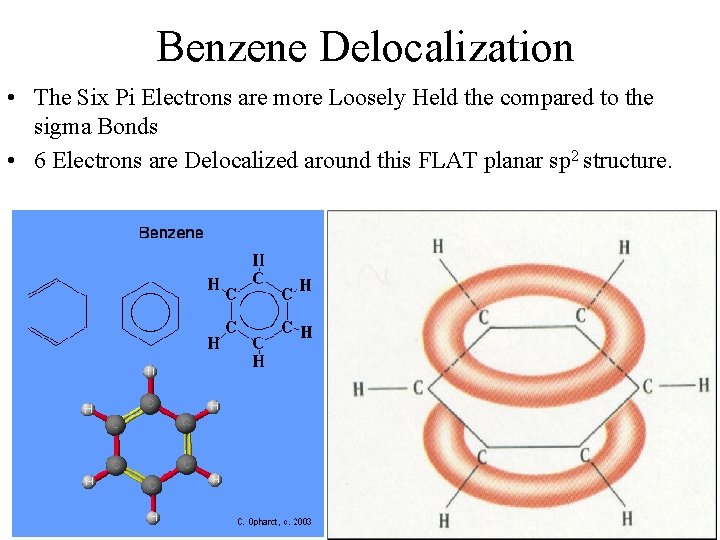
Benzene Delocalization • The Six Pi Electrons are more Loosely Held the compared to the sigma Bonds • 6 Electrons are Delocalized around this FLAT planar sp 2 structure. 8
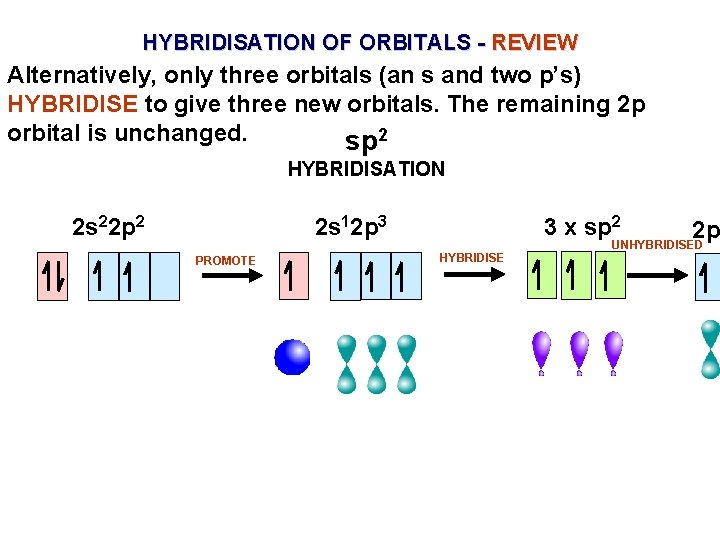
HYBRIDISATION OF ORBITALS - REVIEW Alternatively, only three orbitals (an s and two p’s) HYBRIDISE to give three new orbitals. The remaining 2 p orbital is unchanged. sp 2 HYBRIDISATION 2 s 22 p 2 2 s 12 p 3 PROMOTE 3 x sp 2 HYBRIDISE 2 p UNHYBRIDISED
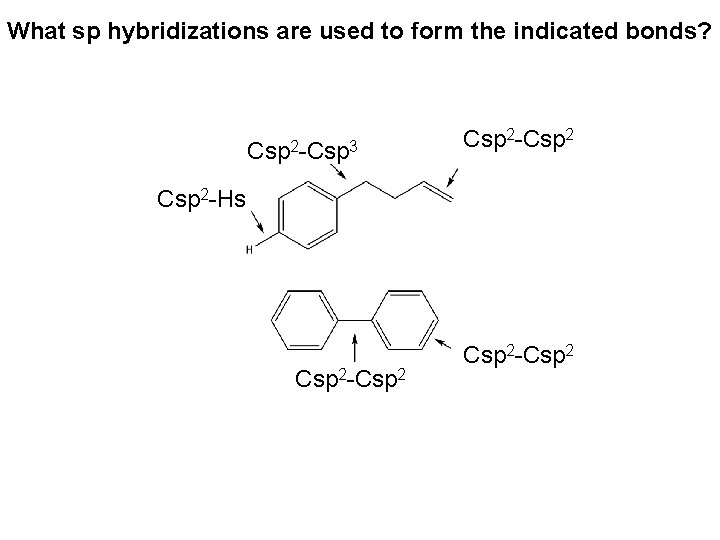
What sp hybridizations are used to form the indicated bonds? Csp 2 -Csp 3 Csp 2 -Csp 2 -Hs Csp 2 -Csp 2
STRUCTURE OF BENZENE ANIMATION
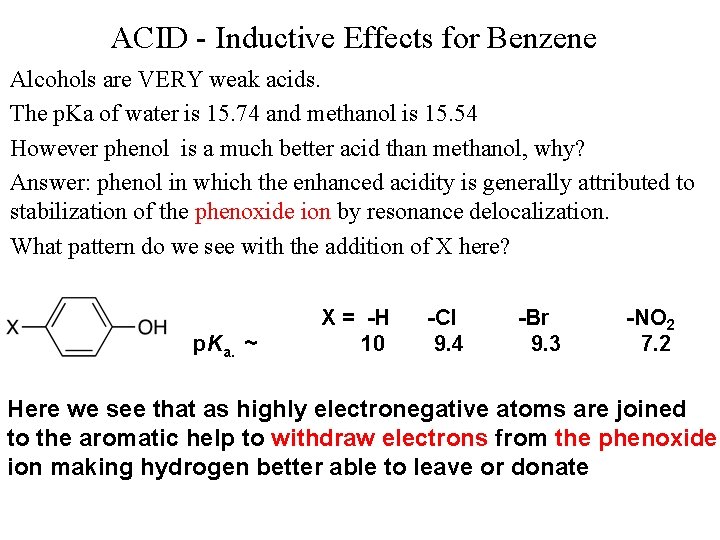
ACID - Inductive Effects for Benzene Alcohols are VERY weak acids. The p. Ka of water is 15. 74 and methanol is 15. 54 However phenol is a much better acid than methanol, why? Answer: phenol in which the enhanced acidity is generally attributed to stabilization of the phenoxide ion by resonance delocalization. What pattern do we see with the addition of X here? p. Ka. ~ X = -H 10 -Cl 9. 4 -Br 9. 3 -NO 2 7. 2 Here we see that as highly electronegative atoms are joined to the aromatic help to withdraw electrons from the phenoxide ion making hydrogen better able to leave or donate
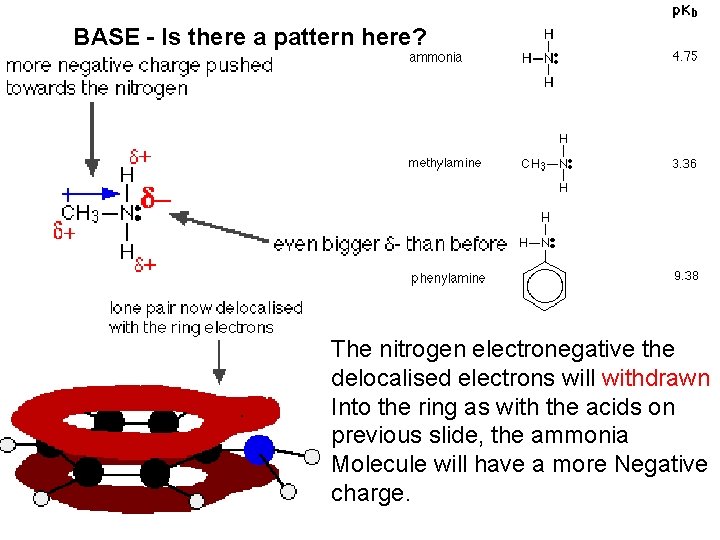
BASE - Is there a pattern here? The nitrogen electronegative the delocalised electrons will withdrawn Into the ring as with the acids on previous slide, the ammonia Molecule will have a more Negative charge.
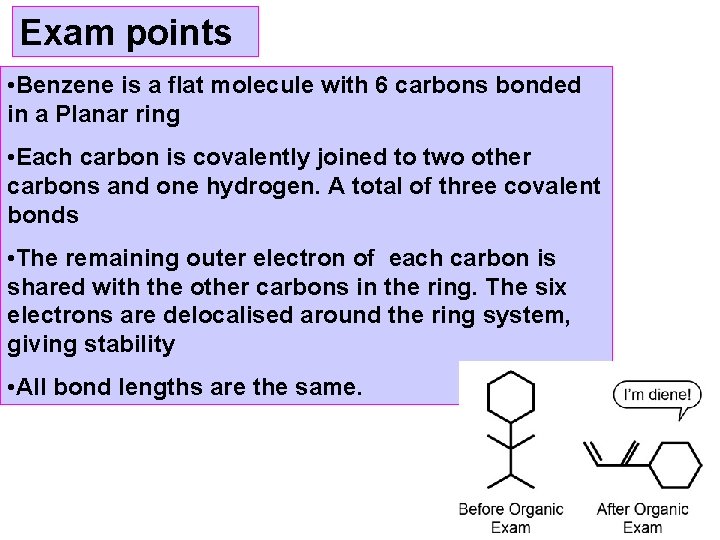
Exam points • Benzene is a flat molecule with 6 carbons bonded in a Planar ring • Each carbon is covalently joined to two other carbons and one hydrogen. A total of three covalent bonds • The remaining outer electron of each carbon is shared with the other carbons in the ring. The six electrons are delocalised around the ring system, giving stability • All bond lengths are the same.
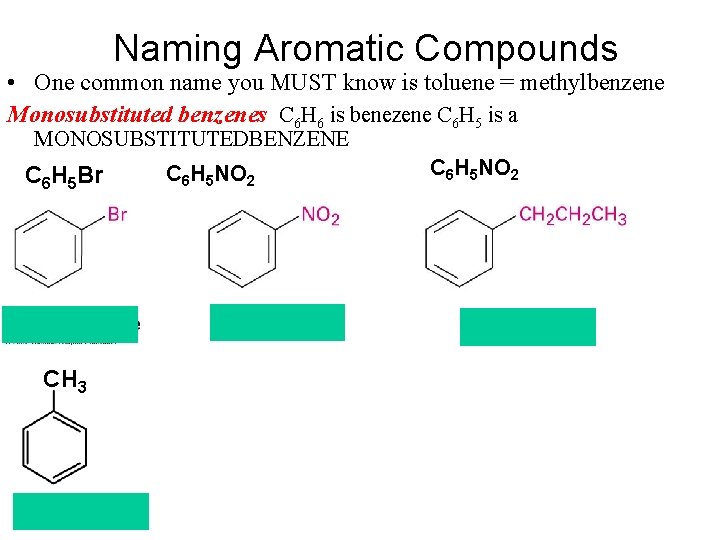
Naming Aromatic Compounds • One common name you MUST know is toluene = methylbenzene Monosubstituted benzenes C 6 H 6 is benezene C 6 H 5 is a MONOSUBSTITUTEDBENZENE C 6 H 5 Br CH 3 Toluene C 6 H 5 NO 2
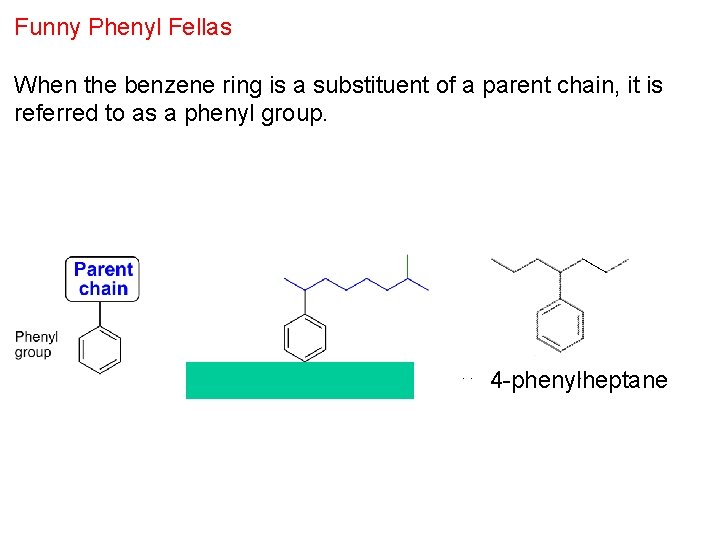
Funny Phenyl Fellas When the benzene ring is a substituent of a parent chain, it is referred to as a phenyl group. 4 -phenylheptane
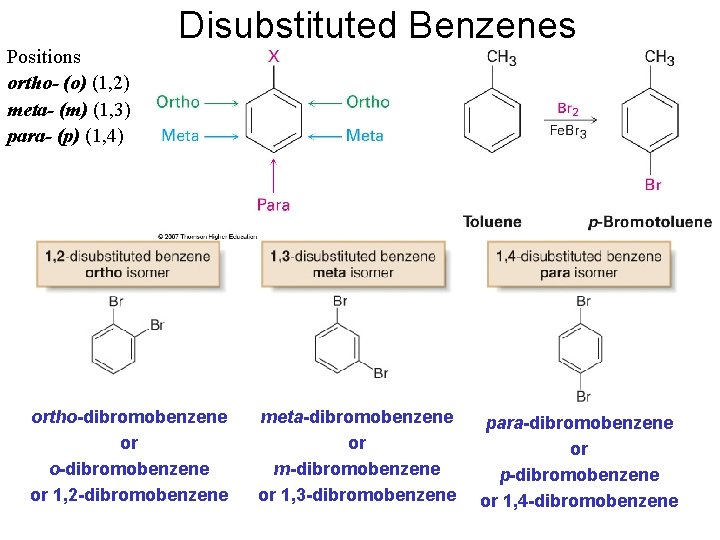
Positions ortho- (o) (1, 2) meta- (m) (1, 3) para- (p) (1, 4) Disubstituted Benzenes ortho-dibromobenzene or 1, 2 -dibromobenzene meta-dibromobenzene or m-dibromobenzene or 1, 3 -dibromobenzene para-dibromobenzene or p-dibromobenzene or 1, 4 -dibromobenzene
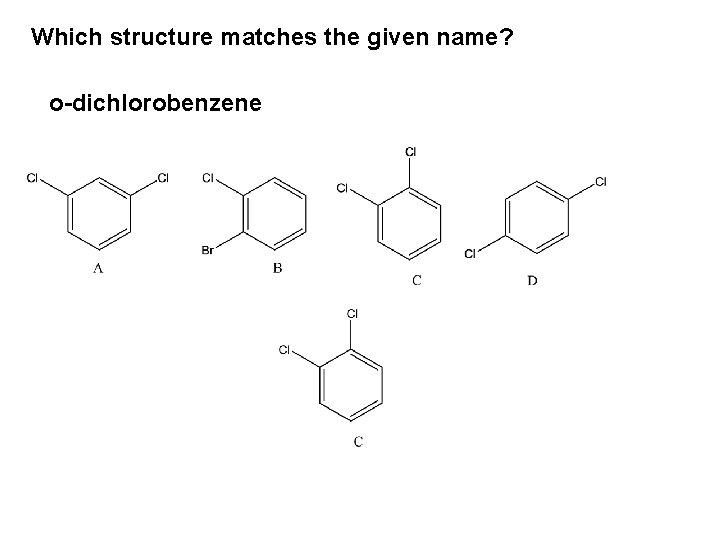
Which structure matches the given name? o-dichlorobenzene
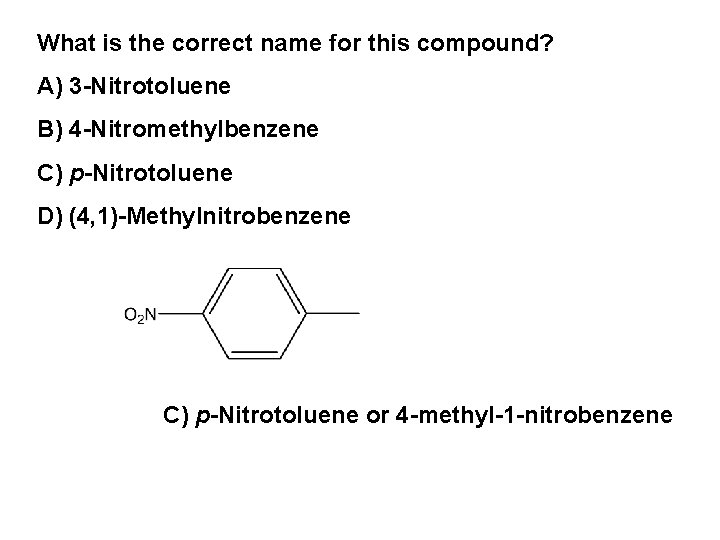
What is the correct name for this compound? A) 3 -Nitrotoluene B) 4 -Nitromethylbenzene C) p-Nitrotoluene D) (4, 1)-Methylnitrobenzene C) p-Nitrotoluene or 4 -methyl-1 -nitrobenzene
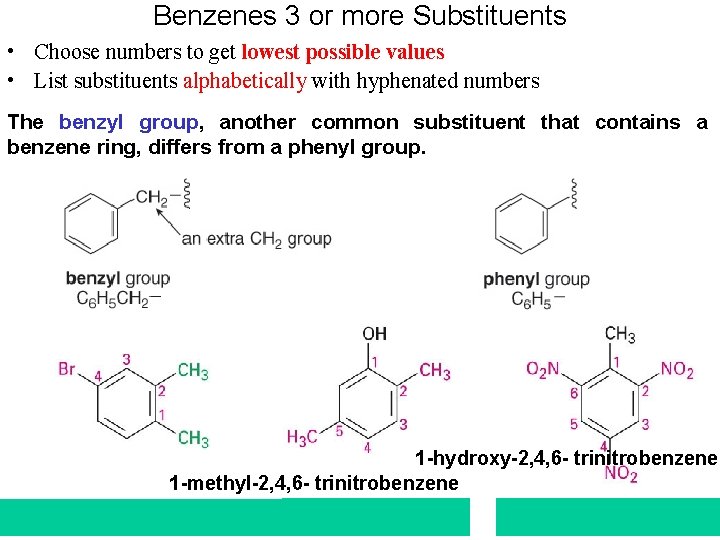
Benzenes 3 or more Substituents • Choose numbers to get lowest possible values • List substituents alphabetically with hyphenated numbers The benzyl group, another common substituent that contains a benzene ring, differs from a phenyl group. 1 -hydroxy-2, 4, 6 - trinitrobenzene 1 -methyl-2, 4, 6 - trinitrobenzene
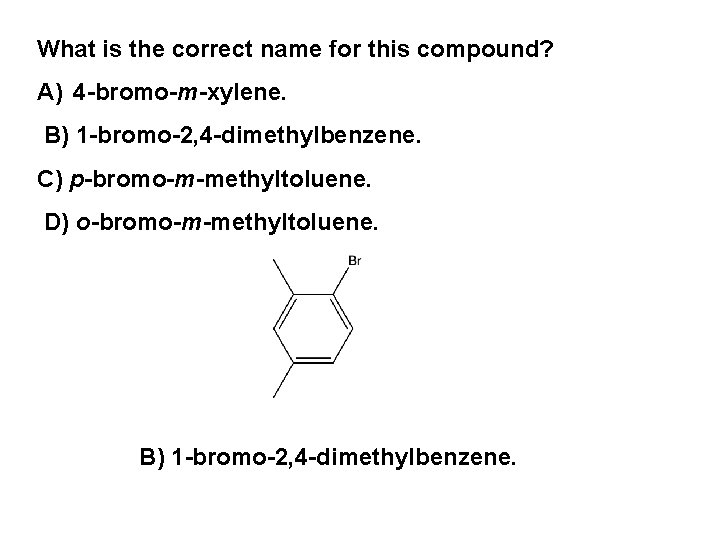
What is the correct name for this compound? A) 4 -bromo-m-xylene. B) 1 -bromo-2, 4 -dimethylbenzene. C) p-bromo-m-methyltoluene. D) o-bromo-m-methyltoluene. B) 1 -bromo-2, 4 -dimethylbenzene.
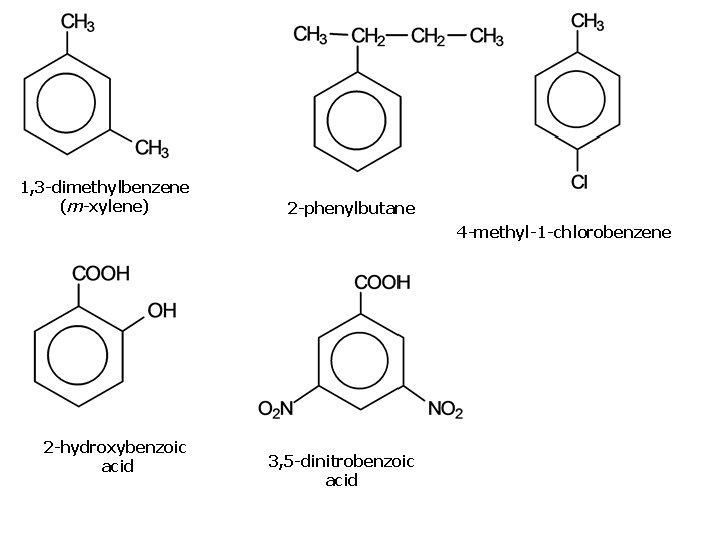
1, 3 -dimethylbenzene (m-xylene) 2 -phenylbutane 4 -methyl-1 -chlorobenzene 2 -hydroxybenzoic acid 3, 5 -dinitrobenzoic acid
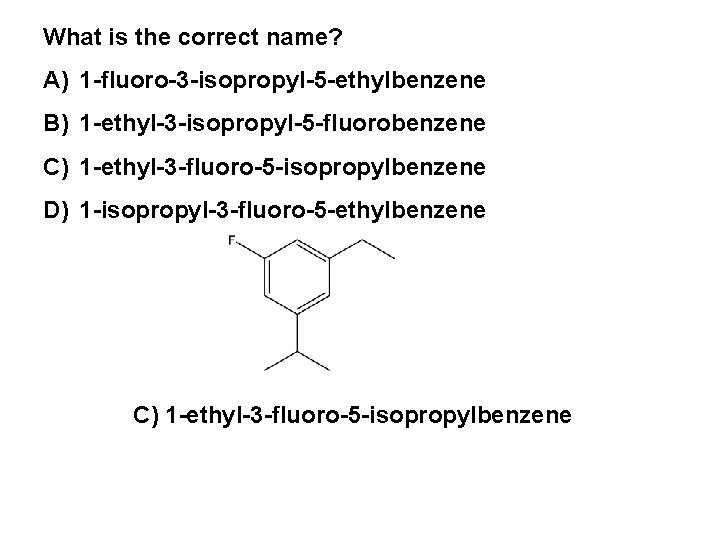
What is the correct name? A) 1 -fluoro-3 -isopropyl-5 -ethylbenzene B) 1 -ethyl-3 -isopropyl-5 -fluorobenzene C) 1 -ethyl-3 -fluoro-5 -isopropylbenzene D) 1 -isopropyl-3 -fluoro-5 -ethylbenzene C) 1 -ethyl-3 -fluoro-5 -isopropylbenzene
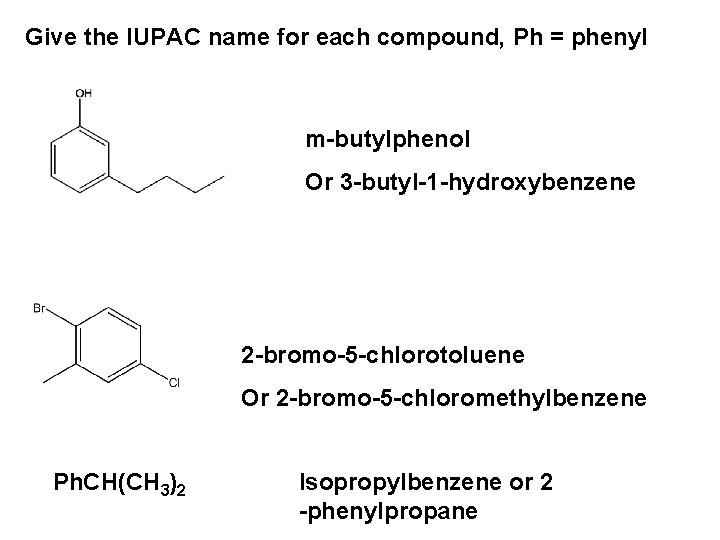
Give the IUPAC name for each compound, Ph = phenyl m-butylphenol Or 3 -butyl-1 -hydroxybenzene 2 -bromo-5 -chlorotoluene Or 2 -bromo-5 -chloromethylbenzene Ph. CH(CH 3)2 Isopropylbenzene or 2 -phenylpropane
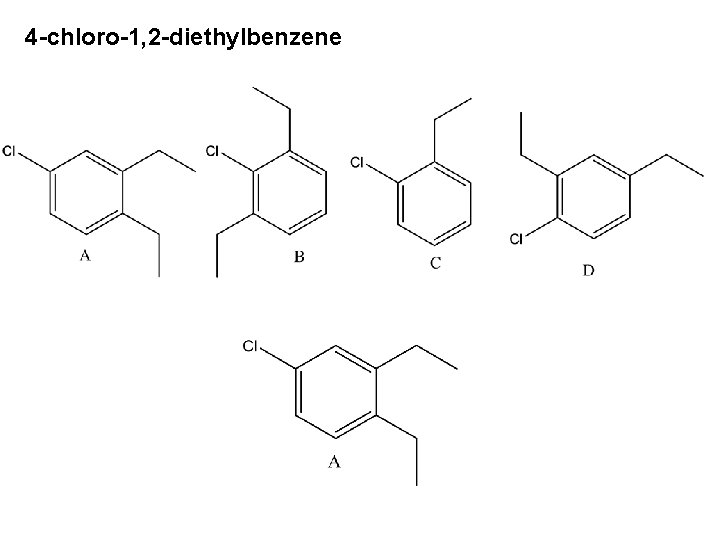
4 -chloro-1, 2 -diethylbenzene
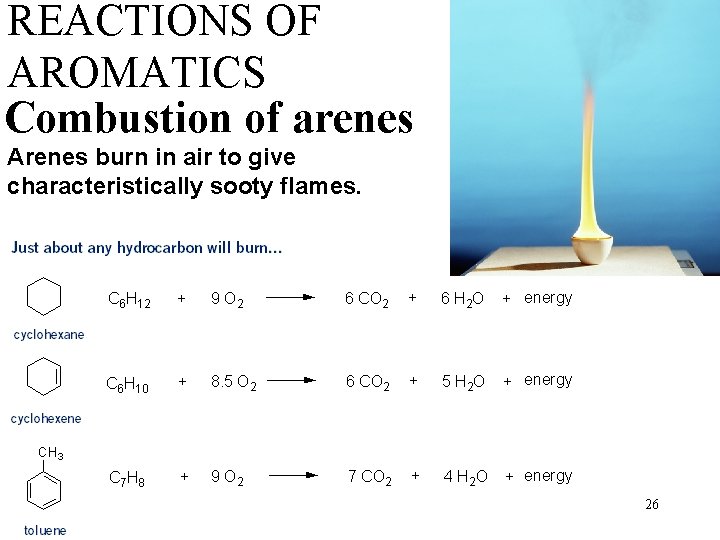
REACTIONS OF AROMATICS Combustion of arenes Arenes burn in air to give characteristically sooty flames. 26
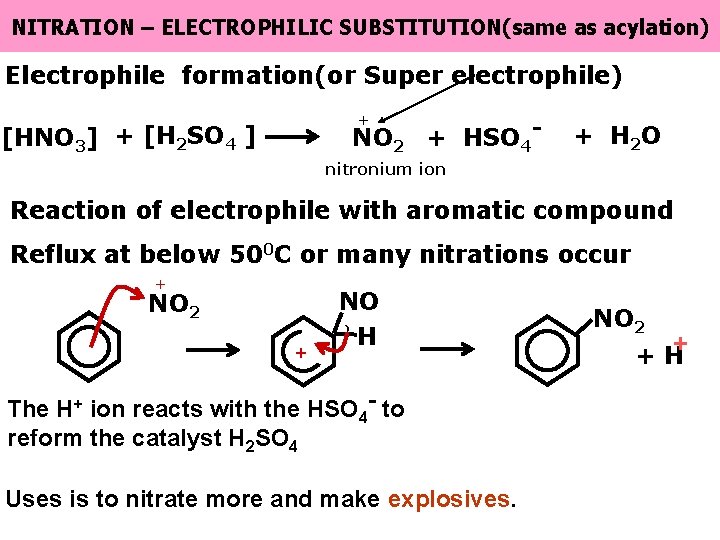
NITRATION – ELECTROPHILIC SUBSTITUTION(same as acylation) Electrophile formation(or Super electrophile) + NO 2 + HSO 4 - [HNO 3] + [H 2 SO 4 ] + H 2 O nitronium ion Reaction of electrophile with aromatic compound Reflux at below 500 C or many nitrations occur + NO 2 H The H+ ion reacts with the HSO 4 - to reform the catalyst H 2 SO 4 Uses is to nitrate more and make explosives. NO 2 + +H
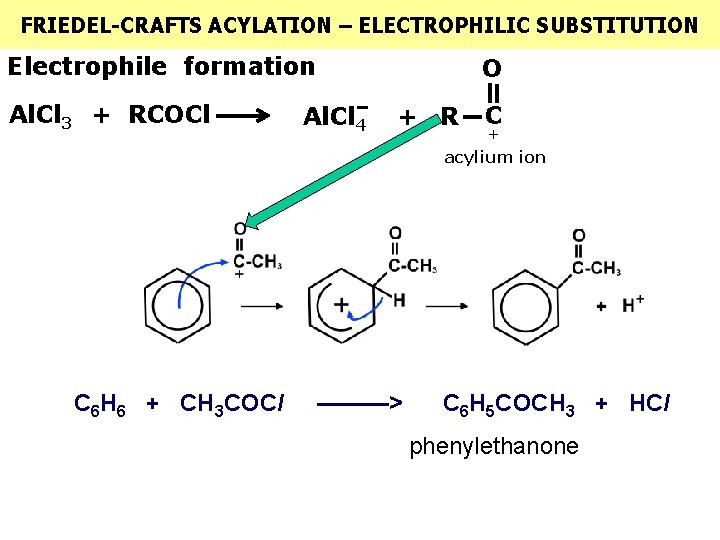
FRIEDEL-CRAFTS ACYLATION – ELECTROPHILIC SUBSTITUTION Electrophile formation Al. Cl 3 + RCOCl C 6 H 6 + CH 3 COCl O Al. Cl 4– + R ———> C + acylium ion C 6 H 5 COCH 3 + HCl phenylethanone
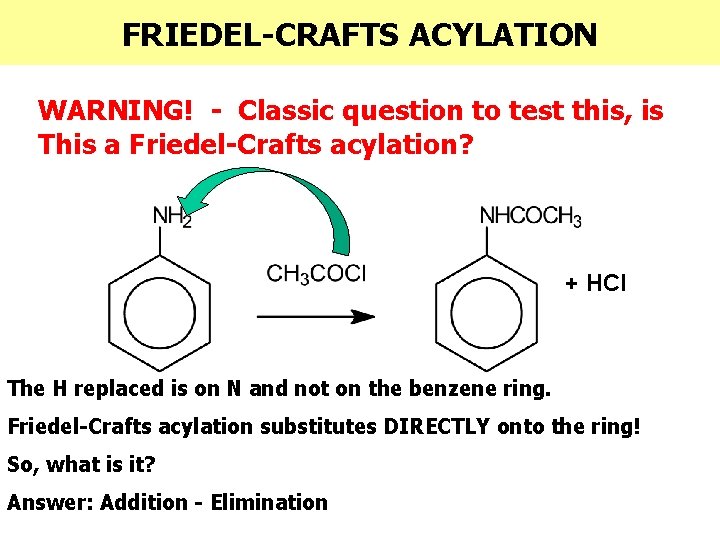
FRIEDEL-CRAFTS ACYLATION WARNING! - Classic question to test this, is This a Friedel-Crafts acylation? + HCl The H replaced is on N and not on the benzene ring. Friedel-Crafts acylation substitutes DIRECTLY onto the ring! So, what is it? Answer: Addition - Elimination
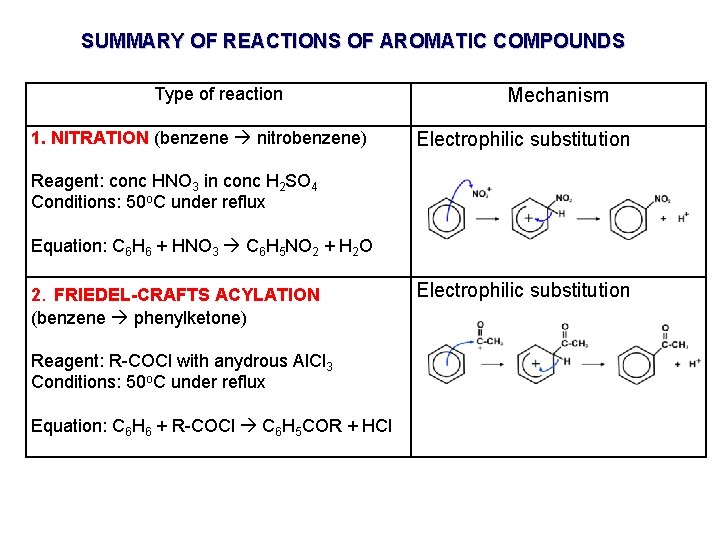
SUMMARY OF REACTIONS OF AROMATIC COMPOUNDS Type of reaction 1. NITRATION (benzene nitrobenzene) Reagent: conc HNO 3 in conc H 2 SO 4 Conditions: 50 o. C under reflux Equation: C 6 H 6 + HNO 3 C 6 H 5 NO 2 + H 2 O 2. FRIEDEL-CRAFTS ACYLATION (benzene phenylketone) Reagent: R-COCl with anydrous Al. Cl 3 Conditions: 50 o. C under reflux Equation: C 6 H 6 + R-COCl C 6 H 5 COR + HCl Mechanism Electrophilic substitution
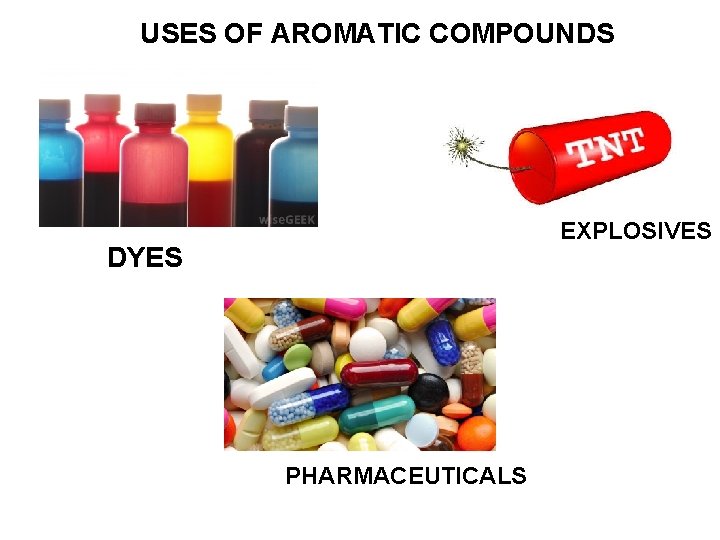
USES OF AROMATIC COMPOUNDS EXPLOSIVES DYES PHARMACEUTICALS
- Slides: 31