
WHAT ARE YOU DOING DEEPA By Alex Hoffmeyer
WHAT ARE YOU DOING? (DEEPA) By: Alex Hoffmeyer & Jaime Esqueda
PURPOSE • The purpose of this study is to find out what students are doing are their phones. RQ 1: What are students’ perceptions of teachers attitudes towards cell phone use? RQ 2: What makes students want to be on their cell phones during class?
RATIONALE Research has been conducted on the following: • Instructors policies regarding technology and it’s association with the perception of verbal aggressiveness in the classroom (Finn & Ledbetter, 2014). • The Association between cell phone usage in class and the negative impacts it has on student learning (Kuznekoff, Munz & Titsworth, 2015). • The impact of texting/posting and how it can prevent information processing (Kuznekoff & Titsworth, 2013). • Teacher immediacy and college students use of text messaging in class (Wei & Wang, 2010).
RATIONALE (CONTINUED) • However, there has been zero research conducted to find out what students are doing on their cell phones and their perceptions of their teachers attitudes towards cell phone use in the classroom.
METHOD FOR SURVEY Participants • 22 participants (10 males, 12 females) • Age range (18 -24) • All were current Mankato State University Students.
METHOD CONTINUED… Procedure • Selected by random convenient sampling. • Surveys were distributed and completed in the CSU. • Average time to complete the survey was 7 minutes.
METHOD CONTINUED… Measures • Survey consisted of 6 questions • RQ 1 (three questions) • Measured on a 5 -likert scale (1 strongly agree- 5 strongly disagree) • RQ 2 (three questions) • Measured on a 5 -likert scale (1 strongly agree- 5 strongly disagree) ***Research responses were then measured to find themes.
FINDINGS • RQ 1: Disrespect was the main theme that emerged. - Students felt that their teachers didn't like cell phones mainly because they felt disrespected. • RQ 2: Most common theme that emerged was addiction to their cell phones. - Most students mentioned they check their cell phones multiple times per class.
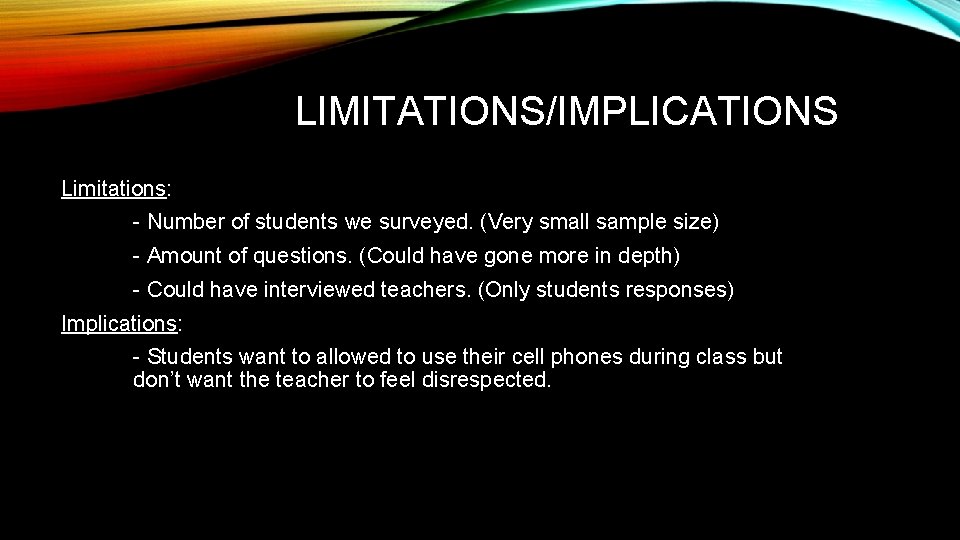
LIMITATIONS/IMPLICATIONS Limitations: - Number of students we surveyed. (Very small sample size) - Amount of questions. (Could have gone more in depth) - Could have interviewed teachers. (Only students responses) Implications: - Students want to allowed to use their cell phones during class but don’t want the teacher to feel disrespected.
METHOD FOR INTERVIEW • Participants/Interviewees • 2 participants (1 male, 1 female) • Age for male = 18 -- Age for female 18 • Both Participants were freshman at Mankato State University.
METHOD CONTINUED… Procedure • Asked both interviewees 12 open-ended questions and coded their responses to find themes that emerged. • Both Participants were chosen from a stratified sampling standpoint.
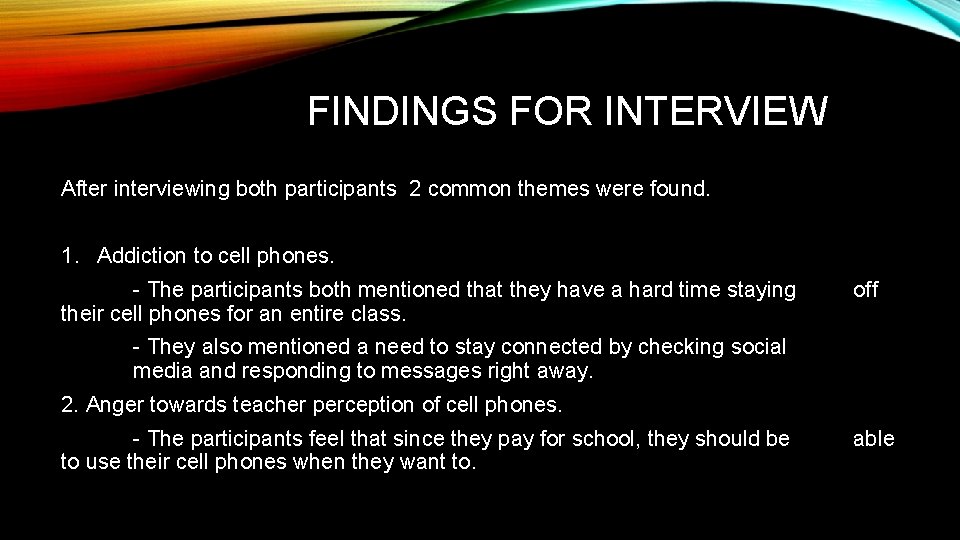
FINDINGS FOR INTERVIEW After interviewing both participants 2 common themes were found. 1. Addiction to cell phones. - The participants both mentioned that they have a hard time staying their cell phones for an entire class. off - They also mentioned a need to stay connected by checking social media and responding to messages right away. 2. Anger towards teacher perception of cell phones. - The participants feel that since they pay for school, they should be to use their cell phones when they want to. able
LIMITATIONS/IMPLICATIONS Limitations - Both interviewees were freshman. - Only conducted two interviews. (should have conducted more for more in-depth results) - We also did’t interview any professors to obtain their point of view. Implications - Staying connected with friends is very important to the students. - Students feel that cell phones provide an escape from reality that they are afraid to give up, even during class.
DIRECTIONS FOR FUTURE RESEARCH • Conduct a study that is considerably larger, so we could get a more accurate perception from students. • Interview Professors as well as students to get a well-rounded understanding of our research question. • Interview students of all grade levels to see if their interpretation of cellphone usage in class is different. • Conduct follow-up interviews to gain interviewee information consistency. • Conduct interviews using this research question at different University locations to see if there any consistencies in our findings. • Have a larger sample size for surveys to gain more accurate information. • Conduct this survey at different University locations.
RESEARCH PROJECT CONCLUSION • The main theme of addiction to cell phone emerged in both our interviews and our surveys. • We believe that the main perceptions the students have of their teachers attitudes of cell phones are. • They get angry that students have advantages they did not have. • They also feel that cell phones are a form of cheating because of how easy information is accessible online. • In summation the students use cell phones to stay connected, satisfy their addiction, and use it as an escape while in the classroom.
APPENDIX Interview Questions • • • Do you use a cellphone in class? • • • When you do go on your cellphone in class, what do you do? i. e. , social media or school related. Does teacher immediacy play a factor as to whether you get on your phone in class? What do you do when you go on your phone? What do you think the negative effects are of using a cellphone in class? How do you believe using your cellphone in class effects your ability to learn? What does a class or teacher need to do/ how does that teacher need to set up their class for you to not want to use your cellphone for the duration of the period? Why do you feel it is necessary for you to use your cellphone in class? Why not wait until after the class is finished? Why do you think teachers act differently to cellphone usage in class compared to our generation? Why do you think some teachers care about cellphone usage in their class, and some do not? Do you think there is a difference for teachers who teach one-hundred level classes compared to teachers who teach fourhundred level classes on their policies for cellphone usage in the classroom?
APPENDIX CONTINUED… Survey Questions Likert scale: 1= strongly disagree; 5 = strongly agree. • • • My teacher has cell phone policy for his or her class. My teacher takes away points for using my cell phone. My teacher’s immediacy affected my cell phone use in class. My teacher uses his or her cell phone during class. My teacher allows me to be on my cell phone during class. My teacher’s class is boring so I use my cell phone as an escape from reality.
APPENDIX CONTINUED… Informed Conent Form • Purpose of the Research Study The purpose of this study is to find out what makes students want to be on their cell phones during class as opposed to not wanting to be on them during class. • Procedures If you agree to be in this study, you will be asked to do the following things: Complete a six question survey that examines how students perceive cell phone usage in the classroom and its affects on overall student’s grade. This survey should take you approximately ten-fifteen minutes. • Risks and Benefits of Being in the Study: There are no foreseeable risks to participating in this study. The benefits of to participation are: that you will be able to voice your opinion anonymously on whether or not you believe cell phone use in the classroom has any effects on student’s grades. • Anonymity: Students names will be kept confidential. • Voluntary Nature of the Study: Participation in this study is voluntary. Your decision whether or not to participate will not result in penalty or loss of benefits to which you are otherwise entitled. If you decide to participate, you are free to not answer any question or withdraw at any time. • Contacts and Questions: The researchers conducting this survey can be contacted by using the following email addresses. - jaime. esqueda@mnsu. edu or alex. hoffmeyer@mnsu. edu or deepa. oommen@mnsu. edu You are encouraged to contact the researchers if you have any questions.
REFERENCES • Finn, A. N. , & Ledbetter, A. M. (2014). Teacher verbal aggressiveness and credibility mediate the relationship between teacher technology policies and perceived student learning. Communication Education, 63(3), 210 -234. doi: 10. 1080/03634523. 2014. 919009 • Jeffrey H. Kuznekoff, Stevie Munz & Scott Titsworth (2015) Mobile Phones in the Classroom: Examining the Effects of Texting, Twitter, and Message Content on Student Learning, Communication Education, 64: 3, 344 -365, DOI: 10. 1080/03634523. 2015. 1038727 • Kuznekoff, J. H. , & Titsworth, S. (2013). The impact of mobile phone usage on student learning. Communication Education, 62(3), 233 -252. doi: 10. 1080/03634523. 2013. 767917 • Wei, F. F. , & Wang, Y. K. (2010). Students’ Silent Messages: Can Teacher Verbal and Nonverbal Immediacy Moderate Student Use of Text Messaging in Class? . Communication Education, 59(4), 475 -496. doi: 10. 1080/03634523. 2010. 496092
- Slides: 19