
What are we trying to achieve through bilingual
What are we trying to achieve through bilingual approaches to education? Phil Ball Valencia, Monday July 4, 2016
Three words 1. What? 2. Why? 3. How?
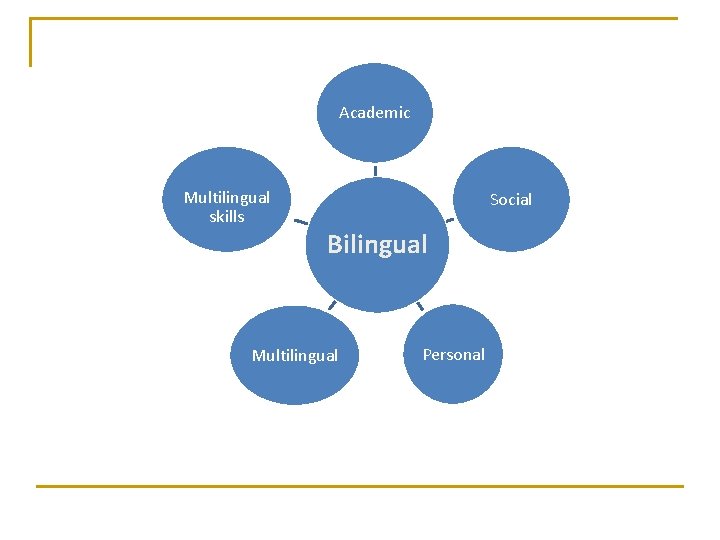
What do we mean by ‘Inspiring teaching and learning in a bilingual environment? ’ 1. Academic environment – T’s and S’s 2. Social environment (home, street) 3. Personal investment (bilinguality) 4. Bilingual as step to multilingual 5. Creating citizens with multilingual skills
Academic Multilingual skills Social Bilingual Multilingual Personal
What has CLIL taught us? 1. Monolingual curricula – a curable disease 2. Curricular content – do more in the target language 3. Towards English as a ‘core skill’ (Graddol – ‘English Next’) 4. Towards competence-based education
There’s more! The impact that multilingual practice/CLIL has on the L 1 curriculum – the ‘rebound effect’ (‘CLIL as a catalyst for change’ – Muñoa, I. 2011) More learner-centred (by default) More language supportive More methodologically considered More thoughtful assessment procedures
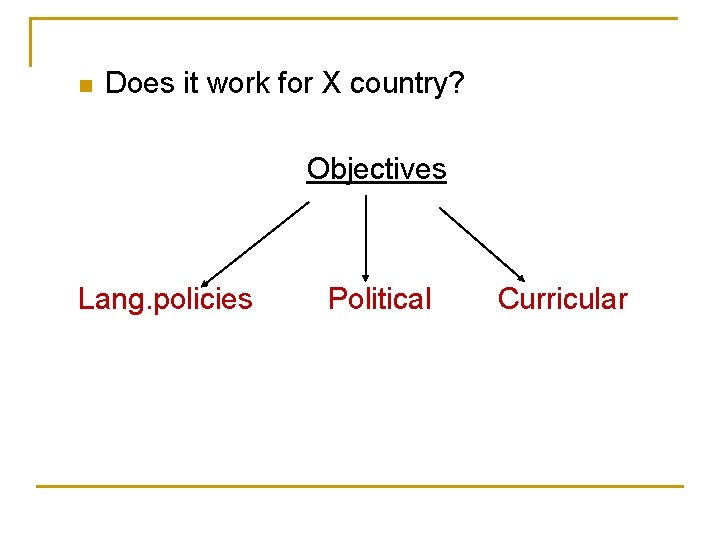
n Does it work for X country? Objectives Lang. policies Political Curricular
The European scene: socio-cultural contexts Spain v Netherlands
The European scene Top-down legislation v Bottom-up unilateral initiatives
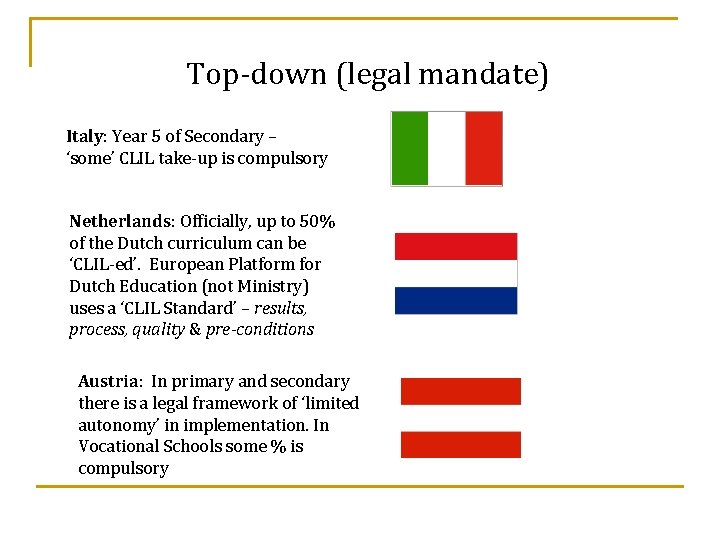
Top-down (legal mandate) Italy: Year 5 of Secondary – ‘some’ CLIL take-up is compulsory Netherlands: Officially, up to 50% of the Dutch curriculum can be ‘CLIL-ed’. European Platform for Dutch Education (not Ministry) uses a ‘CLIL Standard’ – results, process, quality & pre-conditions Austria: In primary and secondary there is a legal framework of ‘limited autonomy’ in implementation. In Vocational Schools some % is compulsory
Bottom-up initiatives Spain Germany Belgium Estonia Lithuania Bulgaria Turkey Czech Republic Slovakia Latvia Romania
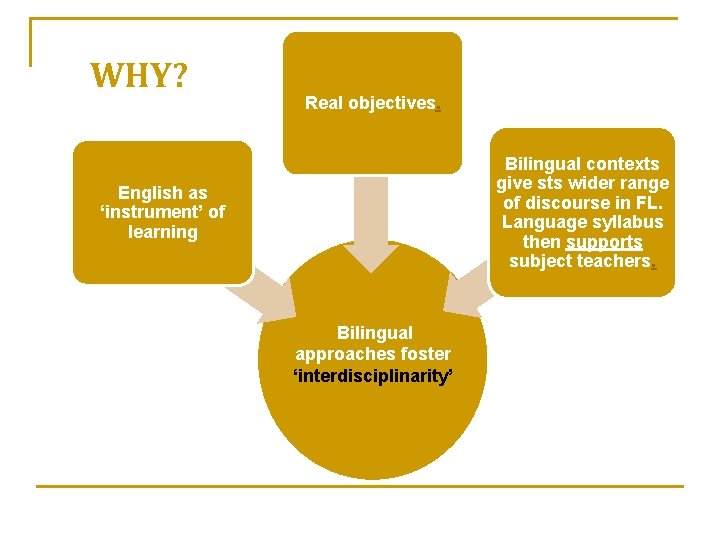
WHY? Real objectives. Bilingual contexts give sts wider range of discourse in FL. Language syllabus then supports subject teachers. English as ‘instrument’ of learning Bilingual approaches foster ‘interdisciplinarity’
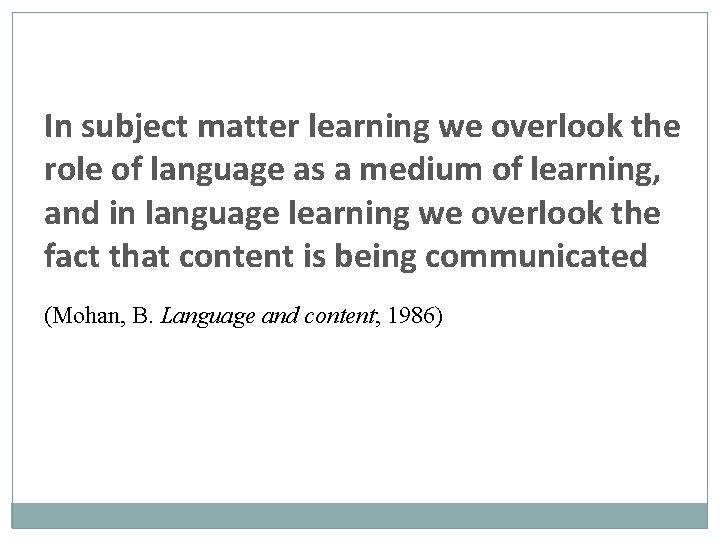
In subject matter learning we overlook the role of language as a medium of learning, and in language learning we overlook the fact that content is being communicated (Mohan, B. Language and content; 1986)
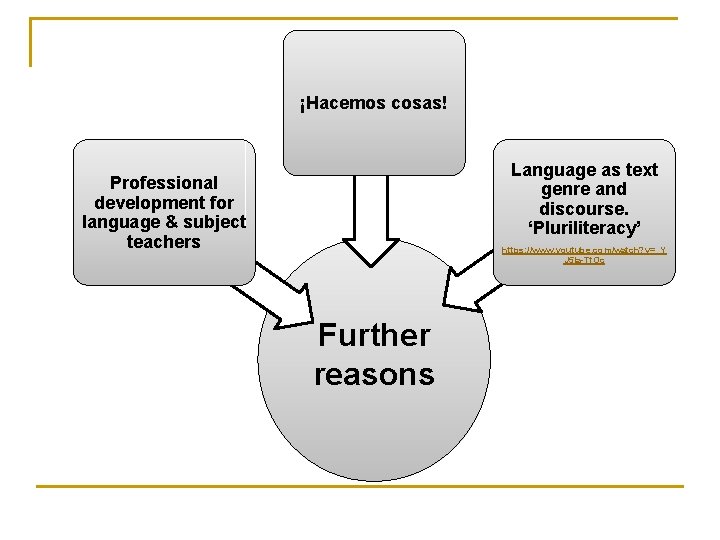
¡Hacemos cosas! Language as text genre and discourse. ‘Pluriliteracy’ Professional development for language & subject teachers https: //www. youtube. com/watch? v=_Y J 5 ja-Tf. Oc Further reasons
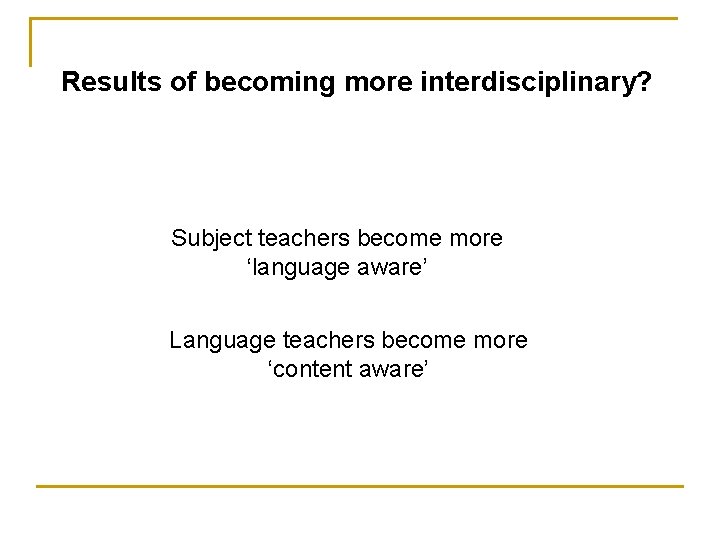
Results of becoming more interdisciplinary? Subject teachers become more ‘language aware’ Language teachers become more ‘content aware’
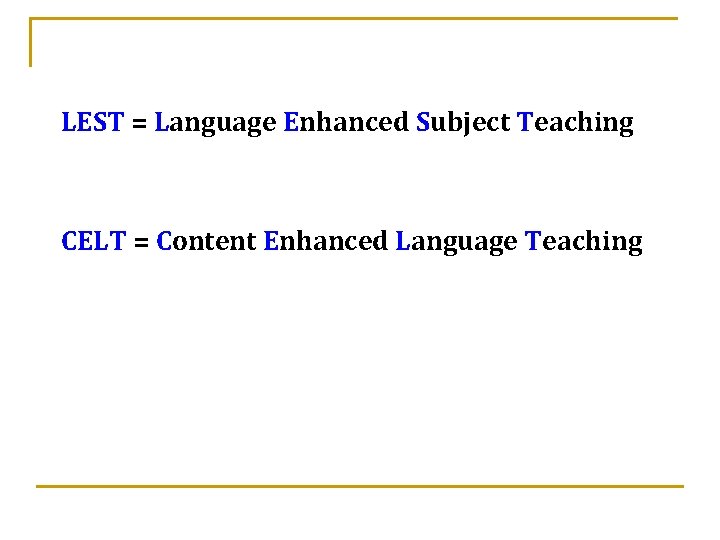
LEST = Language Enhanced Subject Teaching CELT = Content Enhanced Language Teaching
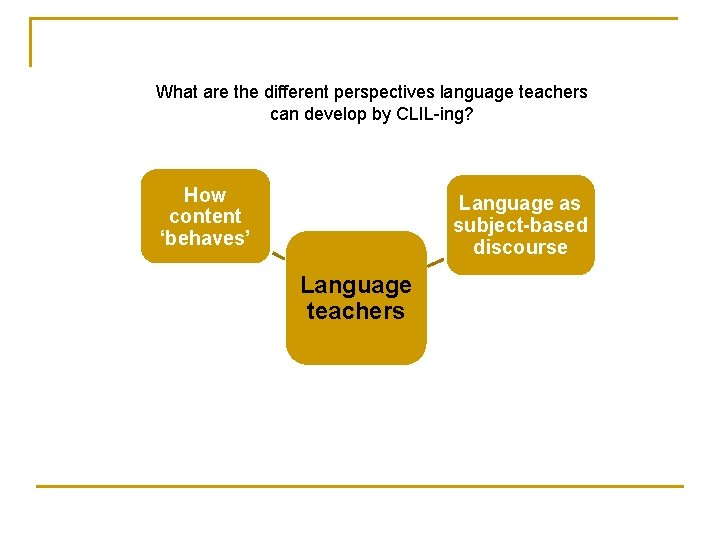
What are the different perspectives language teachers can develop by CLIL-ing? How content ‘behaves’ Language as subject-based discourse Language teachers
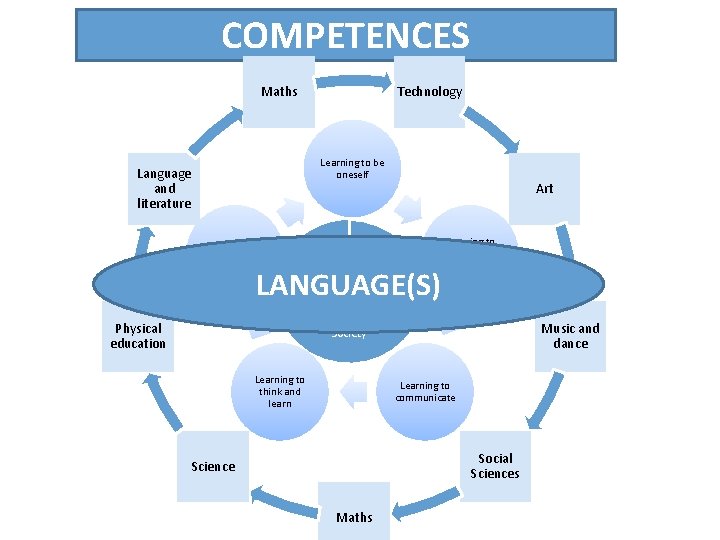
COMPETENCES Maths Technology Learning to be oneself Language and literature Learning to be enterprising Nature Art The individual LANGUAGE(S) Physical education Learning to live with others Music and dance Society Learning to think and learn Learning to communicate Social Sciences Science Maths
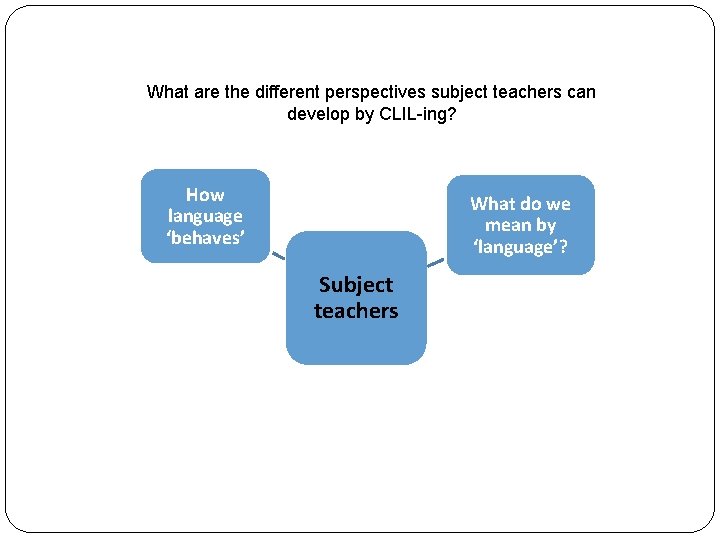
What are the different perspectives subject teachers can develop by CLIL-ing? How language ‘behaves’ What do we mean by ‘language’? Subject teachers
‘Looking for language’ (Kelly, 2015)
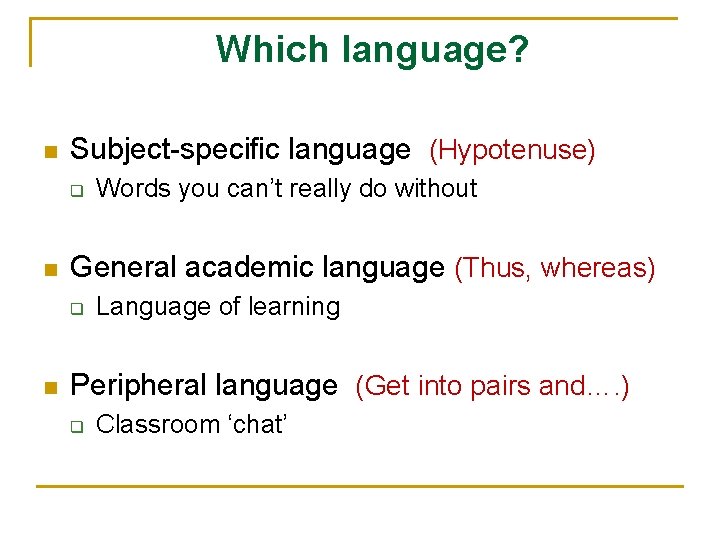
Which language? n Subject-specific language (Hypotenuse) q n General academic language (Thus, whereas) q n Words you can’t really do without Language of learning Peripheral language (Get into pairs and…. ) q Classroom ‘chat’
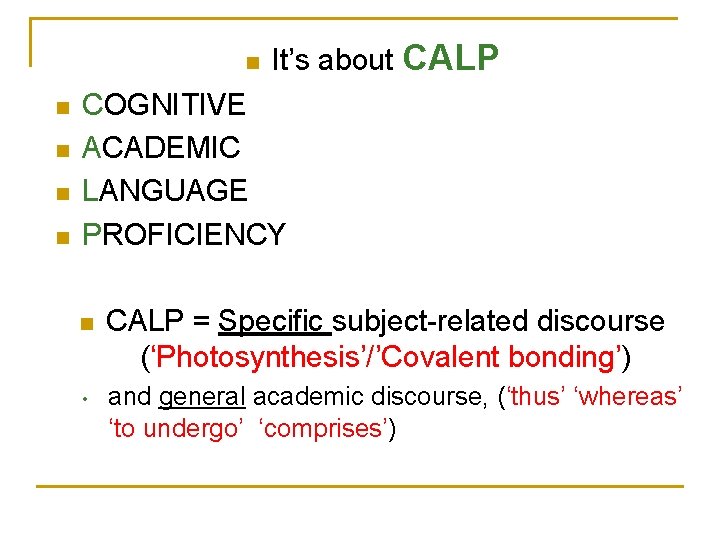
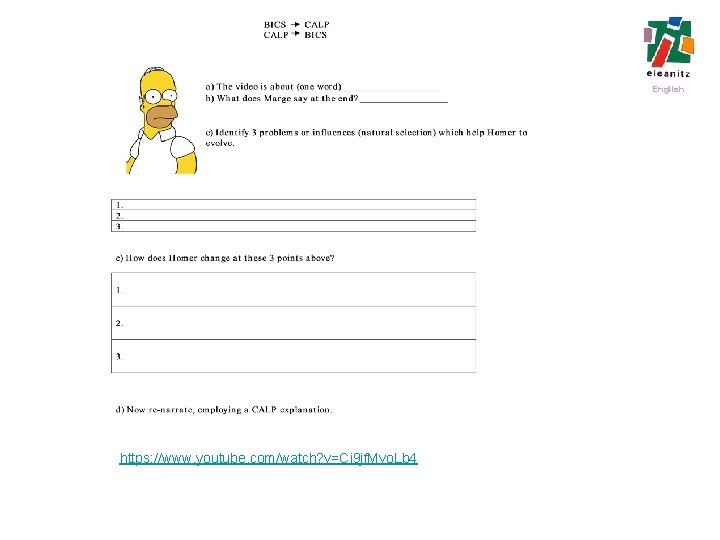
n n n It’s about CALP COGNITIVE ACADEMIC LANGUAGE PROFICIENCY n • CALP = Specific subject-related discourse (‘Photosynthesis’/’Covalent bonding’) and general academic discourse, (‘thus’ ‘whereas’ ‘to undergo’ ‘comprises’)
n n n Not so much about BICS Basic Interpersonal Communication Skills Cummins, J. (1979). Cognitive/academic language proficiency, linguistic interdependence, the optimum age question and some other matters. Working Papers on Bilingualism, 19, 121– 129.
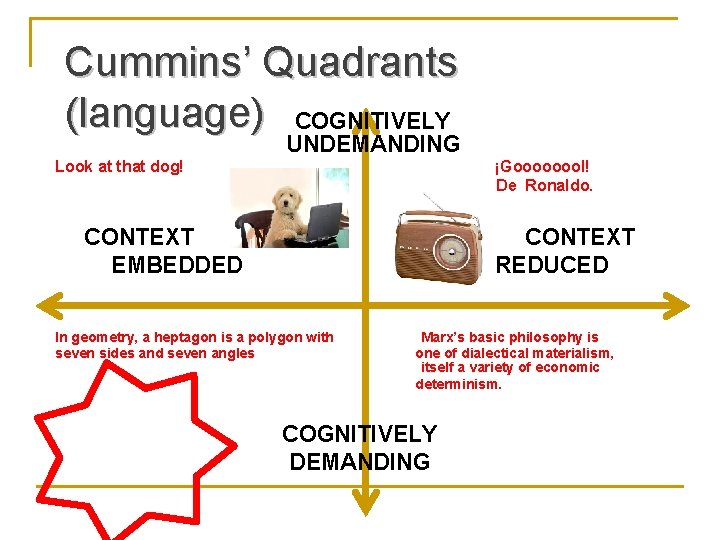
Cummins’ Quadrants (language) COGNITIVELY UNDEMANDING Look at that dog! CONTEXT EMBEDDED ¡Goooooool! De Ronaldo. CONTEXT REDUCED In geometry, a heptagon is a polygon with Marx’s basic philosophy is seven sides and seven angles one of dialectical materialism, itself a variety of economic determinism. COGNITIVELY DEMANDING
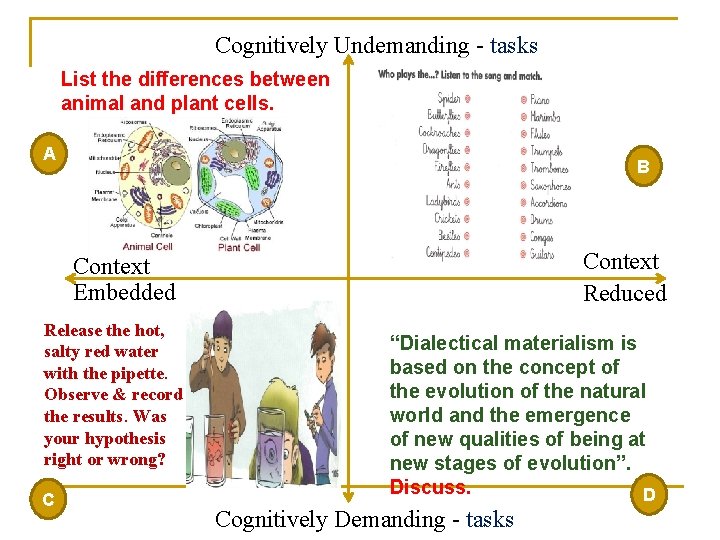
Cognitively Undemanding - tasks List the differences between animal and plant cells. A B Context Reduced Context Embedded Release the hot, salty red water with the pipette. Observe & record the results. Was your hypothesis right or wrong? C “Dialectical materialism is based on the concept of the evolution of the natural world and the emergence of new qualities of being at new stages of evolution”. Discuss. D Cognitively Demanding - tasks
Salience? Making things salient? ‘All (subject) teachers are language teachers’ (Bullock 1975) But language teachers can benefit from understanding the challenges that CLIL (subject) teachers face
English https: //www. youtube. com/watch? v=Ci 9 jf. Mvo. Lb 4
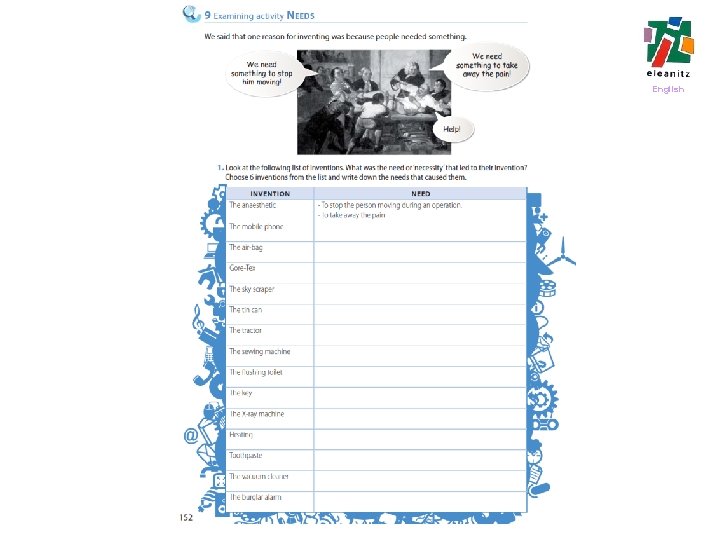
• Inventions (unit) English • http: //www. youtube. com/watch? v=2 g_3 ov. Cnbd 4 (Fry) • http: //www. ekigunea. eus/eu/edukia/dbh 1/english/eng-13/U/7? lang=en (Inventions simulation) • http: //www. ekigunea. eus/eu/edukia/dbh 2/english/eng-2 -2/U/7? lang=en (Healthy u simulation)
English
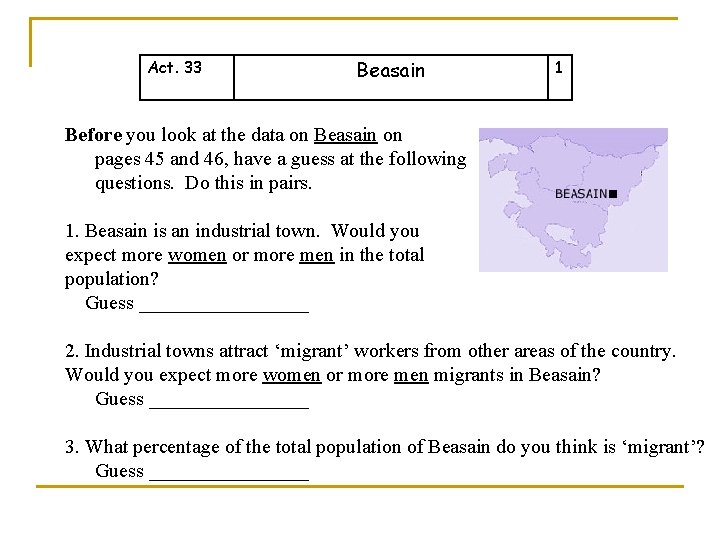
Act. 33 Beasain 1 Before you look at the data on Beasain on pages 45 and 46, have a guess at the following questions. Do this in pairs. 1. Beasain is an industrial town. Would you expect more women or more men in the total population? Guess _________ 2. Industrial towns attract ‘migrant’ workers from other areas of the country. Would you expect more women or more men migrants in Beasain? Guess ________ 3. What percentage of the total population of Beasain do you think is ‘migrant’? Guess ________
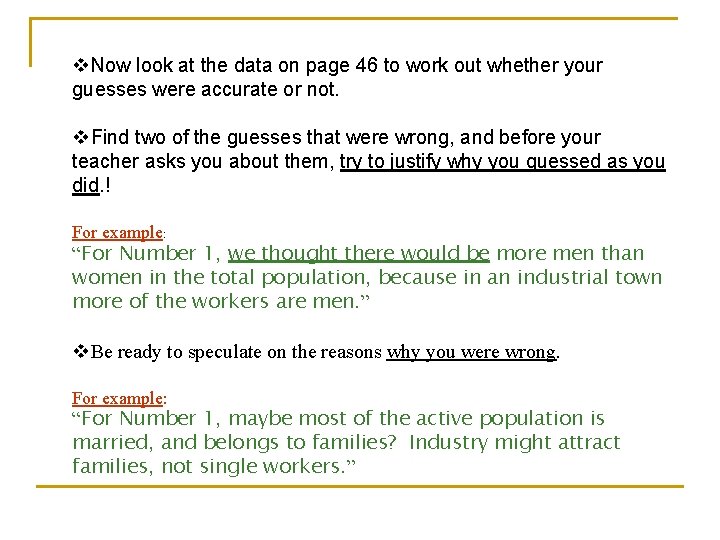
Now look at the data on page 46 to work out whether your guesses were accurate or not. Find two of the guesses that were wrong, and before your teacher asks you about them, try to justify why you guessed as you did. ! For example: “For Number 1, we thought there would be more men than women in the total population, because in an industrial town more of the workers are men. ” Be ready to speculate on the reasons why you were wrong. For example: “For Number 1, maybe most of the active population is married, and belongs to families? Industry might attract families, not single workers. ”
PPP =– Presentation, Practice, Production In language teaching, we used to think that we had to Present and Practise, before really Producing.
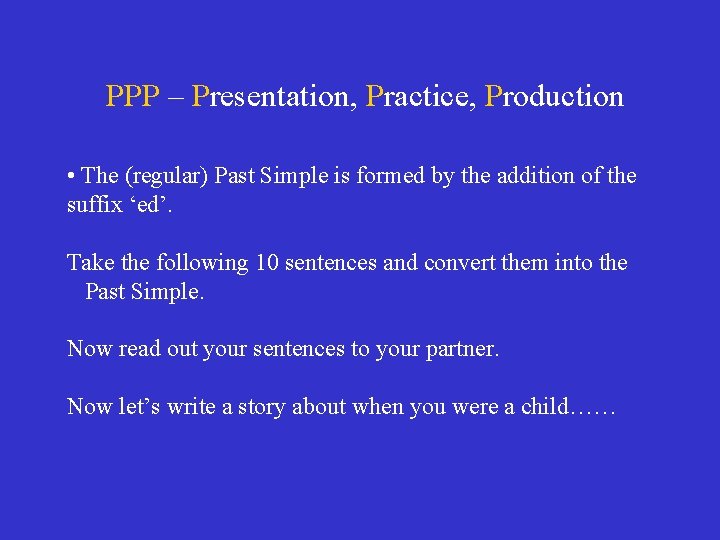
PPP – Presentation, Practice, Production • The (regular) Past Simple is formed by the addition of the suffix ‘ed’. Take the following 10 sentences and convert them into the Past Simple. Now read out your sentences to your partner. Now let’s write a story about when you were a child……
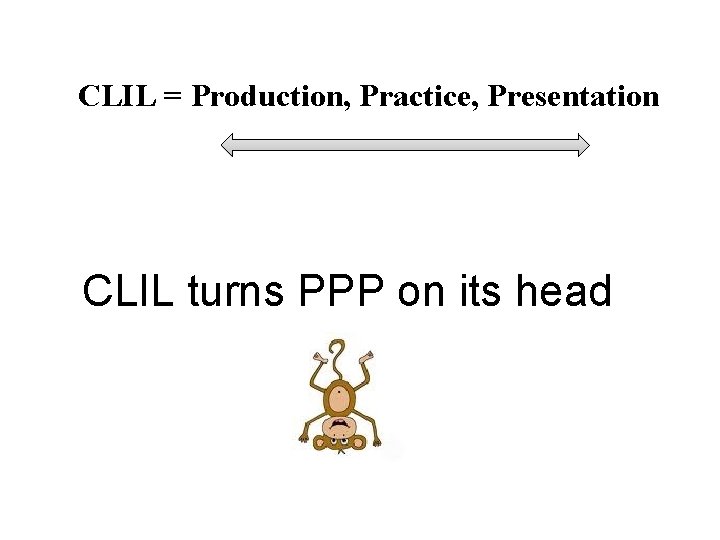
CLIL = Production, Practice, Presentation • CLIL turns PPP on its head
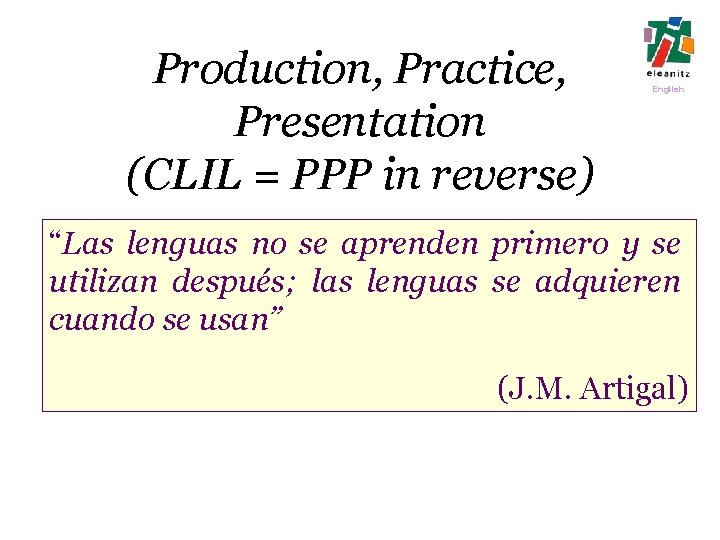
Production, Practice, Presentation (CLIL = PPP in reverse) English “Las lenguas no se aprenden primero y se utilizan después; las lenguas se adquieren cuando se usan” (J. M. Artigal)
Throw them in at the deep end! I’m CLIL-ing! English
If you do (throw them in)…. practise. .
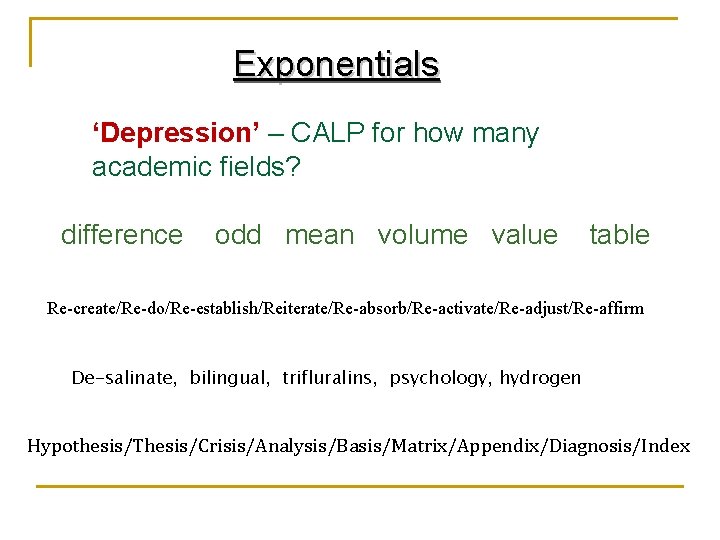
Exponentials ‘Depression’ – CALP for how many academic fields? difference odd mean volume value table Re-create/Re-do/Re-establish/Reiterate/Re-absorb/Re-activate/Re-adjust/Re-affirm De-salinate, bilingual, trifluralins, psychology, hydrogen Hypothesis/Thesis/Crisis/Analysis/Basis/Matrix/Appendix/Diagnosis/Index
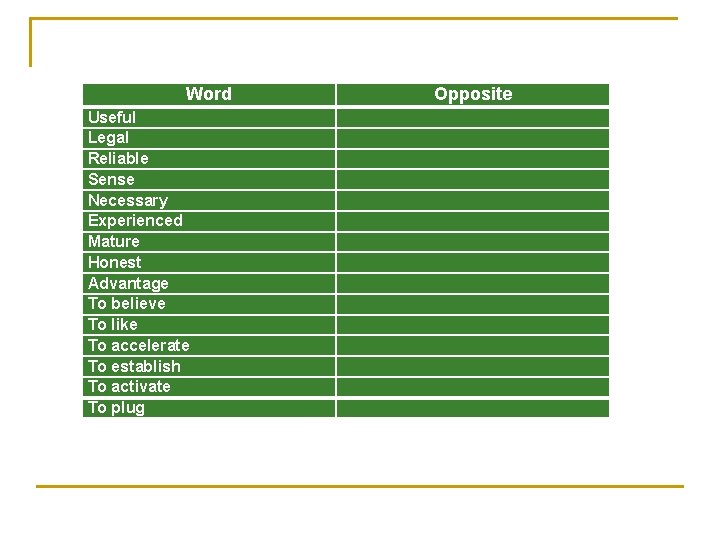
Word Useful Legal Reliable Sense Necessary Experienced Mature Honest Advantage To believe To like To accelerate To establish To activate To plug Opposite
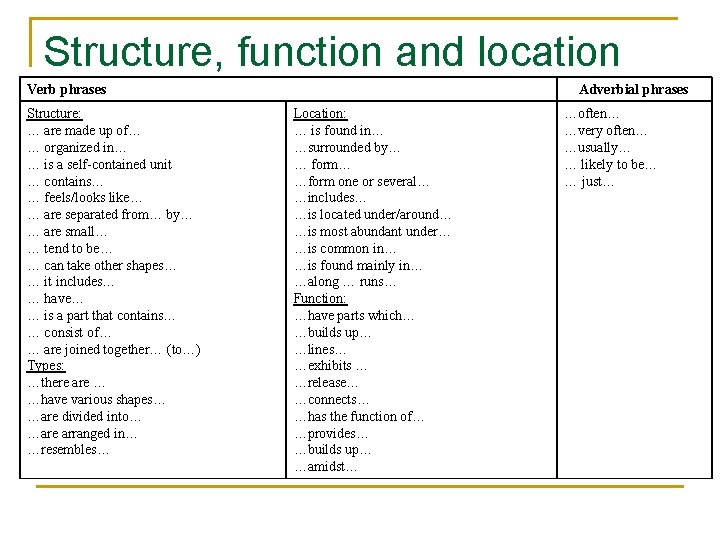
Structure, function and location Verb phrases Structure: … are made up of… … organized in… … is a self-contained unit … contains… … feels/looks like… … are separated from… by… … are small… … tend to be… … can take other shapes… … it includes… … have… … is a part that contains… … consist of… … are joined together… (to…) Types: …there are … …have various shapes… …are divided into… …are arranged in… …resembles… Adverbial phrases Location: … is found in… …surrounded by… … form… …form one or several… …includes… …is located under/around… …is most abundant under… …is common in… …is found mainly in… …along … runs… Function: …have parts which… …builds up… …lines… …exhibits … …release… …connects… …has the function of… …provides… …builds up… …amidst… …often… …very often… …usually… … likely to be… … just…
ball. philip 6@gmail. com ‘Putting CLIL into Practice’ (Ball, Kelly, Clegg); 2015: OUP
Using English ‘…. in order to do something else’ David Graddol, ‘English Next’ (2006) English is no longer a (mere) language. It’s a core skill
LT Objective: Learn the 2 nd Conditional Textbook Topic - Global Warming “If I were President of the World, I would…. ” Assessment criteria are linguistic, not conceptual. Who cares about saving the Earth, as long as I can produce the 2 nd Conditional?
CLIL objective: ‘Save the Earth’ by using the 2 nd Conditional Textbook Topic – ‘Global Warming’ “If I were President of the World, I would…. ” Assessment criteria are conceptual & procedural. (Will our proposals save the Earth? ) The 2 nd Conditional is the vehicle for making these proposals (and saving the world!).
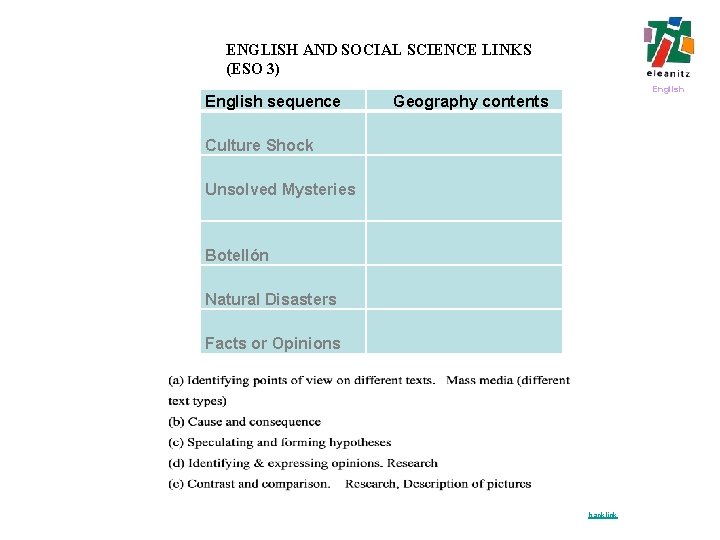
ENGLISH AND SOCIAL SCIENCE LINKS (ESO 3) English sequence Culture Shock Unsolved Mysteries Geography contents Botellón Natural Disasters Facts or Opinions English backlink
English
English
English
English
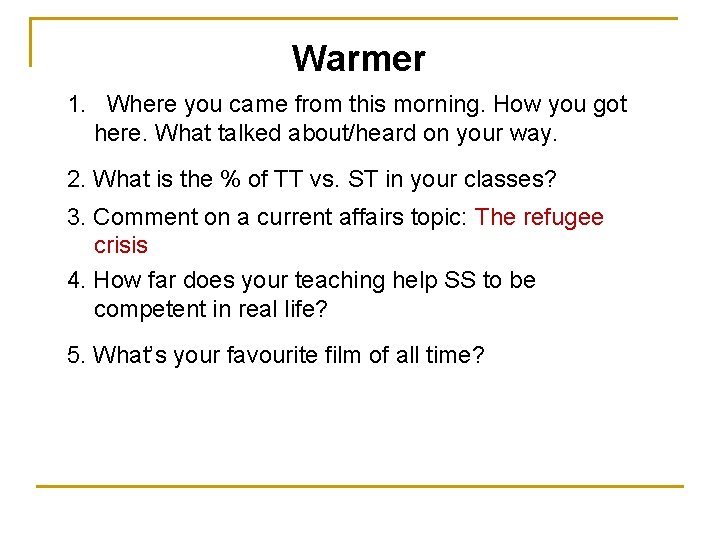
Warmer 1. Where you came from this morning. How you got here. What talked about/heard on your way. 2. What is the % of TT vs. ST in your classes? 3. Comment on a current affairs topic: The refugee crisis 4. How far does your teaching help SS to be competent in real life? 5. What’s your favourite film of all time?
- Slides: 50