
What Are We Learning Objectives By the end
What Are We Learning? Objectives: By the end of this PP you should, ü Watch the video on the nervous system ü Describe the meninges, ventricles and cerebral spinal fluid. ü Analyze the structure of the spinal cord. ü Explain the reflex arc, reflex behavior and tracts of the nervous system. ü Describe the different parts of the brain.
Nervous System Animation Schoolhouse Rock • https: //www. youtube. com/watch? v=ivk_irr H 1 WY 2
Vocabulary • • • CNS Brainstem PNS Meninges Dura mater Arachnoid mater Pia mater Ventricles Cerebral Spinal Fluid choroid plexus arachnoid granulations • • • Spinal Cord Reflex Arc Reflex Behavior Knee-jerk Withdrawal Reflex crossed extensor reflex • Ascending Tracts • Descending Tracts 3
Introduction • The central nervous system (CNS) consists of the brain and spinal cord. • The brainstem connects the brain to the spinal cord. • Communication to the peripheral nervous system (PNS) is by way of the spinal cord. 4
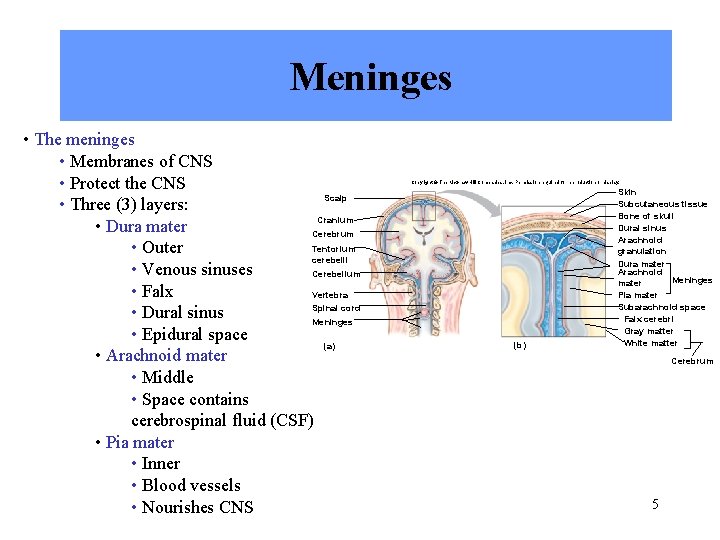
Meninges • The meninges • Membranes of CNS • Protect the CNS Scalp • Three (3) layers: Cranium • Dura mater Cerebrum Tentorium • Outer cerebelli • Venous sinuses Cerebellum • Falx Vertebra Spinal cord • Dural sinus Meninges • Epidural space (a) • Arachnoid mater • Middle • Space contains cerebrospinal fluid (CSF) • Pia mater • Inner • Blood vessels • Nourishes CNS Copyright © The Mc. Graw-Hill Companies, Inc. Permission required for reproduction or display. (b) Skin Subcutaneous tissue Bone of skull Dural sinus Arachnoid granulation Dura mater Arachnoid Meninges mater Pia mater Subarachnoid space Falx cerebri Gray matter White matter Cerebrum 5
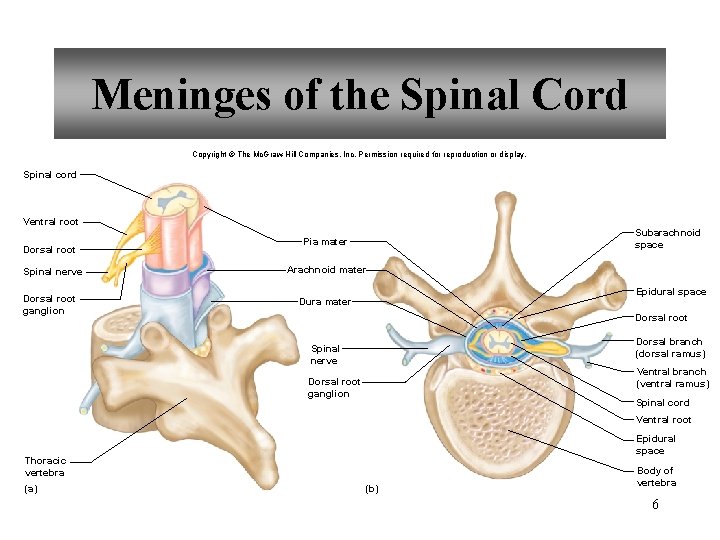
Meninges of the Spinal Cord Copyright © The Mc. Graw-Hill Companies, Inc. Permission required for reproduction or display. Spinal cord Ventral root Dorsal root Spinal nerve Dorsal root ganglion Subarachnoid space Pia mater Arachnoid mater Epidural space Dura mater Dorsal root Dorsal branch (dorsal ramus) Spinal nerve Ventral branch (ventral ramus) Dorsal root ganglion Spinal cord Ventral root Epidural space Thoracic vertebra (a) (b) Body of vertebra 6
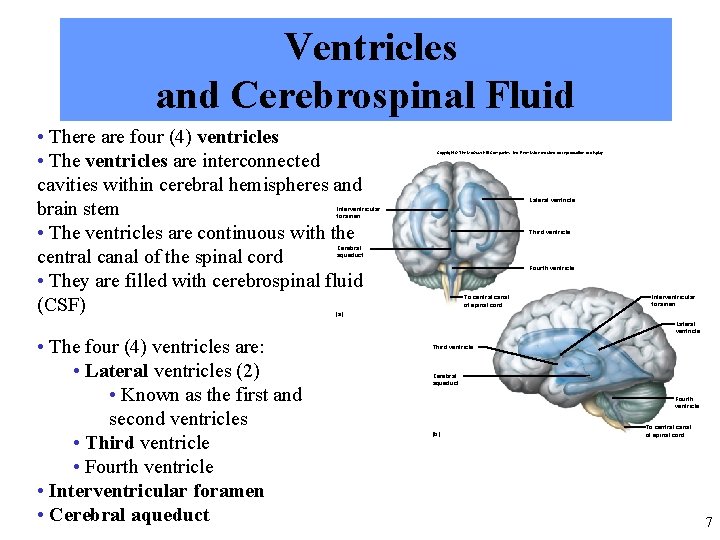
Ventricles and Cerebrospinal Fluid • There are four (4) ventricles • The ventricles are interconnected cavities within cerebral hemispheres and brain stem • The ventricles are continuous with the central canal of the spinal cord • They are filled with cerebrospinal fluid (CSF) Copyright © The Mc. Graw-Hill Companies, Inc. Permission required for reproduction or display. Lateral ventricle Interventricular foramen Third ventricle Cerebral aqueduct Fourth ventricle To central canal of spinal cord Interventricular foramen (a) Lateral ventricle • The four (4) ventricles are: • Lateral ventricles (2) • Known as the first and second ventricles • Third ventricle • Fourth ventricle • Interventricular foramen • Cerebral aqueduct Third ventricle Cerebral aqueduct Fourth ventricle (b) To central canal of spinal cord 7
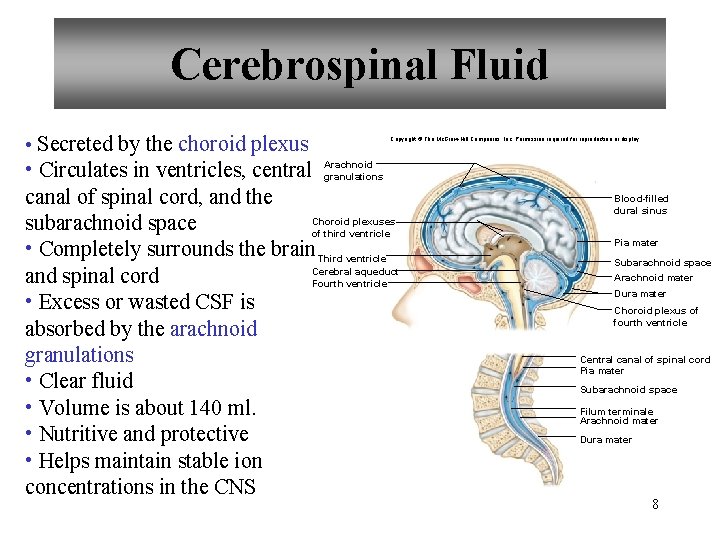
Cerebrospinal Fluid • Secreted by the choroid plexus Copyright © The Mc. Graw-Hill Companies, Inc. Permission required for reproduction or display. • Circulates in ventricles, central Arachnoid granulations canal of spinal cord, and the Choroid plexuses subarachnoid space of third ventricle • Completely surrounds the brain Third ventricle Cerebral aqueduct and spinal cord Fourth ventricle • Excess or wasted CSF is absorbed by the arachnoid granulations • Clear fluid • Volume is about 140 ml. • Nutritive and protective • Helps maintain stable ion concentrations in the CNS Blood-filled dural sinus Pia mater Subarachnoid space Arachnoid mater Dura mater Choroid plexus of fourth ventricle Central canal of spinal cord Pia mater Subarachnoid space Filum terminale Arachnoid mater Dura mater 8
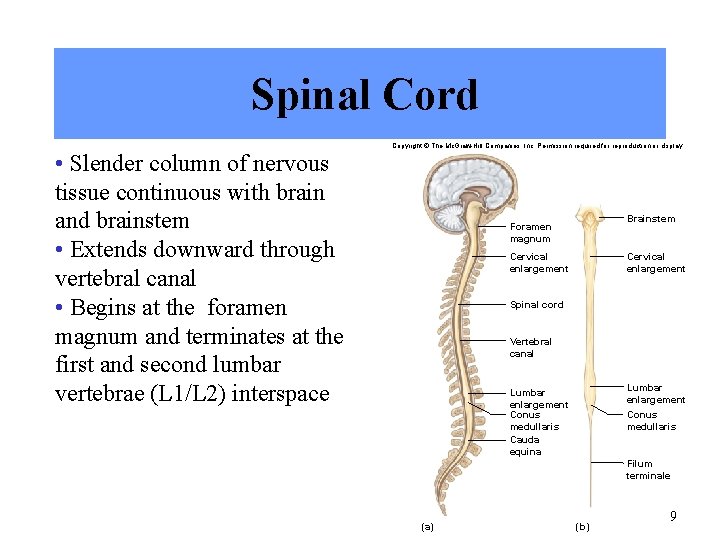
Spinal Cord • Slender column of nervous tissue continuous with brain and brainstem • Extends downward through vertebral canal • Begins at the foramen magnum and terminates at the first and second lumbar vertebrae (L 1/L 2) interspace Copyright © The Mc. Graw-Hill Companies, Inc. Permission required for reproduction or display. Brainstem Foramen magnum Cervical enlargement Spinal cord Vertebral canal Lumbar enlargement Conus medullaris Cauda equina Conus medullaris Filum terminale (a) (b) 9
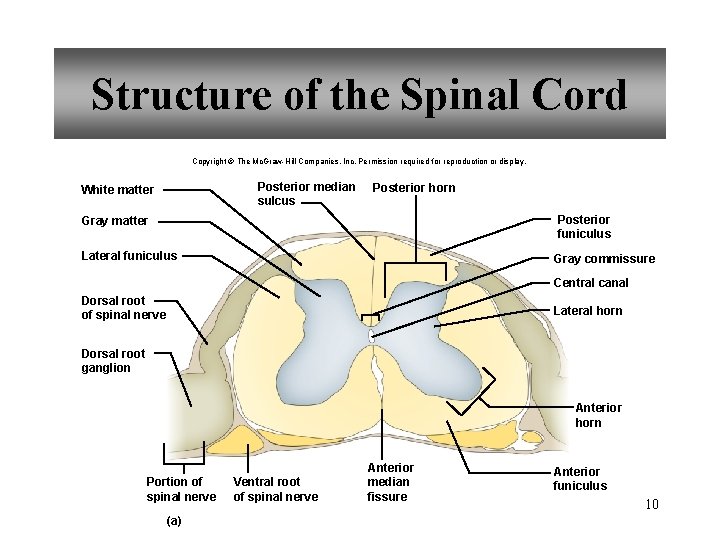
Structure of the Spinal Cord Copyright © The Mc. Graw-Hill Companies, Inc. Permission required for reproduction or display. Posterior median sulcus White matter Posterior horn Posterior funiculus Gray matter Lateral funiculus Gray commissure Central canal Dorsal root of spinal nerve Lateral horn Dorsal root ganglion Anterior horn Portion of spinal nerve (a) Ventral root of spinal nerve Anterior median fissure Anterior funiculus 10
Functions of Spinal Cord • Center for spinal reflexes • Conduit (pathway) for impulses to and from the brain 11
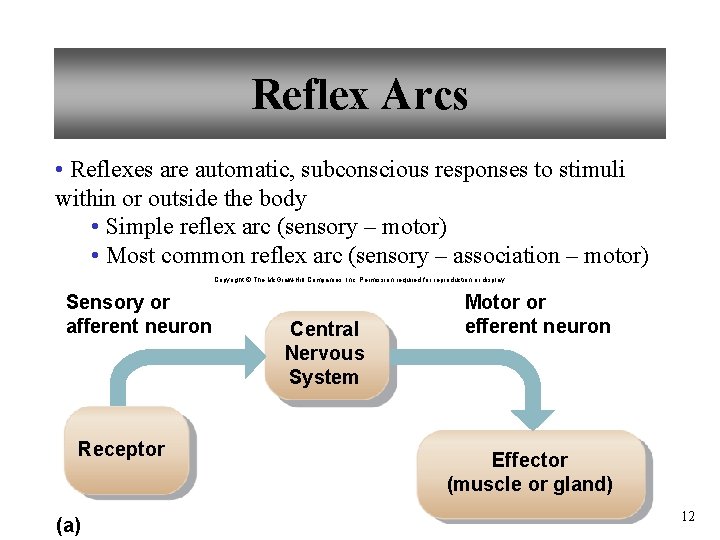
Reflex Arcs • Reflexes are automatic, subconscious responses to stimuli within or outside the body • Simple reflex arc (sensory – motor) • Most common reflex arc (sensory – association – motor) Copyright © The Mc. Graw-Hill Companies, Inc. Permission required for reproduction or display. Sensory or afferent neuron Receptor (a) Central Nervous System Motor or efferent neuron Effector (muscle or gland) 12
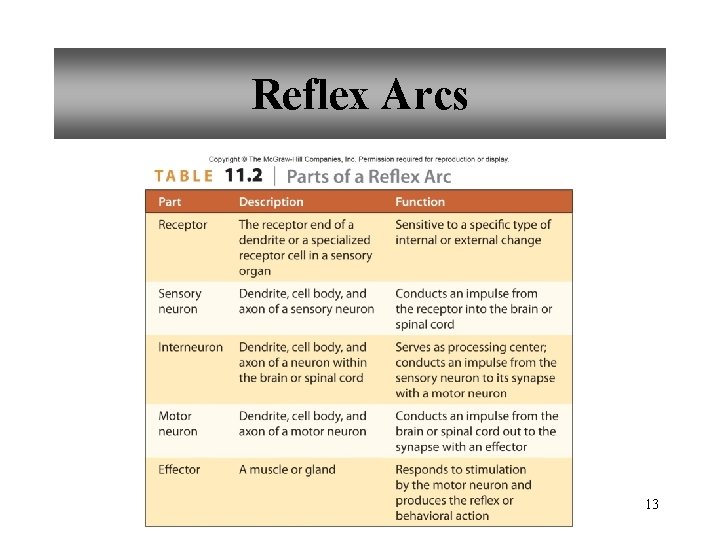
Reflex Arcs 13
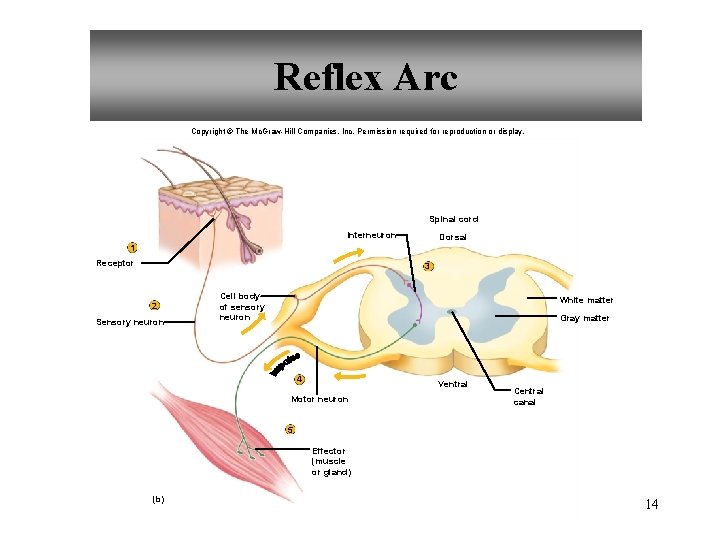
Reflex Arc Copyright © The Mc. Graw-Hill Companies, Inc. Permission required for reproduction or display. Spinal cord Interneuron Dorsal 1 Receptor 3 2 Sensory neuron Cell body of sensory neuron White matter Gray matter 4 Ventral Motor neuron Central canal 5 Effector (muscle or gland) (b) 14
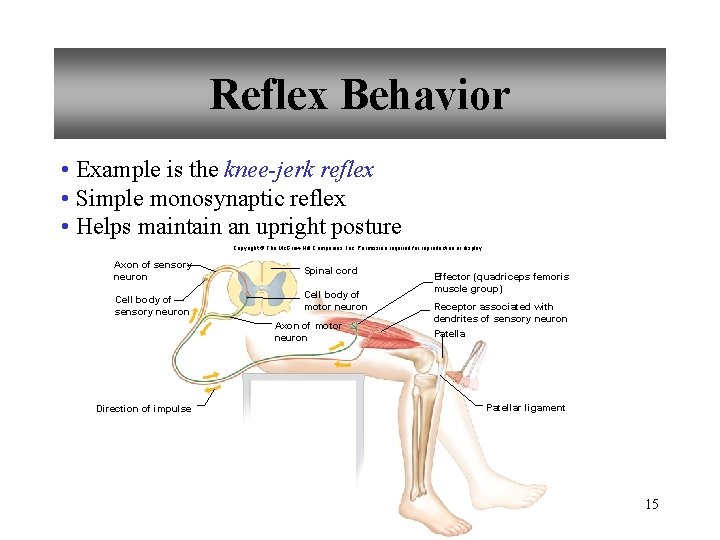
Reflex Behavior • Example is the knee-jerk reflex • Simple monosynaptic reflex • Helps maintain an upright posture Copyright © The Mc. Graw-Hill Companies, Inc. Permission required for reproduction or display. Axon of sensory neuron Cell body of sensory neuron Spinal cord Cell body of motor neuron Axon of motor neuron Direction of impulse Effector (quadriceps femoris muscle group) Receptor associated with dendrites of sensory neuron Patellar ligament 15
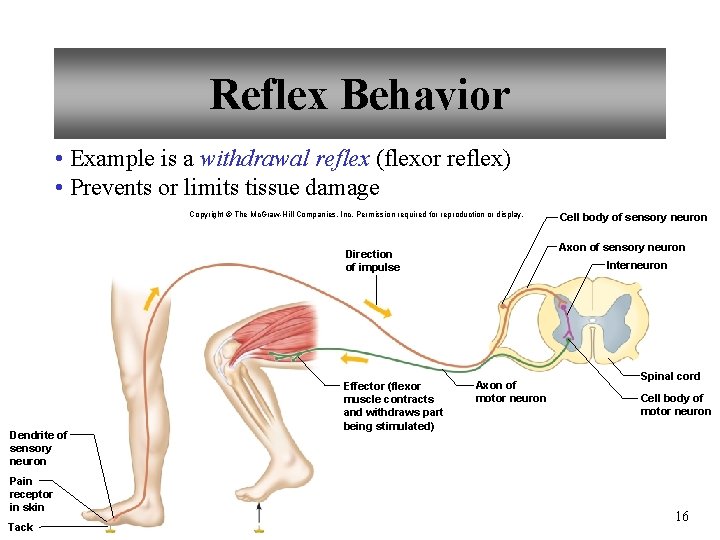
Reflex Behavior • Example is a withdrawal reflex (flexor reflex) • Prevents or limits tissue damage Copyright © The Mc. Graw-Hill Companies, Inc. Permission required for reproduction or display. Axon of sensory neuron Direction of impulse Dendrite of sensory neuron Pain receptor in skin Tack Effector (flexor muscle contracts and withdraws part being stimulated) Cell body of sensory neuron Interneuron Axon of motor neuron Spinal cord Cell body of motor neuron 16
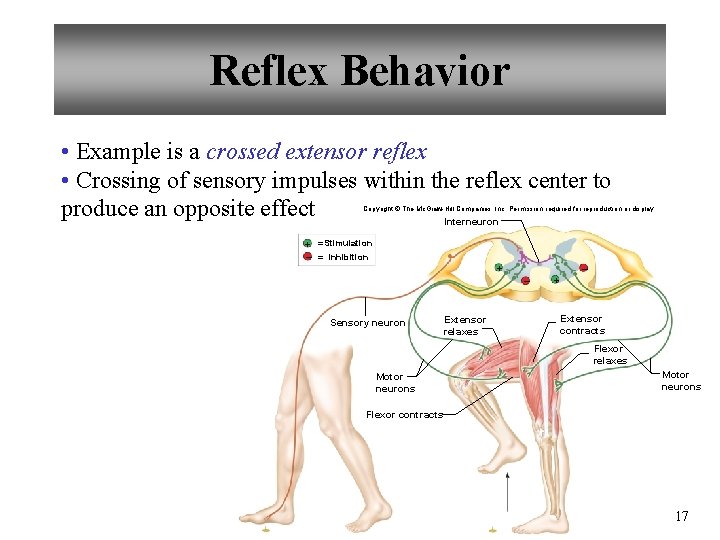
Reflex Behavior • Example is a crossed extensor reflex • Crossing of sensory impulses within the reflex center to produce an opposite effect Interneuron Copyright © The Mc. Graw-Hill Companies, Inc. Permission required for reproduction or display. + =Stimulation – = Inhibition – + – Sensory neuron Extensor relaxes + Extensor contracts Flexor relaxes Motor neurons Flexor contracts 17
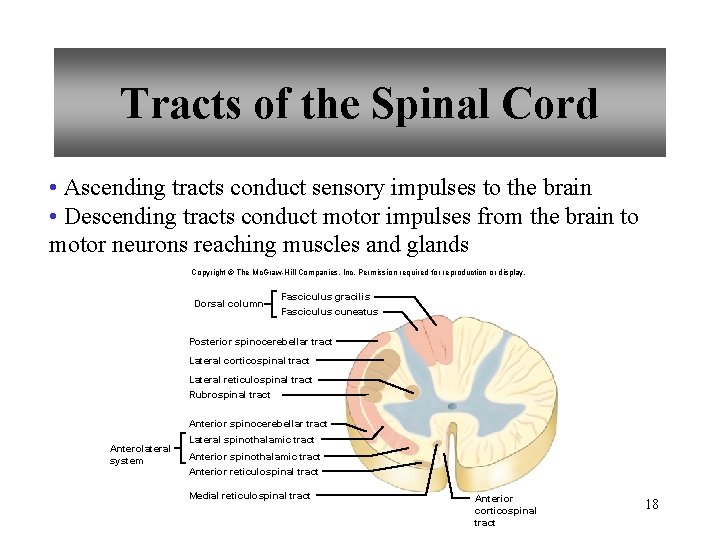
Tracts of the Spinal Cord • Ascending tracts conduct sensory impulses to the brain • Descending tracts conduct motor impulses from the brain to motor neurons reaching muscles and glands Copyright © The Mc. Graw-Hill Companies, Inc. Permission required for reproduction or display. Dorsal column Fasciculus gracilis Fasciculus cuneatus Posterior spinocerebellar tract Lateral corticospinal tract Lateral reticulospinal tract Rubrospinal tract Anterior spinocerebellar tract Anterolateral system Lateral spinothalamic tract Anterior reticulospinal tract Medial reticulospinal tract Anterior corticospinal tract 18
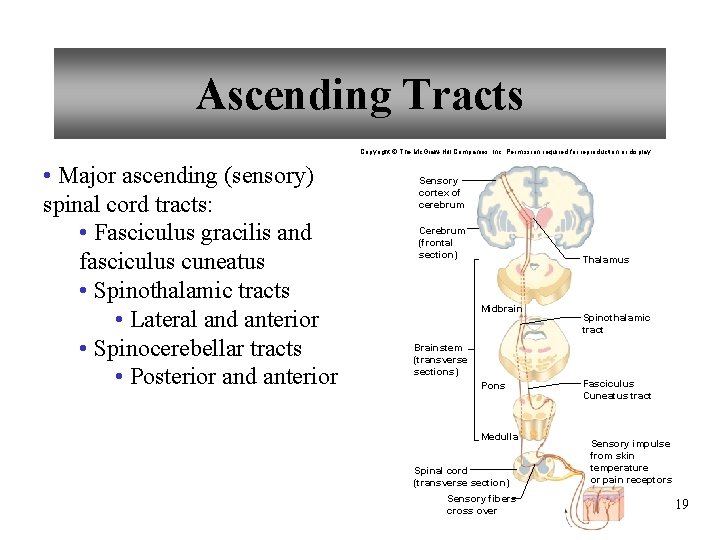
Ascending Tracts Copyright © The Mc. Graw-Hill Companies, Inc. Permission required for reproduction or display. • Major ascending (sensory) spinal cord tracts: • Fasciculus gracilis and fasciculus cuneatus • Spinothalamic tracts • Lateral and anterior • Spinocerebellar tracts • Posterior and anterior Sensory cortex of cerebrum Cerebrum (frontal section) Thalamus Midbrain Spinothalamic tract Brainstem (transverse sections) Pons Medulla Spinal cord (transverse section) Sensory fibers cross over Fasciculus Cuneatus tract Sensory impulse from skin temperature or pain receptors 19
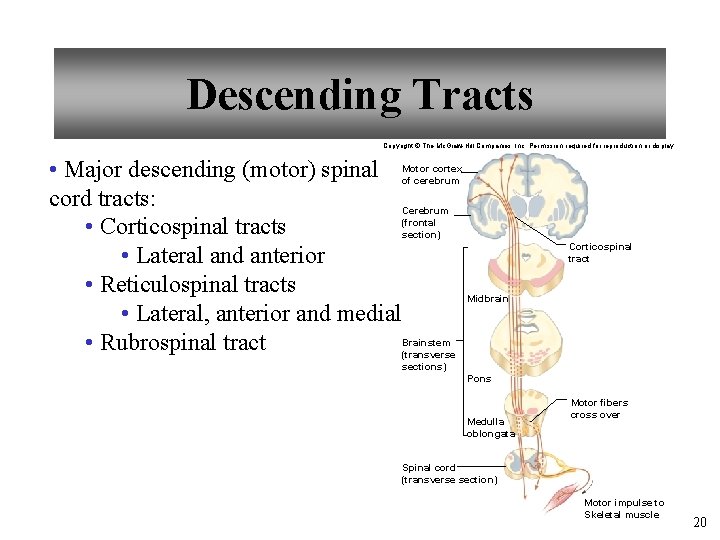
Descending Tracts Copyright © The Mc. Graw-Hill Companies, Inc. Permission required for reproduction or display. cortex • Major descending (motor) spinal Motor of cerebrum cord tracts: Cerebrum (frontal • Corticospinal tracts section) • Lateral and anterior • Reticulospinal tracts Midbrain • Lateral, anterior and medial Brainstem • Rubrospinal tract (transverse Corticospinal tract sections) Pons Medulla oblongata Motor fibers cross over Spinal cord (transverse section) Motor impulse to Skeletal muscle 20
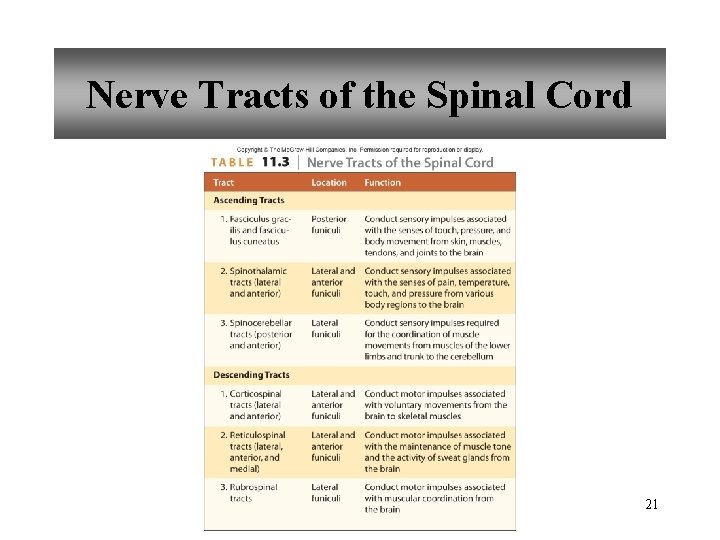
Nerve Tracts of the Spinal Cord 21
The Nervous System, Part 1: Crash Course A&P #8 • https: //www. youtube. com/watch? v=q. Pix_X 9 t 7 E&list=PLK 6 OXn 46 j. YQl. Ui 1 MYIxqc. Sh x 4_6 mf. PZ 6 j&index=1 22
- Slides: 22