
WHAT ARE WE BUYING A brief discussion on
WHAT ARE WE BUYING? A brief discussion on the legal due diligence process Paul W. Griepentrog 1
Goals of legal due diligence • Confirm assumptions underlying the proposed purchase price • Identify potential risks and hurdles to closing • Integration planning • Verify disclosure schedule information 2
Assemble a team • Identify key players • Understand costs – internal time and external fees • Schedule weekly update meetings 3
Build a process • Non-disclosure agreements • Due diligence request list • Data room • Stage the review process • Specialist reviews • Handling sensitive information • Schedule onsite visits • Customer calls and employee visits 4
Report the findings • Written summaries of information review • Identification and proposed resolution of issues • Specific indemnification • Post-closing issue resolution checklist 5
Other concerns • Anti-Trust • Anti-Bribery 6
STRUCTURE OF TRANSACTIONS Richard A. Latta 7
Structure of transactions – common types • Asset purchase • Stock purchase • Other types • • Tax-Free mergers Section 363 Sales in bankruptcy Chapter 128 Sales UCC Article 9 Sales 8
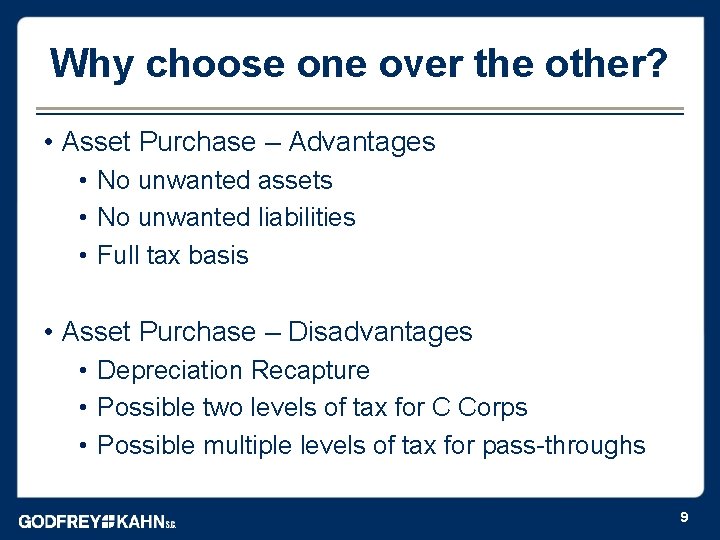
Why choose one over the other? • Asset Purchase – Advantages • No unwanted assets • No unwanted liabilities • Full tax basis • Asset Purchase – Disadvantages • Depreciation Recapture • Possible two levels of tax for C Corps • Possible multiple levels of tax for pass-throughs 9
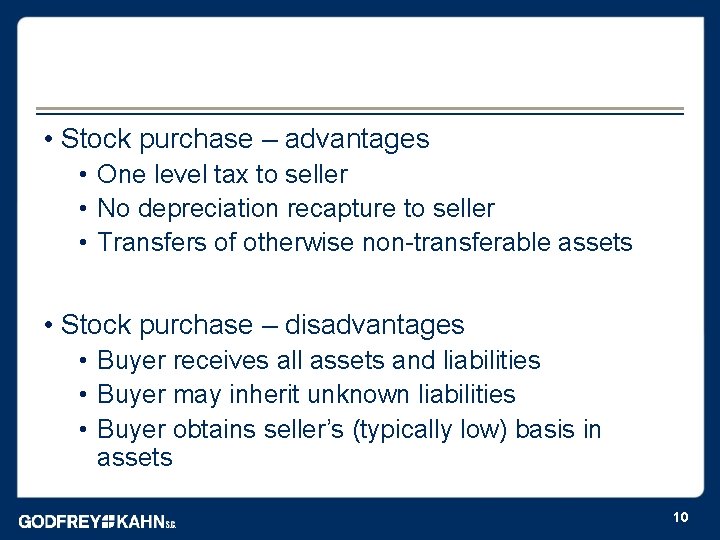
• Stock purchase – advantages • One level tax to seller • No depreciation recapture to seller • Transfers of otherwise non-transferable assets • Stock purchase – disadvantages • Buyer receives all assets and liabilities • Buyer may inherit unknown liabilities • Buyer obtains seller’s (typically low) basis in assets 10
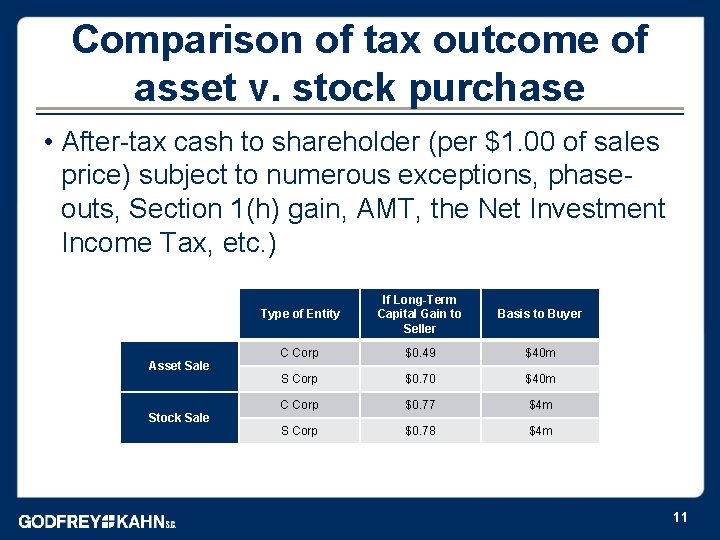
Comparison of tax outcome of asset v. stock purchase • After-tax cash to shareholder (per $1. 00 of sales price) subject to numerous exceptions, phaseouts, Section 1(h) gain, AMT, the Net Investment Income Tax, etc. ) Asset Sale Stock Sale Type of Entity If Long-Term Capital Gain to Seller Basis to Buyer C Corp $0. 49 $40 m S Corp $0. 70 $40 m C Corp $0. 77 $4 m S Corp $0. 78 $4 m 11
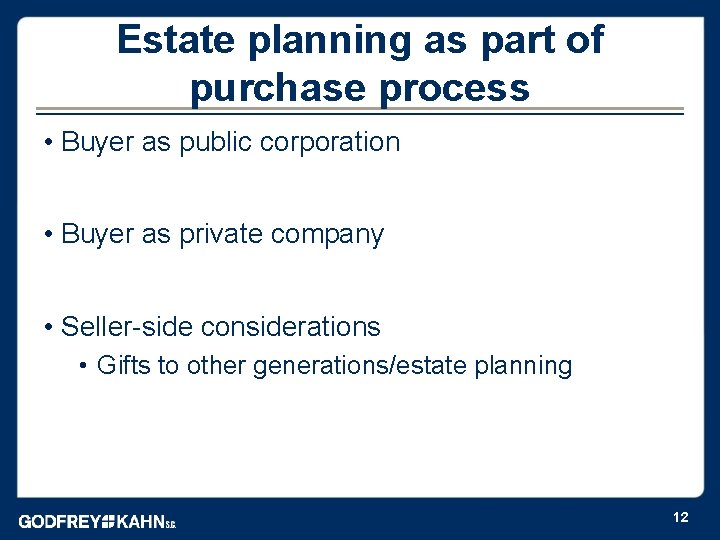
Estate planning as part of purchase process • Buyer as public corporation • Buyer as private company • Seller-side considerations • Gifts to other generations/estate planning 12
• Regulated entities and interaction with regulators • Unique issues created by minority shareholders 13
BENEFIT ISSUES IN ACQUISITIONS Todd M. Cleary 14
Benefits transition approaches • Stock acquisition • Leave target’s plans in place indefinitely • Leave target’s plans in place for period after closing, then terminate and move to buyer’s plans • Require target to terminate its plans prior to closing and bring employees into buyer’s plans 15
Benefits transition approaches • Stock acquisition • If target is participating in plans of another member of selling group, leave employees on those plans until new plans can be established or buyer’s plan can accept them • Consider potential “multiple employer” plan issues • Seller may need to obtain insurance company approval 16
Benefits transition approaches • Asset acquisition • Assume seller’s plans • Bring into buyer’s plans immediately at closing • Pay for COBRA coverage under seller’s plan until new plans can be established • plan likely needs to be held by a member of selling group after closing • not effective for retirement plans or non-medical plans that aren’t subject to COBRA • not effective even for medical plans as to new hires 17
Other transition issues • Nondiscrimination testing for retirement and medical plans • Transition period for retirement plans • Consider whether to require pre-closing termination of target’s 401(k) plan in stock acquisition • 401(k) plan loans may become due • Flexible spending accounts may need to be transitions • COBRA responsibility could flow to buyer 18
Benefits liability concerns • Multiemployer withdrawal liability • Pension plan underfunding • Legal noncompliance of target • Affordable Care Act penalties • Disqualified retirement plans • COBRA and/or HIPAA penalties 14715692 19
CURRENT TRENDS IN M&A Representation and Warranty Insurance (“R&W Insurance”) Danielle M. Machata 20
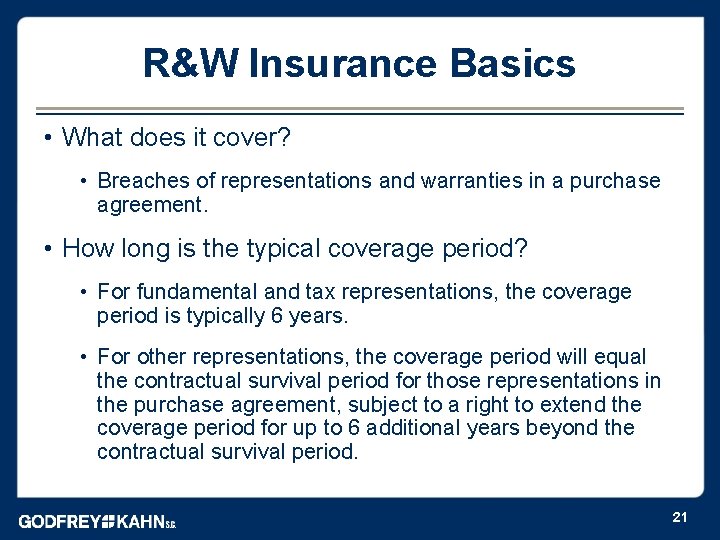
R&W Insurance Basics • What does it cover? • Breaches of representations and warranties in a purchase agreement. • How long is the typical coverage period? • For fundamental and tax representations, the coverage period is typically 6 years. • For other representations, the coverage period will equal the contractual survival period for those representations in the purchase agreement, subject to a right to extend the coverage period for up to 6 additional years beyond the contractual survival period. 21
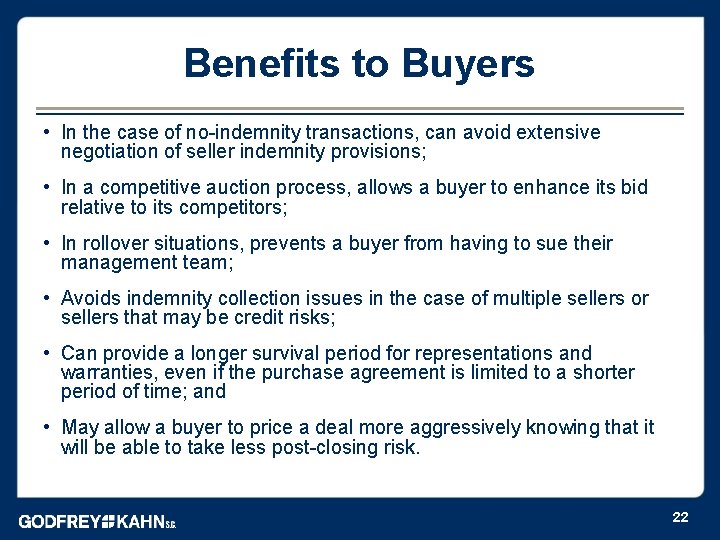
Benefits to Buyers • In the case of no-indemnity transactions, can avoid extensive negotiation of seller indemnity provisions; • In a competitive auction process, allows a buyer to enhance its bid relative to its competitors; • In rollover situations, prevents a buyer from having to sue their management team; • Avoids indemnity collection issues in the case of multiple sellers or sellers that may be credit risks; • Can provide a longer survival period for representations and warranties, even if the purchase agreement is limited to a shorter period of time; and • May allow a buyer to price a deal more aggressively knowing that it will be able to take less post-closing risk. 22
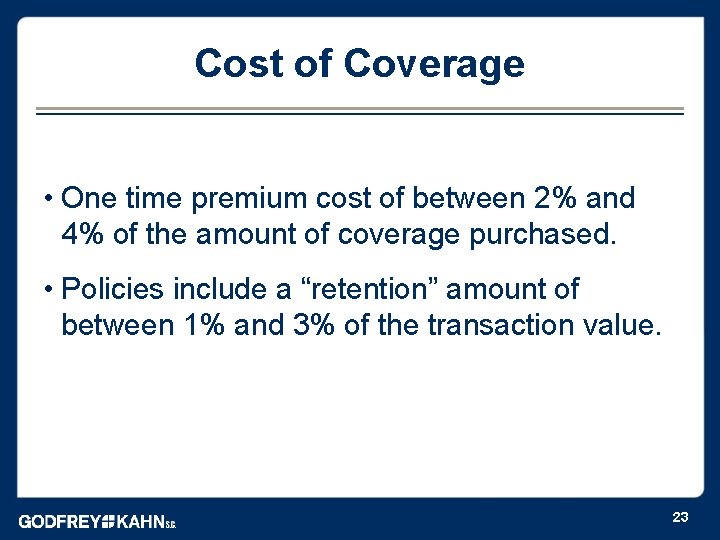
Cost of Coverage • One time premium cost of between 2% and 4% of the amount of coverage purchased. • Policies include a “retention” amount of between 1% and 3% of the transaction value. 23
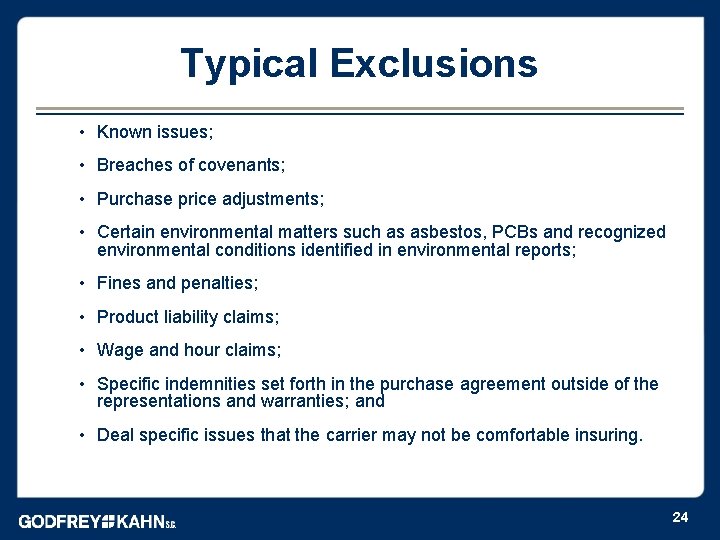
Typical Exclusions • Known issues; • Breaches of covenants; • Purchase price adjustments; • Certain environmental matters such as asbestos, PCBs and recognized environmental conditions identified in environmental reports; • Fines and penalties; • Product liability claims; • Wage and hour claims; • Specific indemnities set forth in the purchase agreement outside of the representations and warranties; and • Deal specific issues that the carrier may not be comfortable insuring. 24

Impact of the Exclusion of Known Issues • A typical response of a seller that is being asked to make broad representations and warranties in a purchase agreement is to prepare a set of disclosure schedules that is equally broad (likely overbroad) and comprehensive. • However, any items set forth in the disclosure schedules will not be covered by the insurance policy. Therefore, the buyer will take one of two strategies: • Refuse to allow certain matters to be set forth on the schedules in fear that they will lead to unanticipated high liability and no coverage; or • Attempt to revise the representations and warranties so that certain information is no longer required to be provided in the disclosure schedule. 25
Impact of the Exclusion of Known Issues • In pushing the removal of items from the schedules that are known exceptions to the warranties, the buyer effectively is telling the seller to give up some of its basket/retention so that the buyer can have access to the policy, which can be very controversial. • If the representations and warranties are revised so that items can be removed from the disclosure schedules, the representations and warranties could become more limited and less useful in shifting the risk to the insurer. • Furthermore, these strategies do not solve the problem that a buyer will be required to deliver a “declaration” to the insurer that states that no member of the buyer’s “deal team” has knowledge of a breach of any of the representations and warranties or that any document or information delivered to the insurer is materially false, incomplete, inaccurate or misleading. 26
Ways to Address Issues Relating to Exclusions • Assess whether a traditional indemnification provision would be better for the transaction at hand. • Try to have the seller agree in the letter of intent that the seller will bear traditional indemnification risk (which would be substantially more than the retention) for all items excluded from the policy. • Before proceeding with extensive due diligence to identify and understand certain risks for which coverage would not otherwise exist, assess whether such additional due diligence will make the buyer more or less protected. 27
Ways to Address Coverage Gaps • Request specific indemnification from the seller, which would provide protection outside of the representations and warranties. • Limit the definition of knowledge in the policy to “actual” knowledge. • Make sure the “deal team” whose knowledge counts is as limited as possible. 28
Definition of Losses • Categories of damages sellers push to exclude from the definition of losses: incidental, consequential, lost profits or revenues, diminution in value, exemplary and punitive damages. • 2013 ABA Deal Points Study - Private Target Mergers and Acquisitions: • The losses that are covered did not specifically mention diminution in value in 69% of all purchase agreements, expressly included diminution in value in 14%, and expressly excluded diminution in value in 17%; • The losses that are covered did not specifically mention incidental damages in 67% of all purchase agreements, expressly included incidental damages in 16% and expressly excluded incidental damages in 17%; and • The losses that are covered did not specifically mention consequential damages in 44% of all purchase agreements, expressly included consequential damages in 2% and expressly excluded consequential damages in 54%. 29
Definition of Losses • The express exclusion of these types of damages in the purchase agreement may prevent the buyer from recovering its actual damages for many of the “worst case scenario” problems intended to be protected under the insurance policy. For example: • Suppose a seller represents to a buyer that the seller’s top customer has agreed in a contract to purchase a certain number of products from the seller over the next 3 years. If that contract is not binding or does not exist, and buyer has excluded lost profits as a measure of damages from the purchase agreement, the buyer would not be able to recover its actual damages for that breach of representation. • Similarly, if the seller’s audited financials drastically overstated earnings, and buyer paid a multiple of earnings for the seller, buyer may have paid a purchase price that was 50% more than the seller’s value but not be able to recover any of these losses under the insurance policy. 30

Takeaways • Typical seller behavior can create problems with your R&W Insurance policy. • R&W Insurance policies contain exclusions from coverage, so a buyer may not be getting all of the protection it thinks it is getting; and • As a result of the exclusions, a buyer may want (or need to) seek specific indemnities from a seller in order to address coverage gaps, leading to disappointed sellers. 31
Thank You OFFICES IN MILWAUKEE, MADISON, WAUKESHA, GREEN BAY AND APPLETON, WISCONSIN AND WASHINGTON, D. C. The presentation and materials are intended to provide information on legal issues and should not be construed as legal advice. In addition, attendance at a Godfrey & Kahn, S. C. presentation does not create an attorney-client relationship. Please consult the speaker if you have any questions concerning the information discussed during this seminar. 14717153 32
- Slides: 32