
What are they Why do we need them

- Slides: 11
What are they? Why do we need them?
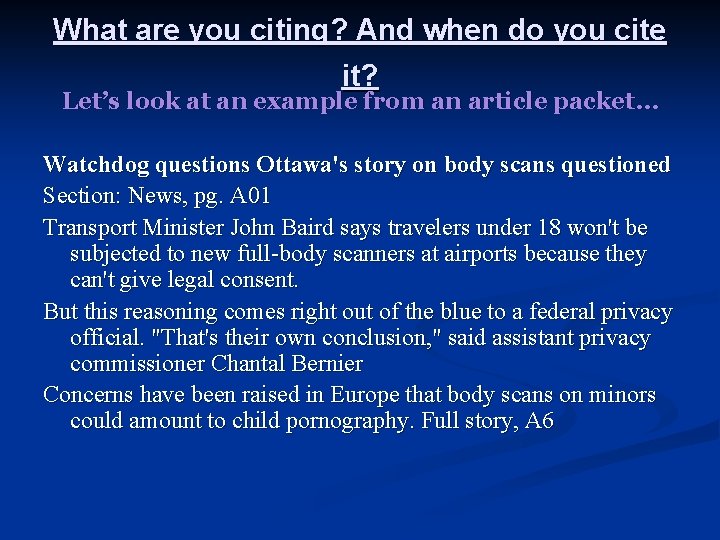
What are you citing? And when do you cite it? Let’s look at an example from an article packet… Watchdog questions Ottawa's story on body scans questioned Section: News, pg. A 01 Transport Minister John Baird says travelers under 18 won't be subjected to new full-body scanners at airports because they can't give legal consent. But this reasoning comes right out of the blue to a federal privacy official. "That's their own conclusion, " said assistant privacy commissioner Chantal Bernier Concerns have been raised in Europe that body scans on minors could amount to child pornography. Full story, A 6
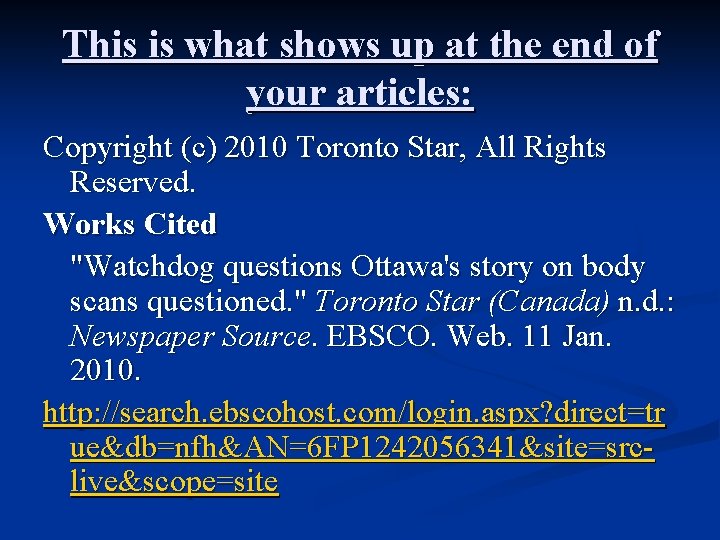
This is what shows up at the end of your articles: Copyright (c) 2010 Toronto Star, All Rights Reserved. Works Cited "Watchdog questions Ottawa's story on body scans questioned. " Toronto Star (Canada) n. d. : Newspaper Source. EBSCO. Web. 11 Jan. 2010. http: //search. ebscohost. com/login. aspx? direct=tr ue&db=nfh&AN=6 FP 1242056341&site=srclive&scope=site
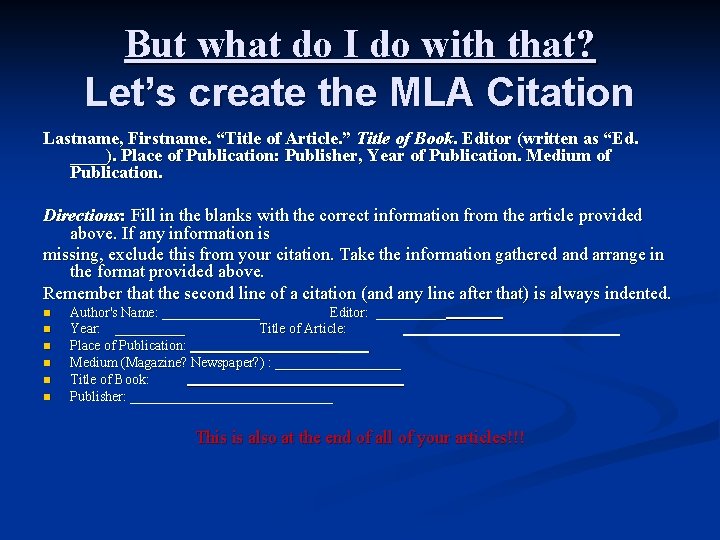
But what do I do with that? Let’s create the MLA Citation Lastname, Firstname. “Title of Article. ” Title of Book. Editor (written as “Ed. ____). Place of Publication: Publisher, Year of Publication. Medium of Publication. Directions: Fill in the blanks with the correct information from the article provided above. If any information is missing, exclude this from your citation. Take the information gathered and arrange in the format provided above. Remember that the second line of a citation (and any line after that) is always indented. n n n Author's Name: _______ Editor: _________ Year: _____ Title of Article: Place of Publication: ___________ Medium (Magazine? Newspaper? ) : _________ Title of Book: Publisher: _______________ This is also at the end of all of your articles!!!
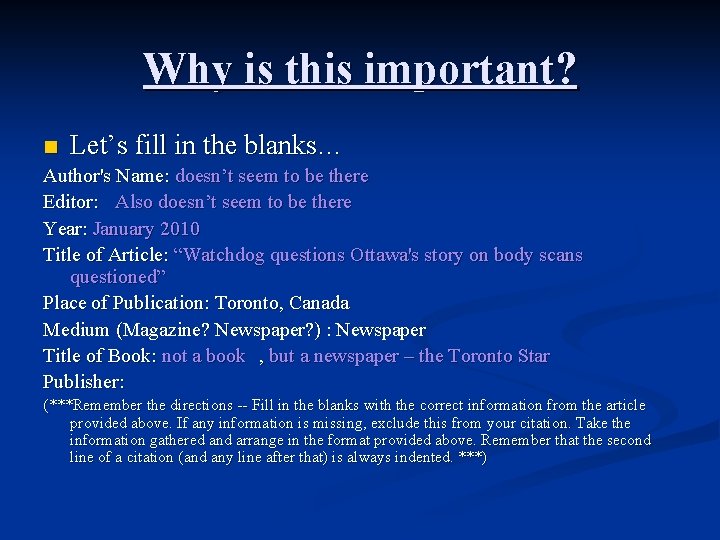
Why is this important? n Let’s fill in the blanks… Author's Name: doesn’t seem to be there Editor: Also doesn’t seem to be there Year: January 2010 Title of Article: “Watchdog questions Ottawa's story on body scans questioned” Place of Publication: Toronto, Canada Medium (Magazine? Newspaper? ) : Newspaper Title of Book: not a book , but a newspaper – the Toronto Star Publisher: (***Remember the directions -- Fill in the blanks with the correct information from the article provided above. If any information is missing, exclude this from your citation. Take the information gathered and arrange in the format provided above. Remember that the second line of a citation (and any line after that) is always indented. ***)
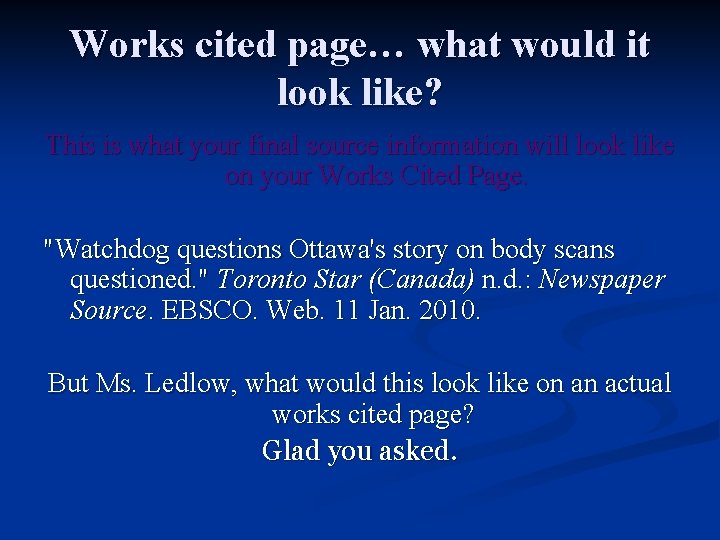
Works cited page… what would it look like? This is what your final source information will look like on your Works Cited Page. "Watchdog questions Ottawa's story on body scans questioned. " Toronto Star (Canada) n. d. : Newspaper Source. EBSCO. Web. 11 Jan. 2010. But Ms. Ledlow, what would this look like on an actual works cited page? Glad you asked.
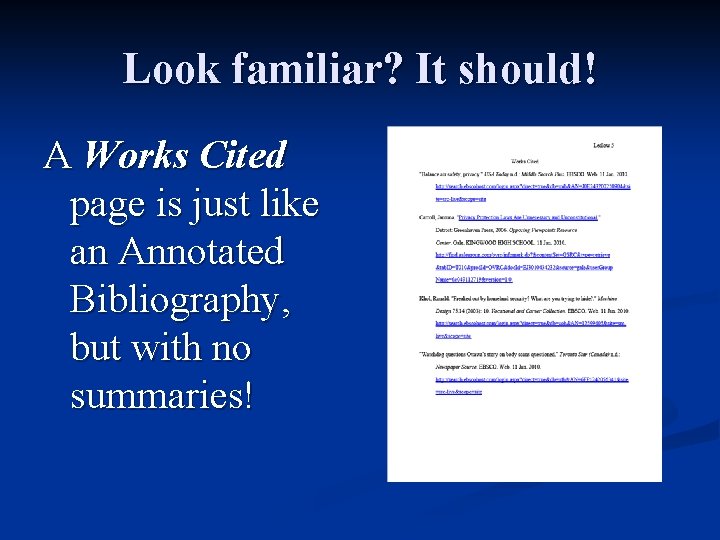
Look familiar? It should! A Works Cited page is just like an Annotated Bibliography, but with no summaries!
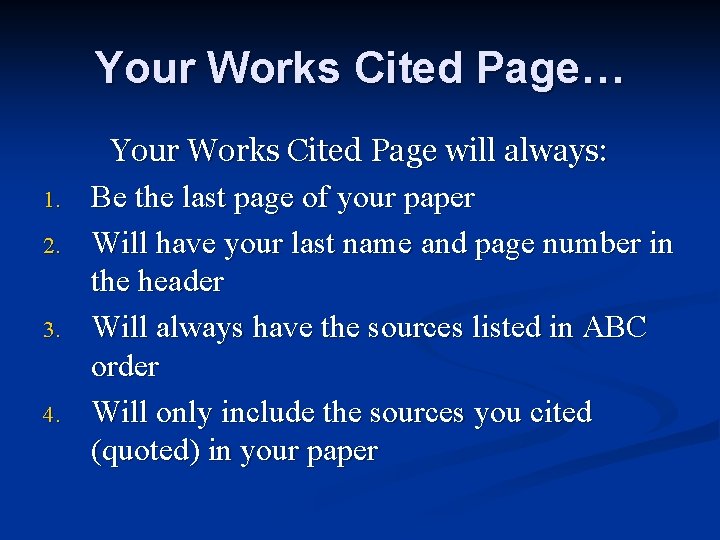
Your Works Cited Page… 1. 2. 3. 4. Your Works Cited Page will always: Be the last page of your paper Will have your last name and page number in the header Will always have the sources listed in ABC order Will only include the sources you cited (quoted) in your paper
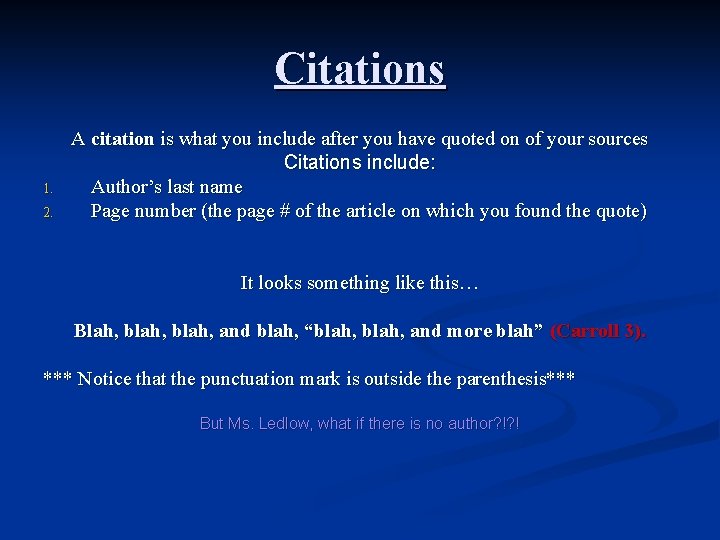
Citations 1. 2. A citation is what you include after you have quoted on of your sources Citations include: Author’s last name Page number (the page # of the article on which you found the quote) It looks something like this… Blah, blah, and blah, “blah, and more blah” (Carroll 3). *** Notice that the punctuation mark is outside the parenthesis*** But Ms. Ledlow, what if there is no author? !? !
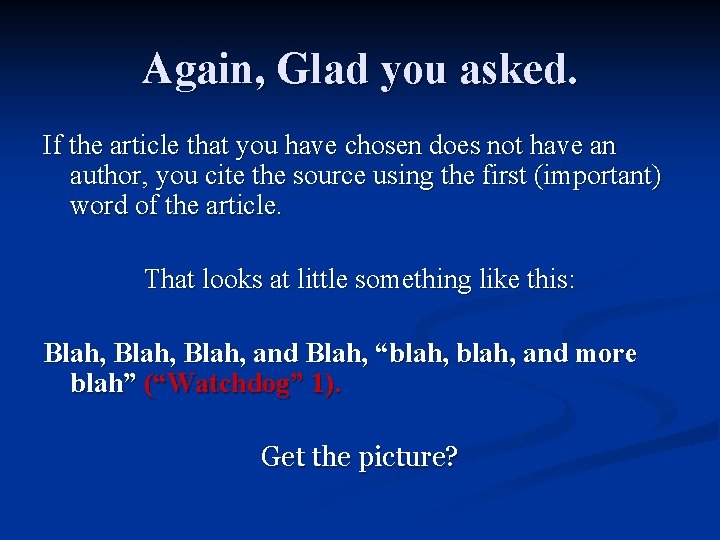
Again, Glad you asked. If the article that you have chosen does not have an author, you cite the source using the first (important) word of the article. That looks at little something like this: Blah, and Blah, “blah, and more blah” (“Watchdog” 1). Get the picture?
GOOD!