
What are the possible causes of climate change
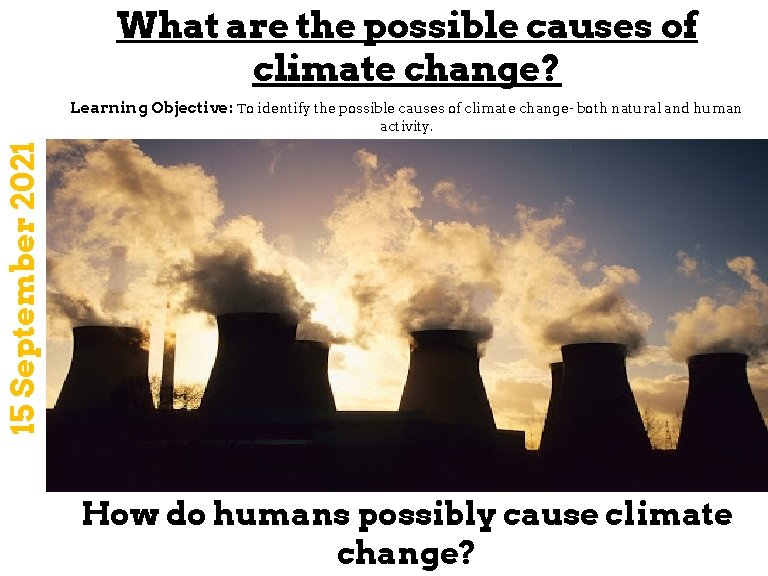
What are the possible causes of climate change? Learning Objective: To identify the possible causes of climate change- both natural and human 15 September 2021 activity. How do humans possibly cause climate change?
Key Terms Sunspot: a spot or dark patch that appears from time to time on the surface of the Sun. It is associated with an outburst of energy. Milankovitch Cycles: the cyclical time periods that relate to the Earth’s orbital changes around the Sun. Global Warming: a trend associated with climate change involving a warming trend (0. 85°C since 1880). Natural Greenhouse Effect: the natural warming of the planet as some of the heat reflected by the Earth is absorbed by liquids and gases in the atmosphere, such as CO 2. Enhanced Greenhouse Effect: the warming of the atmosphere caused by human activities, resulting in the natural greenhouse effect becoming more effective.
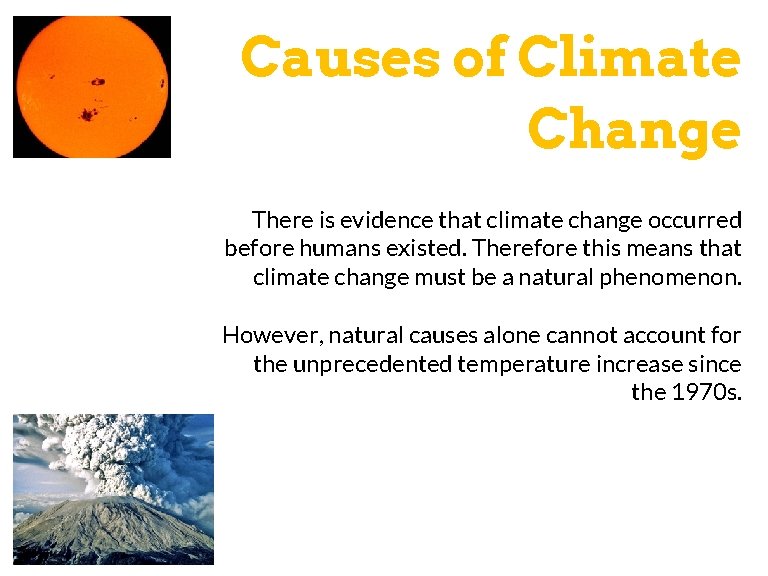
Causes of Climate Change There is evidence that climate change occurred before humans existed. Therefore this means that climate change must be a natural phenomenon. However, natural causes alone cannot account for the unprecedented temperature increase since the 1970 s.

Variations in the Sun’s energy Sunspots are darker patches on the Sun’s surface. They are caused by magnetic activity inside the Sunspots increase from a minimum to a maximum number in a sunspot cycle about every eleven years. Scientists suggest that the more sunspots there are, the more heat is given off by the Sun. However, solar output from the Sun has barely increased in the last 50 years, so can not be responsible for the climate change seen since 1970.
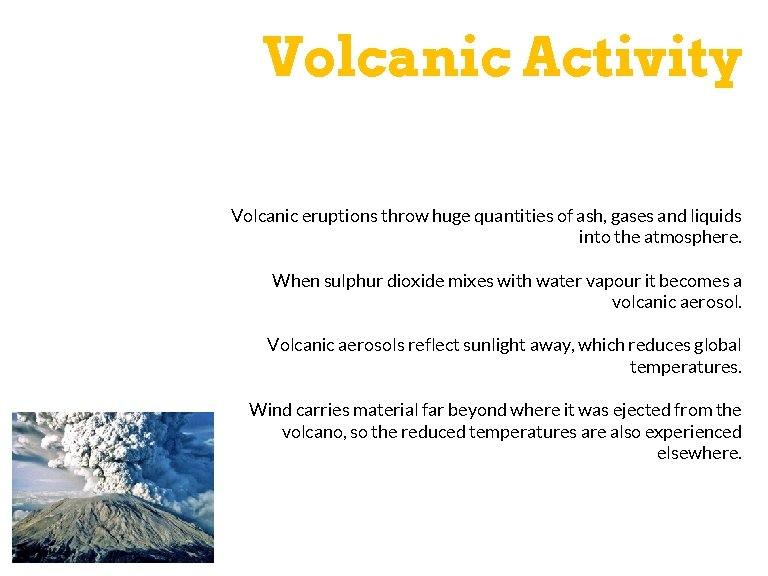
Volcanic Activity Volcanic eruptions throw huge quantities of ash, gases and liquids into the atmosphere. When sulphur dioxide mixes with water vapour it becomes a volcanic aerosol. Volcanic aerosols reflect sunlight away, which reduces global temperatures. Wind carries material far beyond where it was ejected from the volcano, so the reduced temperatures are also experienced elsewhere.
Changes in the Earth’s Orbit The distribution of the Sun’s energy on Earth varies due to changes in the Earth’s orbit. The cyclical time periods that relate to the Earth’s orbital changes around the sun are called Milankovitch cycles. There are three of them: axial title, precession and eccentricity.
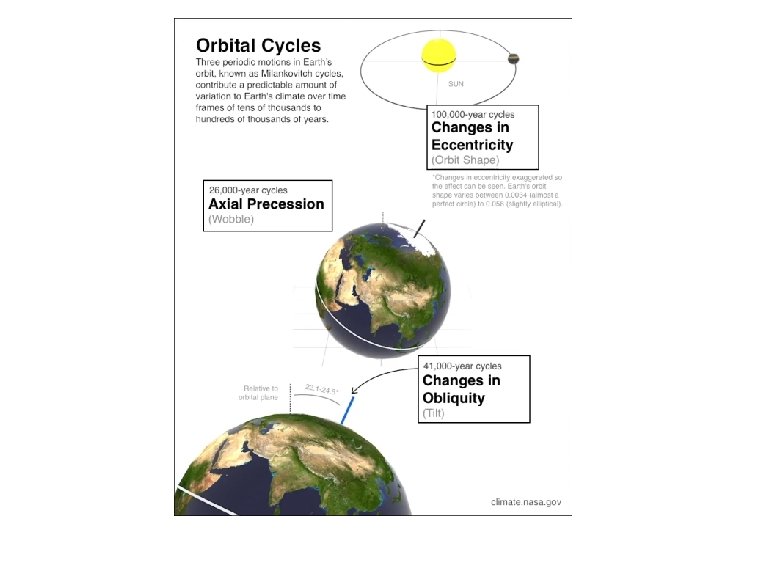
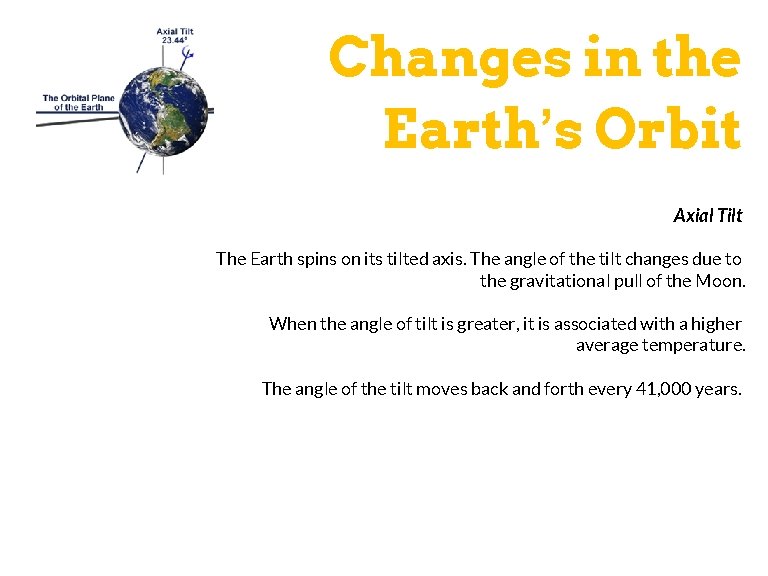
Changes in the Earth’s Orbit Axial Tilt The Earth spins on its tilted axis. The angle of the tilt changes due to the gravitational pull of the Moon. When the angle of tilt is greater, it is associated with a higher average temperature. The angle of the tilt moves back and forth every 41, 000 years.
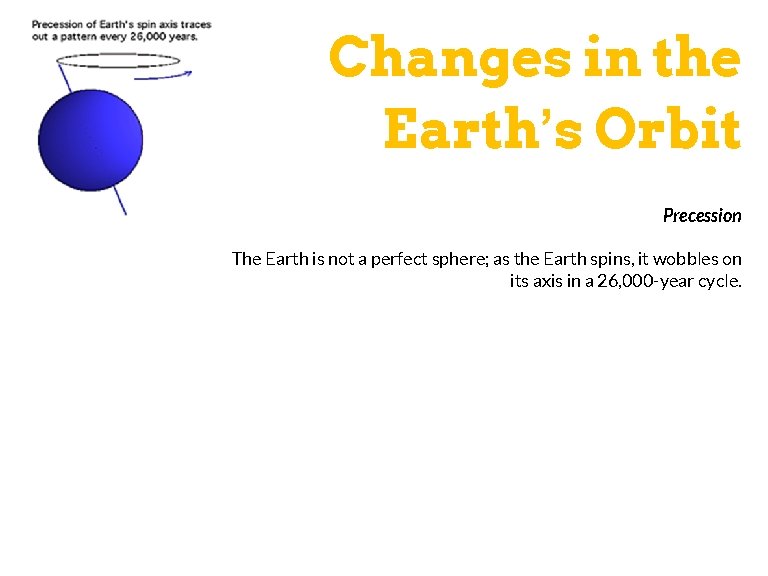
Changes in the Earth’s Orbit Precession The Earth is not a perfect sphere; as the Earth spins, it wobbles on its axis in a 26, 000 -year cycle.
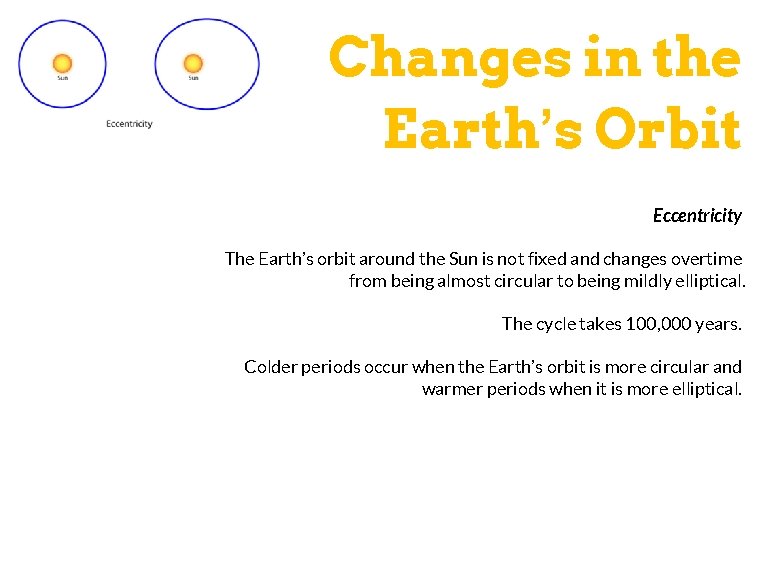
Changes in the Earth’s Orbit Eccentricity The Earth’s orbit around the Sun is not fixed and changes overtime from being almost circular to being mildly elliptical. The cycle takes 100, 000 years. Colder periods occur when the Earth’s orbit is more circular and warmer periods when it is more elliptical.
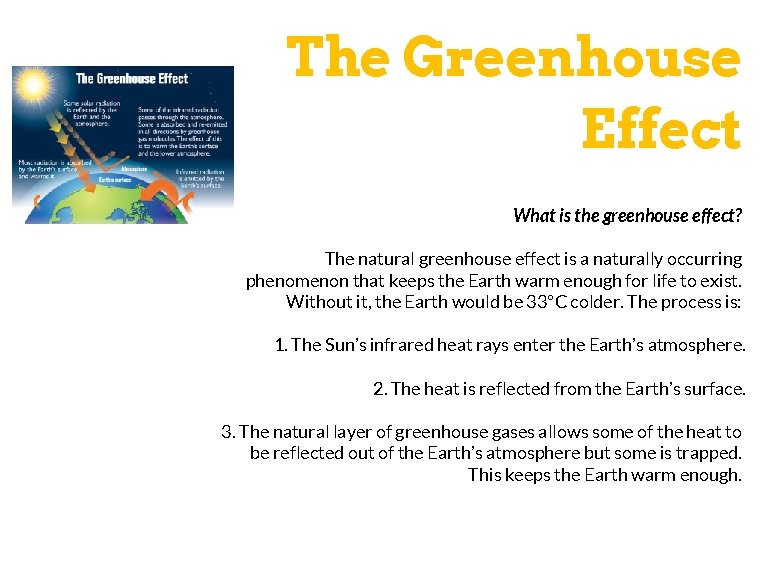
The Greenhouse Effect What is the greenhouse effect? The natural greenhouse effect is a naturally occurring phenomenon that keeps the Earth warm enough for life to exist. Without it, the Earth would be 33°C colder. The process is: 1. The Sun’s infrared heat rays enter the Earth’s atmosphere. 2. The heat is reflected from the Earth’s surface. 3. The natural layer of greenhouse gases allows some of the heat to be reflected out of the Earth’s atmosphere but some is trapped. This keeps the Earth warm enough.
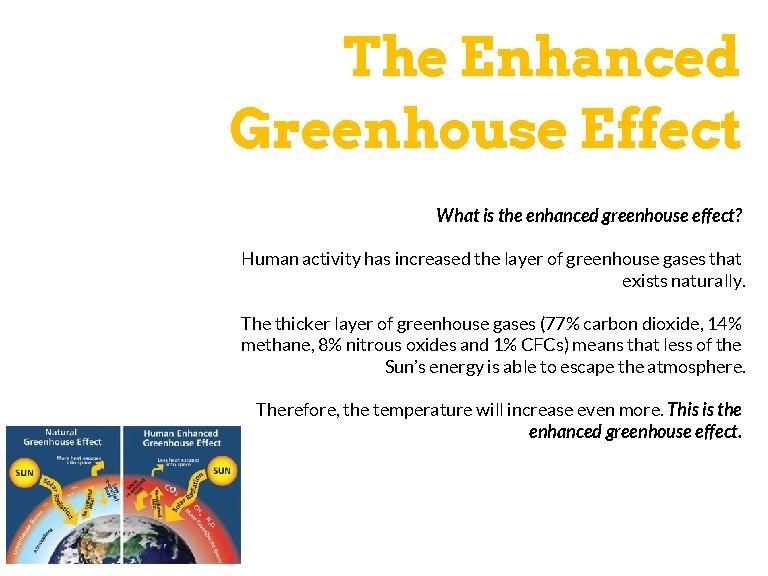
The Enhanced Greenhouse Effect What is the enhanced greenhouse effect? Human activity has increased the layer of greenhouse gases that exists naturally. The thicker layer of greenhouse gases (77% carbon dioxide, 14% methane, 8% nitrous oxides and 1% CFCs) means that less of the Sun’s energy is able to escape the atmosphere. Therefore, the temperature will increase even more. This is the enhanced greenhouse effect.
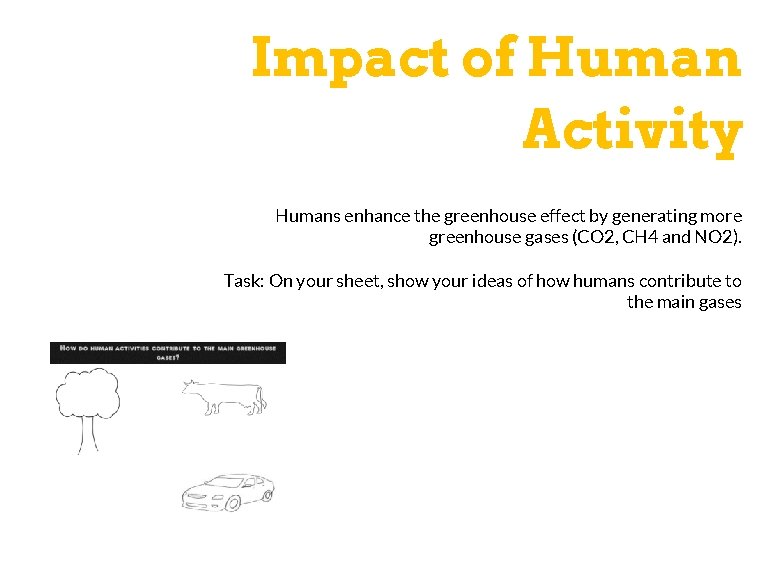
Impact of Human Activity Humans enhance the greenhouse effect by generating more greenhouse gases (CO 2, CH 4 and NO 2). Task: On your sheet, show your ideas of how humans contribute to the main gases
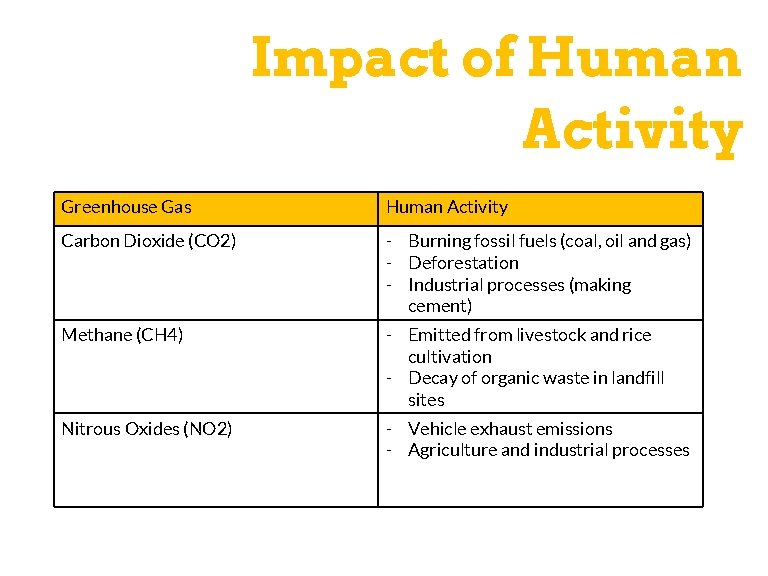
Impact of Human Activity Greenhouse Gas Human Activity Carbon Dioxide (CO 2) - Burning fossil fuels (coal, oil and gas) - Deforestation - Industrial processes (making cement) Methane (CH 4) - Emitted from livestock and rice cultivation - Decay of organic waste in landfill sites Nitrous Oxides (NO 2) - Vehicle exhaust emissions - Agriculture and industrial processes
![Exam Question Explain two natural causes of climate change. [4] 2 x points (causes)](http://slidetodoc.com/presentation_image_h2/ab1716de0d8254bcdd5eddb5593b8d9b/image-16.jpg "Exam Question Explain two natural causes of climate change. [4] 2 x points (causes)")
Exam Question Explain two natural causes of climate change. [4] 2 x points (causes) 2 x developments (how/why)

Resources
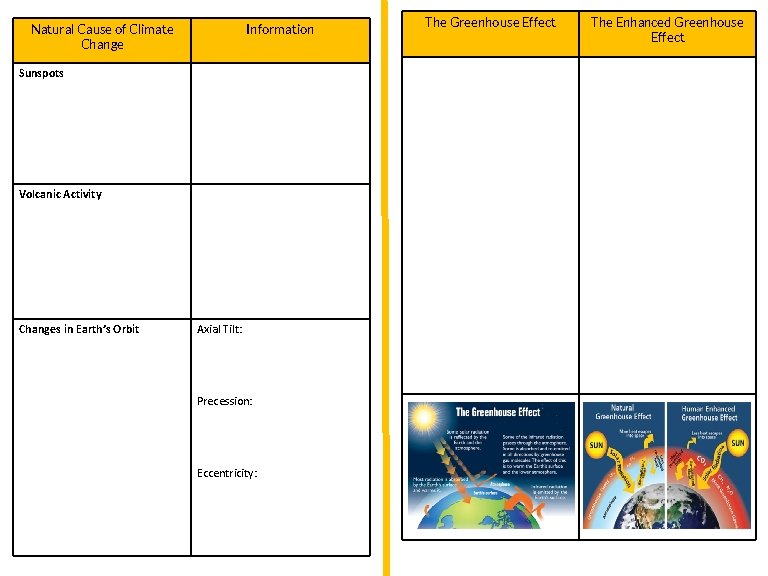
Natural Cause of Climate Change Information Sunspots Volcanic Activity Changes in Earth’s Orbit Axial Tilt: Precession: Eccentricity: The Greenhouse Effect The Enhanced Greenhouse Effect
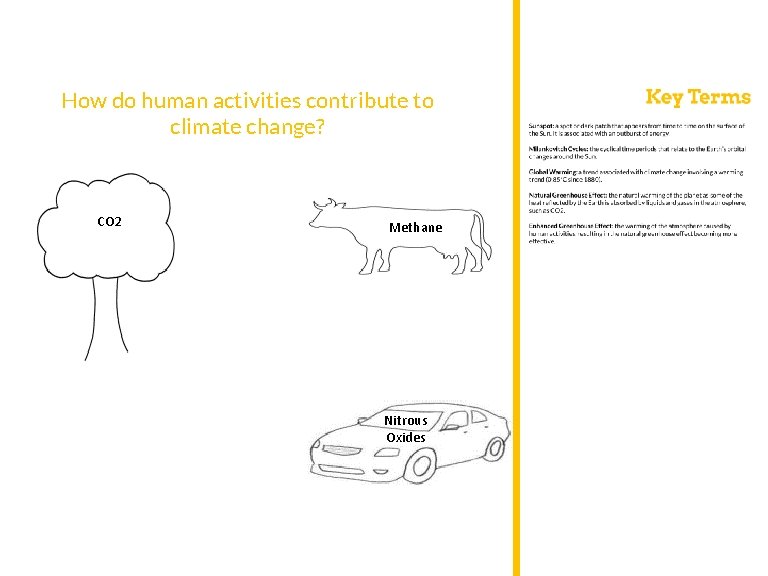
How do human activities contribute to climate change? CO 2 Methane Nitrous Oxides
- Slides: 19