
What are the implications of Chinas changing population



- Slides: 23
What are the implications of China’s changing population?
Getting started With this resource you will be learning about population change and approaches to population management through a detailed case study of China. You’ll need a notepad on which to make notes as you go along, or you could make notes, paste images, etc. on your device. You can view these slides: • as a slide-show for any animations and to follow links • in ‘normal’ view if you want to add call-outs or extra slides to make notes, paste images, answer questions. © Geographical Association, 2021
Population matters – but how and why? You may already have begun to study demography. But how much do you know about why population is an important thing for countries to consider? Make a spider diagram of reasons why population is an important aspect of geography. Population matters © Geographical Association, 2021
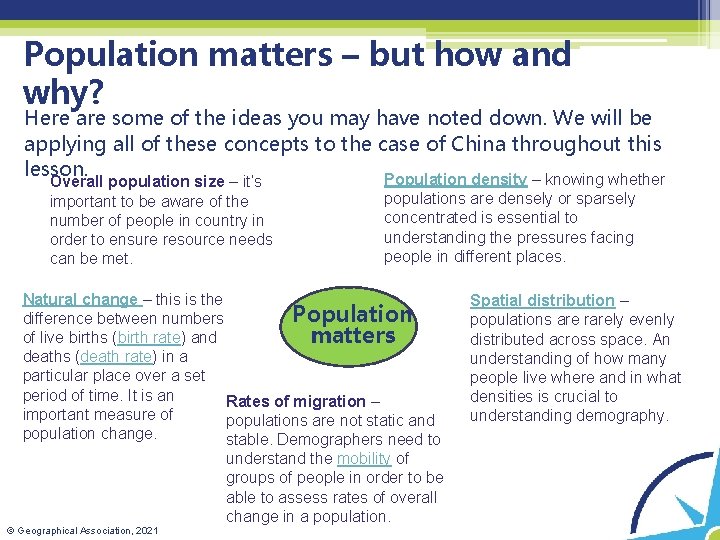
Population matters – but how and why? Here are some of the ideas you may have noted down. We will be applying all of these concepts to the case of China throughout this lesson. Population density – knowing whether Overall population size – it’s important to be aware of the number of people in country in order to ensure resource needs can be met. populations are densely or sparsely concentrated is essential to understanding the pressures facing people in different places. Natural change – this is the Population difference between numbers of live births (birth rate) and matters deaths (death rate) in a particular place over a set period of time. It is an Rates of migration – important measure of populations are not static and population change. stable. Demographers need to © Geographical Association, 2021 understand the mobility of groups of people in order to be able to assess rates of overall change in a population. Spatial distribution – populations are rarely evenly distributed across space. An understanding of how many people live where and in what densities is crucial to understanding demography.
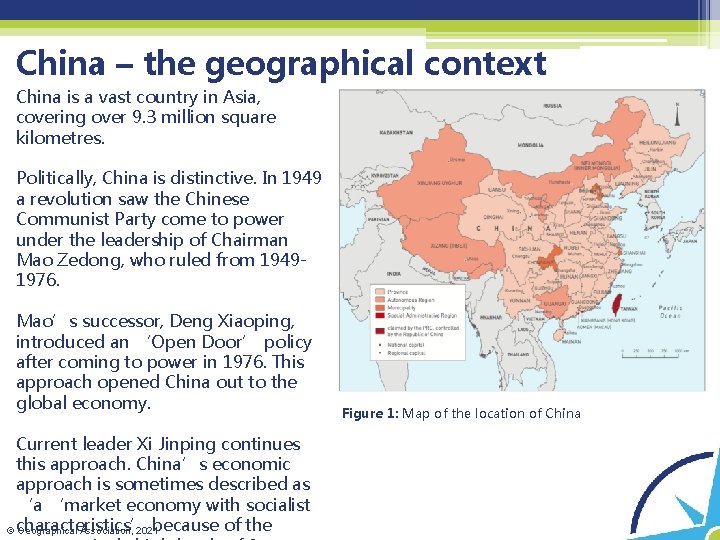
China – the geographical context China is a vast country in Asia, covering over 9. 3 million square kilometres. Politically, China is distinctive. In 1949 a revolution saw the Chinese Communist Party come to power under the leadership of Chairman Mao Zedong, who ruled from 19491976. Mao’s successor, Deng Xiaoping, introduced an ‘Open Door’ policy after coming to power in 1976. This approach opened China out to the global economy. Current leader Xi Jinping continues this approach. China’s economic approach is sometimes described as ‘a ‘market economy with socialist because of the © characteristics’ Geographical Association, 2021 Figure 1: Map of the location of China
China’s demographic context Activity On the next few slides you will find information and activities to help you understand the demographic context of China today. As you read through these slides and complete the activities you should take notes. You may wish to create a mind map using the suggested headings below. China’s demographic background Cultural diversity and the treatment of minorities in China International migration © Geographical Association, 2021 Population during the Mao years China’s population Rural-to-urban migration Later, longer, fewer The One Child Policy China’s Hukuo system
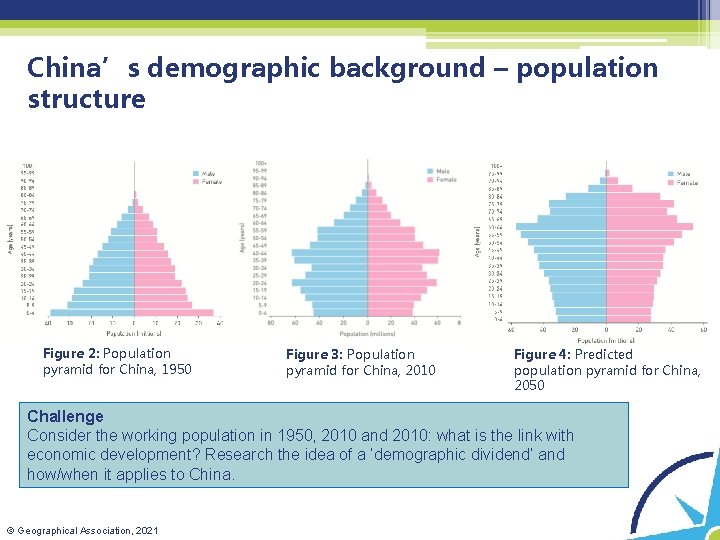
China’s demographic background • China has a population of over 1. 4 billion – that’s almost one fifth of the world’s entire population. • Nevertheless, that is a smaller proportion than in the past. In 1750, when China had a population of 225 million, this was around 28% of the world’s total. • China has had the world’s largest population for centuries, but the UN predicts that India’s population may overtake China’s by 2027. • China’s population structure has changed significantly in recent years. These changes can be seen from studying the population pyramids on the next slide. • The most significant change is in the dependency ratio. Since 2011 this has been increasing, caused mainly by annual increases in 2021 the old-age dependency ratio © Geographical Association, Activities 1. Study the population pyramids on the next slide. Use them to take notes on China’s changing population structure (or you could annotate a copy of the slide). 2. Where possible, try to use the words from the key term list below in your notes: Key terms: youthful population; ageing population; working population; dependency ratio 3. Have you studied the Demographic Transition Model yet? Try to link China’s changing population structure over time to the stages of the model.
China’s demographic background – population structure Figure 2: Population pyramid for China, 1950 Figure 3: Population pyramid for China, 2010 Figure 4: Predicted population pyramid for China, 2050 Challenge Consider the working population in 1950, 2010 and 2010: what is the link with economic development? Research the idea of a ‘demographic dividend’ and how/when it applies to China. © Geographical Association, 2021
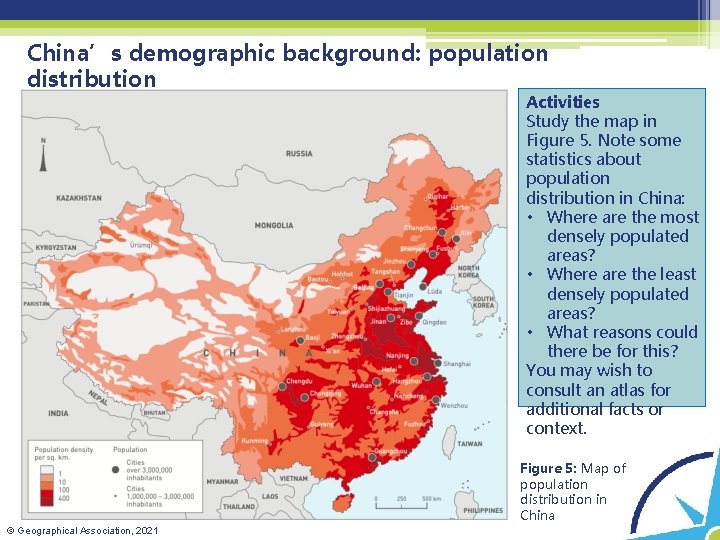
China’s demographic background: population distribution Activities Study the map in Figure 5. Note some statistics about population distribution in China: • Where are the most densely populated areas? • Where are the least densely populated areas? • What reasons could there be for this? You may wish to consult an atlas for additional facts or context. Figure 5: Map of population distribution in China © Geographical Association, 2021
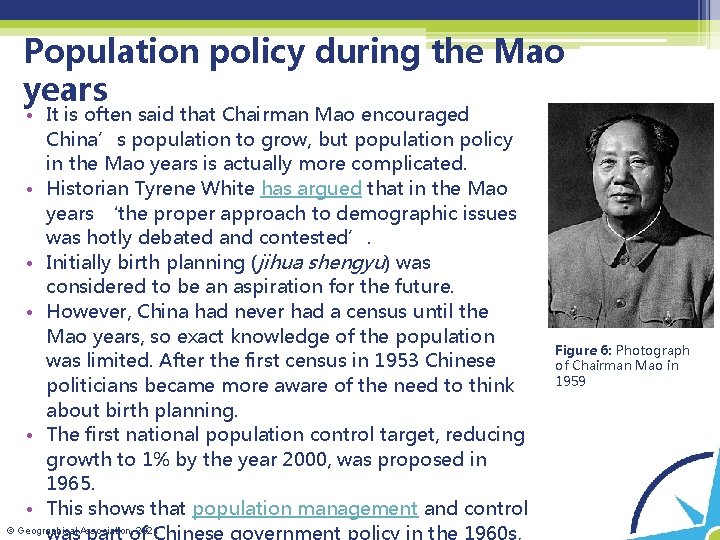
Population policy during the Mao years • It is often said that Chairman Mao encouraged China’s population to grow, but population policy in the Mao years is actually more complicated. • Historian Tyrene White has argued that in the Mao years ‘the proper approach to demographic issues was hotly debated and contested’. • Initially birth planning (jihua shengyu) was considered to be an aspiration for the future. • However, China had never had a census until the Mao years, so exact knowledge of the population was limited. After the first census in 1953 Chinese politicians became more aware of the need to think about birth planning. • The first national population control target, reducing growth to 1% by the year 2000, was proposed in 1965. • This shows that population management and control © Geographical Association, 2021 was part of Chinese government policy in the 1960 s, Figure 6: Photograph of Chairman Mao in 1959
Later, longer, fewer in the 1970 s • In the early 1970 s China introduced a policy approach for birth planning known in English as ‘later, longer, fewer’. • This was an anti-natalist policy that encouraged people to have children at an older age, to leave longer spaces between children, and to aim to have fewer children. • A popular slogan attached to the policy suggested that ‘one is not too few, two is enough, three is too many’. • Family planning was made more accessible and free contraceptives were distributed. • The policy is credited with achieving a significant slowing of China’s population growth rate. In 1970 the Totally Fertility Rate (TFR) was around 3. 3, whereas it had fallen to about 1. 5 in 1978. This was a remarkably low TFR for what was then a developing country. © Geographical Association, 2021 Activity Many people are aware of some of the negative consequences of the One Child Policy, but did you know that some of these negative impacts began with the ‘later, longer, fewer’ campaign? • Read this summary of recent research and add some notes about the negative consequences of ’later, longer, fewer’.
The One Child Policy • The One Child Policy is China’s most famous anti-natalist policy. • The policy was launched by China’s leader Deng Xiaoping in 1979. • Birth permits were required in order to have children, and women had to undergo examinations to see if they were pregnant. • Severe penalties, including fines, sacking and withdrawal of urban residency permits were imposed on those having illegal pregnancies. • In rural areas, where male children were prized culturally as well as for their labour, government officials resorted to forced abortions and sterilisations. • In 1984, following widespread resistance, modifications were made to the policy. Rural families were allowed to have one son or two children if a girl came first. • In 2013 a relaxation of the policy allowed many couples to apply to have a second child. The One Child Policy was officially abandoned on 1 January 2016, with all parents now able to have © Geographical Association, 2021 two children. Activities The One Child Policy is complex, and can best be understood as an intensification of existing anti-natalist policies. 1. First, study the data in this link and add some facts about the impacts of China’s antinatalist policies to your notes. 2. Next, watch this clip on the recent changes to the One Child Policy. 3. Then, read this article summarising recent research into the effects of the policy. 4. Finally, it is important to try to understand how the One Child Policy shaped the lived experiences of Chinese people. Watch Nanfu Wang discuss her experiences.
China’s Hukuo system • This system is a household registration system that has existed for centuries. However, in 1958 Mao’s government made the system an important part of the way China monitored and supported its population. • In more modern times the system has been connected to the welfare system. After 1958 citizens were categorized as living in agricultural or nonagricultural areas. Non-agricultural residents were given access to some benefits that agricultural residents were not. • Non-agricultural residents received benefits including access to more education and better retirement provision. • Recently the system has come under pressure as a result of people moving from the countryside to the cities in China. Rural migrants to cities had less access to work and benefits because of their registration. • Since 2014 reforms to the Hukuo system have tried to remove of the inequalities between urban © Geographical Association, some 2021 Activities In recent years China’s Hukuo system has been criticised. 1. First, watch this video and make notes on the Hukuo system. 2. Read this article and make a list of social and economic disadvantages of the Hukuo system.
Rural-to-urban migration in China • The Hukuo system has come under pressure in recent years because of the enormous scale of internal migration in China since 1978. • Rural-to-urban migration increased once China developed an export-oriented development programme leading to the expansion of manufacturing in cities. • Young people from deprived rural areas moved in large numbers to cities in search of work and better lifestyles. • China now has over 800 million urban residents. That’s around 60% of the population and more than twice the total population of the USA! There are more than 100 cities with populations of more than 1 million. • Urbanisation has also helped China’s economy. A construction boom has stimulated demand for concrete, steel and other goods as well as providing a large number of jobs. • Geographer Chris Hamnett has suggested that Chinese urbanization is unique in world history. © Geographical Association, 2021 Activities Urbanisation in China is an extremely important geographical process. • First, watch this video and note down some facts about it. • Second, read this article and make a table of advantages and disadvantages of urbanisation in China. • Then, read this article on Shenzhen as an example of urbanisation in China. Challenge: Watch this video and answer the question: Why are there ‘ghost cities’ in China?
China and international migration • International migration has become an increasingly important part of Chinese society. • In 2017 it was estimated that there were around 10 million Chinese migrants living overseas. • Meanwhile, in 2017 it was estimated that there were around 1 million overseas immigrants living in China. • These immigrants are not distributed equally across the country. Estimates suggest that around 25% of them live and work in Shanghai, and the vast majority of international migrants live in China’s cities. • Attitudes to overseas migrants in China are not always positive, and allegations of © Geographical Association, 2021 racism towards migrants, especially Activities 1. Read this article and summarise the increasing importance of international migration for China. 2. Then, read this article on racism in China. How do you think this might affect the lived experience of migrants in China?
Cultural diversity and the treatment of minorities in China • Officially there are 56 ethnic groups in China. • However, 92% of the population belongs to one ethnic group – Han Chinese. • Many minority ethnic groups live in border regions where they can maintain their own traditions and customs. • However, the Chinese state is often suspicious of these communities and has put policies in place to respond to their diversity. For example, there has been a policy of planned in-migration of Han Chinese to Xinjiang in north-west China in an attempt to promote social stability. • One example of a minority ethnic group in China is the Uighur people. This community are prominent in Xinjiang. There have been recent allegations that the Chinese government is mistreating this community. © Geographical Association, 2021 Activities Read this article about the Uighur community in Xinjiang. Try to answer these questions: 1. Who are the Uighur people? 2. What has there place in Chinese society been? 3. What allegations have been made about their treatment today?
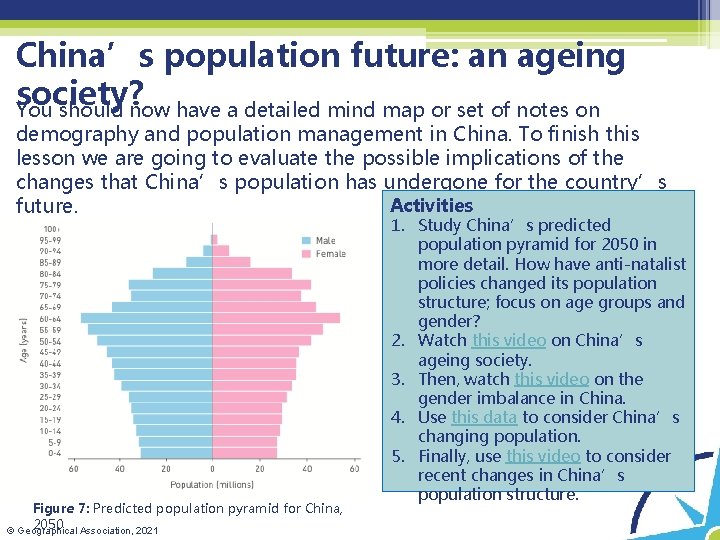
China’s population future: an ageing society? You should now have a detailed mind map or set of notes on demography and population management in China. To finish this lesson we are going to evaluate the possible implications of the changes that China’s population has undergone for the country’s Activities future. Figure 7: Predicted population pyramid for China, 2050 © Geographical Association, 2021 1. Study China’s predicted population pyramid for 2050 in more detail. How have anti-natalist policies changed its population structure; focus on age groups and gender? 2. Watch this video on China’s ageing society. 3. Then, watch this video on the gender imbalance in China. 4. Use this data to consider China’s changing population. 5. Finally, use this video to consider recent changes in China’s population structure.
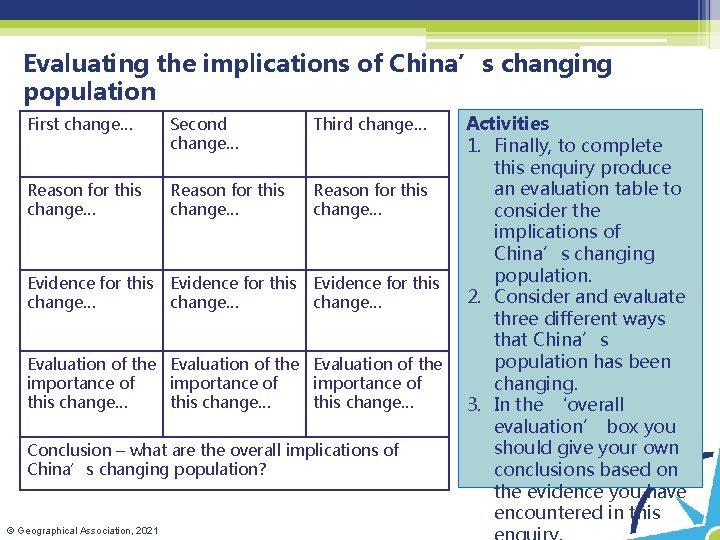
Evaluating the implications of China’s changing population First change… Second change… Third change… Reason for this change… Evidence for this change… Evaluation of the importance of this change… Conclusion – what are the overall implications of China’s changing population? © Geographical Association, 2021 Activities 1. Finally, to complete this enquiry produce an evaluation table to consider the implications of China’s changing population. 2. Consider and evaluate three different ways that China’s population has been changing. 3. In the ‘overall evaluation’ box you should give your own conclusions based on the evidence you have encountered in this
Summary • China has had the world’s largest population for centuries. • Since the 1950 s it has implemented a variety of anti-natalist population policies to try to reduce the birth rate and slow population growth. • These policies have been remarkably successful at reducing the Total Fertility Rate. • However, they have also involved a lot of coercion, including forced abortions and sterilisations. China’s population has also resisted these policies, especially in rural areas. • The major consequence of these anti-natalist policies is that China now faces the prospect of an ageing society, which will lead to many further social and economic changes. • China’s society has also become increasingly unevenly distributed due to high rates of rural-to-urban migration. • This internal migration has put pressure on the Hukuo system, China’s system of household registration. • At the same time, international migration has become an increasingly important part of Chinese society. • There also longstanding concerns about the treatment of ethnic minorities in China, and there have been particularly troubling recent allegations about the treatment of the Uighur peoples in Xinjiang. • Recent changes to the Hukuo system and One Child Policy show that China’s leaders are aware of the importance of population change to their country. © Geographical Association, 2021 • However, it remains unclear how effective these reforms will be, and it is likely that
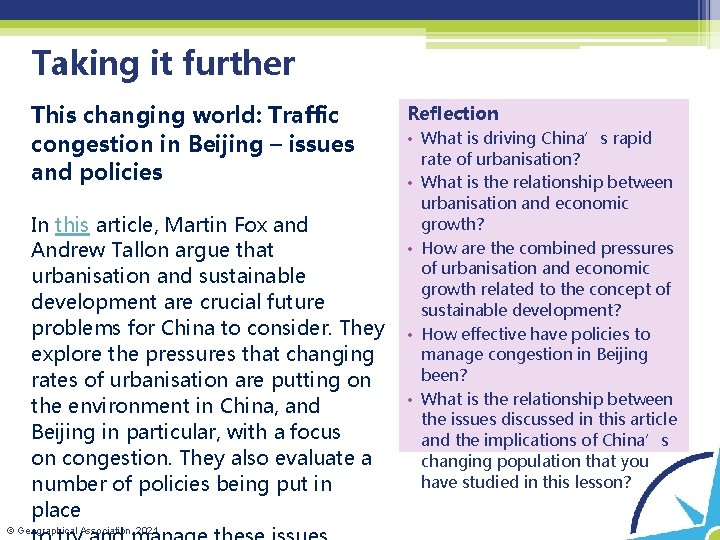
Taking it further This changing world: Traffic congestion in Beijing – issues and policies In this article, Martin Fox and Andrew Tallon argue that urbanisation and sustainable development are crucial future problems for China to consider. They explore the pressures that changing rates of urbanisation are putting on the environment in China, and Beijing in particular, with a focus on congestion. They also evaluate a number of policies being put in place © Geographical Association, 2021 Reflection • What is driving China’s rapid rate of urbanisation? • What is the relationship between urbanisation and economic growth? • How are the combined pressures of urbanisation and economic growth related to the concept of sustainable development? • How effective have policies to manage congestion in Beijing been? • What is the relationship between the issues discussed in this article and the implications of China’s changing population that you have studied in this lesson?
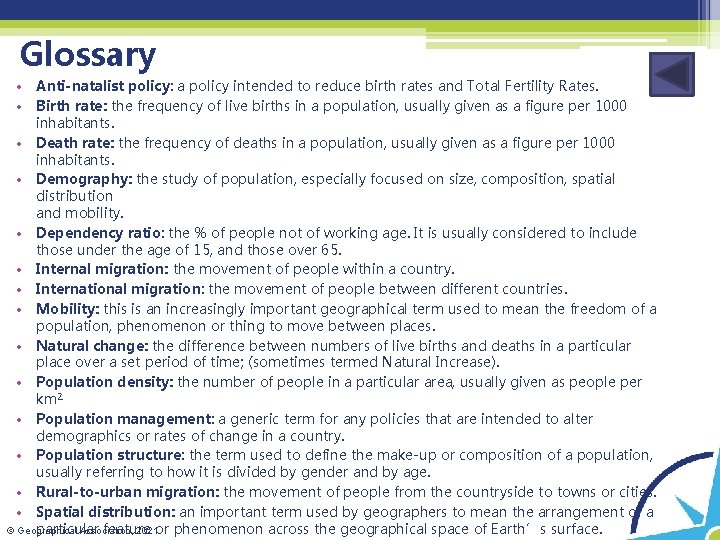
Glossary • Anti-natalist policy: a policy intended to reduce birth rates and Total Fertility Rates. • Birth rate: the frequency of live births in a population, usually given as a figure per 1000 inhabitants. • Death rate: the frequency of deaths in a population, usually given as a figure per 1000 inhabitants. • Demography: the study of population, especially focused on size, composition, spatial distribution and mobility. • Dependency ratio: the % of people not of working age. It is usually considered to include those under the age of 15, and those over 65. • Internal migration: the movement of people within a country. • International migration: the movement of people between different countries. • Mobility: this is an increasingly important geographical term used to mean the freedom of a population, phenomenon or thing to move between places. • Natural change: the difference between numbers of live births and deaths in a particular place over a set period of time; (sometimes termed Natural Increase). • Population density: the number of people in a particular area, usually given as people per km 2. • Population management: a generic term for any policies that are intended to alter demographics or rates of change in a country. • Population structure: the term used to define the make-up or composition of a population, usually referring to how it is divided by gender and by age. • Rural-to-urban migration: the movement of people from the countryside to towns or cities. • Spatial distribution: an important term used by geographers to mean the arrangement of a particular feature © Geographical Association, 2021 or phenomenon across the geographical space of Earth’s surface.
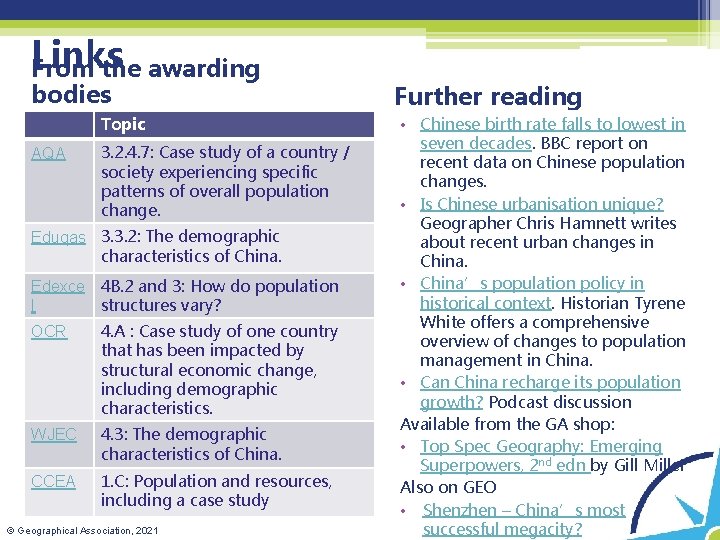
Links From the awarding bodies Topic AQA 3. 2. 4. 7: Case study of a country / society experiencing specific patterns of overall population change. Eduqas 3. 3. 2: The demographic characteristics of China. Edexce l 4 B. 2 and 3: How do population structures vary? OCR 4. A : Case study of one country that has been impacted by structural economic change, including demographic characteristics. WJEC 4. 3: The demographic characteristics of China. CCEA 1. C: Population and resources, including a case study © Geographical Association, 2021 Further reading • Chinese birth rate falls to lowest in seven decades. BBC report on recent data on Chinese population changes. • Is Chinese urbanisation unique? Geographer Chris Hamnett writes about recent urban changes in China. • China’s population policy in historical context. Historian Tyrene White offers a comprehensive overview of changes to population management in China. • Can China recharge its population growth? Podcast discussion Available from the GA shop: • Top Spec Geography: Emerging Superpowers, 2 nd edn by Gill Miller Also on GEO • Shenzhen – China’s most successful megacity?
Acknowledgements This presentation has been written by Daniel Whittall, teacher of Geography at Trinity Sixth Form Academy. Figures • Slide 5, 8, 9 and 16: Figures 1, 2, 3 and 4 and 5 all taken from Emerging superpowers: India and China, by Gill Miller. Published by the Geographical Association in 2018. • Slide 9: Figure 5 taken from Wikipedia, https: //en. wikipedia. org/wiki/Mao_Zedong © Geographical Association, 2021