
What are the Conditions of Excellence in Education

- Slides: 30
What are the Conditions of Excellence in Education? n n n Student Involvement High Expectations Assessment & Feedback 1
What are the Characteristics of Highly Respected Courses? n n n Rapid/Immediate Feedback Detailed Feedback Frequent Evaluation 2
What are Classroom Assessment Techniques (CATS)? Use of small-scale data gathering techniques conducted continuously by teachers to determine what students are learning in a given class Low Threshold Activities 3
What are the Characteristics of CATS? n n n n usually ungraded anonymous learner centered teacher directed mutually beneficial formative context-specific ongoing 4
Potential Impact of CATs n n n Find out what and how your students are thinking n Clarify your goals for your course or class session Obtain information for class session design n Get feedback to make midcourse corrections n Become exposed to how students learn your discipline and identify means to respond to different learning styles n Increase active and cooperative learning n Change the classroom norms for asking questions and admitting deficiencies in understanding Help students become selfaware of their learning Allow students to make midcourse corrections Push students to take their knowledge further Leave behind a trail of information that can be use for post-course improvement (for students and teacher) 5
What are the Working Assumptions of Classroom Assessment? n goals & objectives are explicit and public n students need appropriate and focused feedback n question generated by faculty about own teaching n doesn’t require specialized training n collaboration enhances design & outcome 6
Five Dimensions of Learning n n n Declarative Learning (What) Procedural Learning (How) Conditional Learning (When & Where) Reflective Learning (Why) Metacognitive Learning (How to Learn) 7
Three Key Learning Principles n. Prior Knowledge: Students construct new knowledge based on what they already know (or don’t know). n. Deep Foundational Knowledge: Students need a deep knowledge base and conceptual frameworks. n. Metacognition: Students must identify learning goals and monitor their progress toward them. Bransford, J. , Brown, A. , & Cocking, R. (Eds. ). (1999). How people learn: Brain, mind, experience, and school. Washington, DC: National Academy Press. 8
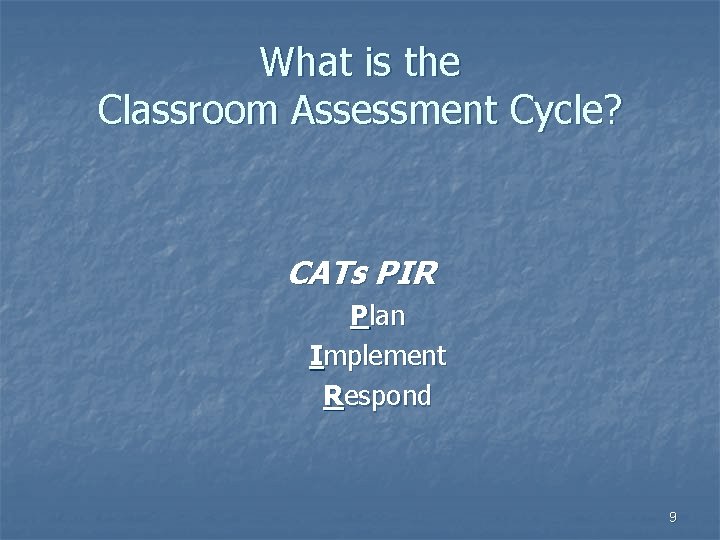
What is the Classroom Assessment Cycle? CATs PIR Plan Implement Respond 9
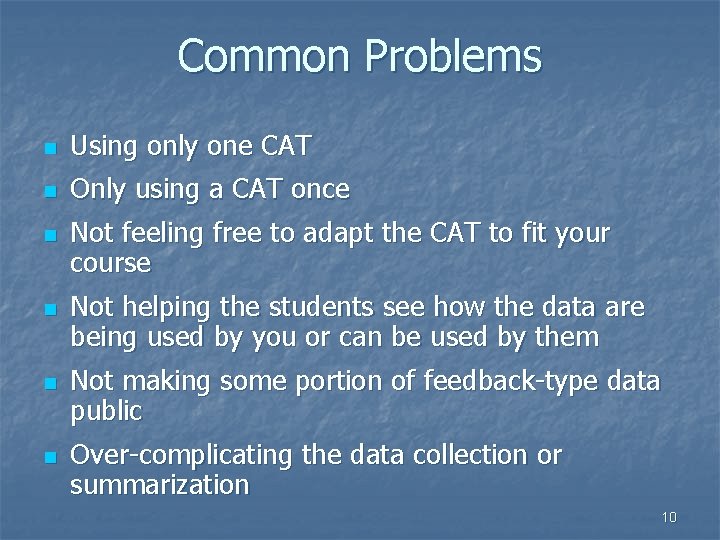
Common Problems n Using only one CAT n Only using a CAT once n n Not feeling free to adapt the CAT to fit your course Not helping the students see how the data are being used by you or can be used by them Not making some portion of feedback-type data public Over-complicating the data collection or summarization 10
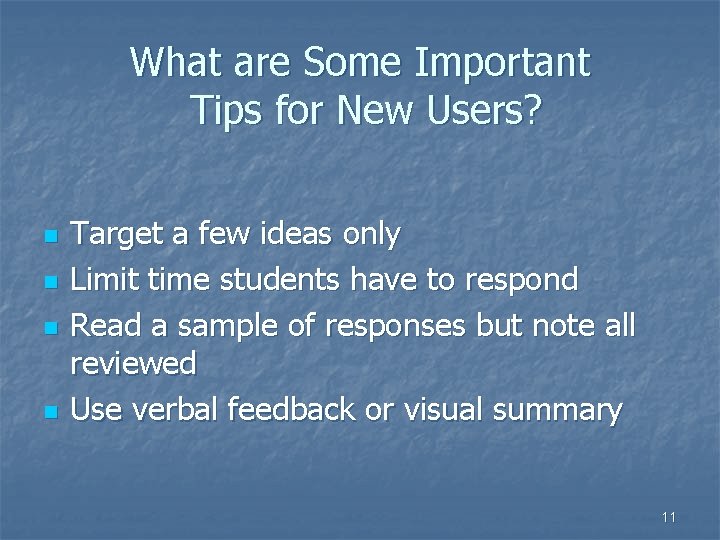
What are Some Important Tips for New Users? n n Target a few ideas only Limit time students have to respond Read a sample of responses but note all reviewed Use verbal feedback or visual summary 11
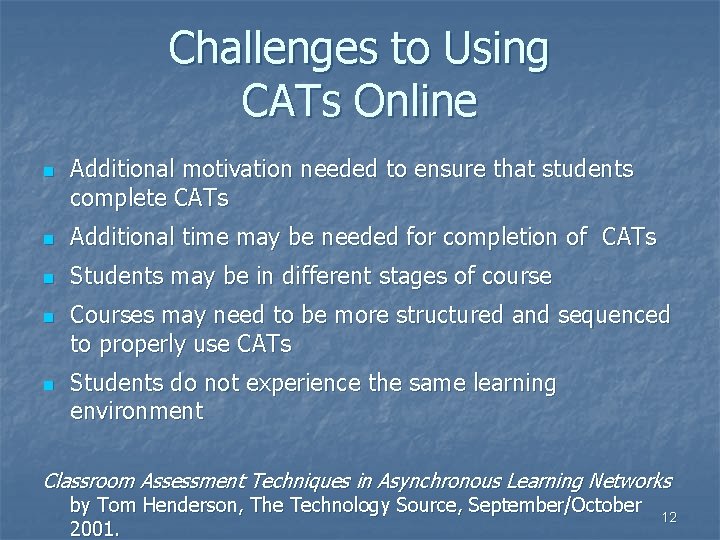
Challenges to Using CATs Online n Additional motivation needed to ensure that students complete CATs n Additional time may be needed for completion of CATs n Students may be in different stages of course n n Courses may need to be more structured and sequenced to properly use CATs Students do not experience the same learning environment Classroom Assessment Techniques in Asynchronous Learning Networks by Tom Henderson, The Technology Source, September/October 2001. 12
Some Good “CAT” Web sites http: //www. siue. edu/~deder/assess/catmain. htm l http: //honolulu. hawaii. edu/intranet/committees/F ac. Dev. Com/guidebk/teachtip/assess-2. htm http: //www. ntlf. com/html/lib/bib/assess. htm http: //www. schreyerinstitute. psu. edu/Resources/ class_assessment. asp http: //www. flaguide. org/ 13
Background Knowledge Probe Classroom Assessment a)Have never heard of this b)Have heard of it, but don’t really know what it means c)Have some idea what this means, but not too clear d)Have a clear idea of what this means and can explain it Teaching Goals Inventory a)Have never heard of this b)Have heard of it, but don’t really know what it means c)Have some idea what this means, but not too clear d)Have a clear idea of what this means and can explain it 14
Focused Listing n n Purpose: This tool helps determine what learners recall about a specific topic, including the concepts they associate with the central point. Working in pairs can help students build their knowledge base and clarify their understanding. This technique can be used before, during, or after a lesson. Steps: Ask students to write the key word at the top of a page and within a set time limit (usually 2 -3 minutes) to jot down related terms important to understanding that topic. 15
Focused Listing On the lines below, please list 5 -7 words or short phrases that describe/define what the phrase “Classroom Assessment” means to you. ________________________________ ________________________________ 16
Assessment of Focused Listing n Compare students' lists with a master one you have generated, looking at both the quantity and quality of their responses. n Categorize responses into "related" or "unrelated" or "appropriate" or "inappropriate" stacks. n Consider compiling a master list and having students then sort them by categories. 17
Focused Listing A Sample Response Classroom Assessment is n Learner-centered n Teacher-directed n Formative n Context-specific n Usually ungraded anonymous n Simple and quick to do n Rooted in good practice 18
Memory Matrix n See handout 19
Minute Paper Please answer each question in 1 -2 sentences. 1. What was the most useful or meaningful thing you learned during this session? 2. What question(s) remain upper-most in your mind as we end this session? 20
The Muddiest Point What was the muddiest point in this session? (In other words, what was least clear to you? ) 21
Defining Features Matrix n See handout 22
Pro & Con Grid Directions: Considering everything you know about CA at this point, what do you see as the most important pros/cons, or costs/benefits of using this approach. List at least 3 important cons(costs) and at 3 pros(benefits) below. Cons/Costs of Using CA Pros/Benefits of Using CA 23
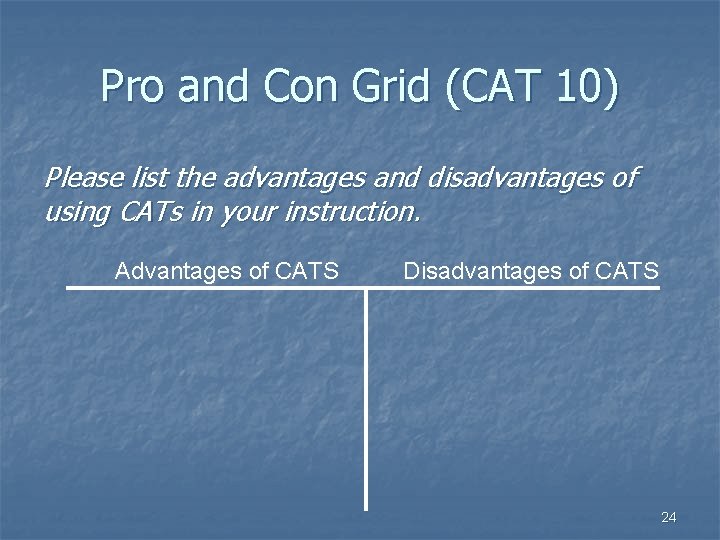
Pro and Con Grid (CAT 10) Please list the advantages and disadvantages of using CATs in your instruction. Advantages of CATS Disadvantages of CATS 24
One Sentence Summary Directions: To create a one-sentence summary, 1 st answer all of the questions below in relation to your topic. Then weave your separate answers into 1 (or 2) summary sentences. Topic: ______________ Who? Does/Did/Will Do What? To/For Whom/What? How? When? Where? Why? 25
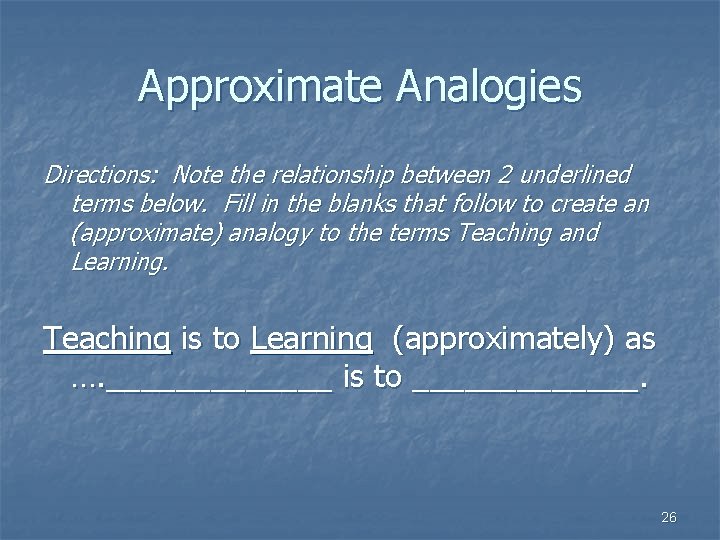
Approximate Analogies Directions: Note the relationship between 2 underlined terms below. Fill in the blanks that follow to create an (approximate) analogy to the terms Teaching and Learning. Teaching is to Learning (approximately) as …. _______ is to _______. 26
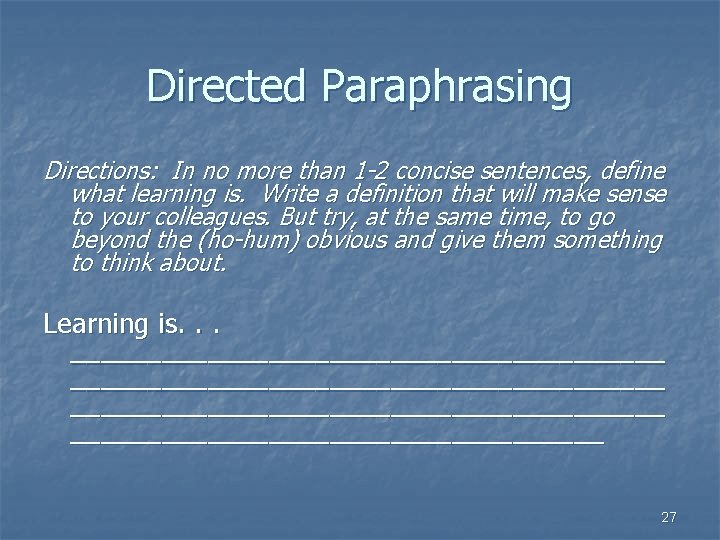
Directed Paraphrasing Directions: In no more than 1 -2 concise sentences, define what learning is. Write a definition that will make sense to your colleagues. But try, at the same time, to go beyond the (ho-hum) obvious and give them something to think about. Learning is. . . _______________________________________ __________________ 27
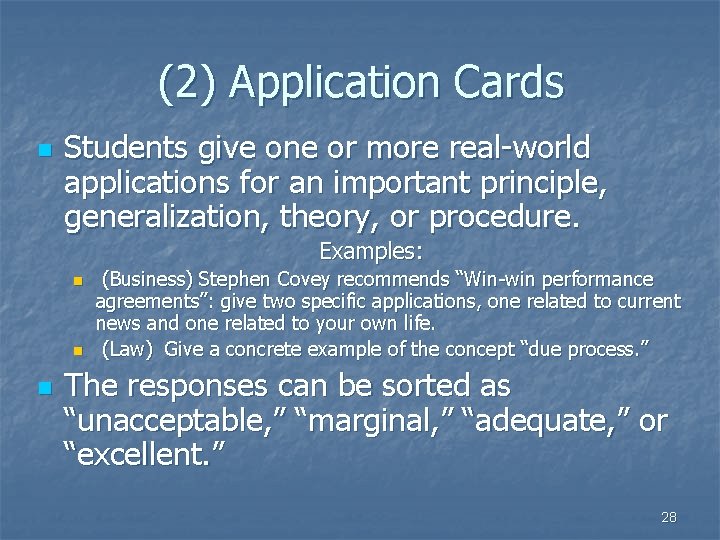
(2) Application Cards n Students give one or more real-world applications for an important principle, generalization, theory, or procedure. Examples: n n n (Business) Stephen Covey recommends “Win-win performance agreements”: give two specific applications, one related to current news and one related to your own life. (Law) Give a concrete example of the concept “due process. ” The responses can be sorted as “unacceptable, ” “marginal, ” “adequate, ” or “excellent. ” 28
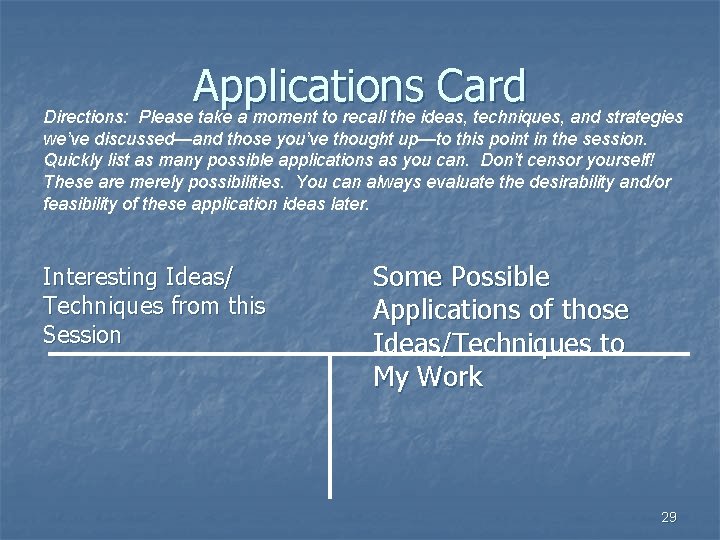
Applications Card Directions: Please take a moment to recall the ideas, techniques, and strategies we’ve discussed—and those you’ve thought up—to this point in the session. Quickly list as many possible applications as you can. Don’t censor yourself! These are merely possibilities. You can always evaluate the desirability and/or feasibility of these application ideas later. Interesting Ideas/ Techniques from this Session Some Possible Applications of those Ideas/Techniques to My Work 29
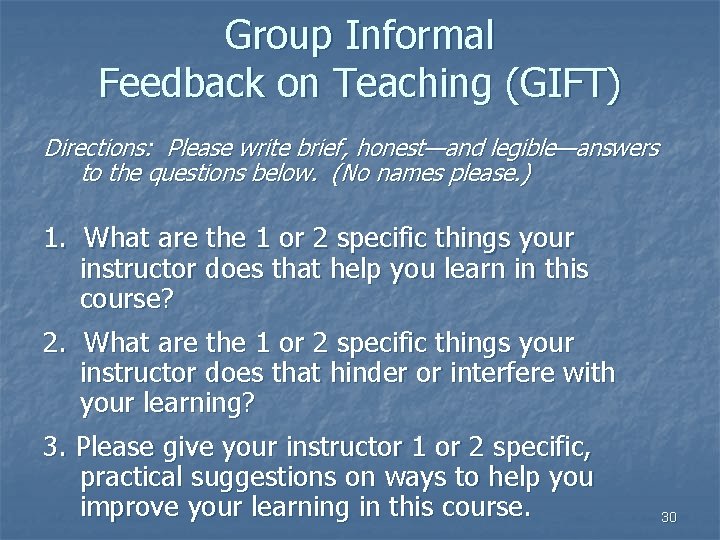
Group Informal Feedback on Teaching (GIFT) Directions: Please write brief, honest—and legible—answers to the questions below. (No names please. ) 1. What are the 1 or 2 specific things your instructor does that help you learn in this course? 2. What are the 1 or 2 specific things your instructor does that hinder or interfere with your learning? 3. Please give your instructor 1 or 2 specific, practical suggestions on ways to help you improve your learning in this course. 30