
What are the broader applications of CAD Using
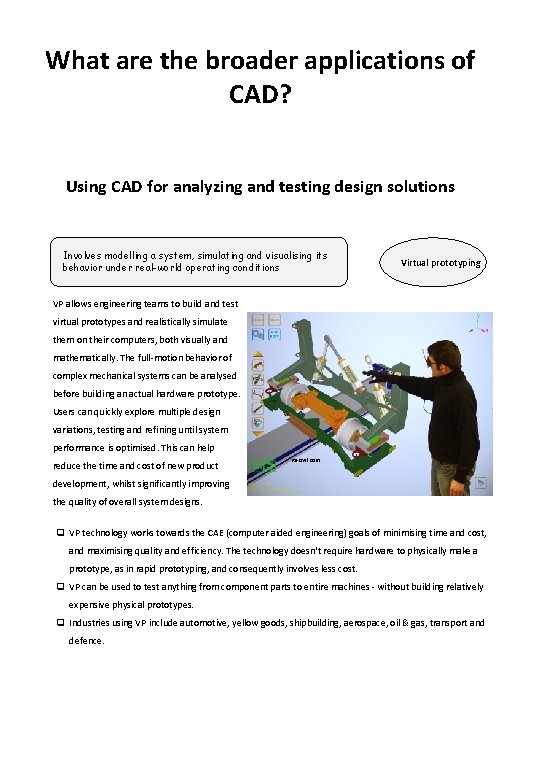
What are the broader applications of CAD? Using CAD for analyzing and testing design solutions Involves modelling a system, simulating and visualising its behavior under real-world operating conditions Virtual prototyping VP allows engineering teams to build and test virtual prototypes and realistically simulate them on their computers, both visually and mathematically. The full-motion behavior of complex mechanical systems can be analysed before building an actual hardware prototype. Users can quickly explore multiple design variations, testing and refining until system performance is optimised. This can help reduce the time and cost of new product its-owl. com development, whilst significantly improving the quality of overall system designs. q VP technology works towards the CAE (computer aided engineering) goals of minimising time and cost, and maximising quality and efficiency. The technology doesn't require hardware to physically make a prototype, as in rapid prototyping, and consequently involves less cost. q VP can be used to test anything from component parts to entire machines - without building relatively expensive physical prototypes. q Industries using VP include automotive, yellow goods, shipbuilding, aerospace, oil & gas, transport and defence.

Computer simulations of a variety of mechanical and biological aspects of the human body Digital Humans Human simulation in product design enables a product to be developed more quickly, as there can be more design iterations in less time. This results in higher product quality, which meets human requirements more accurately. Digital prototypes are cheaper to produce than physical prototypes. Products are safer as a result of more thorough analysis of aspects. For a growing number of organizations, factoring the human element into design, manufacturing and maintenance is a competitive advantage. These organizations are using Jack to realize benefits such as: shorter design time, lower development costs, improved quality, increased productivity, enhanced safety heightened morale. Human simulation commonly occurs in design, manufacturing, maintenance and training. The recording of human and animal movement by any means, for example, by video, magnetic or electro-mechanical devices. Motion Capture Shown right, a person wears a set of acoustic, inertial, LED, magnetic or reflective markers at each joint. Sensors track the position of the markers as the person moves to develop a digital representation of the motion. Motion capture can reduce the cost of animation, which otherwise requires the animator to draw either each frame or key frames that are then interpolated. Motion capture saves time and creates more natural movements than manual animation, but is limited to motions that are anatomically possible. Some applications, for example, animated super-hero martial arts, might require additional impossible movements. A motion capture session records the movements of the actor, not his or her visual appearance. The captured movements are mapped to a 3 D model (human, giant robot) created by a computer artist, to move the model in the same way.
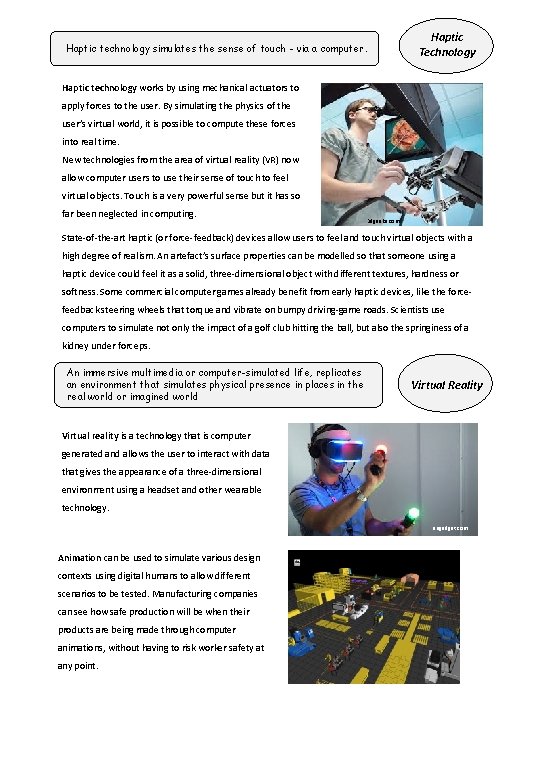
Haptic technology simulates the sense of touch - via a computer. Haptic Technology Haptic technology works by using mechanical actuators to apply forces to the user. By simulating the physics of the user’s virtual world, it is possible to compute these forces into real time. New technologies from the area of virtual reality (VR) now allow computer users to use their sense of touch to feel virtual objects. Touch is a very powerful sense but it has so far been neglected in computing. 3 dgeeks. com State-of-the-art haptic (or force-feedback) devices allow users to feel and touch virtual objects with a high degree of realism. An artefact’s surface properties can be modelled so that someone using a haptic device could feel it as a solid, three-dimensional object with different textures, hardness or softness. Some commercial computer games already benefit from early haptic devices, like the forcefeedback steering wheels that torque and vibrate on bumpy driving-game roads. Scientists use computers to simulate not only the impact of a golf club hitting the ball, but also the springiness of a kidney under forceps. An immersive multimedia or computer-simulated life, replicates an environment that simulates physical presence in places in the real world or imagined world Virtual Reality Virtual reality is a technology that is computer generated and allows the user to interact with data that gives the appearance of a three-dimensional environment using a headset and other wearable technology. engadget. com Animation can be used to simulate various design contexts using digital humans to allow different scenarios to be tested. Manufacturing companies can see how safe production will be when their products are being made through computer animations, without having to risk worker safety at any point.
- Slides: 3