
What are the Barriers to Financial Capability Presentation
What are the Barriers to Financial Capability? Presentation to Protect Association 18 th Nov 2016 Nick Watkins, Head of Insight & Evaluation nick. watkins@moneyadviceservice. org. uk www. fincap. org. uk
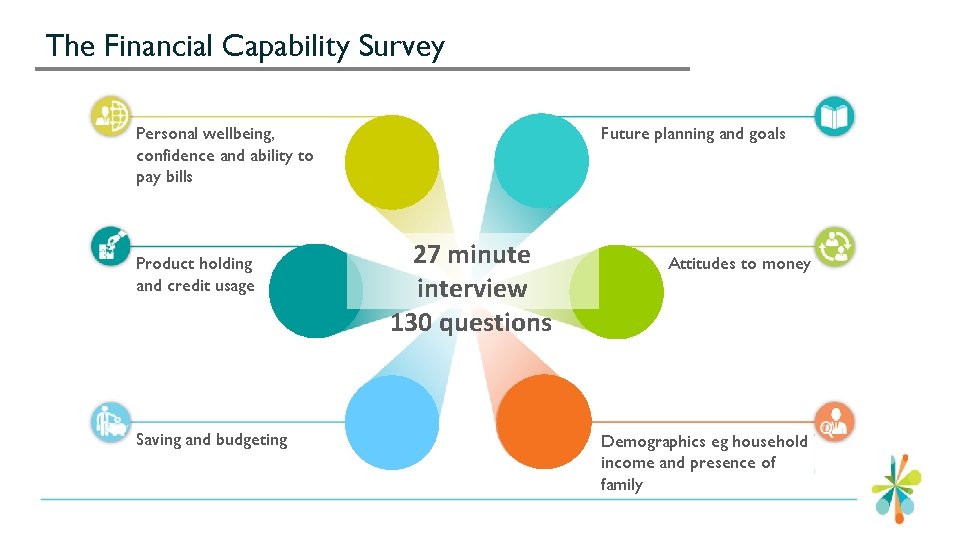
The Financial Capability Survey Personal wellbeing, confidence and ability to pay bills Product holding and credit usage Saving and budgeting Future planning and goals 27 minute interview 130 questions Attitudes to money Demographics eg household income and presence of family

Making sense of it all Wellbeing measures Financially capable behaviours Financial enablers and inhibitors Demographics and other characteristics

Two measures of wellbeing • Current financial wellbeing • • • Satisfaction with financial circumstances Self-reported burden of bills/credit commitments Capacity to pay an unexpected bill of £ 300 Self-reported keeping up with bills and commitments Number of types of missed payments or incurred charges in last 6 months Not anxious about financial situation 75 • Longer-term financial security • • Savings to income ratio Types of loss protection held (will, home contents and life insurance) Types of longer-term savings products held Biggest unexpected bill could pay 38

The key building blocks of longer-term financial security Financially capable behaviours (43%) BUILDING RESILIENCE Managing credit Financial enablers and inhibitors (8%) Demographics and other characteristics (14%) Confidence Numeracy Engagement INCOME Working status Household composition Housing tenure Other things (36%)

The building blocks for interventions Building resilience Managing credit Financial numeracy Financial Confidence Financial engagement
Managing credit • A credit culture • £ 189 bn consumer credit outstandings Sept 2016 - growth 10. 3% (Bo. E) • 11% would rely on credit, borrowing from friends and family or going overdrawn if confronted with an unexpected £ 300 bill • Servicing debts • Revolving credit cards : 16% make minimum repayment (Fin Cap) • Many consumers don’t review debt servicing • In our ‘Squeezed’ segment ….
Managing credit “I have three payday loans which I have missed payments on and a credit card which I have maxed out -this is a constant concern of mine and plays on my mind a lot. The main reason for these debts is I had a period of time without work and to keep my lifestyle I chose to (borrow) money which was a bad idea as I'm now facing the consequences. ” (Squeezed Younger Adult) “It is quite a depressing state of affairs to be honest. You know, we get paid, pay the mortgage, we pay the council tax, we pay back debts , we pay the house insurance… we pay the car insurance, we pay for food, and then we go into overdraft… It is quite depressing actually… you do, kind of, think, ‘oh gosh, when does it get any better? ” (Older Squeezed)
Confidence • Two dimensions • Managing money day-to-day • Making financial product and service decisions • Are people confident making product decisions? • Around 4 in 10 workers confident • Higher amongst men • Young men more than 2 x as likely to be confident as female peers
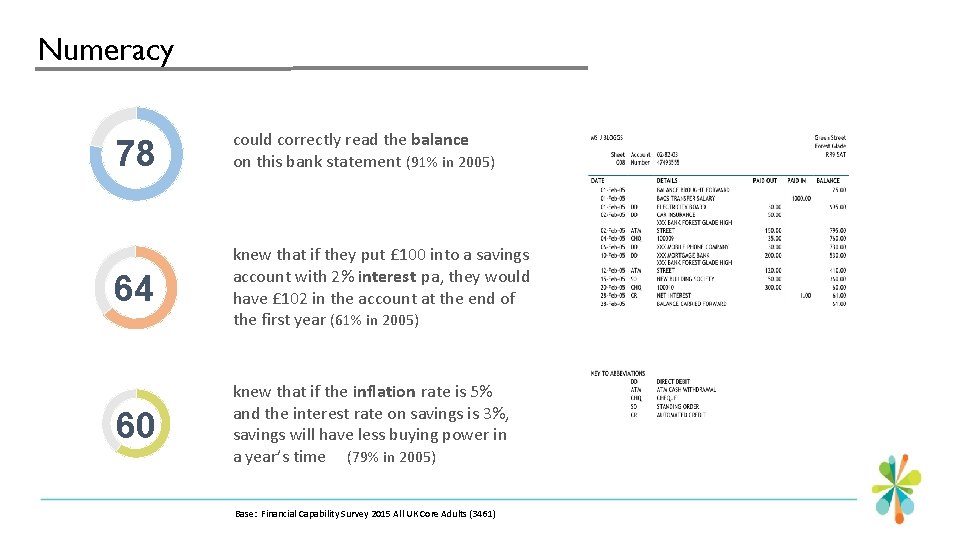
Numeracy 78 could correctly read the balance on this bank statement (91% in 2005) 64 knew that if they put £ 100 into a savings account with 2% interest pa, they would have £ 102 in the account at the end of the first year (61% in 2005) 60 knew that if the inflation rate is 5% and the interest rate on savings is 3%, savings will have less buying power in a year’s time (79% in 2005) Base: Financial Capability Survey 2015 All UK Core Adults (3461)
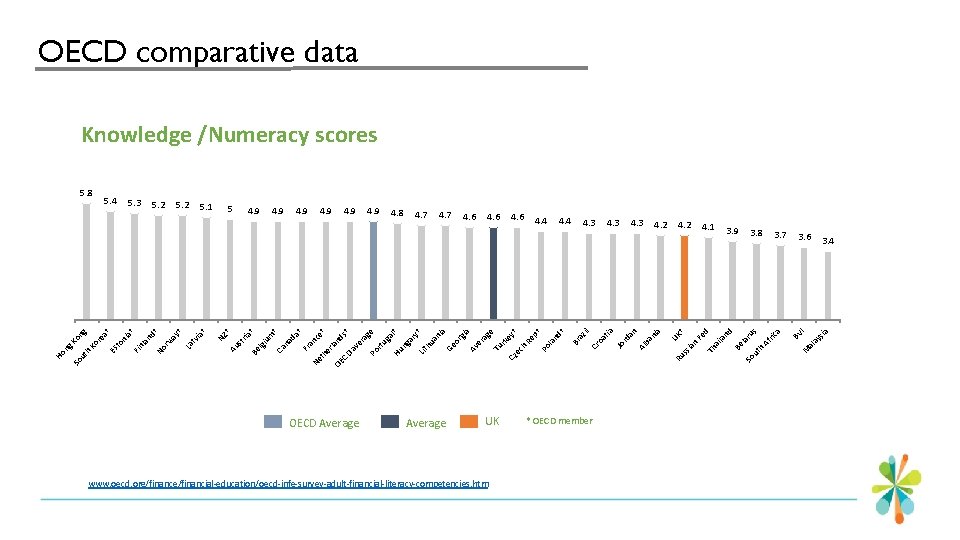
OECD comparative data Knowledge /Numeracy scores OECD Average UK www. oecd. org/finance/financial-education/oecd-infe-survey-adult-financial-literacy-competencies. htm * OECD member So 3. 4 BV I ay sia 3. 6 al ric Af ut h la ru s a 3. 7 M 3. 8 Be ai la Th ia n 3. 9 nd d 4. 1 Fe UK * 4. 2 ss a ni ba Al rd 4. 2 Ru 4. 3 an 4. 3 ia 4. 3 Jo 4. 4 at 4. 4 il 4. 6 az 4. 6 Cr o 4. 6 Br 4. 7 y* Lit hu an ia Ge or gia Av er ag e Tu rk ey Cz * ec h Re p* Po la nd * 4. 7 ng ar rtu ga l* 4. 8 Hu CD av er ag e 4. 9 OE Ne th er la nd s* * ce an da Fr Ca 4. 9 Po 4. 9 * 4. 9 na * 4. 9 lgi um st ria * 4. 9 Be NZ * 5 Au * 5. 1 tv ia ay * rw la 5. 2 No nd * 5. 2 La 5. 3 ni a* a* to Es re ng Ko h Ko ut ng So Ho 5. 4 Fin 5. 8
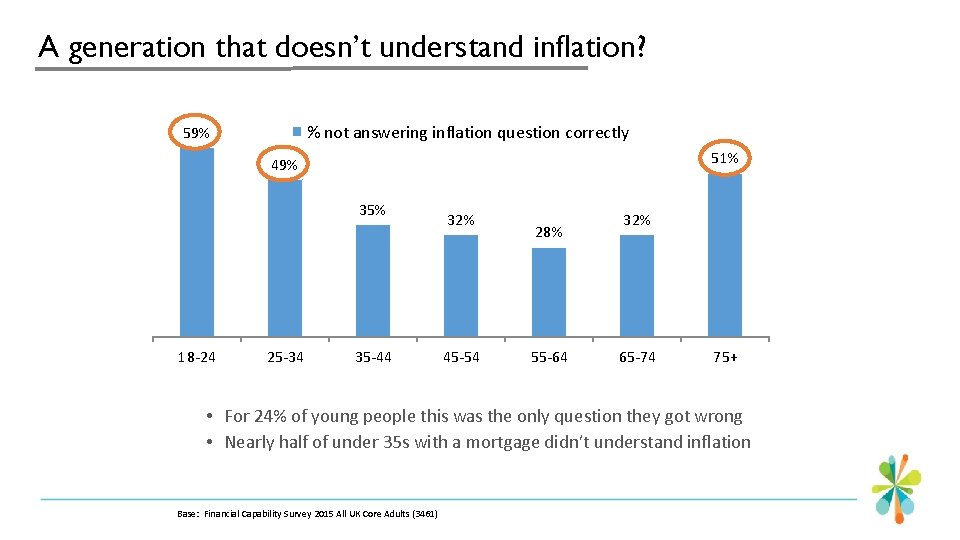
A generation that doesn’t understand inflation? % not answering inflation question correctly 59% 51% 49% 35% 18 -24 25 -34 35 -44 32% 45 -54 28% 55 -64 32% 65 -74 75+ • For 24% of young people this was the only question they got wrong • Nearly half of under 35 s with a mortgage didn’t understand inflation Base: Financial Capability Survey 2015 All UK Core Adults (3461)
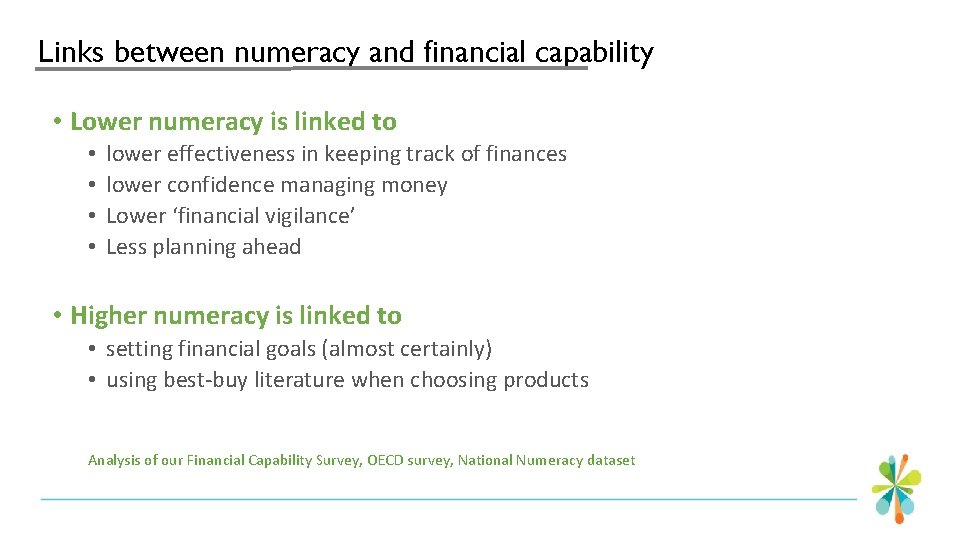
Links between numeracy and financial capability • Lower numeracy is linked to • • lower effectiveness in keeping track of finances lower confidence managing money Lower ‘financial vigilance’ Less planning ahead • Higher numeracy is linked to • setting financial goals (almost certainly) • using best-buy literature when choosing products Analysis of our Financial Capability Survey, OECD survey, National Numeracy dataset
Language can also have an effect • • • MAS research on retirement language MAS research published Feb 2016 Contribution to the x-sector Pensions Language Steering Group Convened by ABI language guide published in Sept- to be launched later this month https: //masassets. blob. core. windows. net/cms/files/000/312/original/Money_Advice_Service_Retirement_Language. pdf
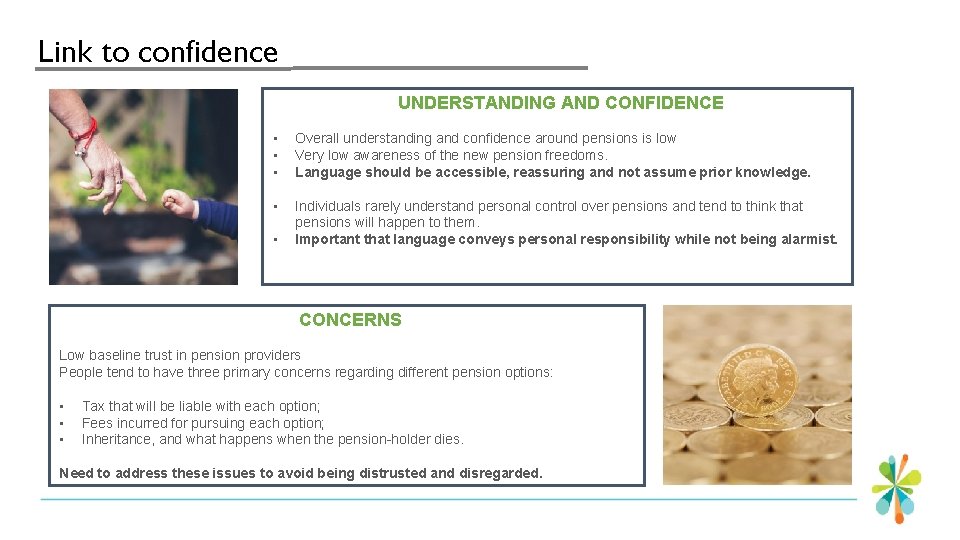
Link to confidence UNDERSTANDING AND CONFIDENCE • • • Overall understanding and confidence around pensions is low Very low awareness of the new pension freedoms. Language should be accessible, reassuring and not assume prior knowledge. • Individuals rarely understand personal control over pensions and tend to think that pensions will happen to them. Important that language conveys personal responsibility while not being alarmist. • CONCERNS Low baseline trust in pension providers People tend to have three primary concerns regarding different pension options: • • • Tax that will be liable with each option; Fees incurred for pursuing each option; Inheritance, and what happens when the pension-holder dies. Need to address these issues to avoid being distrusted and disregarded.
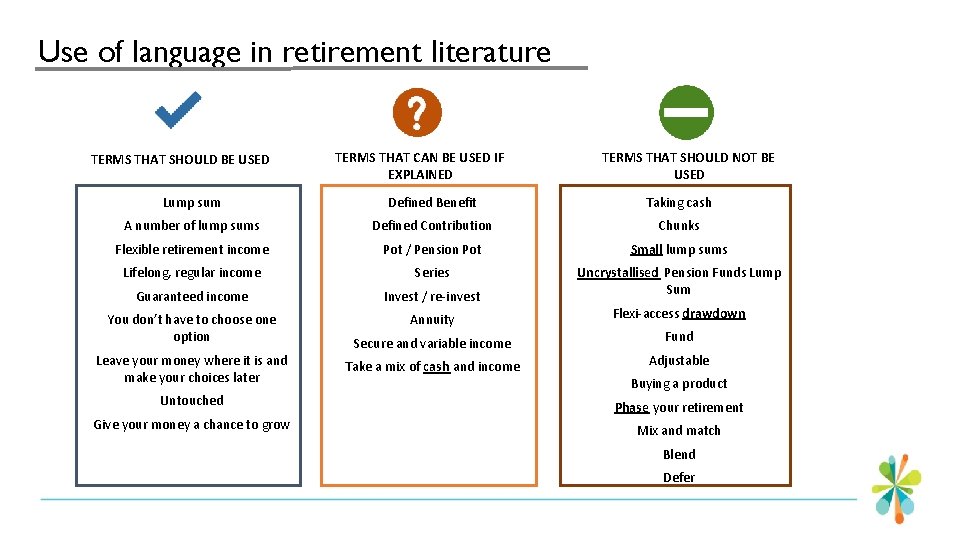
Use of language in retirement literature TERMS THAT SHOULD BE USED TERMS THAT CAN BE USED IF EXPLAINED TERMS THAT SHOULD NOT BE USED Lump sum Defined Benefit Taking cash A number of lump sums Defined Contribution Chunks Flexible retirement income Pot / Pension Pot Small lump sums Lifelong, regular income Series Guaranteed income Invest / re-invest Uncrystallised Pension Funds Lump Sum You don’t have to choose one option Annuity Leave your money where it is and make your choices later Untouched Give your money a chance to grow Secure and variable income Take a mix of cash and income Flexi-access drawdown Fund Adjustable Buying a product Phase your retirement Mix and match Blend Defer
Engagement • Barriers • Thinking about tomorrow, not just living for today • Making time for your finances • Believing you can make a difference • Importance of goals • Will encourage saving • Creates a future focus • Must be plans to support those goals
Conclusions • Achieving longer-term financial security is more difficult than day-to-day • Key barriers are …. • • • Building resilience Managing credit Financial confidence Financial numeracy Financial engagement • As providers you can’t influence many of these but think about • Accessibility of language and numerical examples • How to build confidence • Role of goals in motivating consumers • Confidence and trust are low and it is too easy to put off decisions
- Slides: 18