
What are some of the Challenges and Pitfalls



- Slides: 10
What are some of the Challenges and Pitfalls? • Understanding the documentation from various fields of expertise. • The temptation to apply familiar or popular technology solutions inappropriately. • Evaluating the whole person and how they relate to technology, both low and high tech. • Evaluating the individual’s ability to adopt the technology.
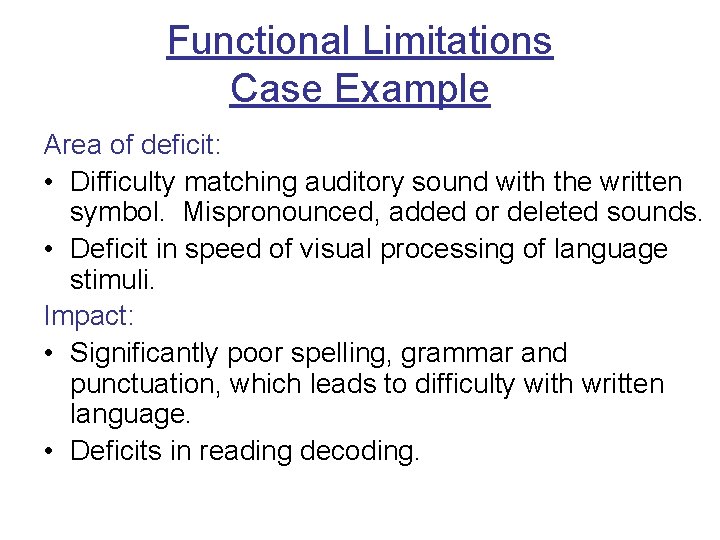
Functional Limitations Case Example Area of deficit: • Difficulty matching auditory sound with the written symbol. Mispronounced, added or deleted sounds. • Deficit in speed of visual processing of language stimuli. Impact: • Significantly poor spelling, grammar and punctuation, which leads to difficulty with written language. • Deficits in reading decoding.
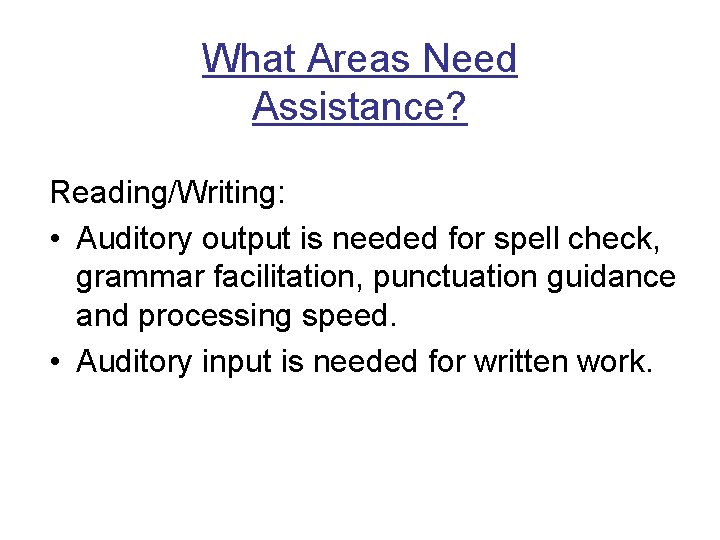
What Areas Need Assistance? Reading/Writing: • Auditory output is needed for spell check, grammar facilitation, punctuation guidance and processing speed. • Auditory input is needed for written work.
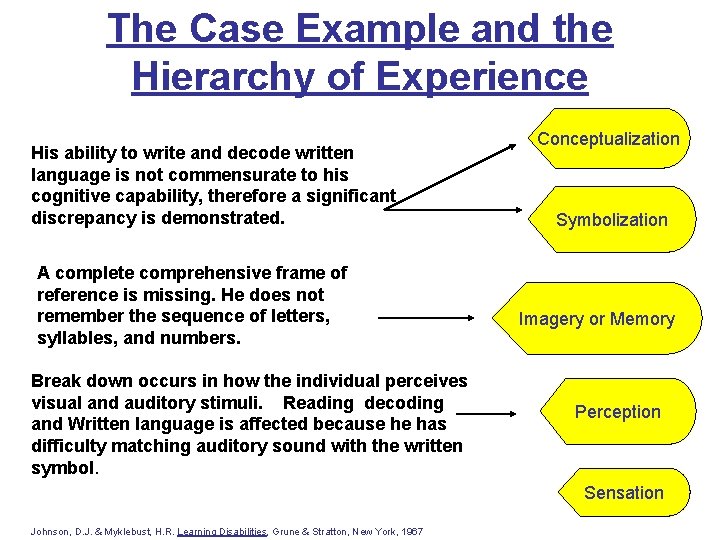
The Case Example and the Hierarchy of Experience His ability to write and decode written language is not commensurate to his cognitive capability, therefore a significant discrepancy is demonstrated. A complete comprehensive frame of reference is missing. He does not remember the sequence of letters, syllables, and numbers. Break down occurs in how the individual perceives visual and auditory stimuli. Reading decoding and Written language is affected because he has difficulty matching auditory sound with the written symbol. Conceptualization Symbolization Imagery or Memory Perception Sensation Johnson, D. J. & Myklebust, H. R. Learning Disabilities, Grune & Stratton, New York, 1967
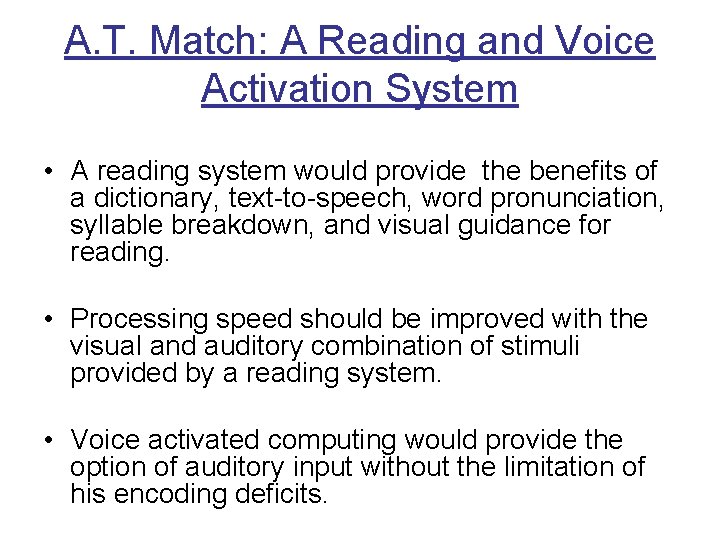
A. T. Match: A Reading and Voice Activation System • A reading system would provide the benefits of a dictionary, text-to-speech, word pronunciation, syllable breakdown, and visual guidance for reading. • Processing speed should be improved with the visual and auditory combination of stimuli provided by a reading system. • Voice activated computing would provide the option of auditory input without the limitation of his encoding deficits.
Voice Activated Computing • • • Voice Stability Puffs and Pauses while speaking Syllable pronunciation Fatigue Concentration Work Environment Manipulation of Microphone Memory Skills Visual Process Comfort level with computers
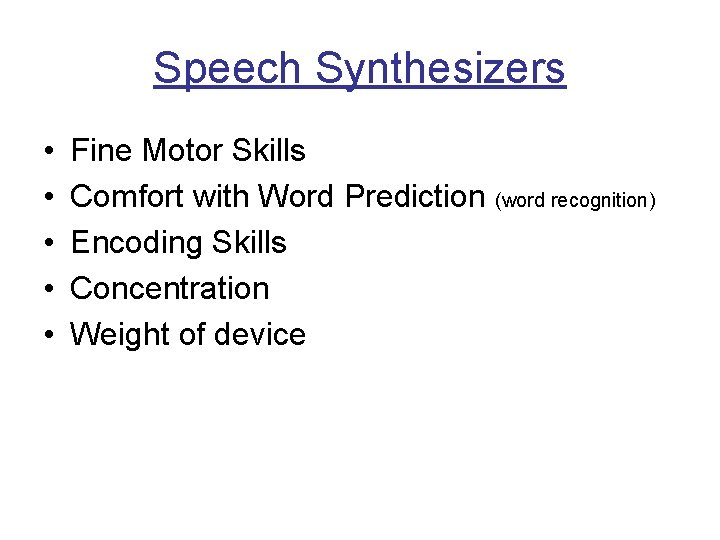
Speech Synthesizers • • • Fine Motor Skills Comfort with Word Prediction (word recognition) Encoding Skills Concentration Weight of device
Visual AT • • • Level of vision Onset of Vision Loss Memory Skills Auditory Processing Tactile Processing Concentration
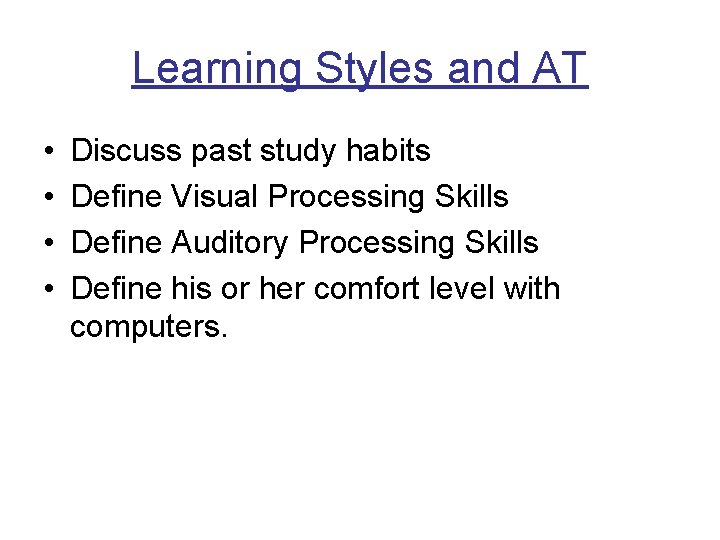
Learning Styles and AT • • Discuss past study habits Define Visual Processing Skills Define Auditory Processing Skills Define his or her comfort level with computers.
Goal: The appropriate match of AT to the functional limitation of an individual.