
What are some benefits risks and limitations of
What are some benefits, risks and limitations of genetic testing?
Disclaimer • This presentation is for educational purposes only and should not be used as a substitute for clinical judgement. GEC-KO aims to aid the practicing clinician by providing informed opinions regarding genetic services that have been developed in a rigorous and evidence-based manner. Physicians must use their own clinical judgement in addition to published articles and the information presented herein. GEC-KO assumes no responsibility or liability resulting from the use of information contained herein.

Objectives This is a brief overview of general benefits, harms and limitations of genetic test to facilitate education and discussion
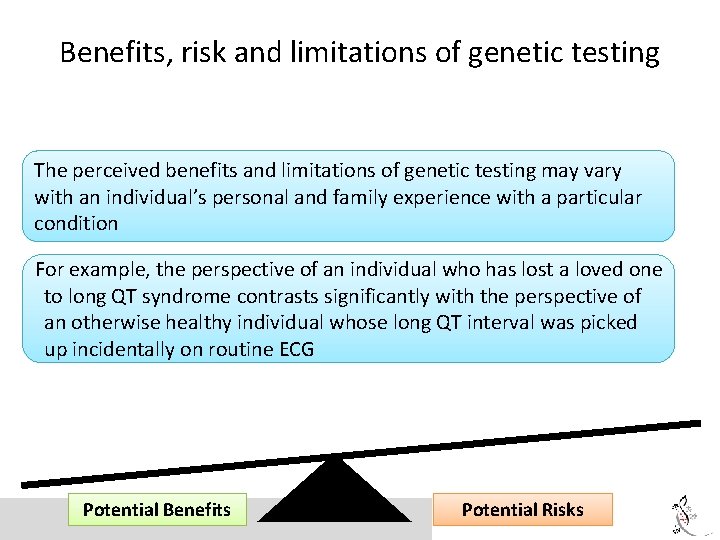
Benefits, risk and limitations of genetic testing The perceived benefits and limitations of genetic testing may vary with an individual’s personal and family experience with a particular condition For example, the perspective of an individual who has lost a loved one to long QT syndrome contrasts significantly with the perspective of an otherwise healthy individual whose long QT interval was picked up incidentally on routine ECG Potential Benefits Potential Risks

Benefits of genetic testing Clarification of risk status OR confirmation of diagnosis in symptomatic individuals or those with borderline clinical investigations Note: Predictive testing (individual will develop a condition) vs Predisposition testing (individual is at risk to develop a condition) Clinical intervention may improve outcome Family members at risk can be identified Assistance with life planning (e. g. decisions if or when to have children, about careers, participation in competitive sports) Reassurance for those with true negative results, for themselves and their offspring Avoidance of unnecessary clinical interventions Potential Benefits Potential Risks

Risk and limitations of genetic testing Adverse psychological reaction Family issues Distress Potential for risk of sudden cardiac death or high risk of cancer Survivor guilt Uncertainty If/when one might develop the disorder Uninformative test result (negative results can neither confirm nor rule out a diagnosis in the absence of a known familial mutation) Variant of uncertain significance Confidentiality issues Potential Benefits Insurance/job discrimination Complacent attitude to health Potential Risks

Genetic testing in children Informed consent is fundamental to genetic and genomic testing Decision to test a child is often made by a surrogate decision maker (e. g. parent, health provider) Canadian College of Medical Geneticists and the Canadian Pediatric Society published guidelines for genetic testing in healthy children in the clinical context (2003)
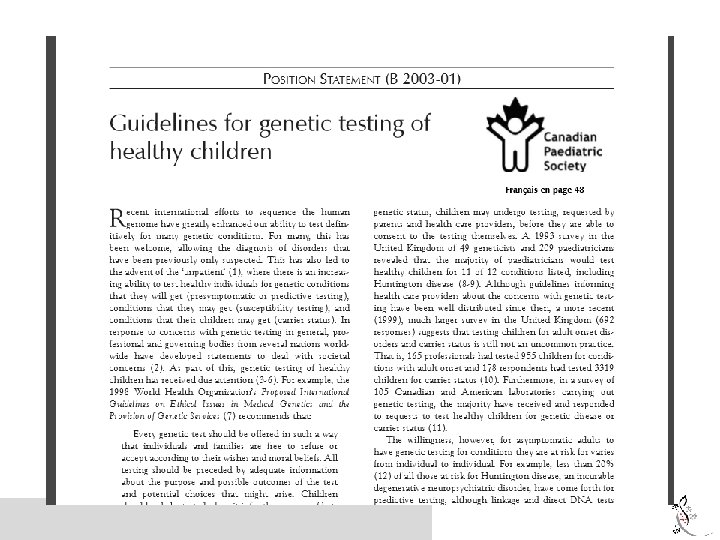
Genetic testing in children Messages The best interests of the child should be the primary consideration Timely medical benefit to the child should guide genetic testing e. g. testing for adult-onset conditions should be deferred
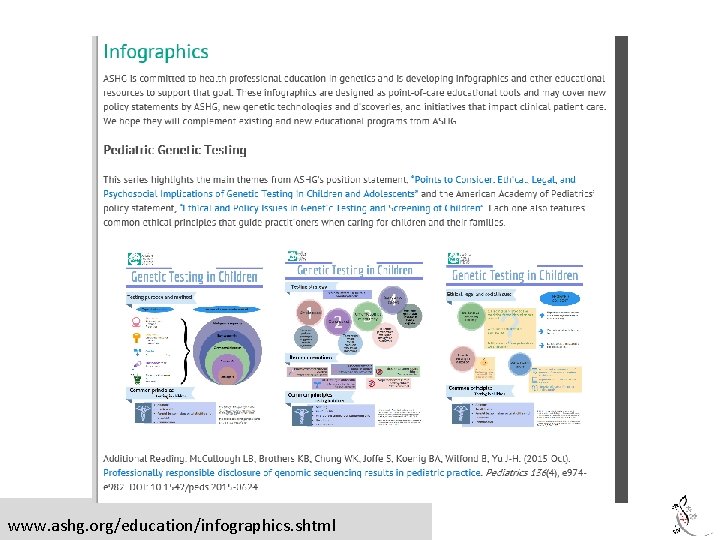
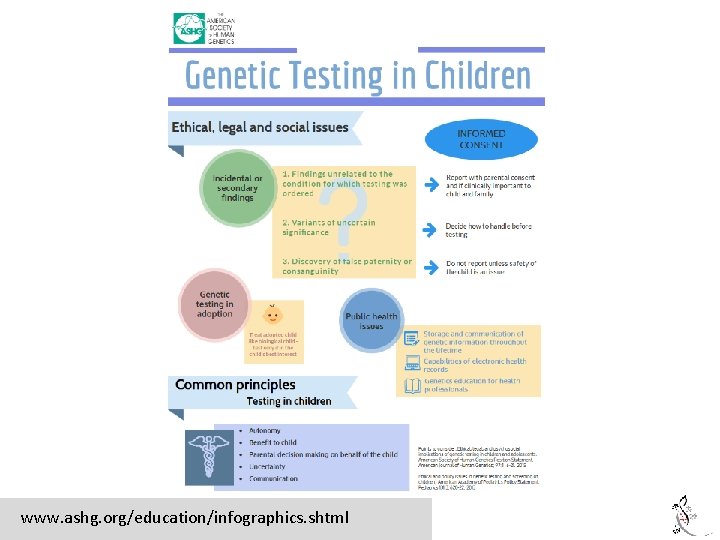
Genetic testing in children American Society of Human Genetics (ASHG) developed infographics to highlight main themes from recent (2015) position statements by ASHG, the American College of Medical Genetics and Genomics and the American Pediatric Society regarding genetic testing in children and adolescence (both clinical and research) http: //www. ashg. org/education/infographics. shtml
Genetic testing in children www. ashg. org/education/infographics. shtml
www. ashg. org/education/infographics. shtml
- Slides: 12