
What are Scenarios and why use them Monika

- Slides: 26
What are Scenarios and why use them? Monika Zurek MA Scenarios Group TSU FAO, Rome ASB Scenarios Training Workshop, Chiang Mai, Nov 17 -23, 2004
Overview of the talk o Looking into the future o What are scenarios? o Why use scenarios? o How have scenarios been used in the past
Looking into the future o Out of curiosity o For scientific exploration o For decision-making n n o Decisions are based on expected outcomes and the trade-offs they imply Decisions involve uncertainty about how the future will unfold For planning purposes/strategic planning exercise
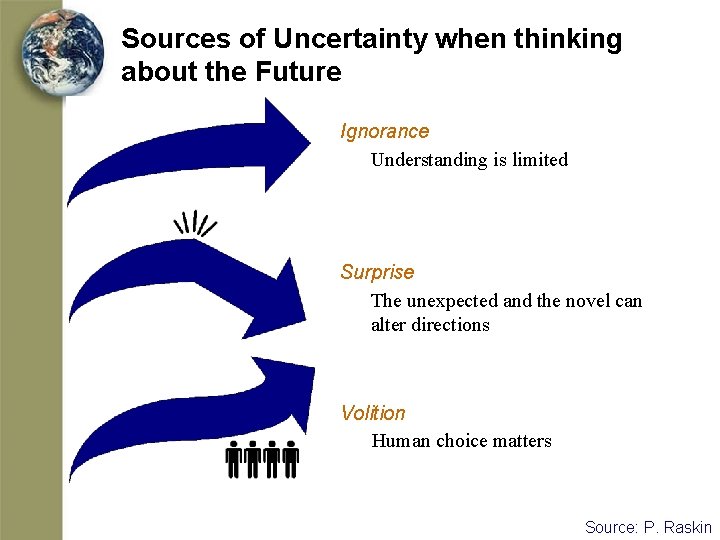
Sources of Uncertainty when thinking about the Future Ignorance Understanding is limited Surprise The unexpected and the novel can alter directions Volition Human choice matters Source: P. Raskin
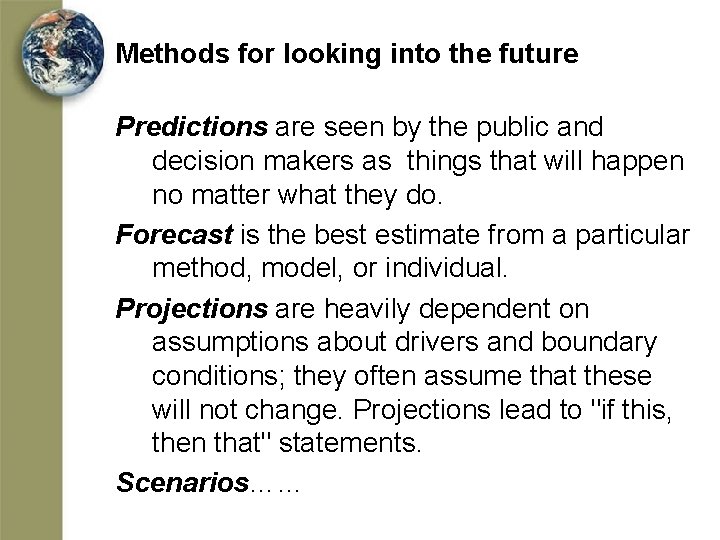
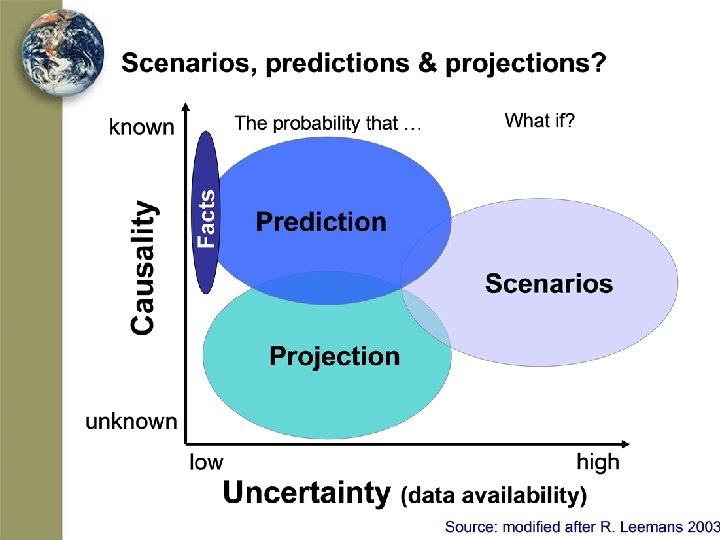
Methods for looking into the future Predictions are seen by the public and decision makers as things that will happen no matter what they do. Forecast is the best estimate from a particular method, model, or individual. Projections are heavily dependent on assumptions about drivers and boundary conditions; they often assume that these will not change. Projections lead to "if this, then that" statements. Scenarios……
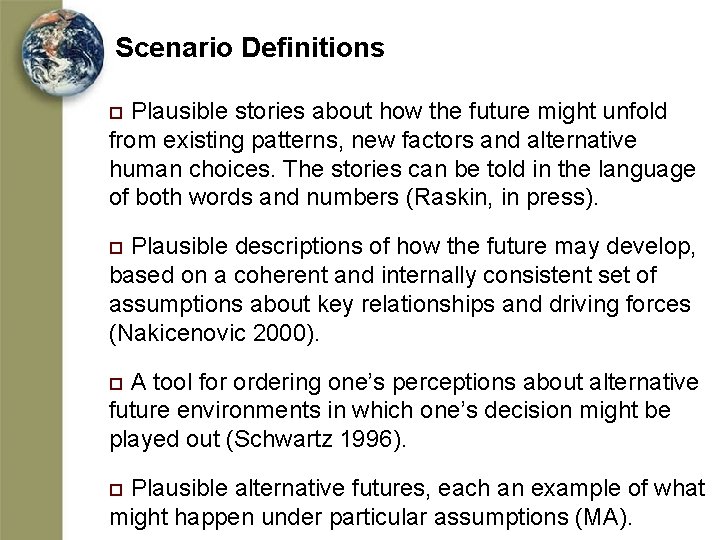
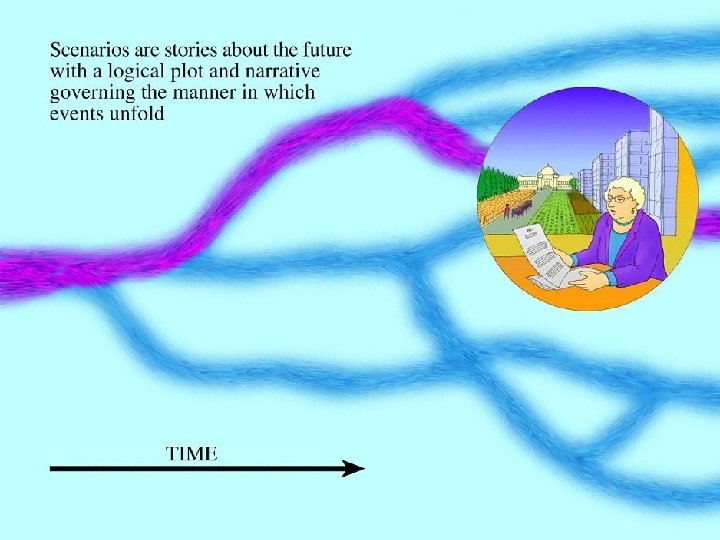
Scenario Definitions Plausible stories about how the future might unfold from existing patterns, new factors and alternative human choices. The stories can be told in the language of both words and numbers (Raskin, in press). o Plausible descriptions of how the future may develop, based on a coherent and internally consistent set of assumptions about key relationships and driving forces (Nakicenovic 2000). o A tool for ordering one’s perceptions about alternative future environments in which one’s decision might be played out (Schwartz 1996). o Plausible alternative futures, each an example of what might happen under particular assumptions (MA). o
Why use scenarios? o Purpose of scenarios: n n n Information dissemination Scientific exploration Decision-making tool o o Understanding all factors influencing the future Robust strategies that work under different worlds Different process of stakeholder involvement in scenario development Understanding and communicating the main assumptions on which people base their notion of the future
Types of scenarios n Exploratory vs. anticipatory scenarios n Baseline vs. alternative/policy scenarios n Qualitative vs. quantitative scenarios, or a combination
Exploratory vs Anticipatory Scenarios exploratory scenarios n present -> future n to explore uncertainties/driving forces/developments n to test impacts of implementing specific policies anticipatory scenarios (also ‘normative’ scenarios) n present <- future n to investigate how specific end state can be reached n to show to achieve environmental targets Source: Henrichs, EEA 2003
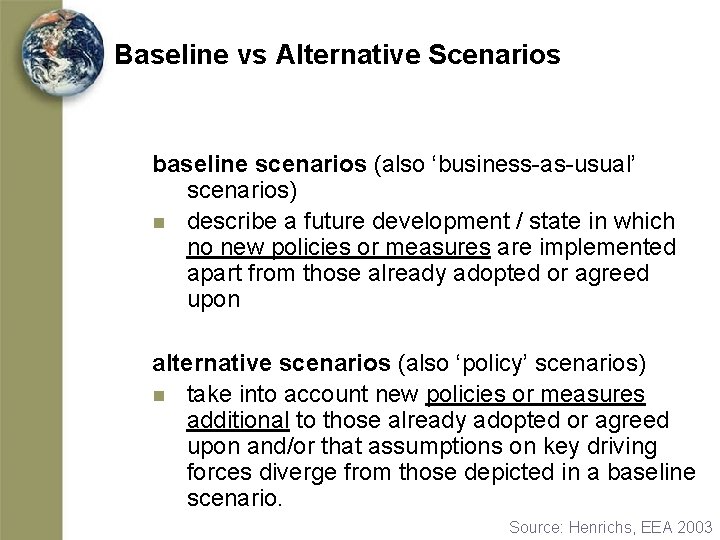
Baseline vs Alternative Scenarios baseline scenarios (also ‘business-as-usual’ scenarios) n describe a future development / state in which no new policies or measures are implemented apart from those already adopted or agreed upon alternative scenarios (also ‘policy’ scenarios) n take into account new policies or measures additional to those already adopted or agreed upon and/or that assumptions on key driving forces diverge from those depicted in a baseline scenario. Source: Henrichs, EEA 2003
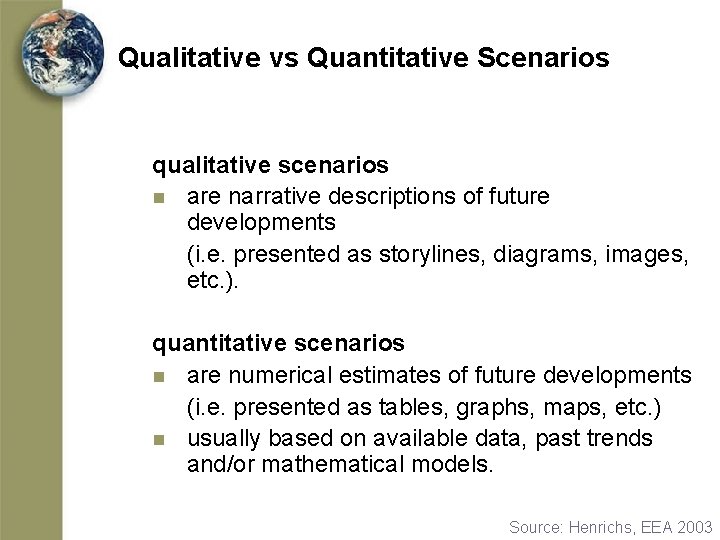
Qualitative vs Quantitative Scenarios qualitative scenarios n are narrative descriptions of future developments (i. e. presented as storylines, diagrams, images, etc. ). quantitative scenarios n are numerical estimates of future developments (i. e. presented as tables, graphs, maps, etc. ) n usually based on available data, past trends and/or mathematical models. Source: Henrichs, EEA 2003
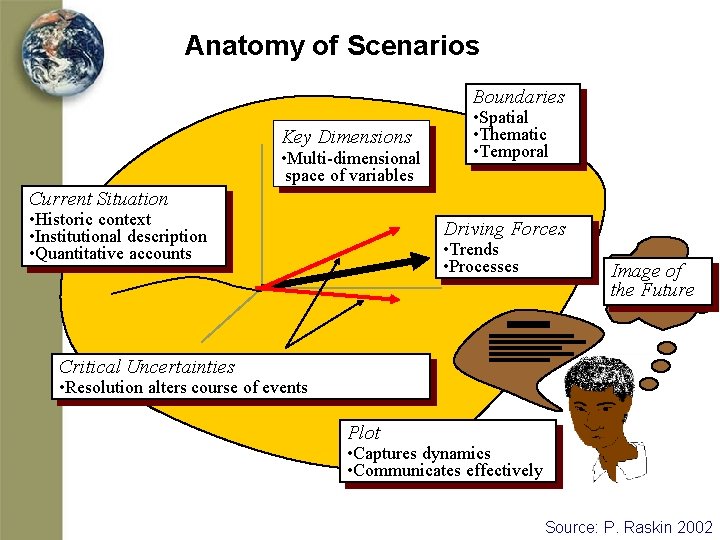
Anatomy of Scenarios Boundaries Key Dimensions • Multi-dimensional space of variables • Spatial • Thematic • Temporal Current Situation • Historic context • Institutional description • Quantitative accounts Driving Forces • Trends • Processes Image of the Future Critical Uncertainties • Resolution alters course of events Plot • Captures dynamics • Communicates effectively Source: P. Raskin 2002
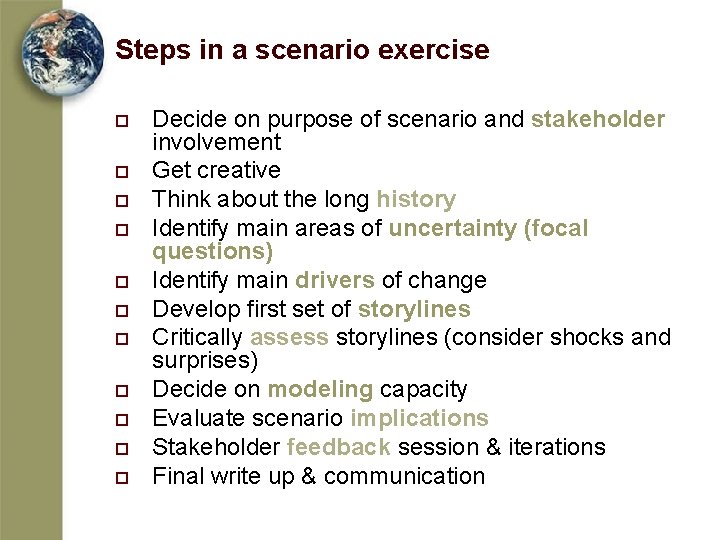
Steps in a scenario exercise o o o Decide on purpose of scenario and stakeholder involvement Get creative Think about the long history Identify main areas of uncertainty (focal questions) Identify main drivers of change Develop first set of storylines Critically assess storylines (consider shocks and surprises) Decide on modeling capacity Evaluate scenario implications Stakeholder feedback session & iterations Final write up & communication
‚Good‘ scenarios should. . . o . . . be plausible (or ‘not implausible‘) o . . . be internally consistent and coherent o . . . be constructed with rigour, detail & creativity o . . . meet the goals of scenario exercise!!!
How the scenarios method has been used so far o o o Strategic planning exercises during cold war period Future studies in 1970 s (e. g. Club of Rome) Royal Dutch Shell develops scenarios method for business planning in 1970/80 s Scenarios used as conflict management tool (Montefleur scen. in SA, Colombia) Scenarios exercises as part of integrated, global, environmental assessments, such as the IPCC, GEO, MA in 1990 s
Shell Int’l Philosophy on Scenarios “Scenarios are used to help link the uncertainties we hold about the future to the decisions we must make today. ” “Scenarios are NOT used to predict the future, but to make leaders more aware of possibilities and therefore able to take advantage of those possibilities as they come along. ”
Why Shell uses scenarios…. In 1970, world oil prices were low and expected to remain so. Shell scenario planners thought a rise in prices could happen, but were unsure of how this might happen. In one scenario, they envisioned a world in which a coalition of oil exporting countries was able to limit production, leading to a rise in oil prices. This scenario was considered radical, but it was plaus
Why Shell uses scenarios…. . (2) The scenario planning exercise led Shell to adjust its business management practices to hedge against the potential for high oil prices. OPEC formed in 1972 and oil prices rose rapidly – an unexpected shock to the global oil market. Shell’s changes to its business practices, and willingness to accept changes in oil prices as permanent, allowed it to adapt to expensive oil faster than its competitors.
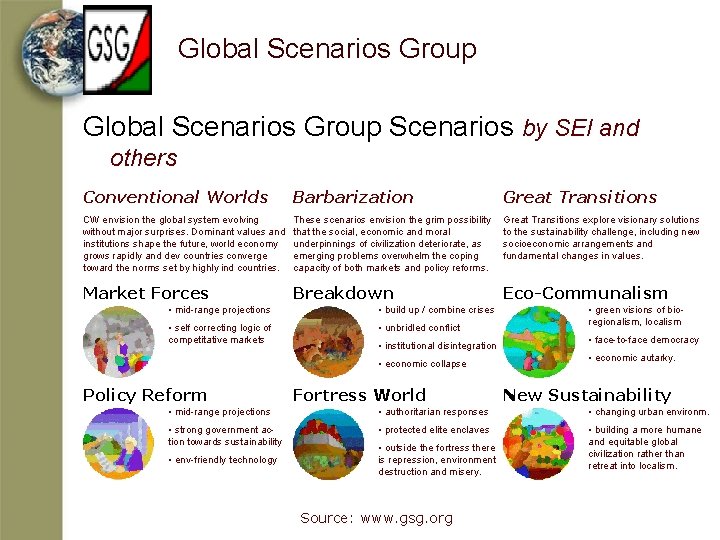
Global Scenarios Group Scenarios by SEI and others Conventional Worlds Barbarization Great Transitions CW envision the global system evolving without major surprises. Dominant values and institutions shape the future, world economy grows rapidly and dev countries converge toward the norms set by highly ind countries. These scenarios envision the grim possibility that the social, economic and moral underpinnings of civilization deteriorate, as emerging problems overwhelm the coping capacity of both markets and policy reforms. Great Transitions explore visionary solutions to the sustainability challenge, including new socioeconomic arrangements and fundamental changes in values. Market Forces Breakdown Eco-Communalism • mid-range projections • build up / combine crises • self correcting logic of competitative markets • unbridled conflict • institutional disintegration • economic collapse Policy Reform Fortress World • green visions of bioregionalism, localism • face-to-face democracy • economic autarky. New Sustainability • mid-range projections • authoritarian responses • changing urban environm. • strong government action towards sustainability • protected elite enclaves • building a more humane and equitable global civilization rather than retreat into localism. • env-friendly technology • outside the fortress there is repression, environment destruction and misery. Source: www. gsg. org
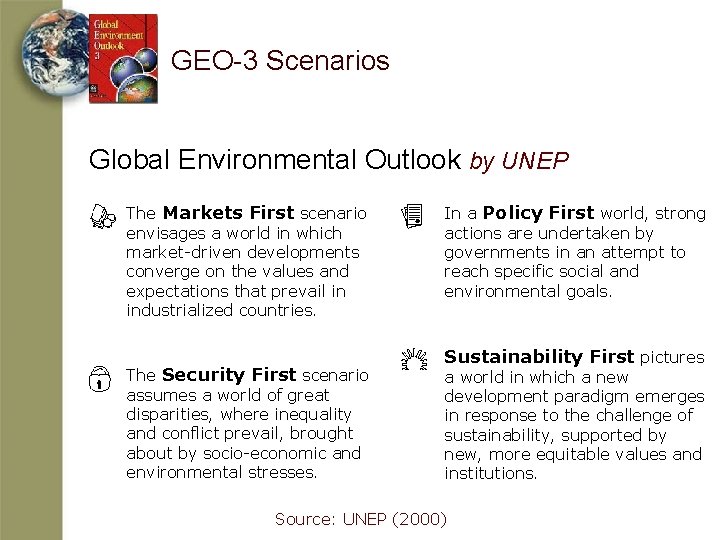
GEO-3 Scenarios Global Environmental Outlook by UNEP The Markets First scenario envisages a world in which market-driven developments converge on the values and expectations that prevail in industrialized countries. The Security First scenario assumes a world of great disparities, where inequality and conflict prevail, brought about by socio-economic and environmental stresses. In a Policy First world, strong actions are undertaken by governments in an attempt to reach specific social and environmental goals. Sustainability First pictures a world in which a new development paradigm emerges in response to the challenge of sustainability, supported by new, more equitable values and institutions. Source: UNEP (2000)
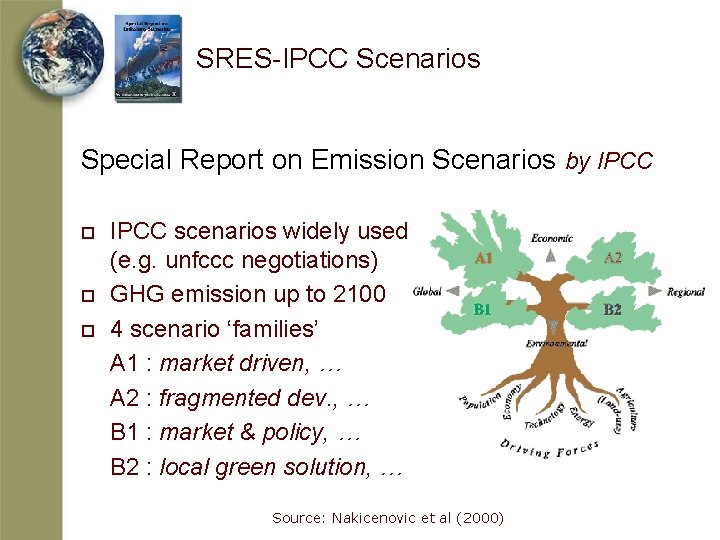
SRES-IPCC Scenarios Special Report on Emission Scenarios by IPCC o o o IPCC scenarios widely used (e. g. unfccc negotiations) GHG emission up to 2100 4 scenario ‘families’ A 1 : market driven, … A 2 : fragmented dev. , … B 1 : market & policy, … B 2 : local green solution, … Source: Nakicenovic et al (2000)
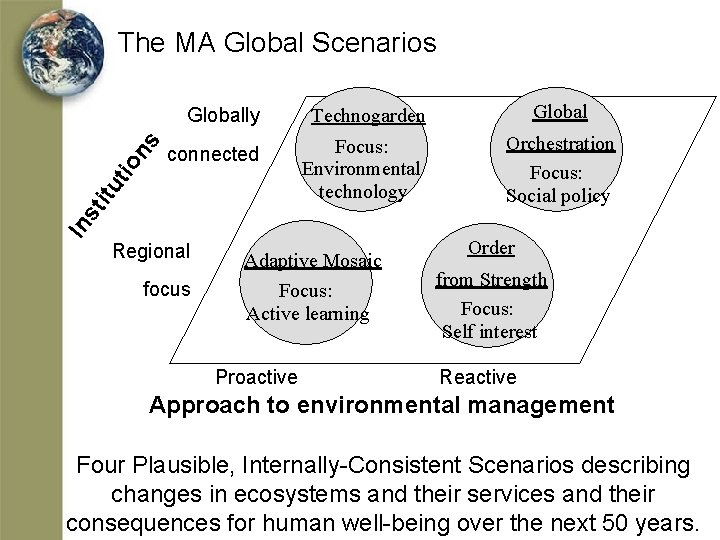
In s tit ut io ns The MA Global Scenarios Globally Technogarden connected Focus: Environmental technology Regional focus Adaptive Mosaic Focus: Active learning Proactive Global Orchestration Focus: Social policy Order from Strength Focus: Self interest Reactive Approach to environmental management Four Plausible, Internally-Consistent Scenarios describing changes in ecosystems and their services and their consequences for human well-being over the next 50 years.