
WHAT ARE PROGRAMMES FOR high quality research knowledge
- Slides: 12
WHAT ARE PROGRAMMES FOR? • • high quality research knowledge transfer/exchange training/capacity building international presence UK Energy Research Centre
ESRC PROGRAMMES IN CONTEXT • the ratio of directed to responsive mode funding at ESRC has been 2: 1 • this compares to 1: 2 for other research councils • Ho. C S&T committee has recommended that resources be shifted towards the responsive mode • ESRC accepts this, so less emphasis on programmes UK Energy Research Centre
ESRC PROGRAMMES – EVALUATION EVIDENCE • mixed outcomes – some strong performances but many have failed to add value in terms of synergy and research coherence • centres meet their objectives better than programmes • programmes are more likely to fall short on key objectives • weak programmes cover too wide an area in relation to resources with impacts on coherence and manageability • tight commissioning schedules and limited powers for directors • programme projects receive lower evaluation grades than responsive mode projects…. • …. but they generate a greater volume of output UK Energy Research Centre
TO WHAT EXTENT HAVE ESRC RESEARCH PROGRAMMES HAD DEFINED AGENDAS? • example: (failed) proposal for Environment and Sustainability programme to follow Global Environmental Change… … included 50 separate questions • “ESRC does not regard the directed and responsive modes as separate silos but as part of a spectrum of funding opportunities” • “most of ESRC’s research programmes are responsive competitions within a broadly defined subject area” UK Energy Research Centre
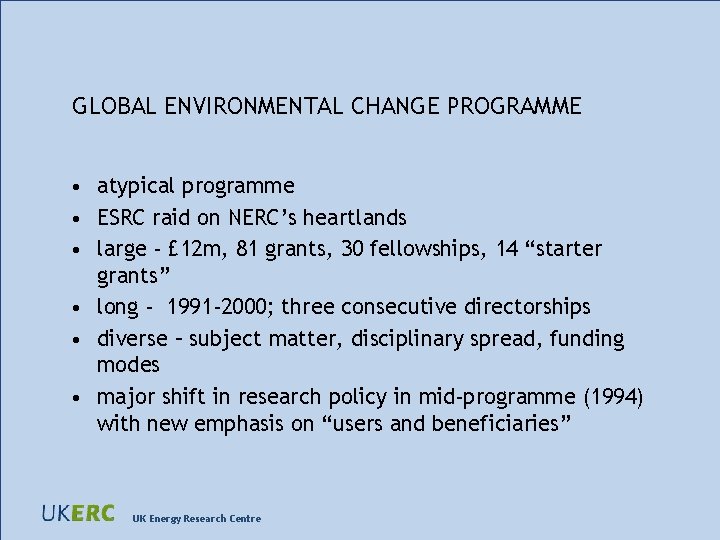
GLOBAL ENVIRONMENTAL CHANGE PROGRAMME • atypical programme • ESRC raid on NERC’s heartlands • large - £ 12 m, 81 grants, 30 fellowships, 14 “starter grants” • long - 1991 -2000; three consecutive directorships • diverse – subject matter, disciplinary spread, funding modes • major shift in research policy in mid-programme (1994) with new emphasis on “users and beneficiaries” UK Energy Research Centre
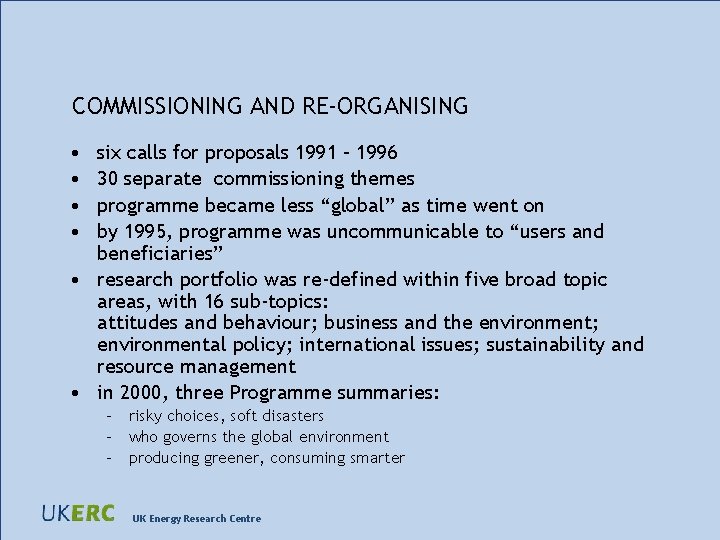
COMMISSIONING AND RE-ORGANISING • • six calls for proposals 1991 – 1996 30 separate commissioning themes programme became less “global” as time went on by 1995, programme was uncommunicable to “users and beneficiaries” • research portfolio was re-defined within five broad topic areas, with 16 sub-topics: attitudes and behaviour; business and the environment; environmental policy; international issues; sustainability and resource management • in 2000, three Programme summaries: – risky choices, soft disasters – who governs the global environment – producing greener, consuming smarter UK Energy Research Centre
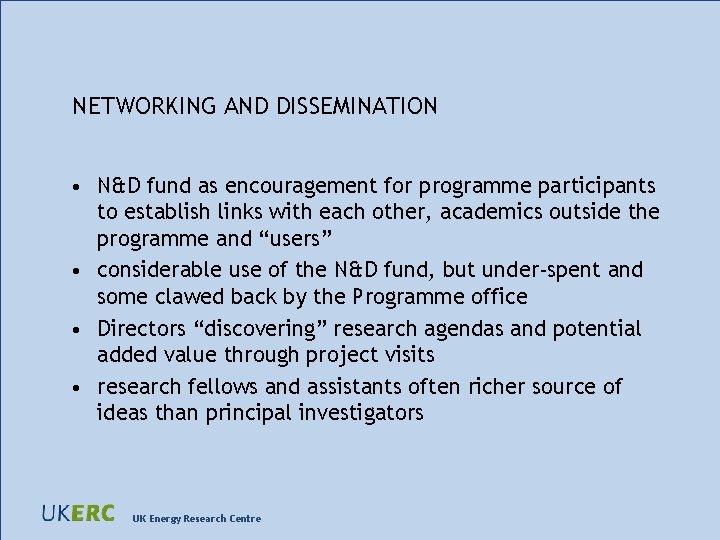
NETWORKING AND DISSEMINATION • N&D fund as encouragement for programme participants to establish links with each other, academics outside the programme and “users” • considerable use of the N&D fund, but under-spent and some clawed back by the Programme office • Directors “discovering” research agendas and potential added value through project visits • research fellows and assistants often richer source of ideas than principal investigators UK Energy Research Centre
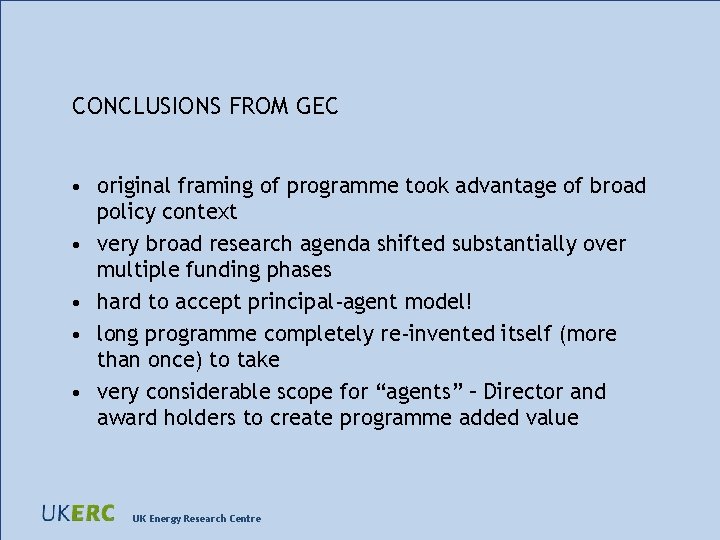
CONCLUSIONS FROM GEC • original framing of programme took advantage of broad policy context • very broad research agenda shifted substantially over multiple funding phases • hard to accept principal-agent model! • long programme completely re-invented itself (more than once) to take • very considerable scope for “agents” – Director and award holders to create programme added value UK Energy Research Centre
GLOBAL ENVIRONMENTAL CHANGE PROGRAMME SUCCESSES • • • capacity building created a research community(ies) international presence for UK social science quality of individual awards reasonable attributable to: – longevity – opportunities for joining up through N&D etc – accumulation (individuals holding consecutive awards) and gapfilling UK Energy Research Centre
(FAILED) ENVIRONMENT AND SUSTAINABILITY BID • steering group comprising: – – • • civil servants (including chair) business representatives of other research councils academics all members active participants in discussion supported by academic “consultant” bid not accepted by Council too broad, unfocused – 50 questions UK Energy Research Centre
RESEARCH EVALUATION COMMITTEE RECOMMENDATIONS • • closer involvement of users in research design less constrained commissioning timetables dialogue with short-listed applicants about content using second/multiple phase funding to fill out portfolios, adapt to policy needs • greater powers for Directors to intervene UK Energy Research Centre
PROGRAMME DESIGN • if the research councils, as “principals”, wanted to define a high impact “useful” research agenda would they do it this way? • large numbers of research questions to prompt innovative proposals, not define research agenda • invitation for widely spread research “communities” to participate • alternative … two-three tightly defined research questions, defined with user which each project must address • what do you want a programme to achieve? UK Energy Research Centre