
What are learning styles Information enters your brain
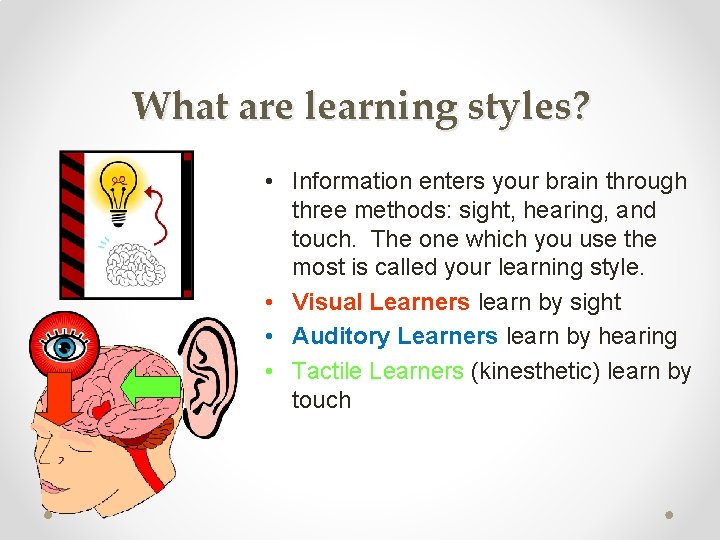
What are learning styles? • Information enters your brain through three methods: sight, hearing, and touch. The one which you use the most is called your learning style. • Visual Learners learn by sight • Auditory Learners learn by hearing • Tactile Learners (kinesthetic) learn by touch
Visual Learners • Prefer to see information such as pictures, diagrams, cartoons, or demonstrations • Picture words and concepts that they hear as images • Might get easily distracted during a lecture with no visual aids • Could become overwhelmed with intense visuals accompanied by lecture • Benefit from using charts, maps, notes, and flash cards when studying
Auditory Learners • • Prefer to hear information spoken Can absorb a lecture with little effort May not need detailed notes to learn Often avoid eye contact in order to concentrate • May read aloud to themselves • Like background music when they study

Tactile or Kinesthetic Learners • Prefer touch as their primary mode for taking in information • In traditional lecture situations, they should write out important facts • Create study sheets connected to vivid examples • Role-playing might help them learn and remember important ideas
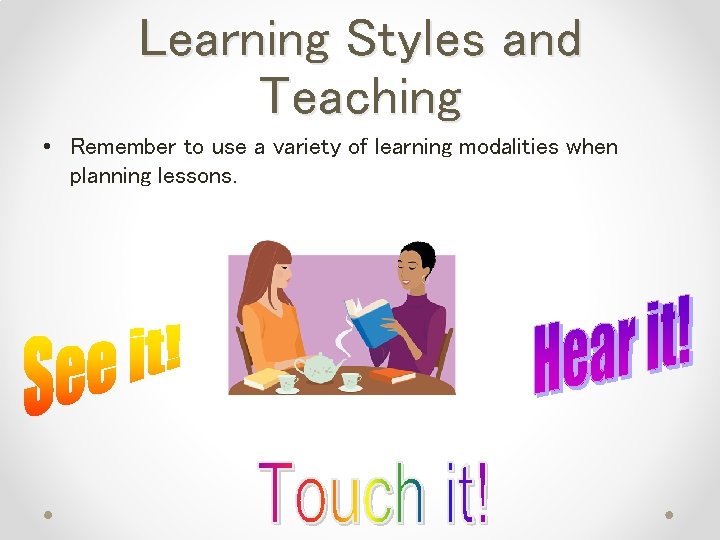
Learning Styles and Teaching • Remember to use a variety of learning modalities when planning lessons.
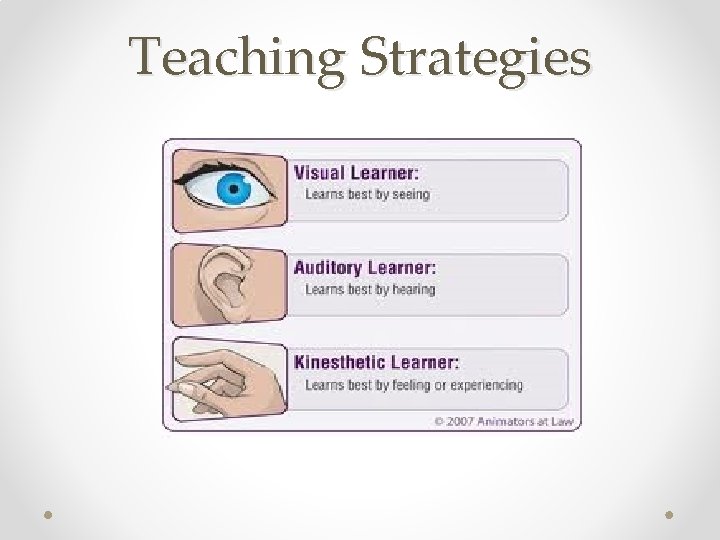
Teaching Strategies
Visual Learners Create Draw pictures to represent ideas, paint. Models Games: matching, Describe in detail Color, lines, and puzzles shapes Visual cues to remember Creative designs Have a “being there” Sculptures experience Graphic organizers Field trip Art media Visualization and Displays imagine Posters Graphics Charts Flowcharts Brochures Videos Pictures and illustrations Cartoons and caricatures Color-coding
Auditory Learners • Play word games for vocabulary Explain ideas Tell jokes, riddles, and limericks Trivia games Write Report - oral and written Explain Describe and discuss Interviews Label Give and follow directions Retell Essays Audio recordings Speeches Debates Research Projects Quizzes and tests Logs, journals, diaries Questions and answers
Tactile/Kinesthetic Learners • Opportunities to move and handle materials Trace and highlight Act out concepts and stories role playing Models Experiments Write or draw while listening Walk while thinking Use hands and arms for expression Imagine themselves in a situation Simulate Dance or mime Perform Create, construct, or develop Gestures or actions to support learning Manipulatives Inventions Sports participation Demonstrating using physical movement Exercises Hands-on experiences Simulations / Roleplaying Field trips Movement routines
What is your dominant learning style? • Complete the Learning Styles Inventory. • Are you surprised by the results? • How will this information assist you with planning instructional activities for students?
- Slides: 10