
What are gears Wheels with teeth Why gears
- Slides: 14
What are gears? Wheels with teeth
Why gears? They transfer motion from 1 part to another. Gears can increase speed. Gears can be used to pull heavy loads. But… …not both.
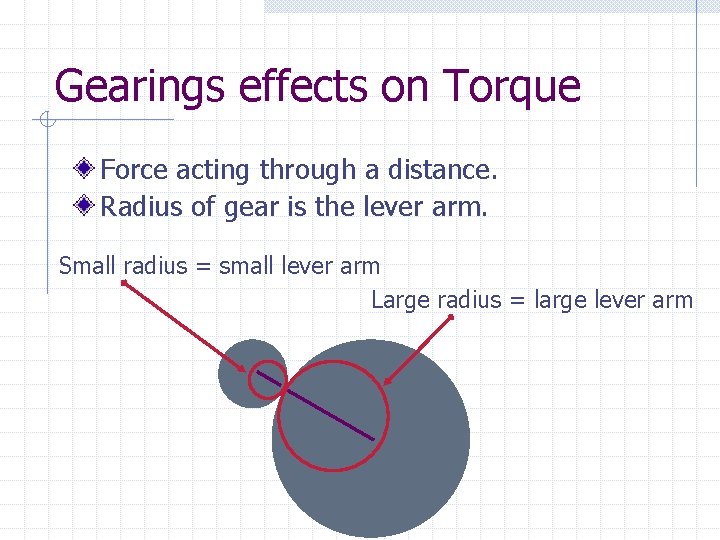
Torque can be described as a force causing rotational acceleration, that is, causing something to spin. Torque=Applied Force * distance to pivot Greater force or longer distance means more torque
Motors deliver torque in a small package They can be used wherever rotational motion is needed. Motors differ in the amount of torque they output and the speed at which they spin.
Gearing - Why? You don’t always have the perfect motor for the job Gearing is used to change the speed and torque output of a motor to suit your design needs Gearing results in a compromise between speed and torque. To gain speed, you must sacrifice torque. To gain torque, you must sacrifice speed.
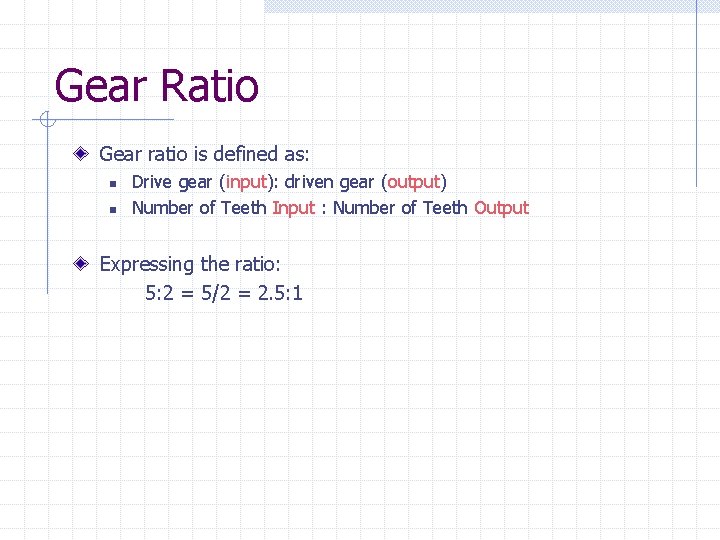
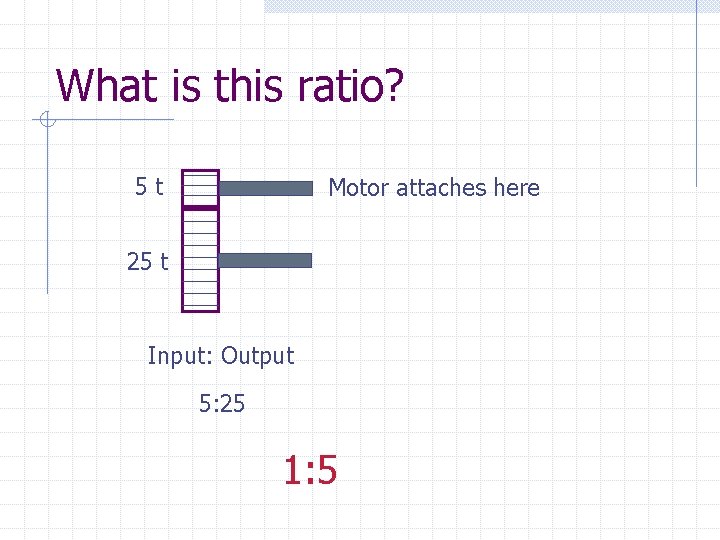
Gear Ratio Gear ratio is defined as: n n Drive gear (input): driven gear (output) Number of Teeth Input : Number of Teeth Output Expressing the ratio: 5: 2 = 5/2 = 2. 5: 1
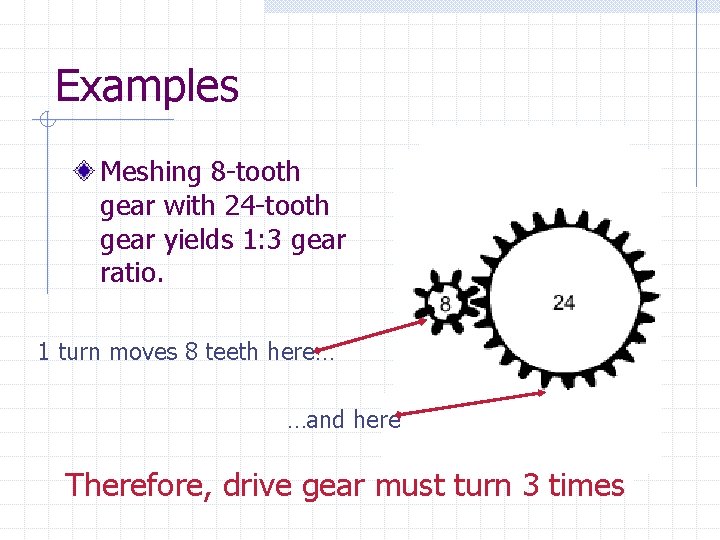
Examples Meshing 8 -tooth gear with 24 -tooth gear yields 1: 3 gear ratio. 1 turn moves 8 teeth here… …and here Therefore, drive gear must turn 3 times
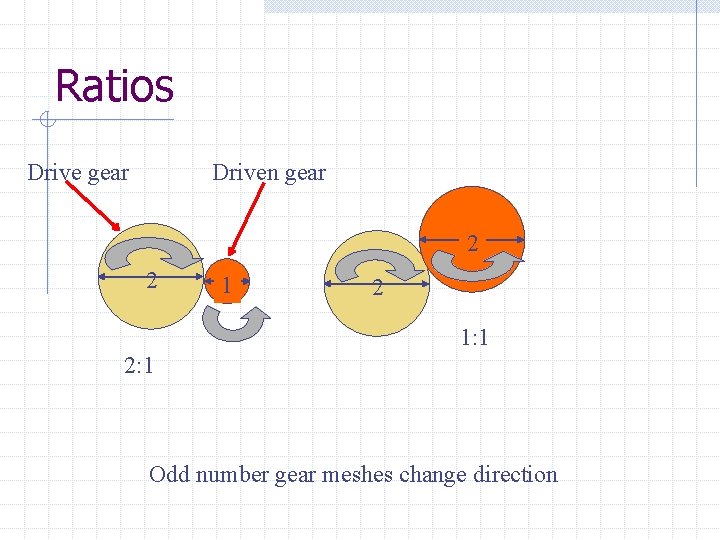
Ratios Drive gear Driven gear 2 2 1: 1 2: 1 Odd number gear meshes change direction
What is this ratio? 5 t Motor attaches here 25 t Input: Output 5: 25 1: 5
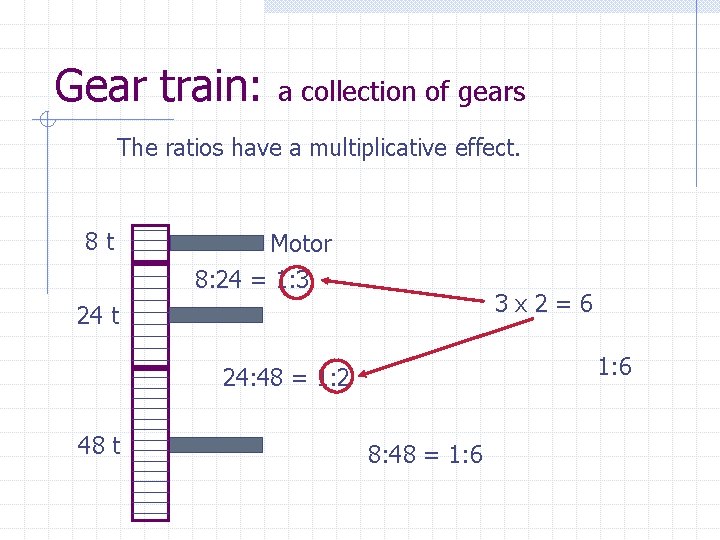
Gear train: a collection of gears The ratios have a multiplicative effect. 8 t Motor 8: 24 = 1: 3 3 x 2=6 24 t 1: 6 24: 48 = 1: 2 48 t 8: 48 = 1: 6
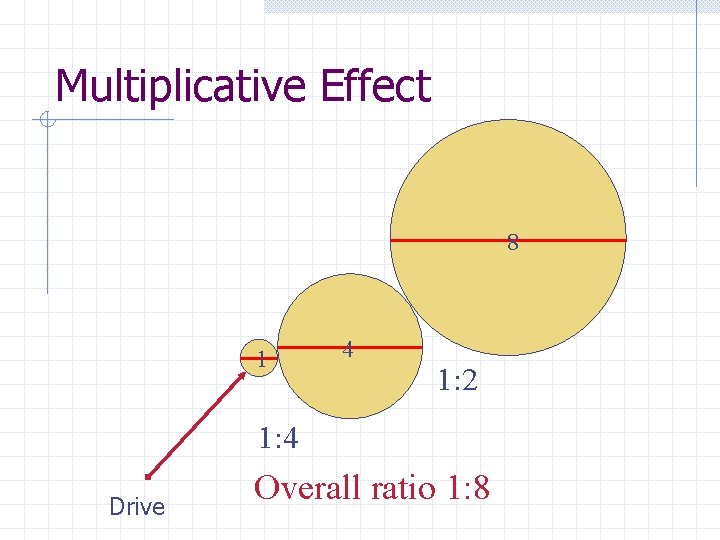
Multiplicative Effect 8 1 4 1: 2 1: 4 Drive Overall ratio 1: 8
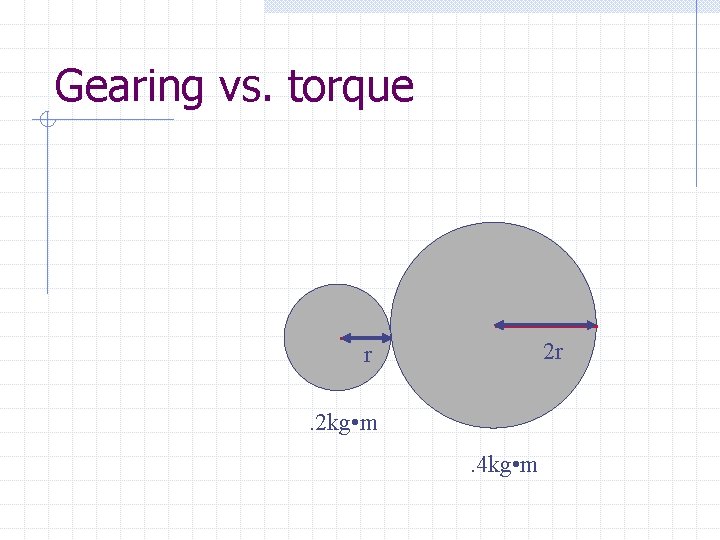
Gearings effects on Torque Force acting through a distance. Radius of gear is the lever arm. Small radius = small lever arm Large radius = large lever arm
Gearing vs. torque 2 r r. 2 kg • m. 4 kg • m
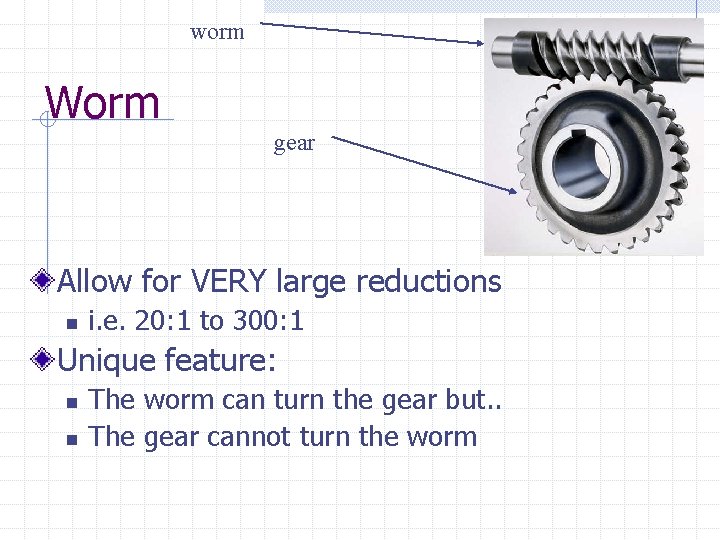
worm Worm gear Allow for VERY large reductions n i. e. 20: 1 to 300: 1 Unique feature: n n The worm can turn the gear but. . The gear cannot turn the worm