
What are fossils The remains imprints or traces


- Slides: 16
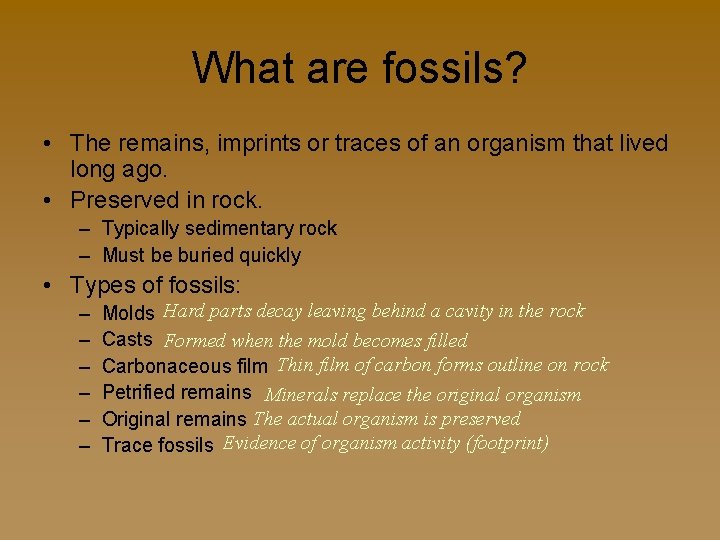
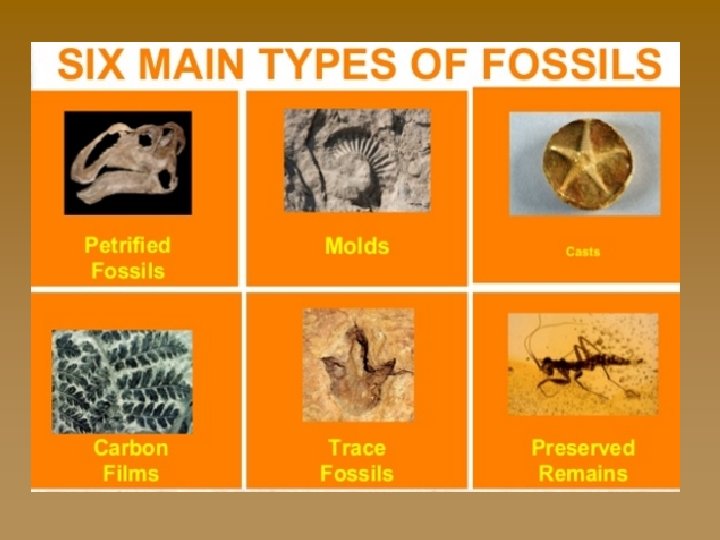
What are fossils? • The remains, imprints or traces of an organism that lived long ago. • Preserved in rock. – Typically sedimentary rock – Must be buried quickly • Types of fossils: – – – Molds Hard parts decay leaving behind a cavity in the rock Casts Formed when the mold becomes filled Carbonaceous film Thin film of carbon forms outline on rock Petrified remains Minerals replace the original organism Original remains The actual organism is preserved Trace fossils Evidence of organism activity (footprint)
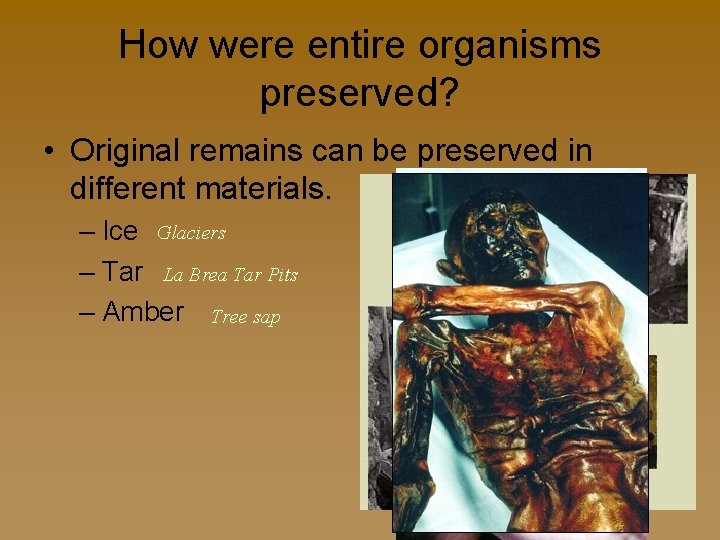
How were entire organisms preserved? • Original remains can be preserved in different materials. – Ice Glaciers – Tar La Brea Tar Pits – Amber Tree sap
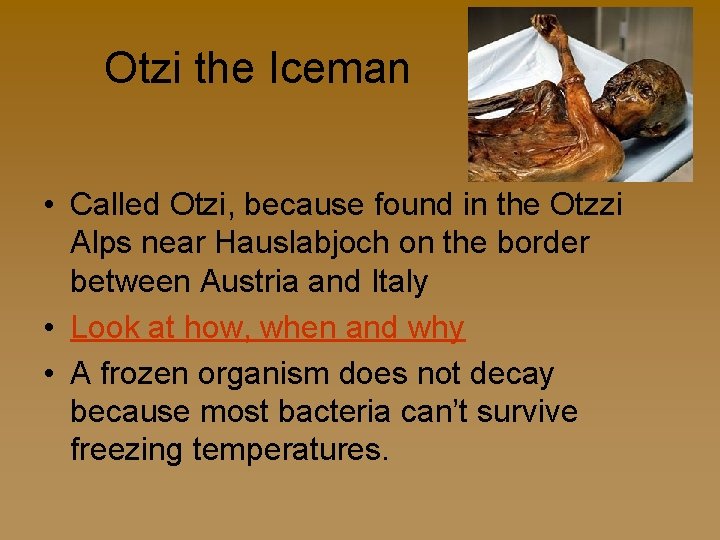
Otzi the Iceman • Called Otzi, because found in the Otzzi Alps near Hauslabjoch on the border between Austria and Italy • Look at how, when and why • A frozen organism does not decay because most bacteria can’t survive freezing temperatures.
Oldest human found • Omo • Pics of Skulls
Different types of fossils • Mummification-Fossilized remains of an organism found in very dry places • Gastrolith-Fossilized stone from the digestive system of a dinosaur (stomach stone)
Diff types of Fossils • Coprolite-fossilized dung or waste • Petrification-Minerals replace organic material • Imprint-carbonized impressions of plants and fish
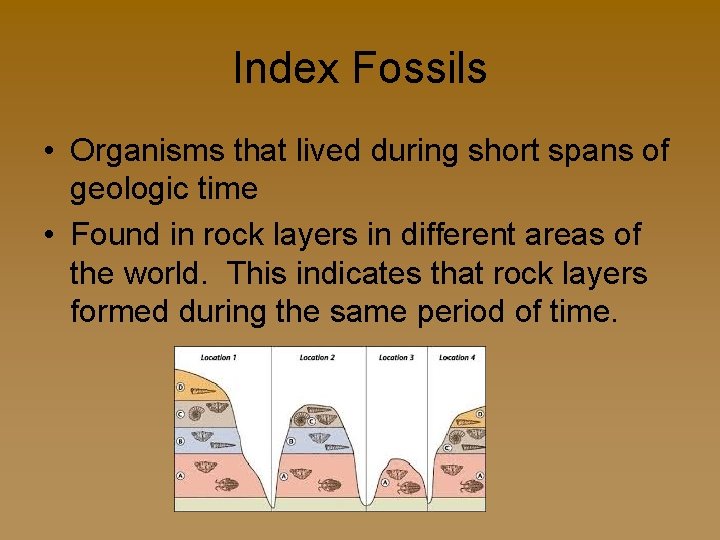
Index Fossils • Organisms that lived during short spans of geologic time • Found in rock layers in different areas of the world. This indicates that rock layers formed during the same period of time.
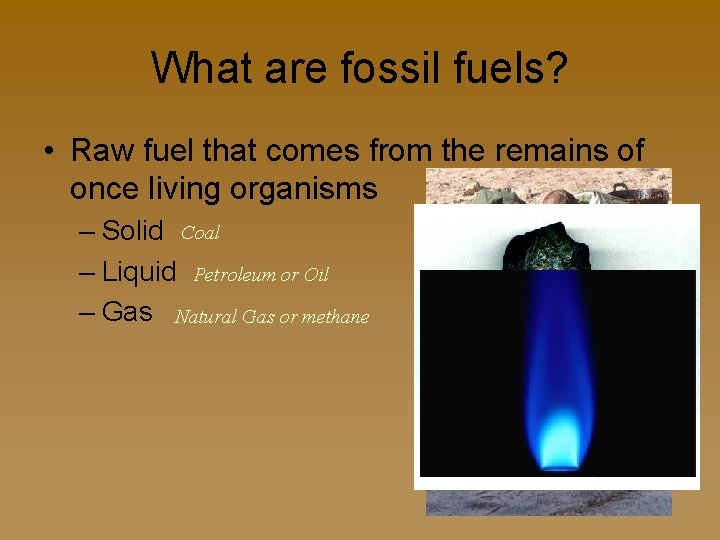
What are fossil fuels? • Raw fuel that comes from the remains of once living organisms – Solid Coal – Liquid Petroleum or Oil – Gas Natural Gas or methane
Why do scientists study fossils? • • Clues to the past Global changes & regional changes Environmental Natural disasters Climate change Geologic Evolution
How can relative age of rocks be determined? • Using the law of superposition relative age can be determined • Relative age is comparing one objects age to another. – If there are three layers • Top is youngest • Then middle • Bottom is oldest – Index fossil is always found in a particular layer
How is absolute age determined? • The specific age of a rock or fossil • Uses radioactive decay – Half-life is the amount of time it takes for ½ of the mass of an element to decay into, more stable, element. – The rate of decay can be measured – Particular elements have a constant rate of decay – Carbon-14 dating for living things – Not always 100% accurate! Half-life
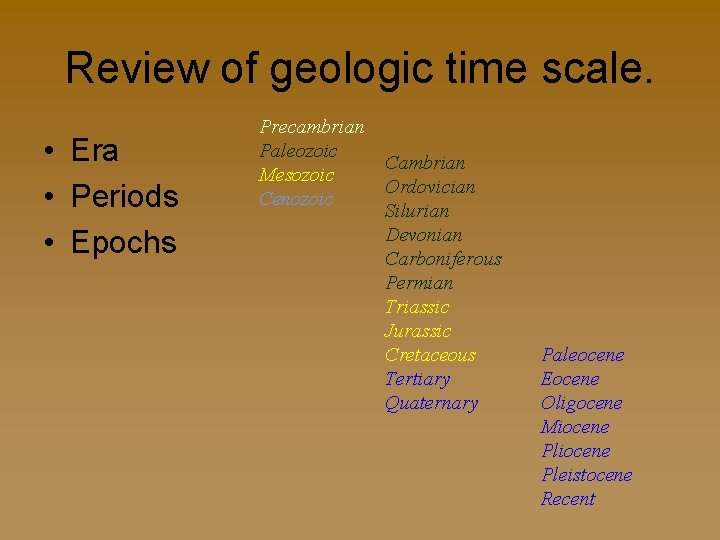
Review of geologic time scale. • Era • Periods • Epochs Precambrian Paleozoic Mesozoic Cenozoic Cambrian Ordovician Silurian Devonian Carboniferous Permian Triassic Jurassic Cretaceous Tertiary Quaternary Paleocene Eocene Oligocene Miocene Pleistocene Recent
What is a fossil? ? ? • Play palentologists studying fossils • Play palenotologists studying tracks and traces