
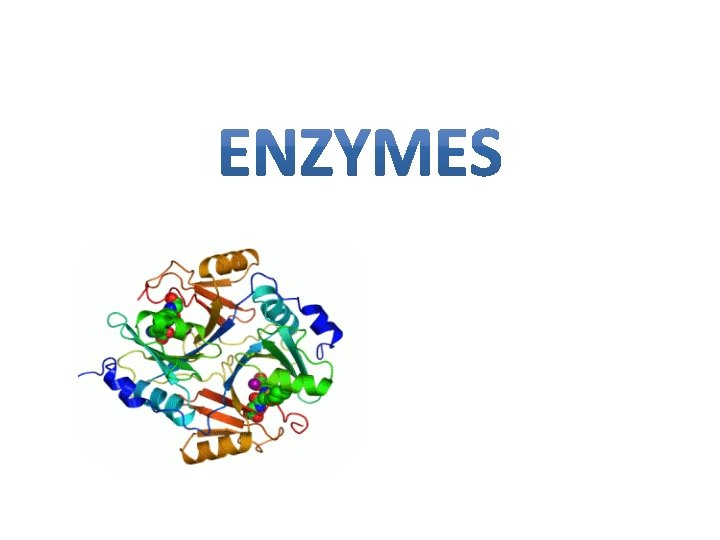
What are enzymes Enzymes are the most important
- Slides: 21
What are enzymes? ? • Enzymes are the most important tools in the living cells. • Enzymes are defined as being organic, colloidal catalyst formed of proteins and produced by the living organisms. • In the cell there are many enzymes. • Enzymes are responsible for all the chemical reactions necessary for life.
• Life is simply a system of cooperating enzyme reactions: growth, reproduction, muscular activities, digestion, all these physiological functions need the presence of enzymes. • Enzymes occur in different levels in the various organs of animals and plants. • Enzymes vary according to the substance they acts on.
• Enzymes are biochemical catalyst possessing definite organic protein formed by living tissues, and in their action, they are independent on the presence of theses tissues. • Their actions are sensitive to temperature, p. H and other environmental changes. • The term substrate is used to indicate the specific substance attacked by enzymes.
• Intracellular enzymes: Some enzymes are fixed to the cells and cannot be obtained except after crushing and destroying the cells. • Extracellular enzymes: some enzymes exist free and can be easily extracted. Their action is outside the cells.
CHEMICAL COMPOSITION OF ENZYMES • Enzymes contain colloidal carrier formed of protein and an active group. • This active group which is not protein can be easly separated. It is called coenzyme. Many coenzymes are vitamins in nature. • Co-enzymes is a part of the enzymes. It is stable diffusuble and non-protein substance. • The co-enzyme alone cannot perform any enzymatic activity, but when present associated with the apoenzyme, the enzymatic reaction can be done.
Classification of enzymes • Simple enzymes: formed of simple proteins eg. Lipase, amylase and protease. • Complex or conjugated protein enzymes: • a) enzymes possessing prosthetic as active groups. • B) Enzymes possessing co-enzymes as the active groups. • The apoenzyme (protein fraction) + co-enzyme = Holoenzymes
PROPERTIES OF ENZYMES • All enzymes are protein, high molecular weight. • Enzymes are soluble in water, diluted glycerol and diluted alcohol. • The temperature is important for the enzymatic activity. High temperature destroys the enzymes. The optimum temperature for enzymes action is 37 -17 c • They are sensitive to the p. H. High concentration of acids and alkalis destroys the enzymes.
PROPERTIES OF ENZYMES • Enzymes are affected by ultra violet light and x -ray irradiation. • Enzymes may be found in the cells containing the substrate, while others are present in different cells of the same tissue. • Enzymes may be present in the cells in an inactive from (zymogen or proenzymes). For the activation of zymogen, kinases are essential.
• The kinase is defined as a naturally occurring organic substance necessary for the conversion of the inactive zymogen to the active form. • Enzymes are specific in their action. The enzymes can catalyse a small range of reaction and in many cases catalyse only one type of reaction. • The enzyme unit is defined as the definite amount of an enzyme which in a fixed time, temperture and p. H is able to split an exact amount of substrate
• The name of the enzyme may be derived from the reaction which it catalyses. eg. Oxidase, dehydrogenase. • Also it may be derived from the name of the substrate eg. lipase, sucrase. • The suffix ase indicates that it is an enzyme. If the enzyme acts on lipids it is called lipase. Both amylases and lipases are hydrolases.
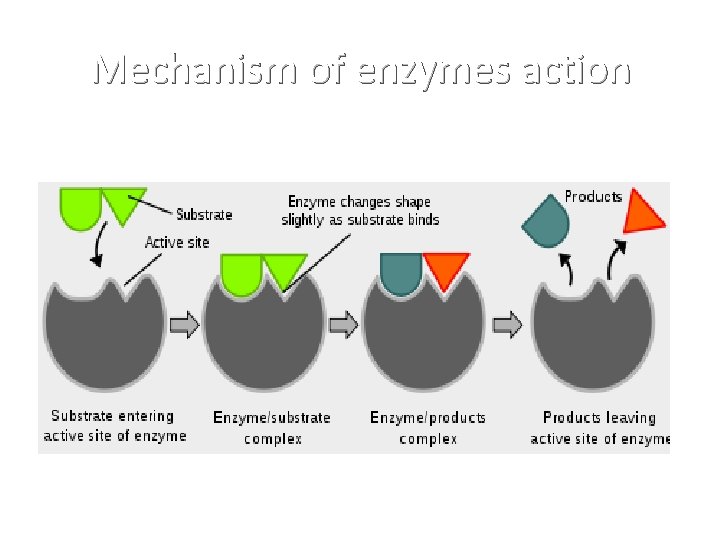
Mechanism of enzymes action • To explain enzyme action, there is a union of some sort between the enzyme and its substrate. • The intermediate enzyme –substrate complexs, decomposes giving rise to the free enzyme once more and the substrate is splitten to its end products.
Mechanism of enzymes action
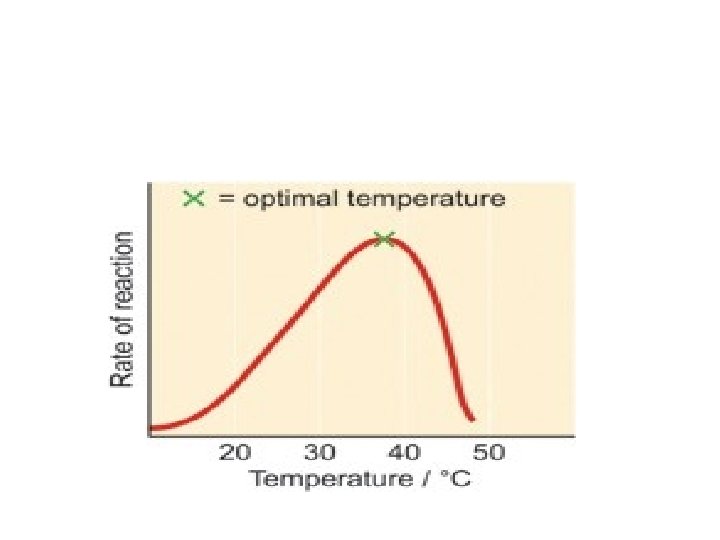
Factors affecting the enzyme action 1 -Temperature: All enzymes are irreversibly destroyed by heat when the temperature is between 70 -100 c. This is due to the denaturation of the protein of the enzyme. • Optimum Temperature: It is the temperature at which the enzymes exhibits maximum activity and below or above this optimum temperature the velocity of the reaction drops rapidly.
Factors affecting the enzyme action • The optimum temperature for most enzymes is 40 c. • An increase in the rate of the reaction until the maximum rate is reached. • At higher temperature, the rate of reaction decrease with rise of the temperature, due to denaturation of the protein part of the enzyme by heat.
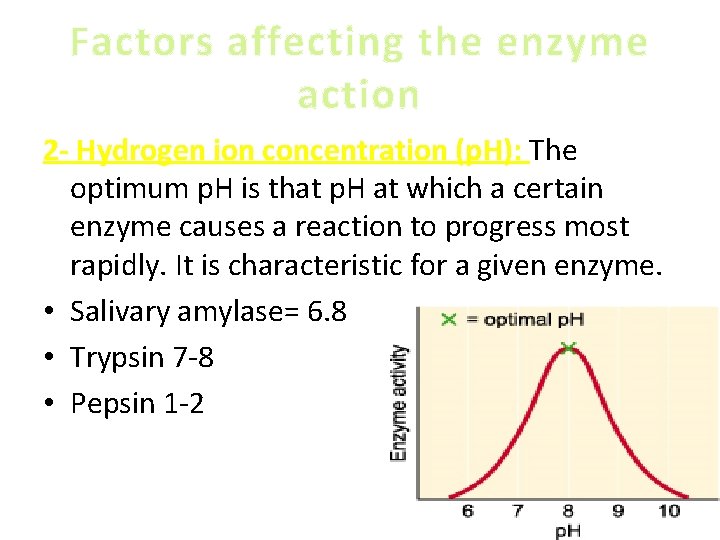
Factors affecting the enzyme action 2 - Hydrogen ion concentration (p. H): The optimum p. H is that p. H at which a certain enzyme causes a reaction to progress most rapidly. It is characteristic for a given enzyme. • Salivary amylase= 6. 8 • Trypsin 7 -8 • Pepsin 1 -2
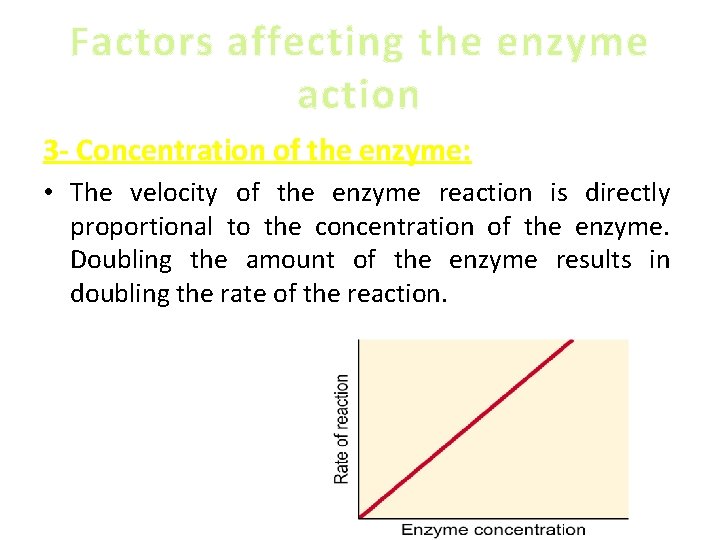
Factors affecting the enzyme action 3 - Concentration of the enzyme: • The velocity of the enzyme reaction is directly proportional to the concentration of the enzyme. Doubling the amount of the enzyme results in doubling the rate of the reaction.
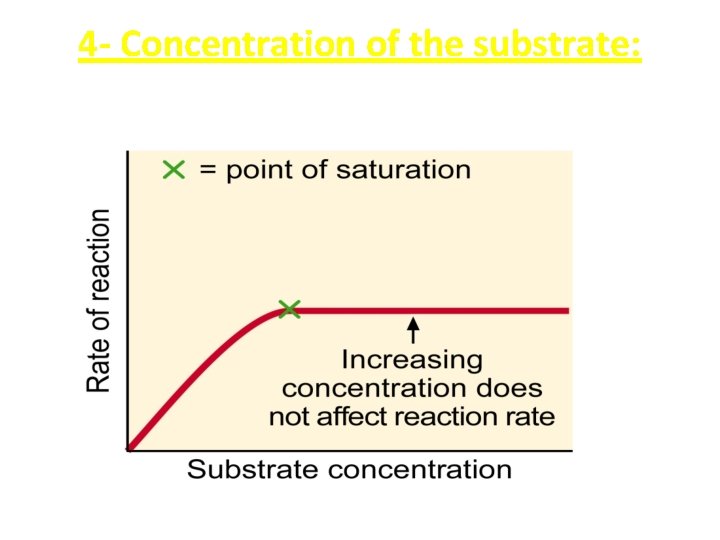
4 - Concentration of the substrate: • If the amount of enzyme is fixed, the rate of the enzymatic reaction is proportional to the concentration of the substrate, till a certain concentration in which any increase in the amount of the substrate causes no further increase in the velocity of the reaction.
4 - Concentration of the substrate:
• • 5 - Surface area of the substrate 6 - Time factor 7 - Accumulation of end products 8 - Presence or absence of inhibitors