
WHAT ARE EMOTIONS n Happiness fear anger affection


- Slides: 31
WHAT ARE EMOTIONS ? n Happiness, fear, anger, affection, shame, disgust, surprise, lust, sadness, elation, love, frustration, anxiety, failure, achievement etc. The above are the emotions which directly affect our day-today life. There are TWO dimensions of emotions: n n Physiological side: ‘Emotion’ is a complex state of human mind, involving bodily changes of widespread character such as breathing, pounding heart, flushed face, sweating palms, pulse rate, gland secretions, etc. Psychological side: a state of excitement or perturbation marked by strong feelings.
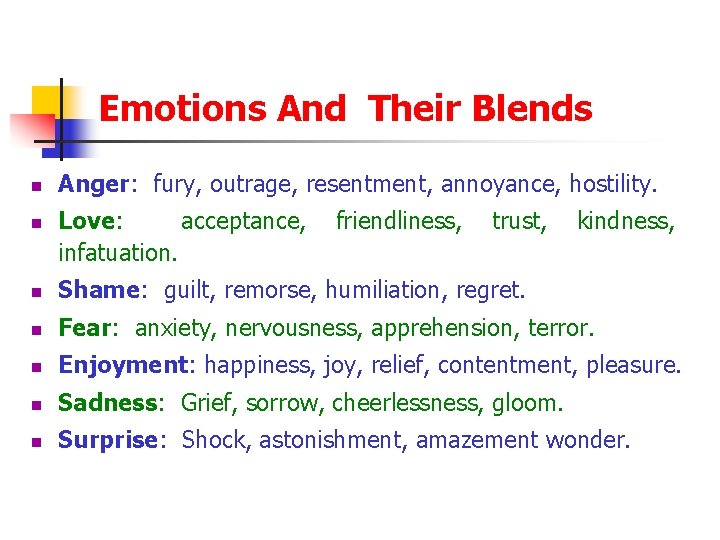
Emotions And Their Blends n n Anger: fury, outrage, resentment, annoyance, hostility. Love: acceptance, infatuation. friendliness, trust, kindness, n Shame: guilt, remorse, humiliation, regret. n Fear: anxiety, nervousness, apprehension, terror. n Enjoyment: happiness, joy, relief, contentment, pleasure. n Sadness: Grief, sorrow, cheerlessness, gloom. n Surprise: Shock, astonishment, amazement wonder.
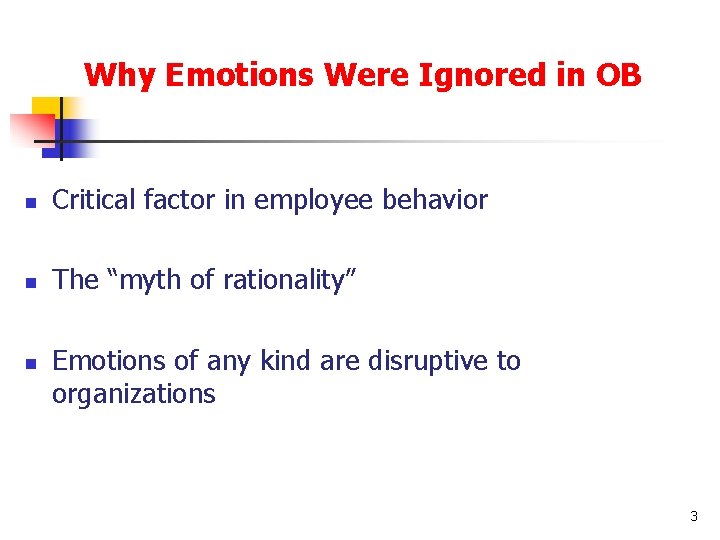
Why Emotions Were Ignored in OB n Critical factor in employee behavior n The “myth of rationality” n Emotions of any kind are disruptive to organizations 3
What Are Emotions? Affect A broad range of feelings that people experience Emotions Intense feelings that are directed at someone or something Moods Feelings that tend to be less intense than emotions and that lack a contextual stimulus 4
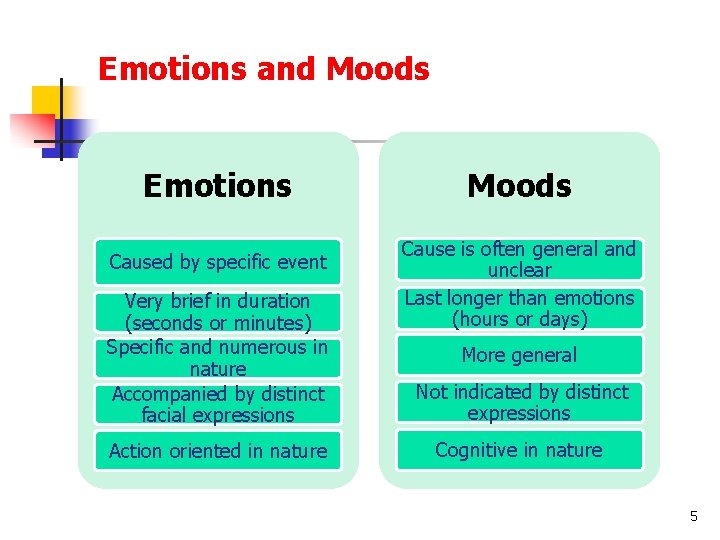
Emotions and Moods Emotions Caused by specific event Very brief in duration (seconds or minutes) Specific and numerous in nature Accompanied by distinct facial expressions Action oriented in nature Moods Cause is often general and unclear Last longer than emotions (hours or days) More general Not indicated by distinct expressions Cognitive in nature 5
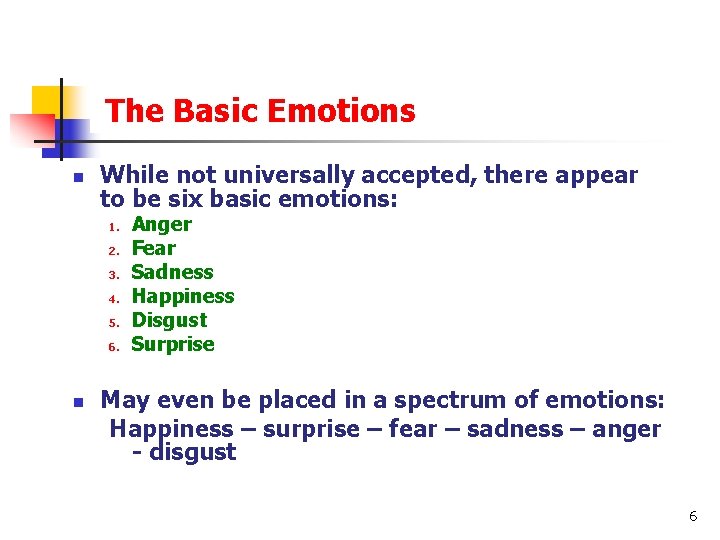
The Basic Emotions n While not universally accepted, there appear to be six basic emotions: 1. 2. 3. 4. 5. 6. n Anger Fear Sadness Happiness Disgust Surprise May even be placed in a spectrum of emotions: Happiness – surprise – fear – sadness – anger - disgust 6
Sources of Emotions and Moods n n n n n Personality Day and Time of the Week Weather Stress Social Activities Sleep Exercise Age Gender 7
Gender and Emotions n n Women n Can show greater emotional expression n Experience emotions more intensely n Display emotions more frequently n Are more comfortable in expressing emotions n Are better at reading others’ emotions Men n Believe that displaying emotions is inconsistent with the male image n Are innately less able to read and to identify with others’ emotions n Have less need to seek social approval by showing positive emotions 8
What Is the Function of Emotion? n What Functions Do Emotions Serve? n n n Darwin argued they help in survival problemsolving Evolutionary psychology: people must experience emotions as there is a purpose behind them Not all researchers agree with this assessment 9
Emotional Labor An employee’s expression of organizationally desired emotions during interpersonal transactions at work. n Emotional Dissonance: n Employees have to project one emotion while simultaneously feeling another n Can be very damaging and lead to burnout 10
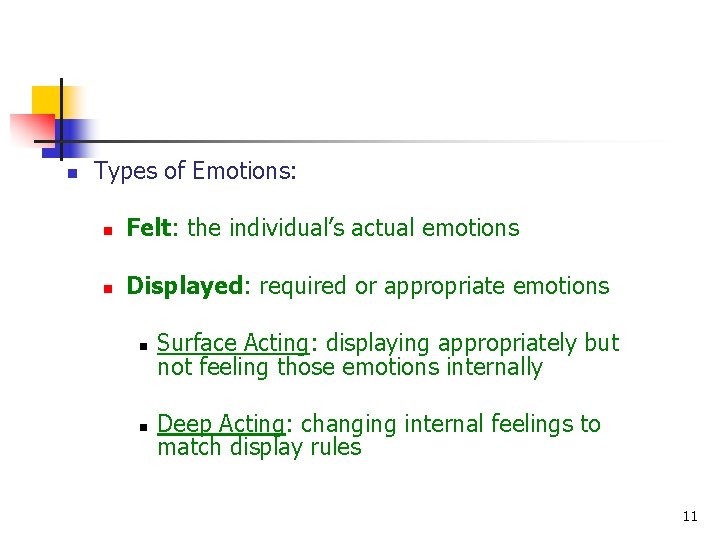
n Types of Emotions: n Felt: the individual’s actual emotions n Displayed: required or appropriate emotions n n Surface Acting: displaying appropriately but not feeling those emotions internally Deep Acting: changing internal feelings to match display rules 11
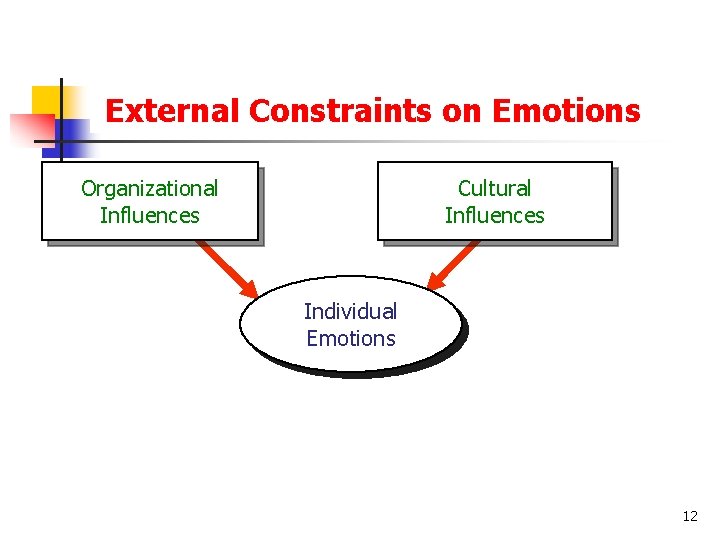
External Constraints on Emotions Organizational Influences Cultural Influences Individual Emotions 12
EXTERNAL CONTSTRAINTS ON EMOTIONS 1. ORGANIZATIONAL EXPECTATIONS q Job requirements q Doctors & air-traffic controllers – never show emotions & get excited or panic q Sports announcers, lawyers – show emotions to be effective 13
2. CULTURAL INFLUENCES q Americans value enthusiasm q Americans – smiling is a sign of friendliness – viewed positively q Chinese consider negative emotions to be useful and constructive q Norms for expressing emotions differ across cultural groups: q Japanese - smiling indicates a lack of intelligence q French – make no effort to hide their personal feelings about customers 14
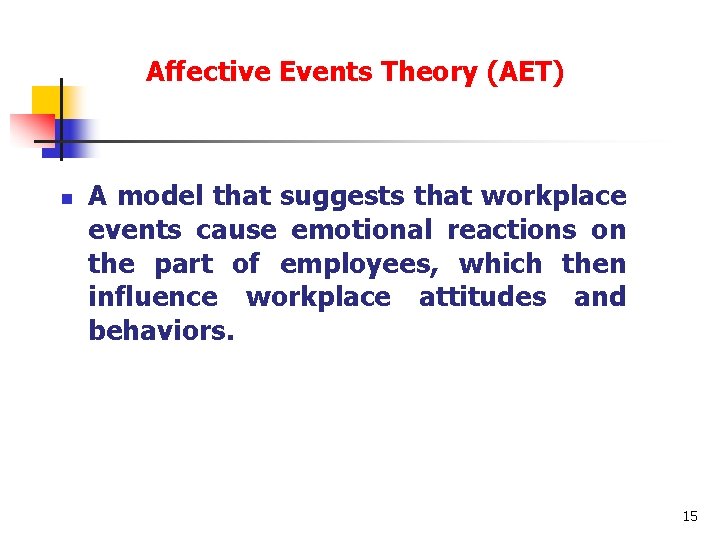
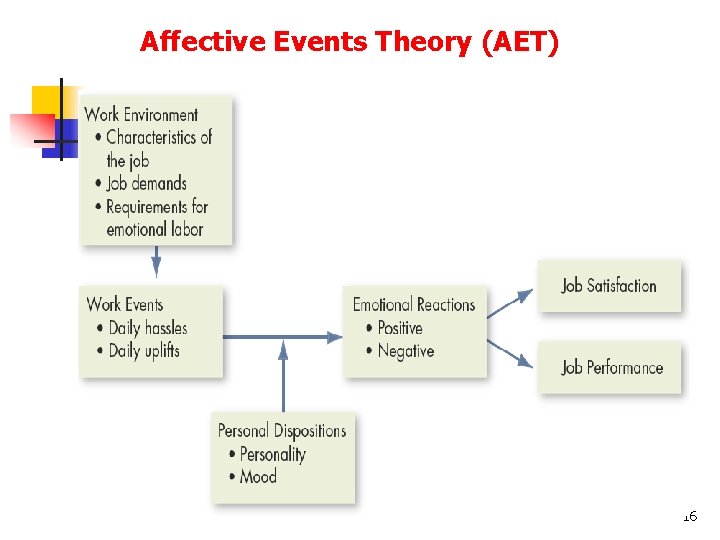
Affective Events Theory (AET) n A model that suggests that workplace events cause emotional reactions on the part of employees, which then influence workplace attitudes and behaviors. 15
Affective Events Theory (AET) 16
AET Implies n n n Emotions provide valuable insights about behavior Emotions, and the minor events that cause them, should not be ignored at work: they accumulate Current and past emotions affect job satisfaction Emotional fluctuations create variations in job satisfaction and performance. Both negative and positive emotions can distract workers and reduce job performance. 17
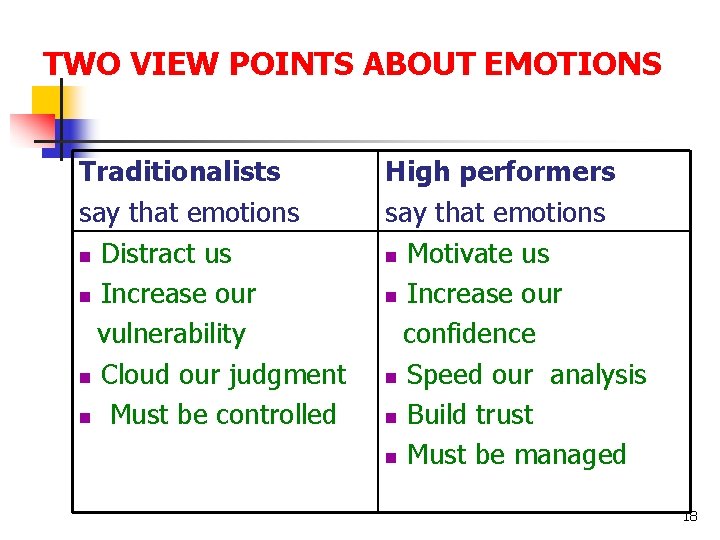
TWO VIEW POINTS ABOUT EMOTIONS Traditionalists say that emotions n Distract us n Increase our vulnerability n Cloud our judgment n Must be controlled High performers say that emotions n Motivate us n Increase our confidence n Speed our analysis n Build trust n Must be managed 18
OB Applications of Emotions and Moods n n n n Emotions and Selection Decision Making Creativity Motivation Leadership Customer Services Deviant Workplace Behaviors 19
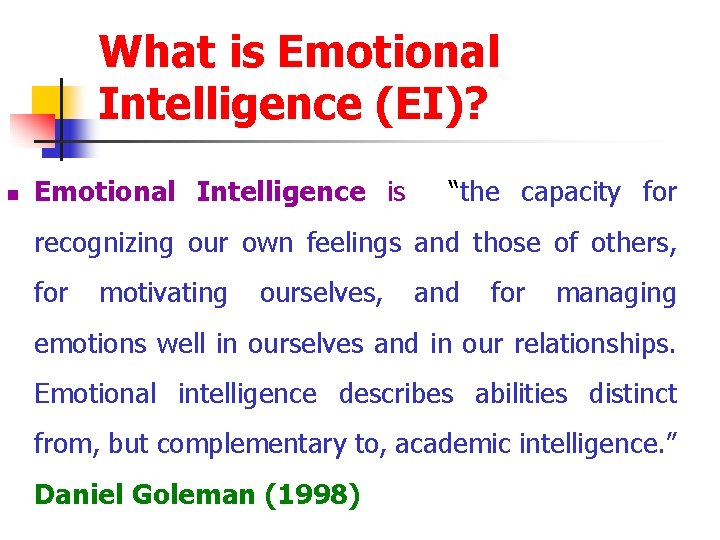
What is Emotional Intelligence (EI)? n Emotional Intelligence is “the capacity for recognizing our own feelings and those of others, for motivating ourselves, and for managing emotions well in ourselves and in our relationships. Emotional intelligence describes abilities distinct from, but complementary to, academic intelligence. ” Daniel Goleman (1998)
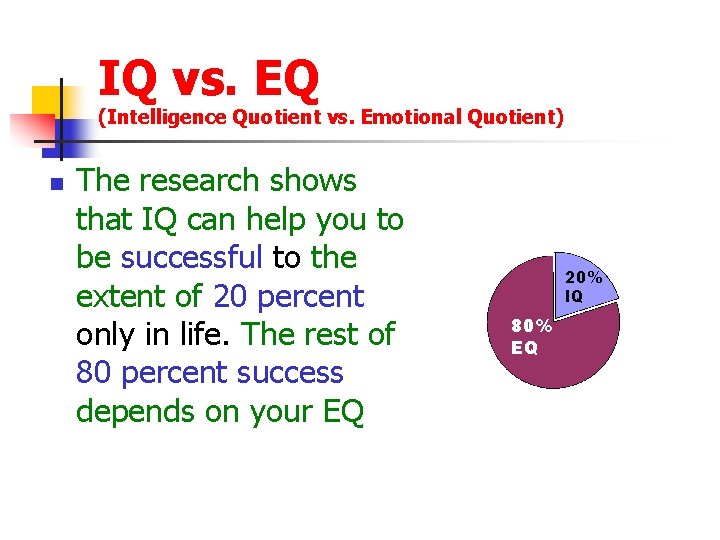
IQ vs. EQ (Intelligence Quotient vs. Emotional Quotient) n The research shows that IQ can help you to be successful to the extent of 20 percent only in life. The rest of 80 percent success depends on your EQ 20% IQ 80% EQ
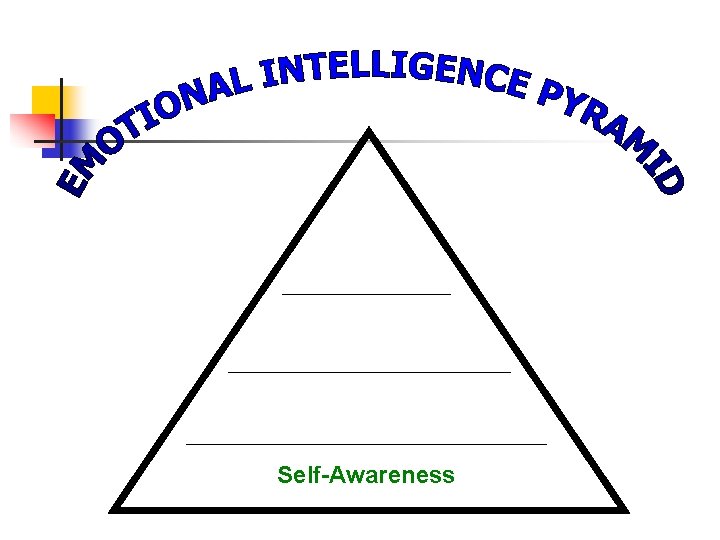
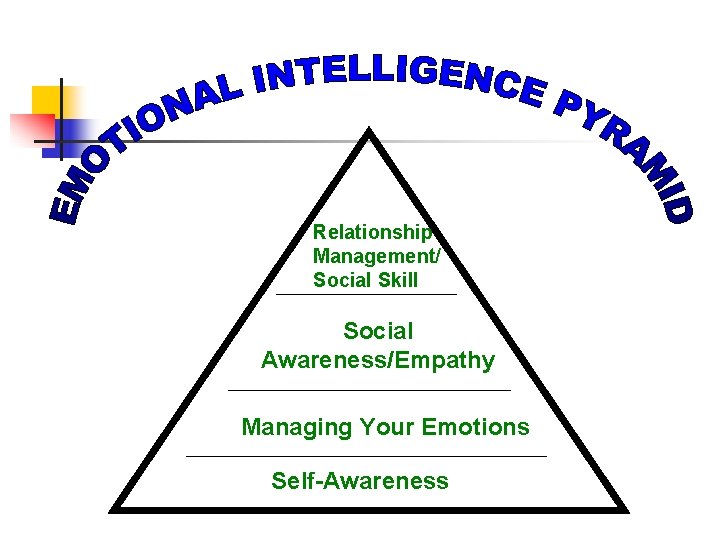
Self-Awareness
SELF AWARENESS n n n Knowing what we are feeling in the moment and using those preferences to guide our decision making; having a realistic assessment of our own abilities and a well-grounded confidence sense of self-
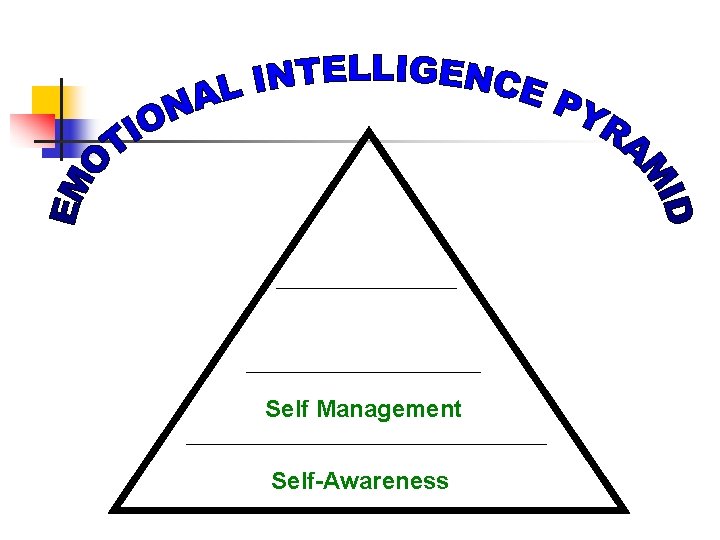
Self Management Self-Awareness
Managing Your Emotions n n n Emotional self-control: Keeping disruptive emotions and impulses under control; Transparency: Displaying honesty and integrity; trustworthiness; Adaptability: Flexibility in adapting to changing situation or overcoming obstacles; Achievement: The drive to improve performance to meet inner standards of excellence; Initiative: Readiness to act and seize opportunities; Optimism: Seeing the good side of events.
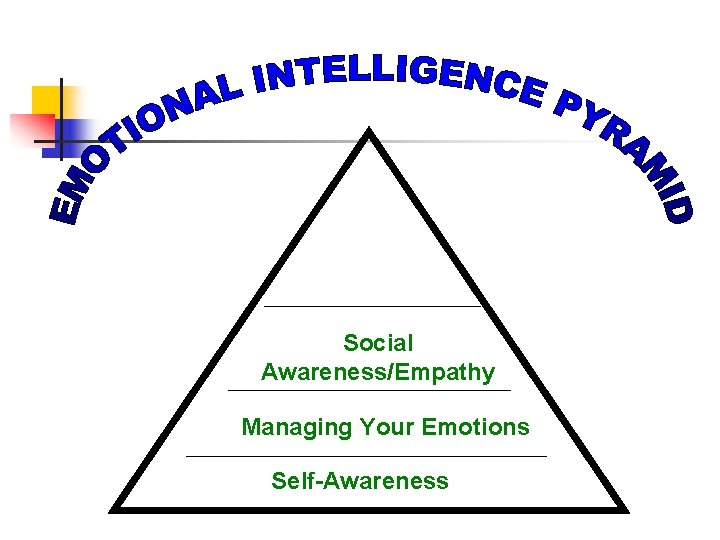
Social Awareness/Empathy Managing Your Emotions Self-Awareness
Social Awareness/Empathy n Sensing what people are feeling n Being able to take their perspective n Cultivating rapport and attunement with a broad diversity of people
Relationship Management/ Social Skill Social Awareness/Empathy Managing Your Emotions Self-Awareness
Social Skills n Handling emotions in relationships well and accurately; n reading social situations and networks; n Interacting smoothly; n Using these skills to persuade and lead, negotiate and settle disputes, for cooperation and teamwork.
Relationship Management n n n Inspirational leadership: Guiding and motivating with a compelling vision Influence: Wielding a range of tactics for persuasion; Developing Others: Bolstering others’ abilities through feedback and guidance; Change Catalyst: Initiating, managing and leading in a new direction; Conflict management: Resolving disagreements Building bonds: Cultivating and maintaining a web of relationships
n “Anyone can be angry—that is easy. But to be angry with the right person, to the right degree, at the right time, for the right purpose, and in the right way — that is not easy. ”