
What and why l Portfolio management is actually


- Slides: 32
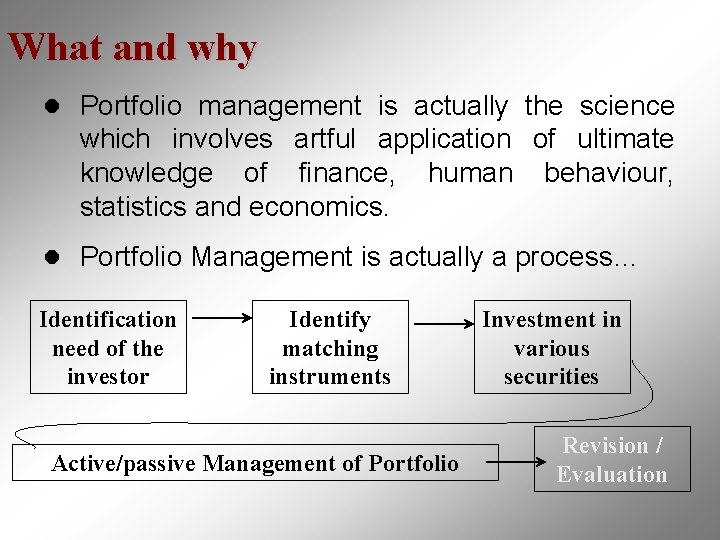
What and why l Portfolio management is actually the science which involves artful application of ultimate knowledge of finance, human behaviour, statistics and economics. l Portfolio Management is actually a process… Identification need of the investor Identify matching instruments Active/passive Management of Portfolio Investment in various securities Revision / Evaluation
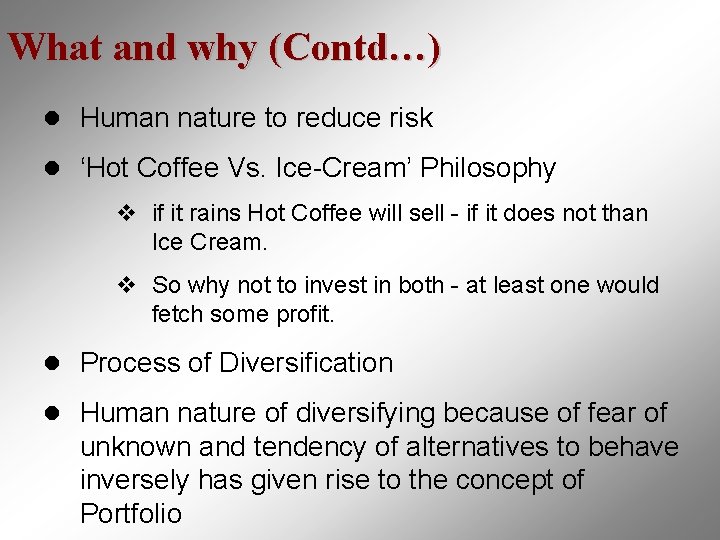
What and why (Contd…) l Human nature to reduce risk l ‘Hot Coffee Vs. Ice-Cream’ Philosophy v if it rains Hot Coffee will sell - if it does not than Ice Cream. v So why not to invest in both - at least one would fetch some profit. l Process of Diversification l Human nature of diversifying because of fear of unknown and tendency of alternatives to behave inversely has given rise to the concept of Portfolio
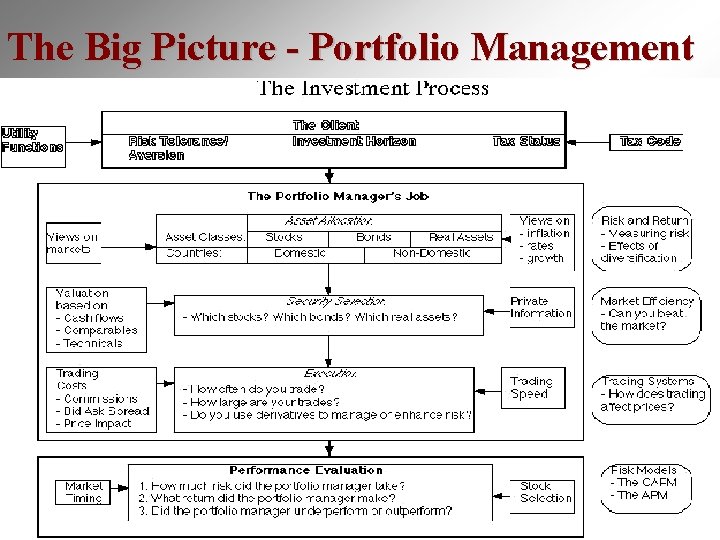
The Big Picture - Portfolio Management
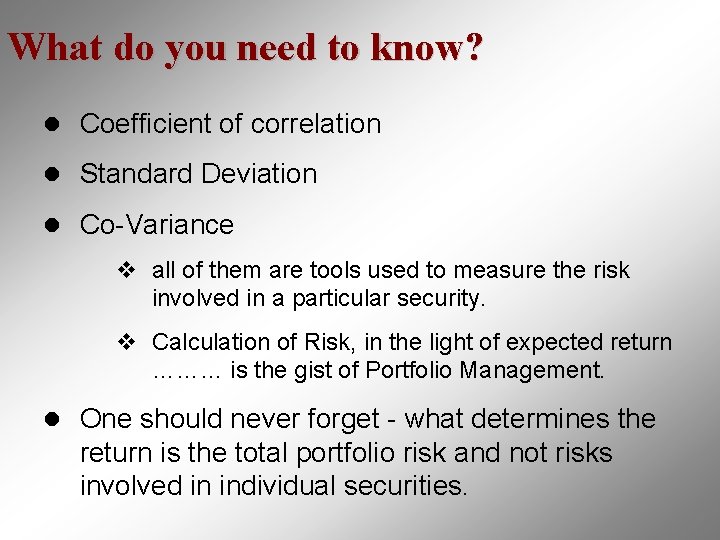
What do you need to know? l Coefficient of correlation l Standard Deviation l Co-Variance v all of them are tools used to measure the risk involved in a particular security. v Calculation of Risk, in the light of expected return ……… is the gist of Portfolio Management. l One should never forget - what determines the return is the total portfolio risk and not risks involved in individual securities.
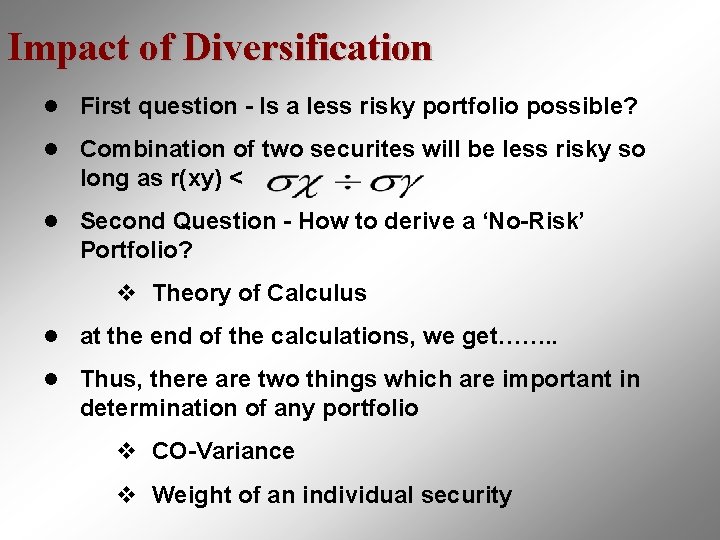
Impact of Diversification l First question - Is a less risky portfolio possible? l Combination of two securites will be less risky so long as r(xy) < l Second Question - How to derive a ‘No-Risk’ Portfolio? v Theory of Calculus l at the end of the calculations, we get……. . l Thus, there are two things which are important in determination of any portfolio v CO-Variance v Weight of an individual security
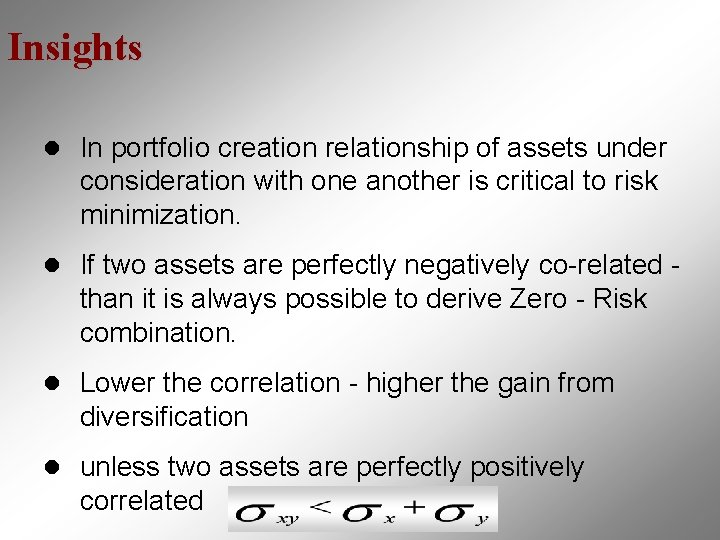
Insights l In portfolio creation relationship of assets under consideration with one another is critical to risk minimization. l If two assets are perfectly negatively co-related - than it is always possible to derive Zero - Risk combination. l Lower the correlation - higher the gain from diversification l unless two assets are perfectly positively correlated
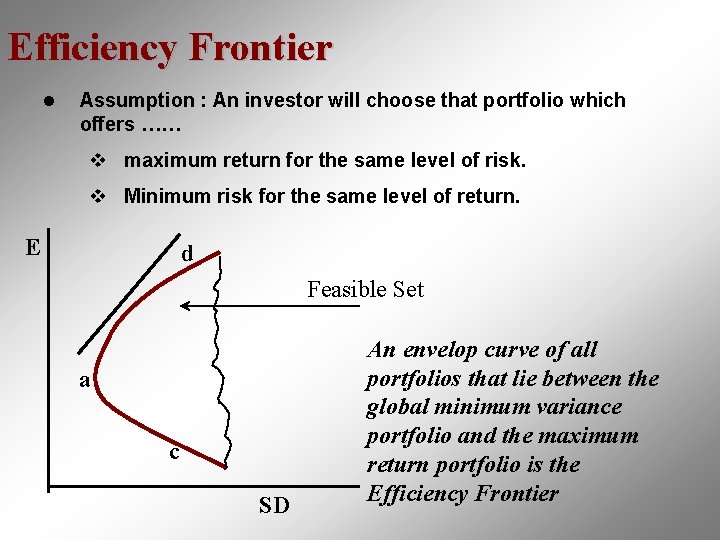
Efficiency Frontier l Assumption : An investor will choose that portfolio which offers …… v maximum return for the same level of risk. v Minimum risk for the same level of return. E d Feasible Set a c SD An envelop curve of all portfolios that lie between the global minimum variance portfolio and the maximum return portfolio is the Efficiency Frontier
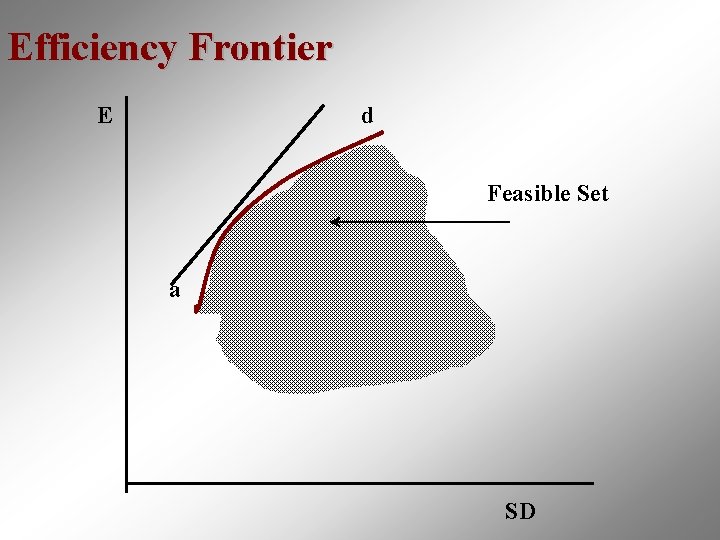
Efficiency Frontier E d Feasible Set a SD
Generation Efficient Portfolios l Two constraints v Risk v Return l Two Approaches v Calculus v Quadratic Programming l formulation of Problem
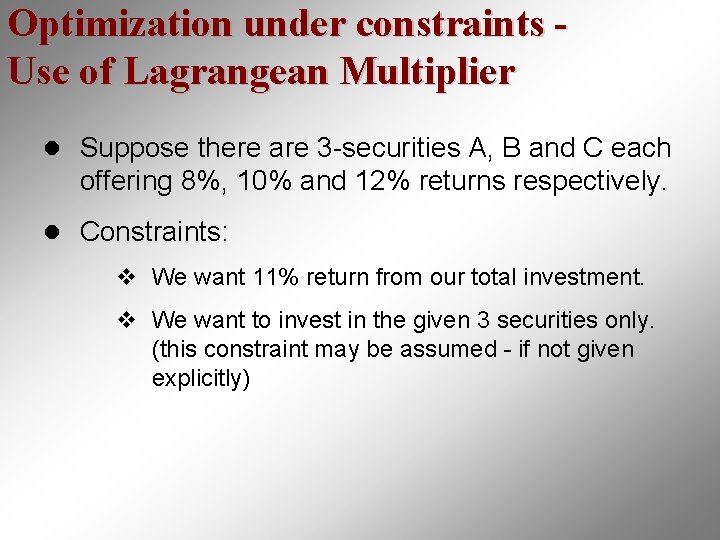
Optimization under constraints Use of Lagrangean Multiplier l Suppose there are 3 -securities A, B and C each offering 8%, 10% and 12% returns respectively. l Constraints: v We want 11% return from our total investment. v We want to invest in the given 3 securities only. (this constraint may be assumed - if not given explicitly)
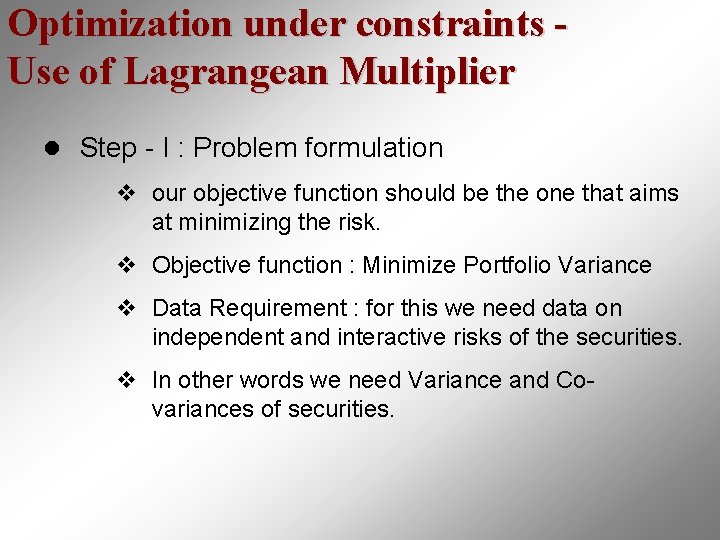
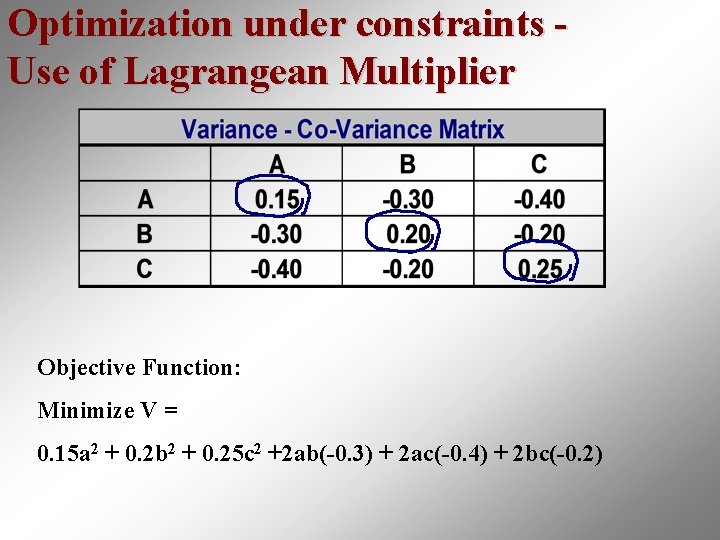
Optimization under constraints Use of Lagrangean Multiplier l Step - I : Problem formulation v our objective function should be the one that aims at minimizing the risk. v Objective function : Minimize Portfolio Variance v Data Requirement : for this we need data on independent and interactive risks of the securities. v In other words we need Variance and Covariances of securities.
Optimization under constraints Use of Lagrangean Multiplier Objective Function: Minimize V = 0. 15 a 2 + 0. 2 b 2 + 0. 25 c 2 +2 ab(-0. 3) + 2 ac(-0. 4) + 2 bc(-0. 2)
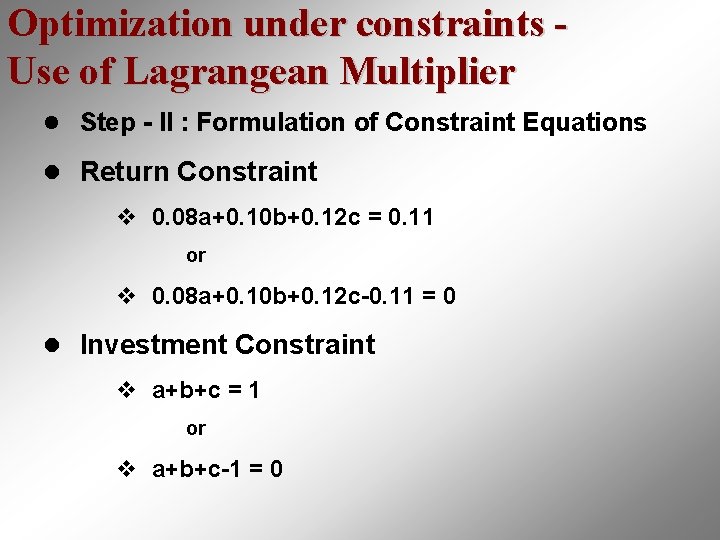
Optimization under constraints Use of Lagrangean Multiplier l Step - II : Formulation of Constraint Equations l Return Constraint v 0. 08 a+0. 10 b+0. 12 c = 0. 11 or v 0. 08 a+0. 10 b+0. 12 c-0. 11 = 0 l Investment Constraint v a+b+c = 1 or v a+b+c-1 = 0
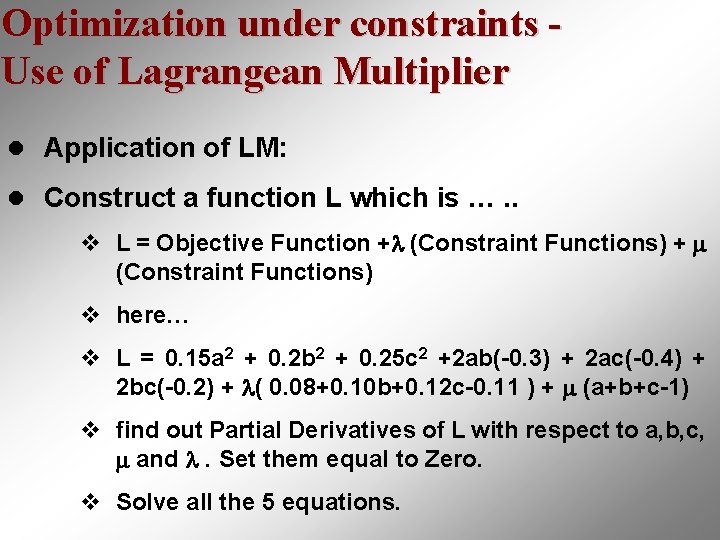
Optimization under constraints Use of Lagrangean Multiplier l Application of LM: l Construct a function L which is …. . v L = Objective Function + (Constraint Functions) + (Constraint Functions) v here… v L = 0. 15 a 2 + 0. 2 b 2 + 0. 25 c 2 +2 ab(-0. 3) + 2 ac(-0. 4) + 2 bc(-0. 2) + ( 0. 08+0. 10 b+0. 12 c-0. 11 ) + (a+b+c-1) v find out Partial Derivatives of L with respect to a, b, c, and . Set them equal to Zero. v Solve all the 5 equations.
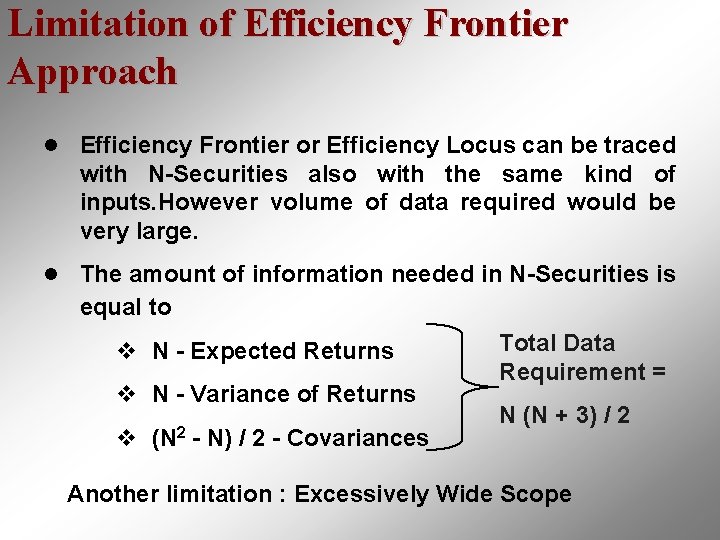
Limitation of Efficiency Frontier Approach l Efficiency Frontier or Efficiency Locus can be traced with N-Securities also with the same kind of inputs. However volume of data required would be very large. l The amount of information needed in N-Securities is equal to v N - Expected Returns v N - Variance of Returns v (N 2 - N) / 2 - Covariances Total Data Requirement = N (N + 3) / 2 Another limitation : Excessively Wide Scope
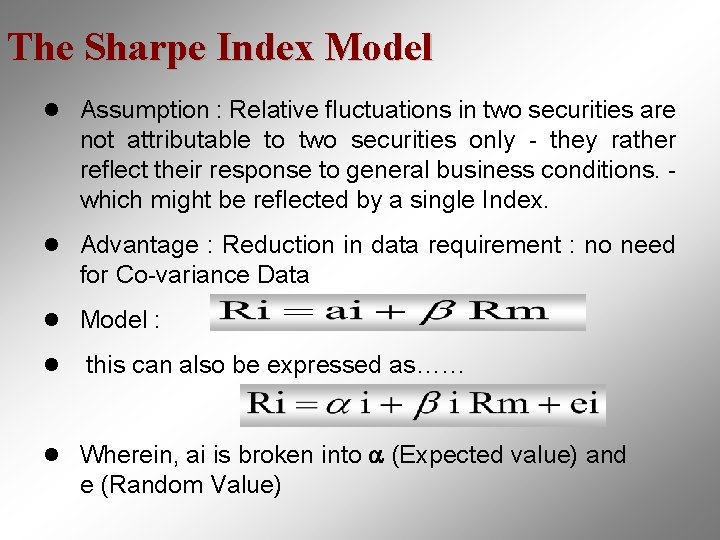
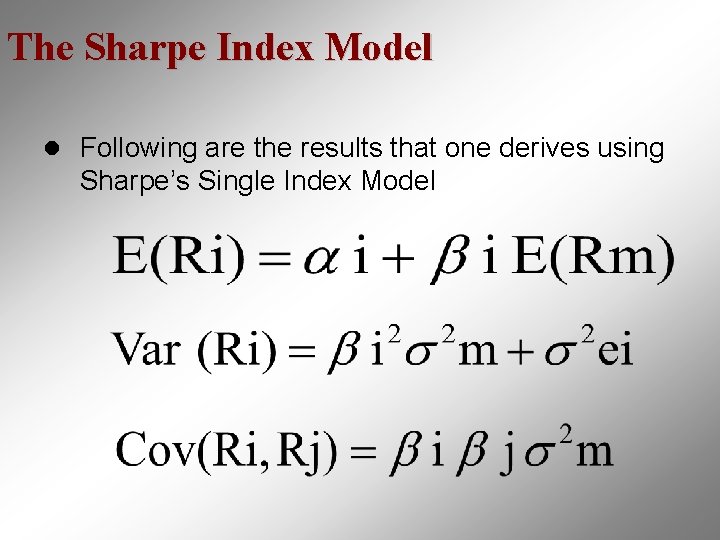
The Sharpe Index Model l Assumption : Relative fluctuations in two securities are not attributable to two securities only - they rather reflect their response to general business conditions. which might be reflected by a single Index. l Advantage : Reduction in data requirement : no need for Co-variance Data l Model : l this can also be expressed as…… l Wherein, ai is broken into (Expected value) and e (Random Value)
The Sharpe Index Model l Following are the results that one derives using Sharpe’s Single Index Model
Some other views l Many researchers have put emphasis on diversification as a tool to reduce risk - most of them stressed not the number of securities but right kinds of securities to reduce risk l King observed that in a typical stock half the variance results from elements that affect the whole market - that means one half of the total risk can never be reduced… l Evans and Archer suggest that unsystematic risk can be reduced naively by holding as few as 1015 stocks - and infact it can be increased by duplicating the sector….
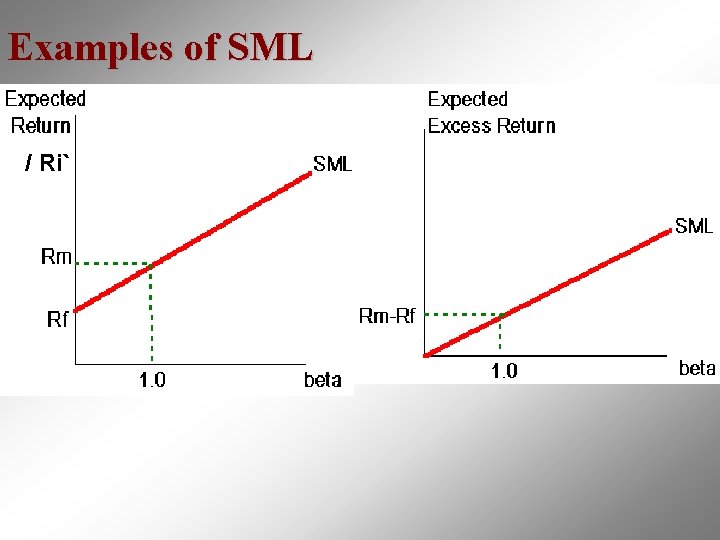
Security Market Line l SML depicts the linear relationship between systematic risk and expected return of individual securities and portfolios. l Remember : the linear relationship between Total Risk and return is depicted by Characteristic Line or Capital Market Line. l Application of SML v performance evaluation of portfolios v test and development of new asset-pricing theories v tests of market efficiency v identification of mis-priced securities
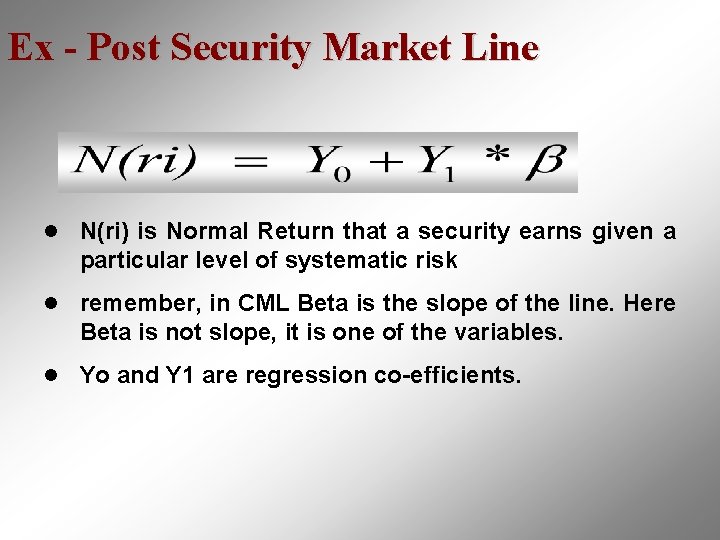
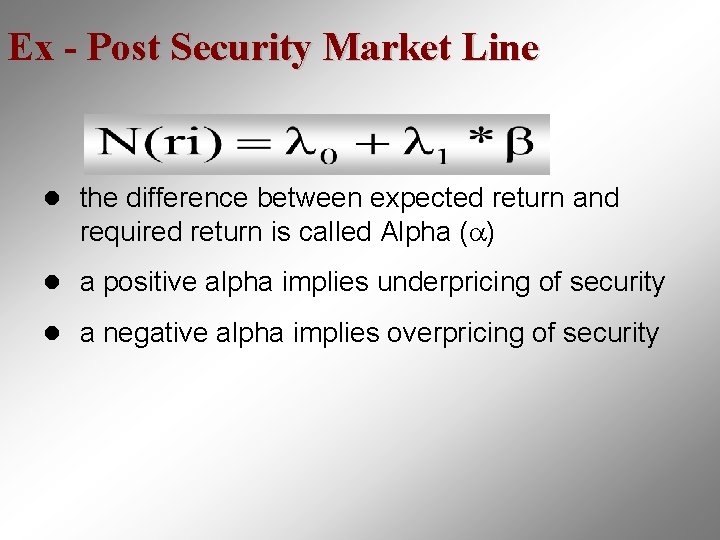
Ex - Post Security Market Line l N(ri) is Normal Return that a security earns given a particular level of systematic risk l remember, in CML Beta is the slope of the line. Here Beta is not slope, it is one of the variables. l Yo and Y 1 are regression co-efficients.
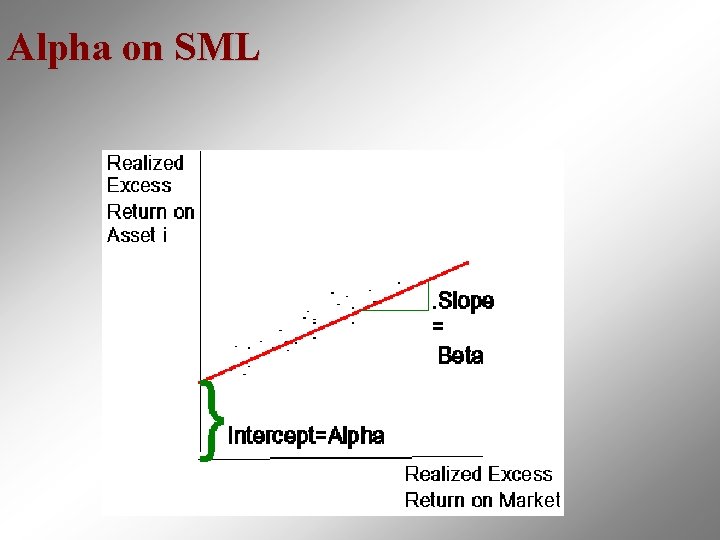
Ex - Post Security Market Line l the difference between expected return and required return is called Alpha ( ) l a positive alpha implies underpricing of security l a negative alpha implies overpricing of security
Examples of SML / Ri`
Alpha on SML
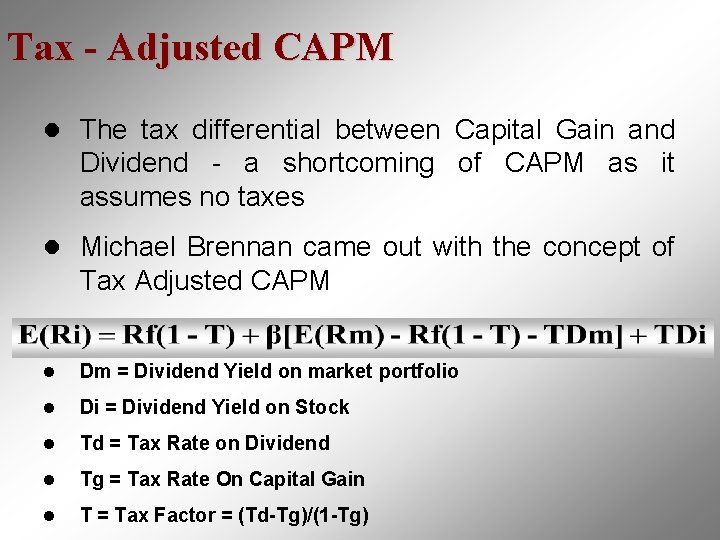
Tax - Adjusted CAPM l The tax differential between Capital Gain and Dividend - a shortcoming of CAPM as it assumes no taxes l Michael Brennan came out with the concept of Tax Adjusted CAPM l Dm = Dividend Yield on market portfolio l Di = Dividend Yield on Stock l Td = Tax Rate on Dividend l Tg = Tax Rate On Capital Gain l T = Tax Factor = (Td-Tg)/(1 -Tg)
Arbitrage Pricing Theory l APT propounded by Stephen Ross recognizes that several systematic factors affect security returns. - not just one factor (Beta) l Two types of factors v Anticipated : incorporated by investors in into the prices v Unanticipated : source of most of the returns. l Movement of Unanticipated or Unsystematic factors cannot be predicted but responsiveness of asset prices to them can definitely be predicted.
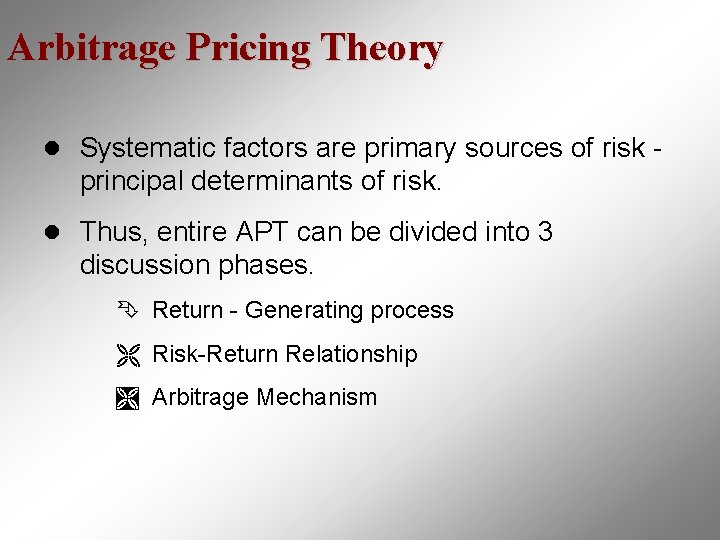
Arbitrage Pricing Theory l Systematic factors are primary sources of risk - principal determinants of risk. l Thus, entire APT can be divided into 3 discussion phases. Ê Return - Generating process Ë Risk-Return Relationship Ì Arbitrage Mechanism
Arbitrage Pricing Theory Return - Generating Process l Stock returns are generated as a function of responsiveness of assest to various factors
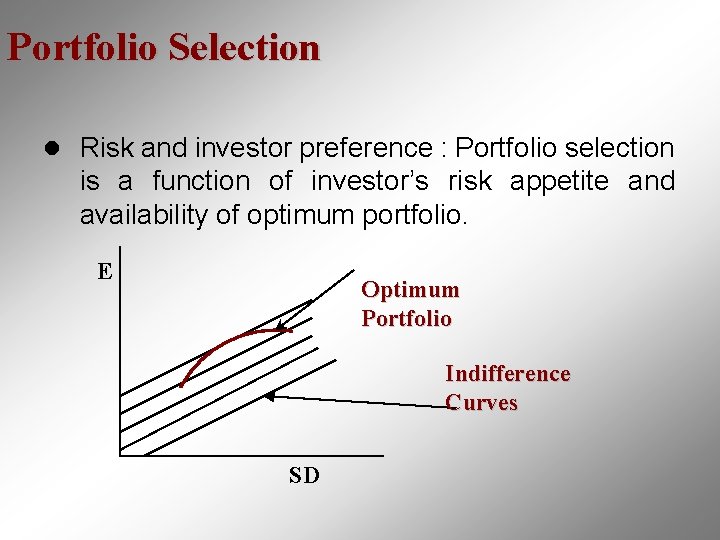
Portfolio Selection l Risk and investor preference : Portfolio selection is a function of investor’s risk appetite and availability of optimum portfolio. E Optimum Portfolio Indifference Curves SD
Portfolio Selection l Simple rule : try to earn maximum Risk-adjusted Return Risk Penalty l assumption : the more risk one bears the more undesirable is an additional unit of risk l Risk Penalty = (Risk Squared / Risk Tolerance) v Risk Squared = Variance of the Portfolio v Risk Tolerance = a number between 0 and 100 that shows the willingness to bear risk.
Portfolio Selection l Utility : A concept derived on the basis of Risk Penalty l Utility = Expected Return - Risk Penalty l consider following example
Asset allocation framework l The process of creation of a portfolio across assets l Step - I : Determination of asset class v on the basis of maturity, form of return, certainty of return, tax status. l Step - 2: Estimation of Risk and Return