
Whales are mammals Like all mammals Whales breathe
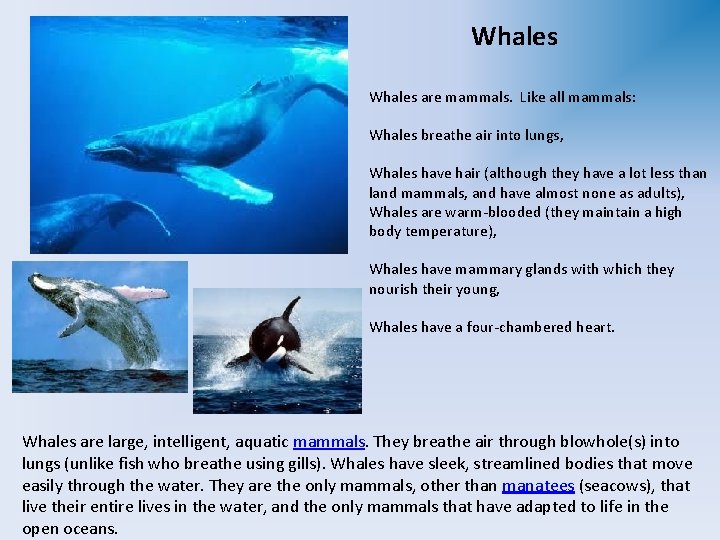
Whales are mammals. Like all mammals: Whales breathe air into lungs, Whales have hair (although they have a lot less than land mammals, and have almost none as adults), Whales are warm-blooded (they maintain a high body temperature), Whales have mammary glands with which they nourish their young, Whales have a four-chambered heart. Whales are large, intelligent, aquatic mammals. They breathe air through blowhole(s) into lungs (unlike fish who breathe using gills). Whales have sleek, streamlined bodies that move easily through the water. They are the only mammals, other than manatees (seacows), that live their entire lives in the water, and the only mammals that have adapted to life in the open oceans.
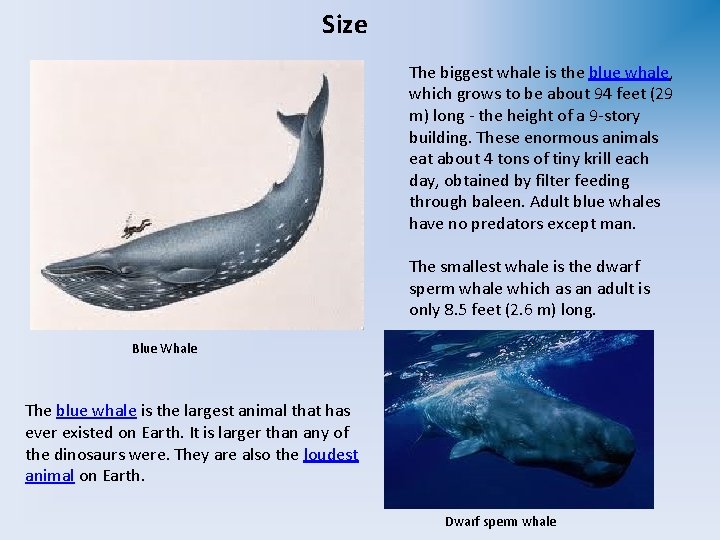
Size The biggest whale is the blue whale, which grows to be about 94 feet (29 m) long - the height of a 9 -story building. These enormous animals eat about 4 tons of tiny krill each day, obtained by filter feeding through baleen. Adult blue whales have no predators except man. The smallest whale is the dwarf sperm whale which as an adult is only 8. 5 feet (2. 6 m) long. Blue Whale The blue whale is the largest animal that has ever existed on Earth. It is larger than any of the dinosaurs were. They are also the loudest animal on Earth. Dwarf sperm whale
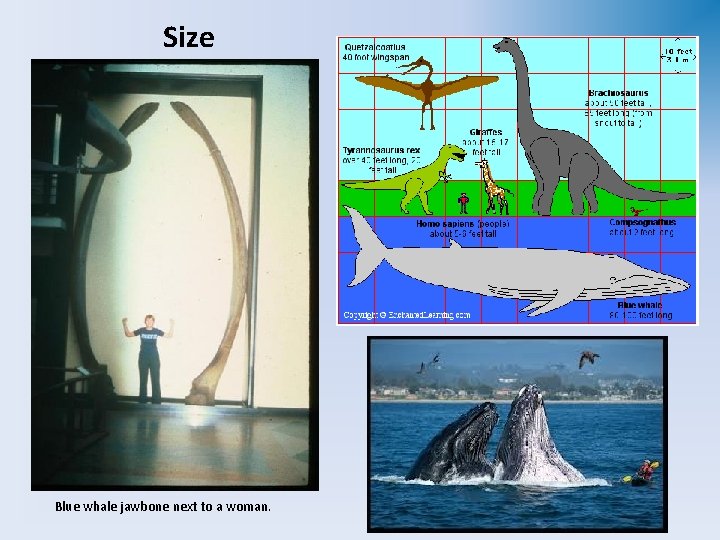
Size Blue whale jawbone next to a woman.
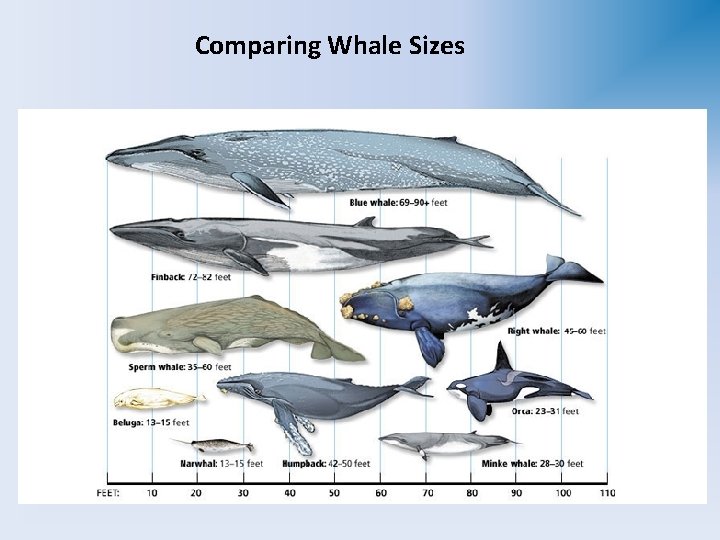
Comparing Whale Sizes
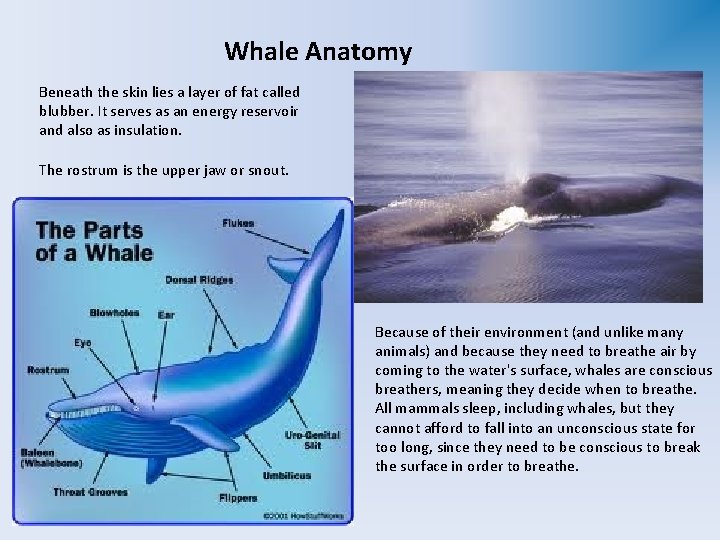
Whale Anatomy Beneath the skin lies a layer of fat called blubber. It serves as an energy reservoir and also as insulation. The rostrum is the upper jaw or snout. Because of their environment (and unlike many animals) and because they need to breathe air by coming to the water's surface, whales are conscious breathers, meaning they decide when to breathe. All mammals sleep, including whales, but they cannot afford to fall into an unconscious state for too long, since they need to be conscious to break the surface in order to breathe.
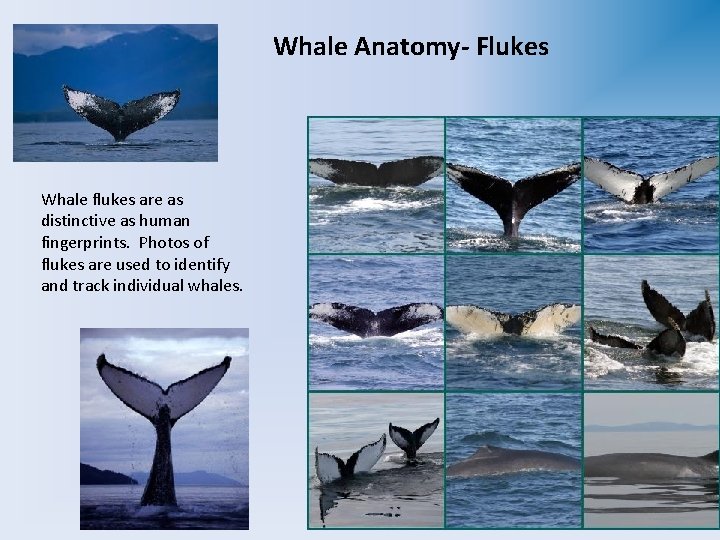
Whale Anatomy- Flukes Whale flukes are as distinctive as human fingerprints. Photos of flukes are used to identify and track individual whales.

Classification Whales belong to the order Cetacea (from the Greek word "ketos" which means whale), which is divided into the following groups: Baleen whales (Mysticeti) - predators that sieve tiny crustaceans, small fish, and other tiny organisms from the water with baleen. Baleen is a comb-like structure that filters the baleen whales' food from the water. Baleen whales are larger than the toothed whales and have 2 blowholes (nostrils). There are 10 species of baleen whales. Females are generally larger than males. Toothed whales (Odontoceti) - predators that use their peg-like teeth to catch fish, squid, and marine mammals, swallowing them whole. They have one blowhole (nostril) and use echolocation to hunt. There about 66 species of toothed whales. Toothed whales have a much stronger social structure than baleen whales, often gathering in pods with a stable social structure. Males are generally larger than females. Cetaceans include the whales, dolphins and porpoises. There are over 75 species of Cetaceans.
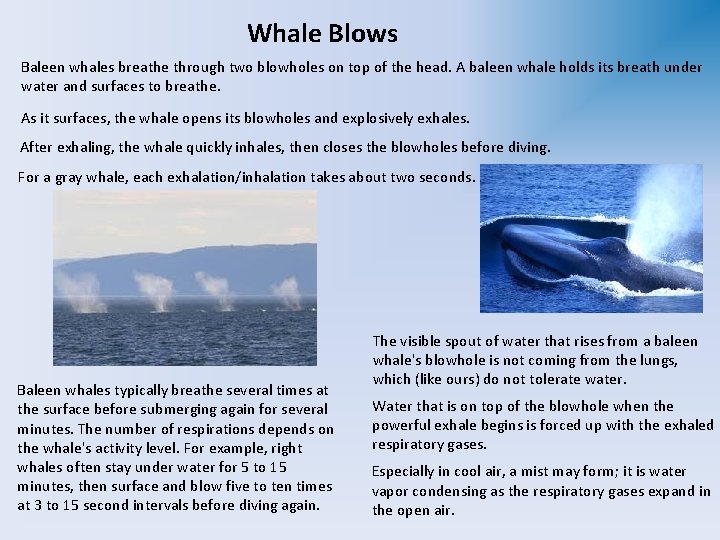
Whale Blows Baleen whales breathe through two blowholes on top of the head. A baleen whale holds its breath under water and surfaces to breathe. As it surfaces, the whale opens its blowholes and explosively exhales. After exhaling, the whale quickly inhales, then closes the blowholes before diving. For a gray whale, each exhalation/inhalation takes about two seconds. Baleen whales typically breathe several times at the surface before submerging again for several minutes. The number of respirations depends on the whale's activity level. For example, right whales often stay under water for 5 to 15 minutes, then surface and blow five to ten times at 3 to 15 second intervals before diving again. The visible spout of water that rises from a baleen whale's blowhole is not coming from the lungs, which (like ours) do not tolerate water. Water that is on top of the blowhole when the powerful exhale begins is forced up with the exhaled respiratory gases. Especially in cool air, a mist may form; it is water vapor condensing as the respiratory gases expand in the open air.
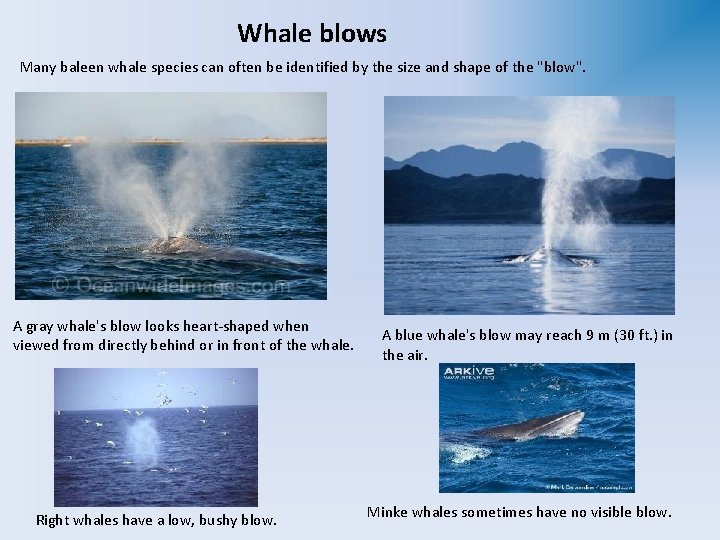
Whale blows Many baleen whale species can often be identified by the size and shape of the "blow". A gray whale's blow looks heart-shaped when viewed from directly behind or in front of the whale. Right whales have a low, bushy blow. A blue whale's blow may reach 9 m (30 ft. ) in the air. Minke whales sometimes have no visible blow.
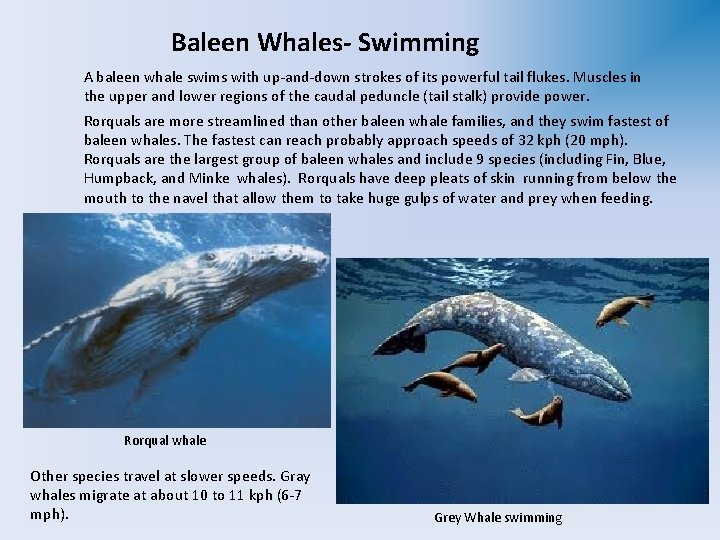
Baleen Whales- Swimming A baleen whale swims with up-and-down strokes of its powerful tail flukes. Muscles in the upper and lower regions of the caudal peduncle (tail stalk) provide power. Rorquals are more streamlined than other baleen whale families, and they swim fastest of baleen whales. The fastest can reach probably approach speeds of 32 kph (20 mph). Rorquals are the largest group of baleen whales and include 9 species (including Fin, Blue, Humpback, and Minke whales). Rorquals have deep pleats of skin running from below the mouth to the navel that allow them to take huge gulps of water and prey when feeding. Rorqual whale Other species travel at slower speeds. Gray whales migrate at about 10 to 11 kph (6 -7 mph). Grey Whale swimming
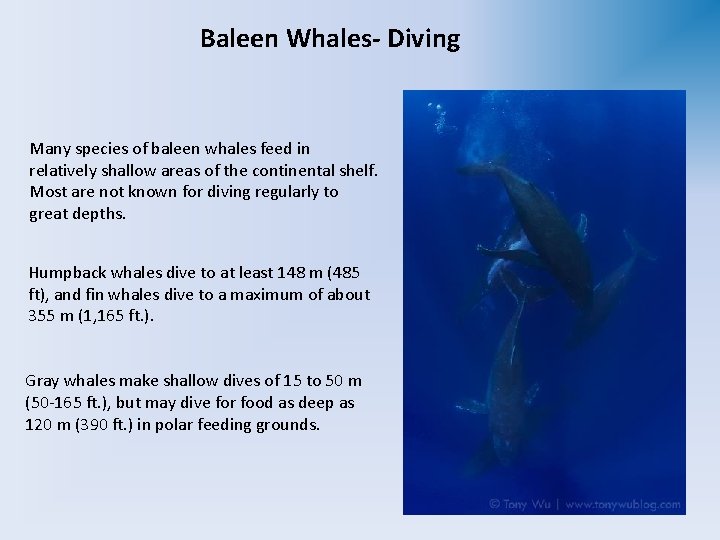
Baleen Whales- Diving Many species of baleen whales feed in relatively shallow areas of the continental shelf. Most are not known for diving regularly to great depths. Humpback whales dive to at least 148 m (485 ft), and fin whales dive to a maximum of about 355 m (1, 165 ft. ). Gray whales make shallow dives of 15 to 50 m (50 -165 ft. ), but may dive for food as deep as 120 m (390 ft. ) in polar feeding grounds.
Baleen Whales- Diving/shunting All marine mammals have special physiological adaptations during a dive. These adaptations enable a baleen whale to conserve oxygen while underwater. Baleen whales, like other mammals, have a slower heart rate while diving. When diving, blood is shunted away from tissues tolerant of low oxygen levels toward the heart, lungs, and brain, where oxygen is needed most Certain protein molecules - hemoglobin and myoglobin - store oxygen in body tissues. Hemoglobin occurs in red blood cells. Myoglobin occurs in muscle tissue. The muscle of baleen whales has twice the myoglobin concentration of the muscle of land mammals.
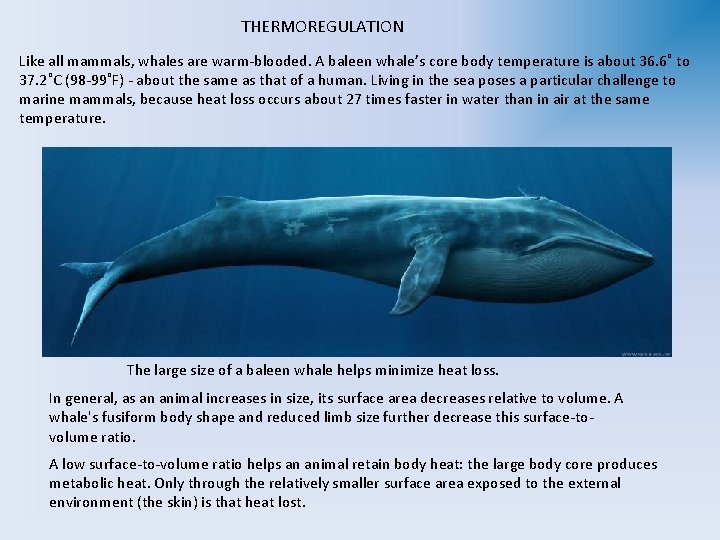
THERMOREGULATION Like all mammals, whales are warm-blooded. A baleen whale’s core body temperature is about 36. 6˚ to 37. 2˚C (98 -99˚F) - about the same as that of a human. Living in the sea poses a particular challenge to marine mammals, because heat loss occurs about 27 times faster in water than in air at the same temperature. The large size of a baleen whale helps minimize heat loss. In general, as an animal increases in size, its surface area decreases relative to volume. A whale's fusiform body shape and reduced limb size further decrease this surface-tovolume ratio. A low surface-to-volume ratio helps an animal retain body heat: the large body core produces metabolic heat. Only through the relatively smaller surface area exposed to the external environment (the skin) is that heat lost.
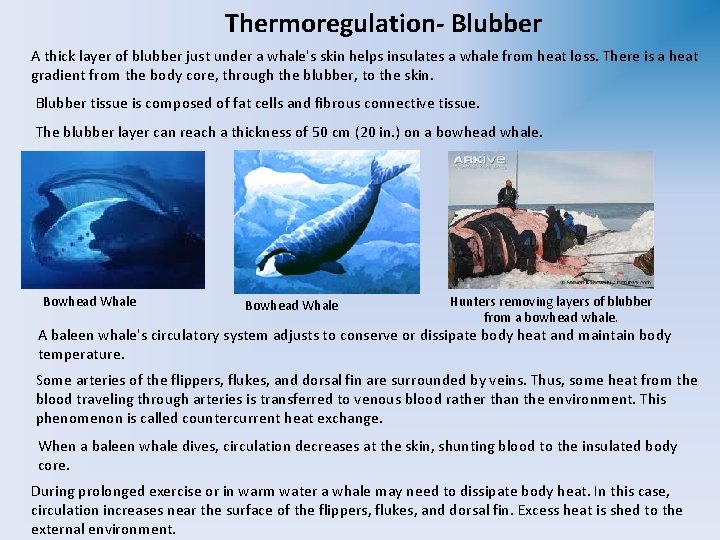
Thermoregulation- Blubber A thick layer of blubber just under a whale's skin helps insulates a whale from heat loss. There is a heat gradient from the body core, through the blubber, to the skin. Blubber tissue is composed of fat cells and fibrous connective tissue. The blubber layer can reach a thickness of 50 cm (20 in. ) on a bowhead whale. Bowhead Whale Hunters removing layers of blubber from a bowhead whale. A baleen whale's circulatory system adjusts to conserve or dissipate body heat and maintain body temperature. Some arteries of the flippers, flukes, and dorsal fin are surrounded by veins. Thus, some heat from the blood traveling through arteries is transferred to venous blood rather than the environment. This phenomenon is called countercurrent heat exchange. When a baleen whale dives, circulation decreases at the skin, shunting blood to the insulated body core. During prolonged exercise or in warm water a whale may need to dissipate body heat. In this case, circulation increases near the surface of the flippers, flukes, and dorsal fin. Excess heat is shed to the external environment.
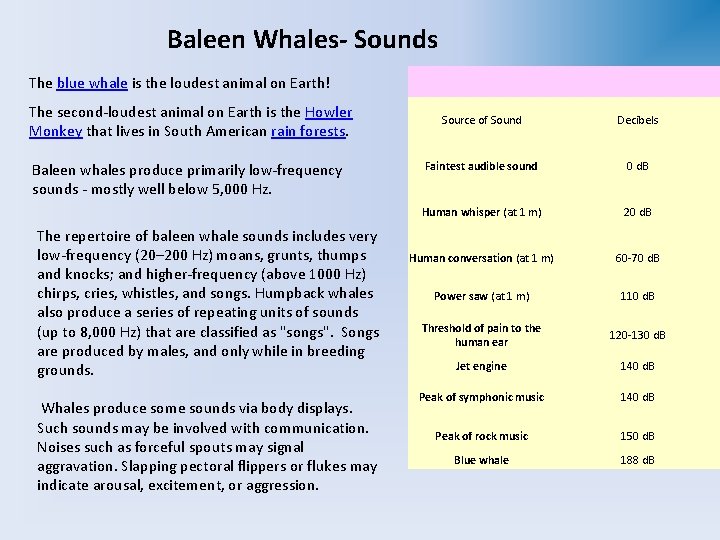
Baleen Whales- Sounds The blue whale is the loudest animal on Earth! The second-loudest animal on Earth is the Howler Monkey that lives in South American rain forests. Baleen whales produce primarily low-frequency sounds - mostly well below 5, 000 Hz. The repertoire of baleen whale sounds includes very low-frequency (20– 200 Hz) moans, grunts, thumps and knocks; and higher-frequency (above 1000 Hz) chirps, cries, whistles, and songs. Humpback whales also produce a series of repeating units of sounds (up to 8, 000 Hz) that are classified as "songs". Songs are produced by males, and only while in breeding grounds. Whales produce some sounds via body displays. Such sounds may be involved with communication. Noises such as forceful spouts may signal aggravation. Slapping pectoral flippers or flukes may indicate arousal, excitement, or aggression. Source of Sound Decibels Faintest audible sound 0 d. B Human whisper (at 1 m) 20 d. B Human conversation (at 1 m) 60 -70 d. B Power saw (at 1 m) 110 d. B Threshold of pain to the human ear 120 -130 d. B Jet engine 140 d. B Peak of symphonic music 140 d. B Peak of rock music 150 d. B Blue whale 188 d. B
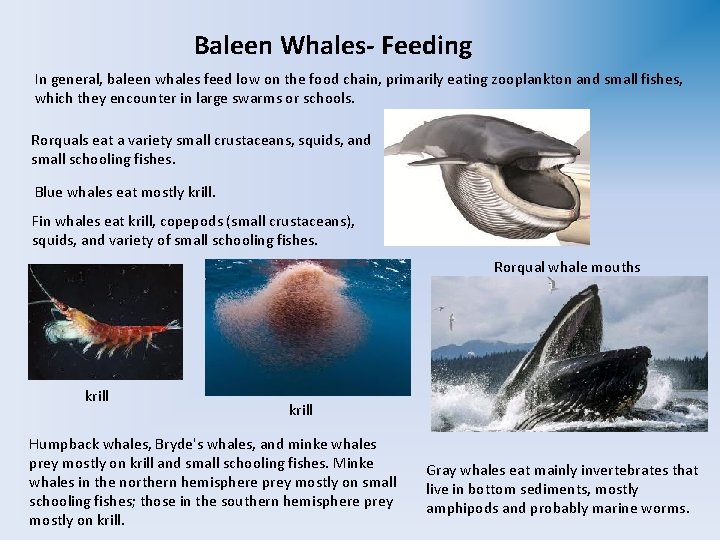
Baleen Whales- Feeding In general, baleen whales feed low on the food chain, primarily eating zooplankton and small fishes, which they encounter in large swarms or schools. Rorquals eat a variety small crustaceans, squids, and small schooling fishes. Blue whales eat mostly krill. Fin whales eat krill, copepods (small crustaceans), squids, and variety of small schooling fishes. Rorqual whale mouths krill Humpback whales, Bryde's whales, and minke whales prey mostly on krill and small schooling fishes. Minke whales in the northern hemisphere prey mostly on small schooling fishes; those in the southern hemisphere prey mostly on krill. Gray whales eat mainly invertebrates that live in bottom sediments, mostly amphipods and probably marine worms.
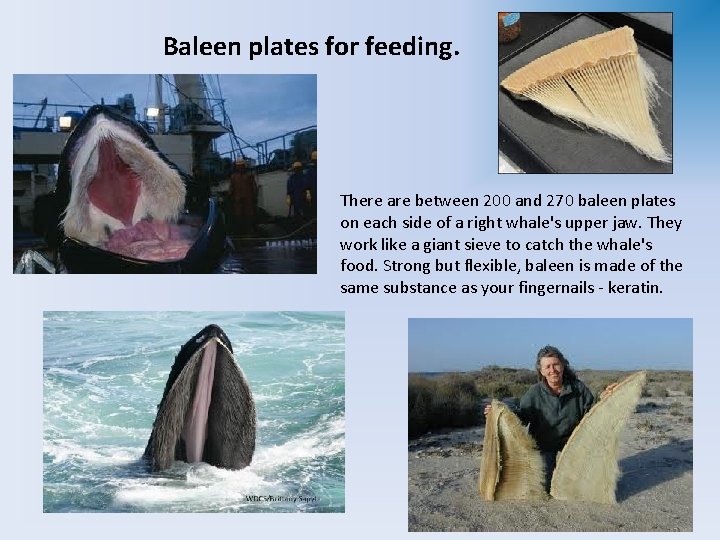
Baleen plates for feeding. There are between 200 and 270 baleen plates on each side of a right whale's upper jaw. They work like a giant sieve to catch the whale's food. Strong but flexible, baleen is made of the same substance as your fingernails - keratin.
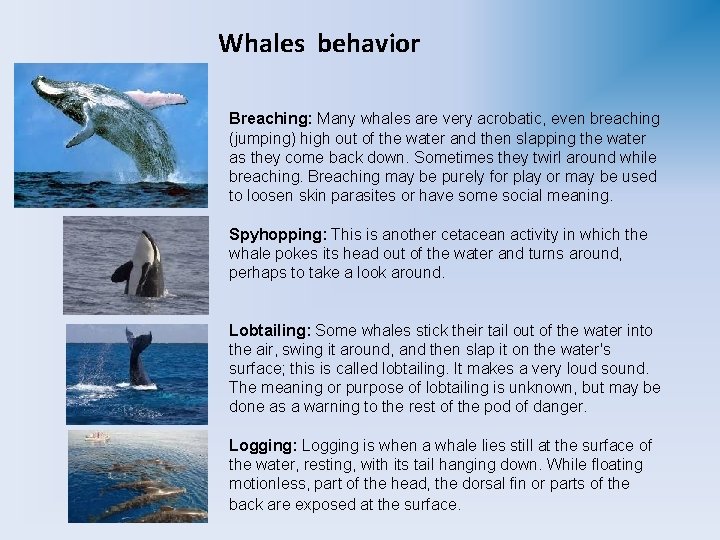
Whales behavior Breaching: Many whales are very acrobatic, even breaching (jumping) high out of the water and then slapping the water as they come back down. Sometimes they twirl around while breaching. Breaching may be purely for play or may be used to loosen skin parasites or have some social meaning. Spyhopping: This is another cetacean activity in which the whale pokes its head out of the water and turns around, perhaps to take a look around. Lobtailing: Some whales stick their tail out of the water into the air, swing it around, and then slap it on the water's surface; this is called lobtailing. It makes a very loud sound. The meaning or purpose of lobtailing is unknown, but may be done as a warning to the rest of the pod of danger. Logging: Logging is when a whale lies still at the surface of the water, resting, with its tail hanging down. While floating motionless, part of the head, the dorsal fin or parts of the back are exposed at the surface.
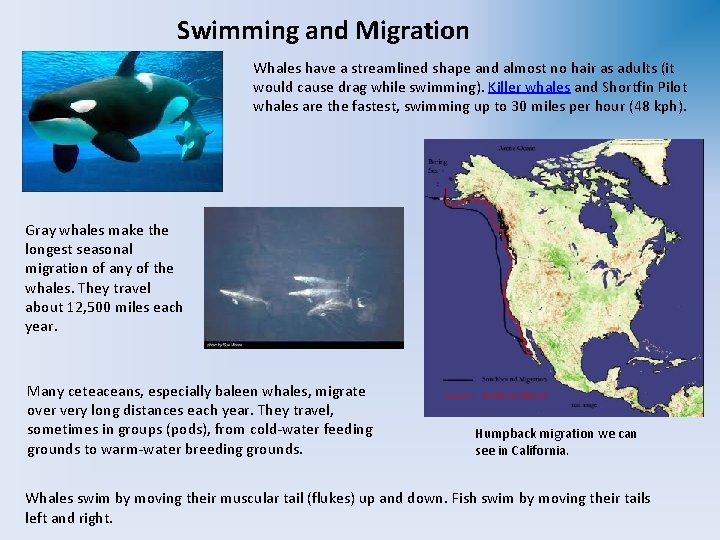
Swimming and Migration Whales have a streamlined shape and almost no hair as adults (it would cause drag while swimming). Killer whales and Shortfin Pilot whales are the fastest, swimming up to 30 miles per hour (48 kph). Gray whales make the longest seasonal migration of any of the whales. They travel about 12, 500 miles each year. Many ceteaceans, especially baleen whales, migrate over very long distances each year. They travel, sometimes in groups (pods), from cold-water feeding grounds to warm-water breeding grounds. Humpback migration we can see in California. Whales swim by moving their muscular tail (flukes) up and down. Fish swim by moving their tails left and right.
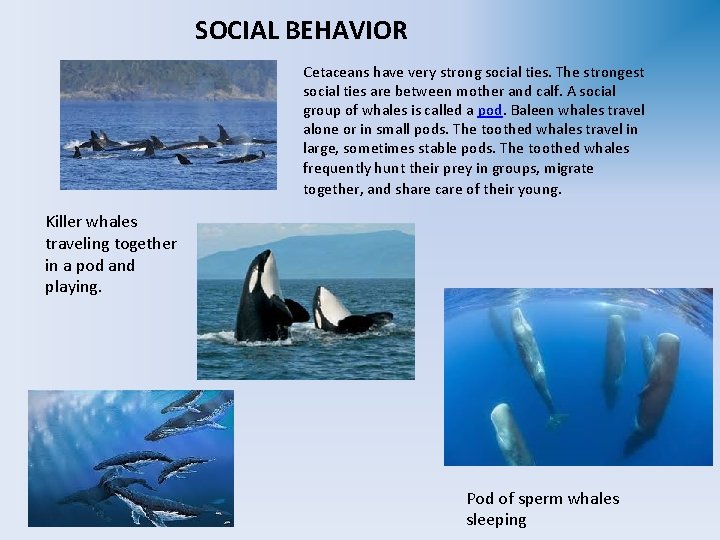
SOCIAL BEHAVIOR Cetaceans have very strong social ties. The strongest social ties are between mother and calf. A social group of whales is called a pod. Baleen whales travel alone or in small pods. The toothed whales travel in large, sometimes stable pods. The toothed whales frequently hunt their prey in groups, migrate together, and share care of their young. Killer whales traveling together in a pod and playing. Pod of sperm whales sleeping
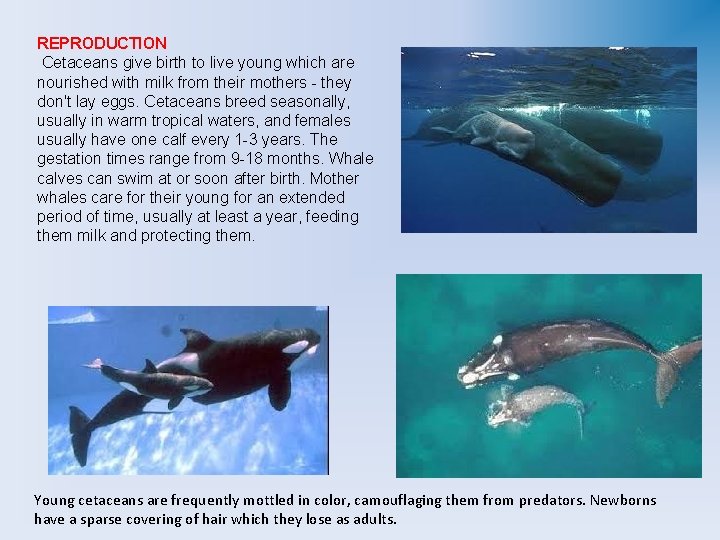
REPRODUCTION Cetaceans give birth to live young which are nourished with milk from their mothers - they don't lay eggs. Cetaceans breed seasonally, usually in warm tropical waters, and females usually have one calf every 1 -3 years. The gestation times range from 9 -18 months. Whale calves can swim at or soon after birth. Mother whales care for their young for an extended period of time, usually at least a year, feeding them milk and protecting them. Young cetaceans are frequently mottled in color, camouflaging them from predators. Newborns have a sparse covering of hair which they lose as adults.
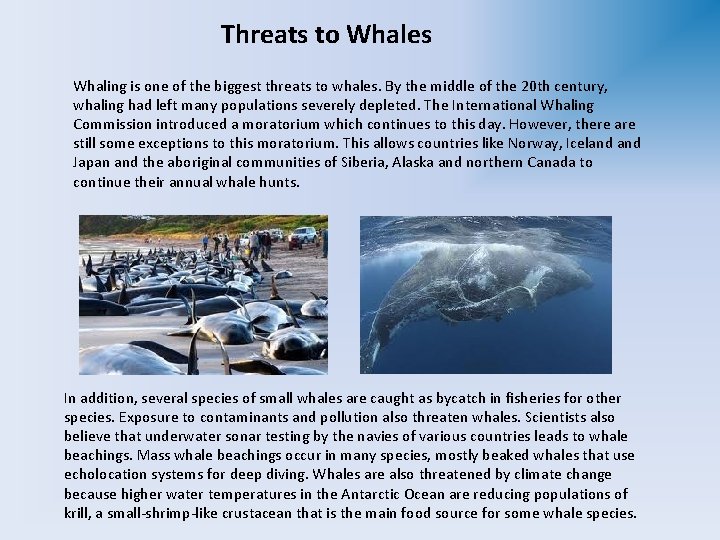
Threats to Whales Whaling is one of the biggest threats to whales. By the middle of the 20 th century, whaling had left many populations severely depleted. The International Whaling Commission introduced a moratorium which continues to this day. However, there are still some exceptions to this moratorium. This allows countries like Norway, Iceland Japan and the aboriginal communities of Siberia, Alaska and northern Canada to continue their annual whale hunts. In addition, several species of small whales are caught as bycatch in fisheries for other species. Exposure to contaminants and pollution also threaten whales. Scientists also believe that underwater sonar testing by the navies of various countries leads to whale beachings. Mass whale beachings occur in many species, mostly beaked whales that use echolocation systems for deep diving. Whales are also threatened by climate change because higher water temperatures in the Antarctic Ocean are reducing populations of krill, a small-shrimp-like crustacean that is the main food source for some whale species.
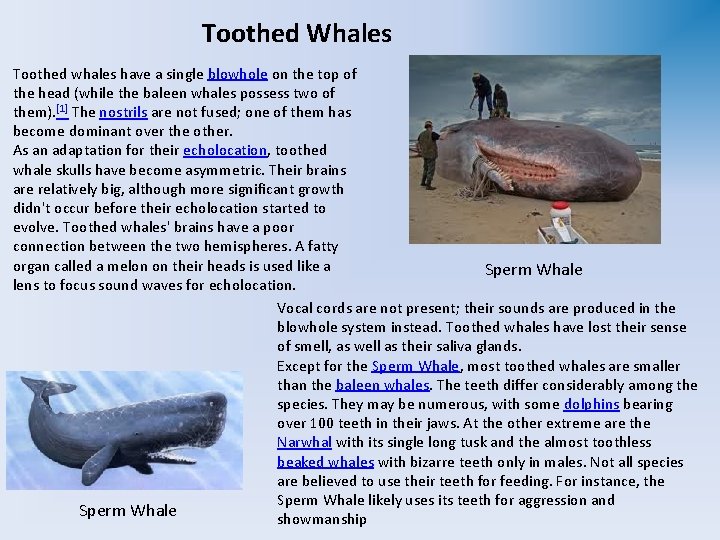
Toothed Whales Toothed whales have a single blowhole on the top of the head (while the baleen whales possess two of them). [1] The nostrils are not fused; one of them has become dominant over the other. As an adaptation for their echolocation, toothed whale skulls have become asymmetric. Their brains are relatively big, although more significant growth didn't occur before their echolocation started to evolve. Toothed whales' brains have a poor connection between the two hemispheres. A fatty organ called a melon on their heads is used like a Sperm Whale lens to focus sound waves for echolocation. Vocal cords are not present; their sounds are produced in the blowhole system instead. Toothed whales have lost their sense of smell, as well as their saliva glands. Except for the Sperm Whale, most toothed whales are smaller than the baleen whales. The teeth differ considerably among the species. They may be numerous, with some dolphins bearing over 100 teeth in their jaws. At the other extreme are the Narwhal with its single long tusk and the almost toothless beaked whales with bizarre teeth only in males. Not all species are believed to use their teeth for feeding. For instance, the Sperm Whale likely uses its teeth for aggression and Sperm Whale showmanship
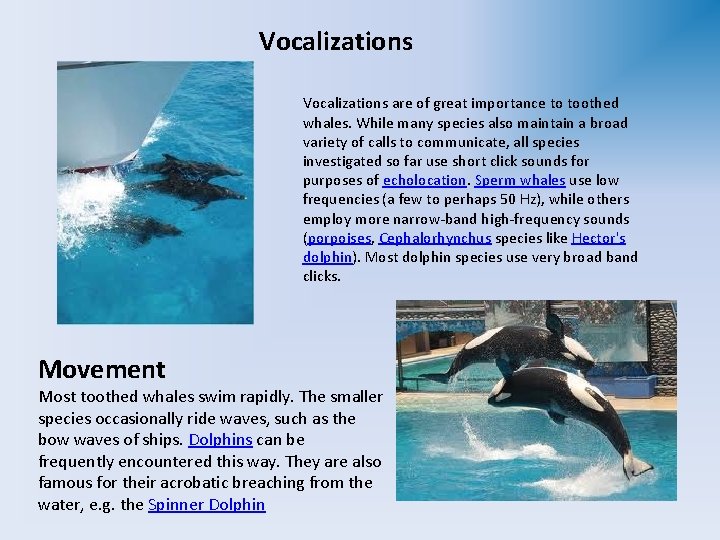
Vocalizations are of great importance to toothed whales. While many species also maintain a broad variety of calls to communicate, all species investigated so far use short click sounds for purposes of echolocation. Sperm whales use low frequencies (a few to perhaps 50 Hz), while others employ more narrow-band high-frequency sounds (porpoises, Cephalorhynchus species like Hector's dolphin). Most dolphin species use very broad band clicks. Movement Most toothed whales swim rapidly. The smaller species occasionally ride waves, such as the bow waves of ships. Dolphins can be frequently encountered this way. They are also famous for their acrobatic breaching from the water, e. g. the Spinner Dolphin
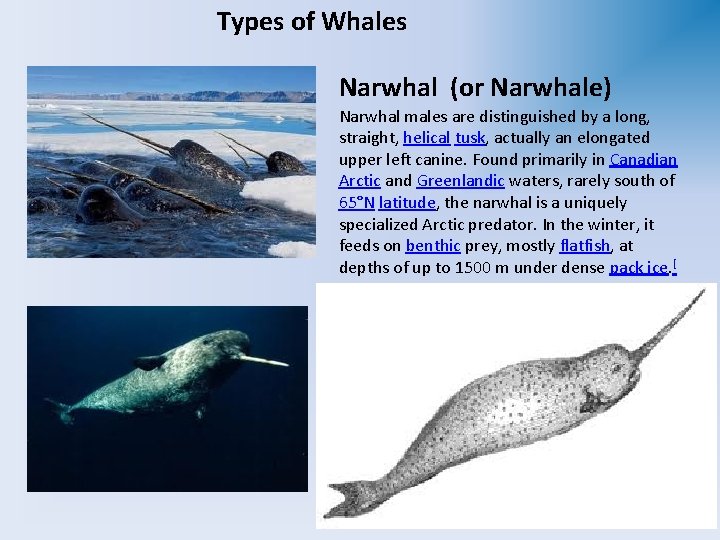
Types of Whales Narwhal (or Narwhale) Narwhal males are distinguished by a long, straight, helical tusk, actually an elongated upper left canine. Found primarily in Canadian Arctic and Greenlandic waters, rarely south of 65°N latitude, the narwhal is a uniquely specialized Arctic predator. In the winter, it feeds on benthic prey, mostly flatfish, at depths of up to 1500 m under dense pack ice. [
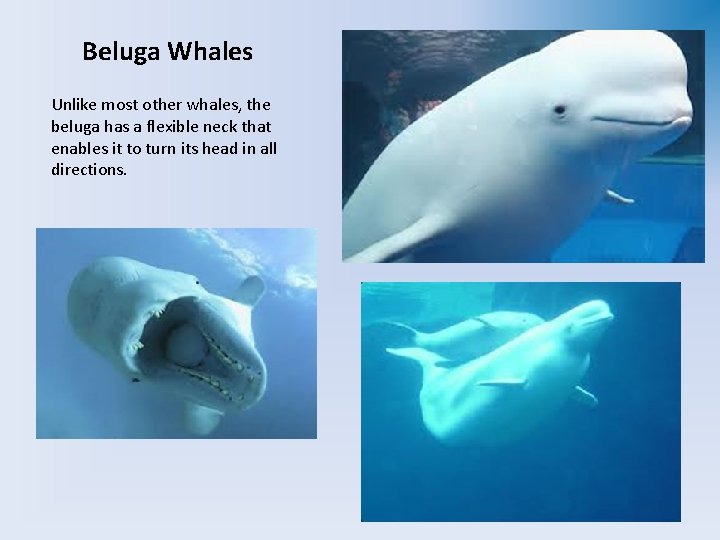
Beluga Whales Unlike most other whales, the beluga has a flexible neck that enables it to turn its head in all directions.
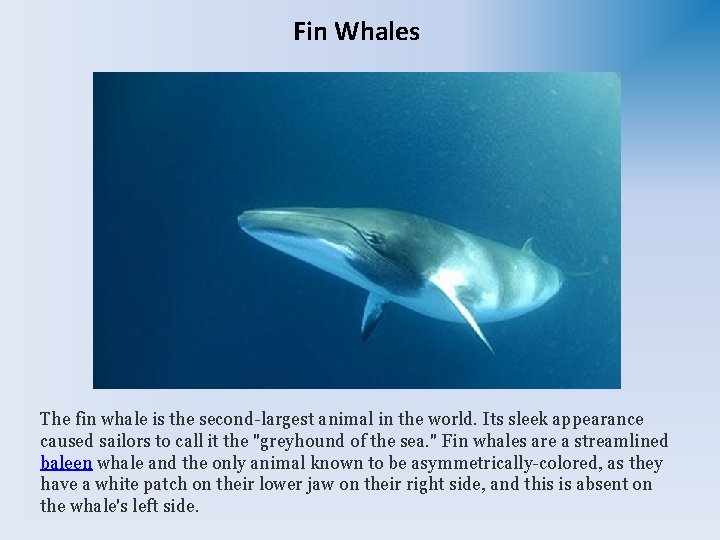
Fin Whales The fin whale is the second-largest animal in the world. Its sleek appearance caused sailors to call it the "greyhound of the sea. " Fin whales are a streamlined baleen whale and the only animal known to be asymmetrically-colored, as they have a white patch on their lower jaw on their right side, and this is absent on the whale's left side.
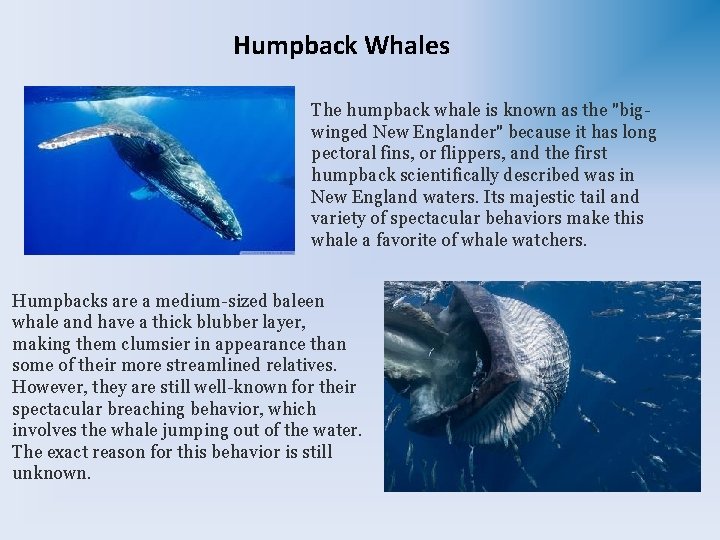
Humpback Whales The humpback whale is known as the "bigwinged New Englander" because it has long pectoral fins, or flippers, and the first humpback scientifically described was in New England waters. Its majestic tail and variety of spectacular behaviors make this whale a favorite of whale watchers. Humpbacks are a medium-sized baleen whale and have a thick blubber layer, making them clumsier in appearance than some of their more streamlined relatives. However, they are still well-known for their spectacular breaching behavior, which involves the whale jumping out of the water. The exact reason for this behavior is still unknown.
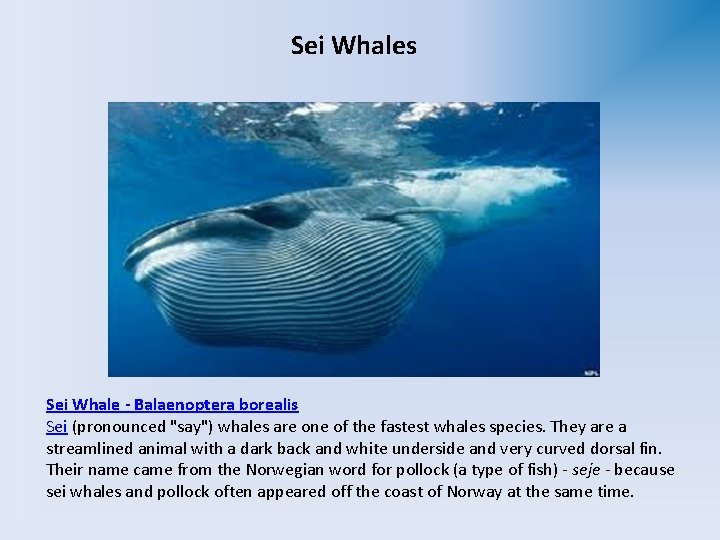
Sei Whales Sei Whale - Balaenoptera borealis Sei (pronounced "say") whales are one of the fastest whales species. They are a streamlined animal with a dark back and white underside and very curved dorsal fin. Their name came from the Norwegian word for pollock (a type of fish) - seje - because sei whales and pollock often appeared off the coast of Norway at the same time.
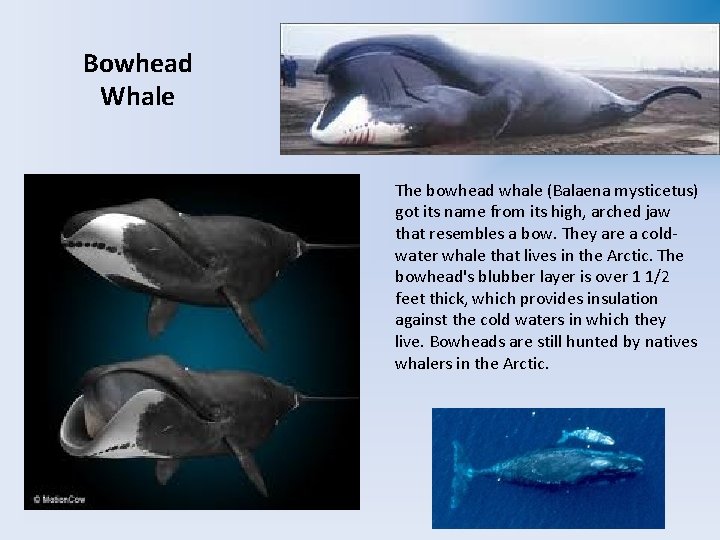
Bowhead Whale The bowhead whale (Balaena mysticetus) got its name from its high, arched jaw that resembles a bow. They are a coldwater whale that lives in the Arctic. The bowhead's blubber layer is over 1 1/2 feet thick, which provides insulation against the cold waters in which they live. Bowheads are still hunted by natives whalers in the Arctic.
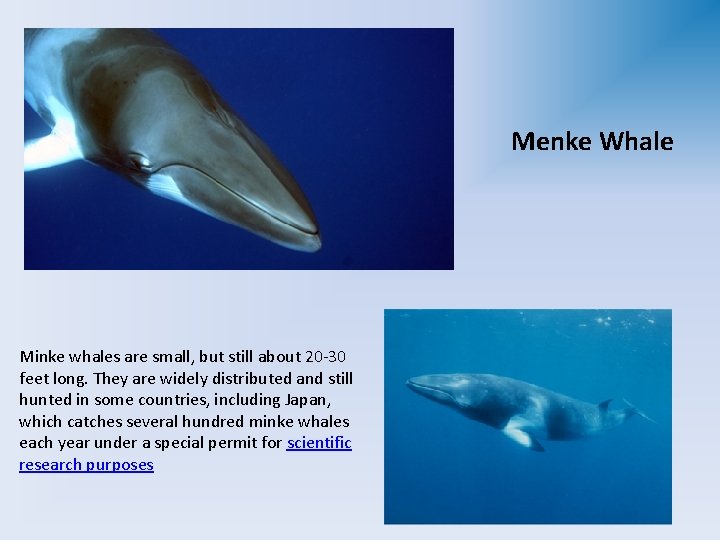
Menke Whale Minke whales are small, but still about 20 -30 feet long. They are widely distributed and still hunted in some countries, including Japan, which catches several hundred minke whales each year under a special permit for scientific research purposes
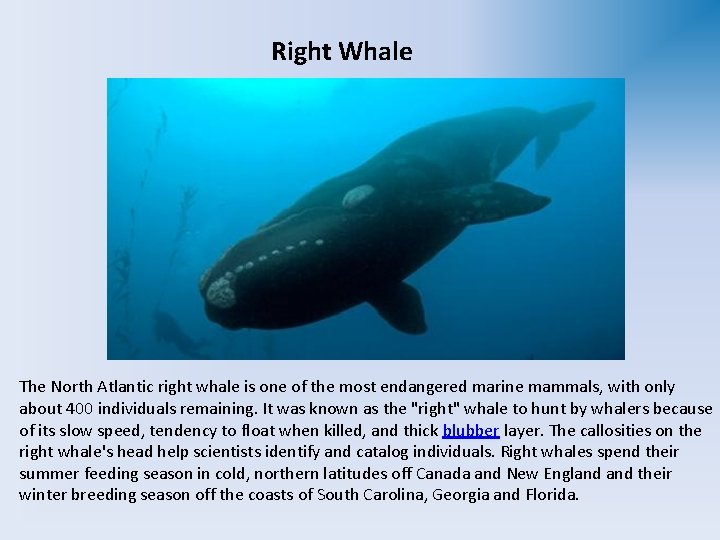
Right Whale The North Atlantic right whale is one of the most endangered marine mammals, with only about 400 individuals remaining. It was known as the "right" whale to hunt by whalers because of its slow speed, tendency to float when killed, and thick blubber layer. The callosities on the right whale's head help scientists identify and catalog individuals. Right whales spend their summer feeding season in cold, northern latitudes off Canada and New England their winter breeding season off the coasts of South Carolina, Georgia and Florida.
- Slides: 32