
Whale of a Tale Lesson What worked for
- Slides: 4
Whale of a Tale Lesson What worked for me… I struggled with… Provided a great glimpse at a real use for genetic sequencing. The activity was completed very quickly. Made the subject less abstract. All students had the same results Provided an interesting example (everyone loves whales!) The essay portion confused the students (my fault? ) Provided an opportunity to collaborate with other students Type of data doesn’t lend itself to tying in math/statistics/visualization Lesson materials were well-written
Discussion questions Test for understanding of DNA structure and function What are some ways scientists make use of genetic sequencing? Forensic analysis, study animal evolution, human heredity, human disease screening, cloning (NOT dinosaurs) What did you predict you would find (based on scenario)? How did your results compare to your prediction? And because I live in Alaska: has anyone ever eaten whale? Is whaling by arctic Natives the same as selling whale in restaurants? Why/why not?
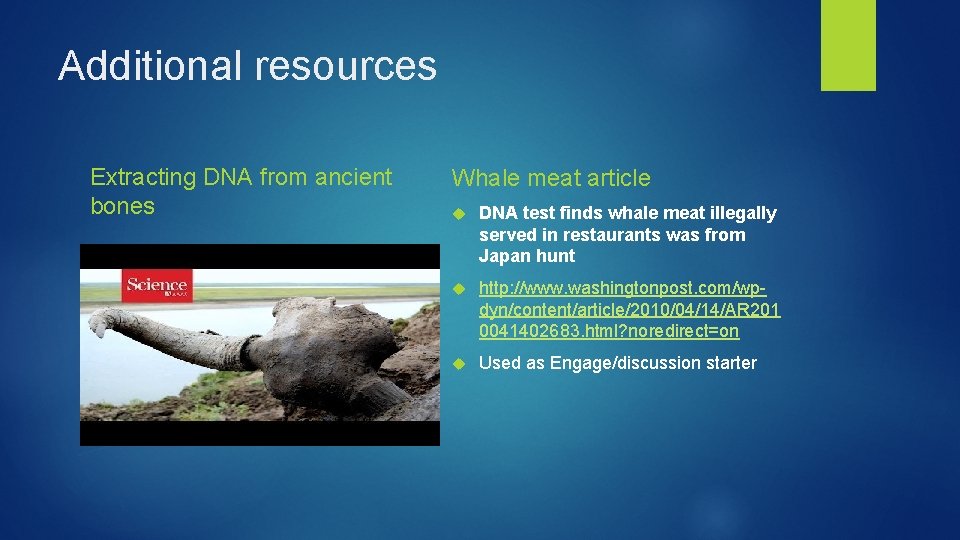
Additional resources Extracting DNA from ancient bones Whale meat article DNA test finds whale meat illegally served in restaurants was from Japan hunt http: //www. washingtonpost. com/wpdyn/content/article/2010/04/14/AR 201 0041402683. html? noredirect=on Used as Engage/discussion starter
Suggestions… Provide more “unknown” sequences Provide multiple writing prompts specific to the scenario. These could allow students to do some further research on the whale species. Teachers can assign a selection of sequences to each student so results aren’t all the same Example: What species of whale did you discover in the whale graveyard? Of the four species you discovered, which where more prized by the whaling industry? Which species were the most impacted? I didn’t use the Webquest due to time restraints, so I can’t comment.