
WGU 20 YEARS OF EXPERIENCE BRINGING COMPETENCYBASED EDUCATION
WGU: 20 YEARS OF EXPERIENCE BRINGING COMPETENCY-BASED EDUCATION TO SCALE Sarah Demark Vice President, Academic Programs FRED HURST Vice President, Academic Advancement AUTHOR’S NAME HERE

Universitas magistrorum et scholarium
OUTLINE • The Case for Innovation • CBE at Scale • Utilizing Data to Advance Student Outcomes • What We’ve Learned
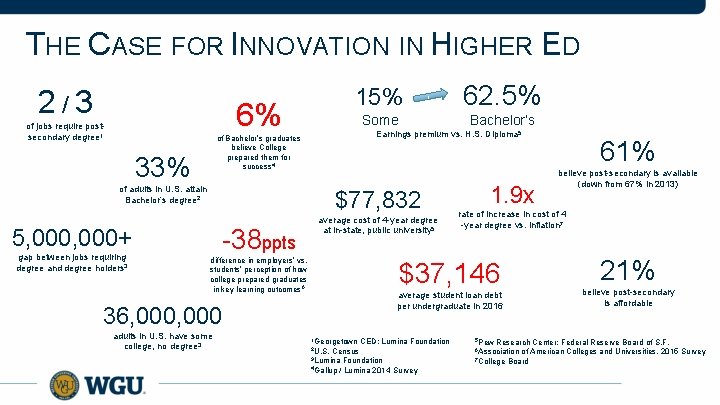
THE CASE FOR INNOVATION IN HIGHER ED 2/3 6% of jobs require postsecondary degree 1 62. 5% Some Bachelor’s Earnings premium vs. H. S. Diploma 5 of Bachelor’s graduates believe College prepared them for success 4 33% of adults in U. S. attain Bachelor’s degree 2 $77, 832 -38 ppts 5, 000+ gap between jobs requiring degree and degree holders 3 15% average cost of 4 -year degree at in-state, public university 5 difference in employers’ vs. students’ perception of how college prepared graduates in key learning outcomes 6 rate of increase in cost of 4 -year degree vs. inflation 7 $37, 146 average student loan debt per undergraduate in 2016 36, 000 adults in U. S. have some college, no degree 3 1. 9 x 1 Georgetown CED; Lumina Foundation Census 3 Lumina Foundation 4 Gallup / Lumina 2014 Survey 2 U. S. 61% believe post-secondary is available (down from 67% in 2013) 5 Pew 21% believe post-secondary is affordable Research Center; Federal Reserve Board of S. F. of American Colleges and Universities, 2015 Survey 7 College Board 6 Association
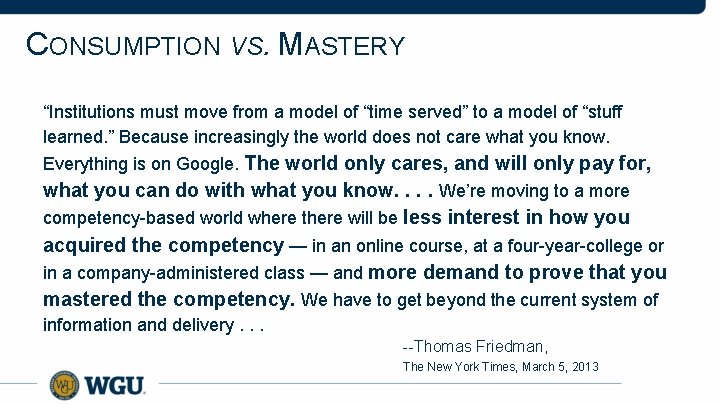
CONSUMPTION VS. MASTERY “Institutions must move from a model of “time served” to a model of “stuff learned. ” Because increasingly the world does not care what you know. Everything is on Google. The world only cares, and will only pay for, what you can do with what you know. . We’re moving to a more competency-based world where there will be less interest in how you acquired the competency — in an online course, at a four-year-college or in a company-administered class — and more demand to prove that you mastered the competency. We have to get beyond the current system of information and delivery. . . --Thomas Friedman, The New York Times, March 5, 2013
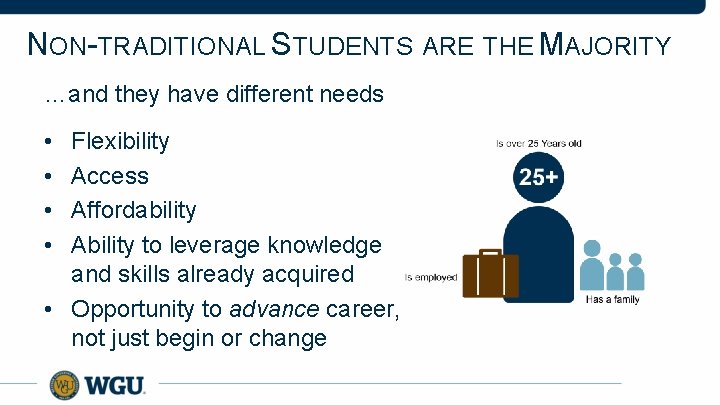
NON-TRADITIONAL STUDENTS ARE THE MAJORITY …and they have different needs • • Flexibility Access Affordability Ability to leverage knowledge and skills already acquired • Opportunity to advance career, not just begin or change
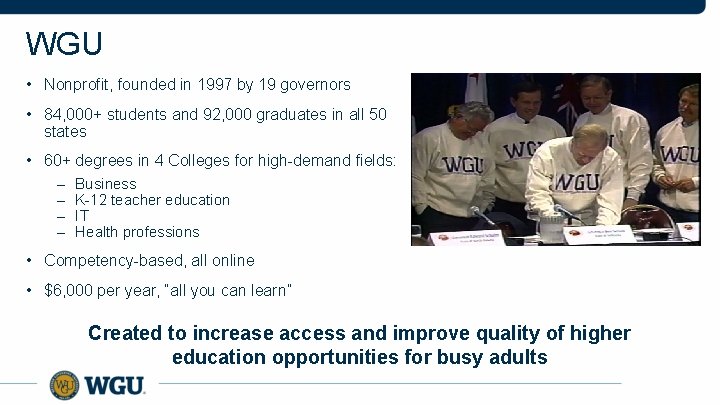
WGU • Nonprofit, founded in 1997 by 19 governors • 84, 000+ students and 92, 000 graduates in all 50 states • 60+ degrees in 4 Colleges for high-demand fields: – – Business K-12 teacher education IT Health professions • Competency-based, all online • $6, 000 per year, “all you can learn” Created to increase access and improve quality of higher education opportunities for busy adults
OUTLINE • The Case for Innovation • CBE at Scale • Utilizing Data to Advance Student Outcomes • What We’ve Learned
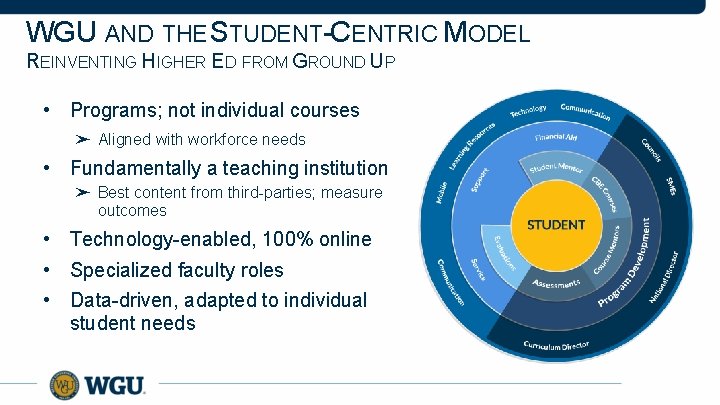
WGU AND THE STUDENT-CENTRIC MODEL REINVENTING HIGHER ED FROM GROUND UP • Programs; not individual courses ➤ Aligned with workforce needs • Fundamentally a teaching institution ➤ Best content from third-parties; measure outcomes • Technology-enabled, 100% online • Specialized faculty roles • Data-driven, adapted to individual student needs
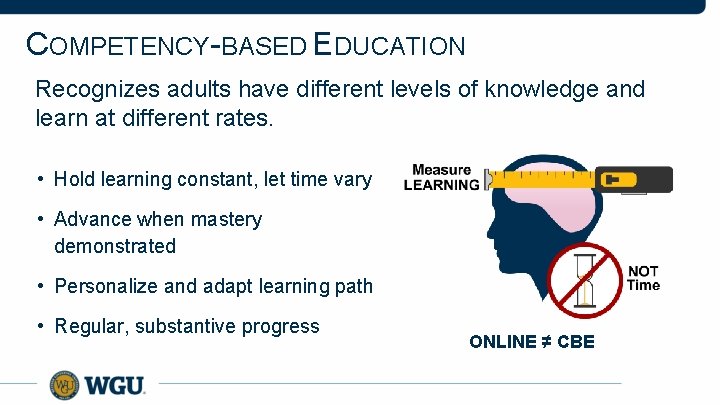
COMPETENCY-BASED EDUCATION Recognizes adults have different levels of knowledge and learn at different rates. • Hold learning constant, let time vary • Advance when mastery demonstrated • Personalize and adapt learning path • Regular, substantive progress ONLINE ≠ CBE
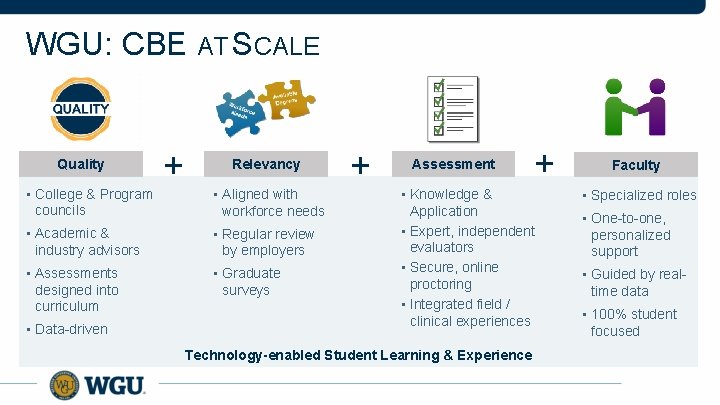
WGU: CBE AT SCALE Quality + Relevancy • College & Program councils • Aligned with workforce needs • Academic & industry advisors • Regular review by employers • Assessments designed into curriculum • Graduate surveys • Data-driven + Assessment + • Knowledge & Application • Expert, independent evaluators • Secure, online proctoring • Integrated field / clinical experiences Technology-enabled Student Learning & Experience Faculty • Specialized roles • One-to-one, personalized support • Guided by realtime data • 100% student focused
PROGRAM & COURSE DESIGN • Required competencies defined and updated in collaboration with academic and industry experts • Leverage best third-party course materials, where available • 6 -month terms, beginning each month - Allows for shorter cycle advancements in programs/courses • Competency validated through expert assessments - Students move quickly through what they already know - Focus on what they need to master
FACULTY AT WGU – SPECIALIZATION Student Mentors • Dedicated, regular one-to-one support for students Course faculty • Provide individualized instruction • Lead group discussions • Support students engaged in specific courses Evaluators • Experts grading / evaluating students performance Curriculum and assessment faculty • Select and develop course materials and assessments
OUTLINE • The Case for Innovation • CBE at Scale • Utilizing Data to Advance Student Outcomes • What We’ve Learned
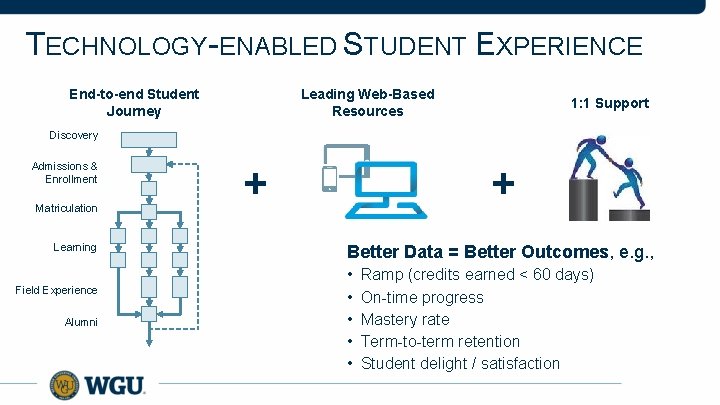
TECHNOLOGY-ENABLED STUDENT EXPERIENCE End-to-end Student Journey Leading Web-Based Resources 1: 1 Support Discovery Admissions & Enrollment Matriculation Learning Field Experience Alumni + + Better Data = Better Outcomes, e. g. , • • • Ramp (credits earned ˂ 60 days) On-time progress Mastery rate Term-to-term retention Student delight / satisfaction
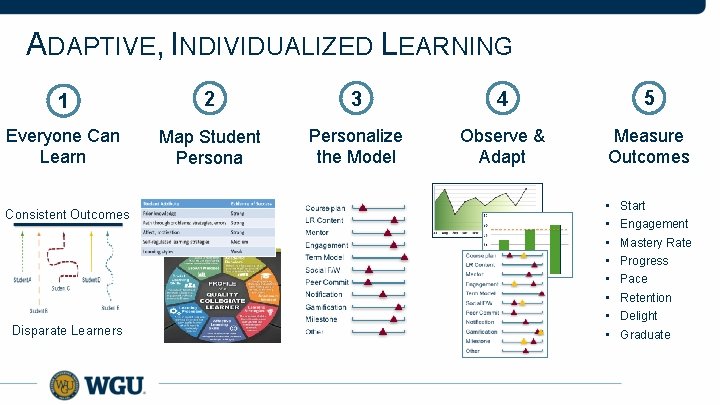
ADAPTIVE, INDIVIDUALIZED LEARNING 1 2 3 4 5 Everyone Can Learn Map Student Personalize the Model Observe & Adapt Measure Outcomes Consistent Outcomes Disparate Learners • • Start Engagement Mastery Rate Progress Pace Retention Delight Graduate
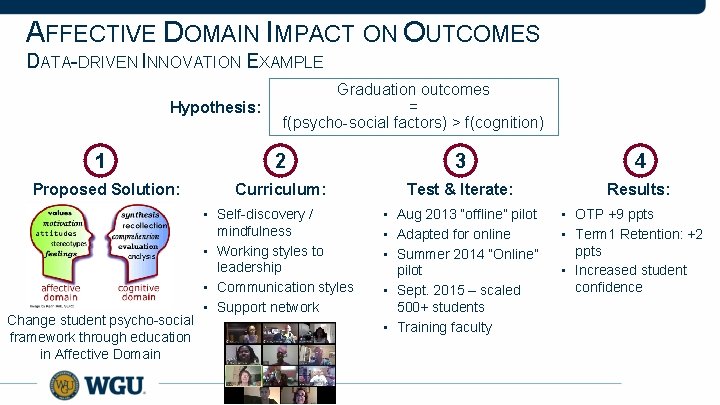
AFFECTIVE DOMAIN IMPACT ON OUTCOMES DATA-DRIVEN INNOVATION EXAMPLE Hypothesis: 1 Proposed Solution: Change student psycho-social framework through education in Affective Domain Graduation outcomes = f(psycho-social factors) > f(cognition) 2 3 4 Curriculum: Test & Iterate: Results: • Self-discovery / mindfulness • Working styles to leadership • Communication styles • Support network • Aug 2013 “offline” pilot • Adapted for online • Summer 2014 “Online” pilot • Sept. 2015 – scaled 500+ students • Training faculty • OTP +9 ppts • Term 1 Retention: +2 ppts • Increased student confidence
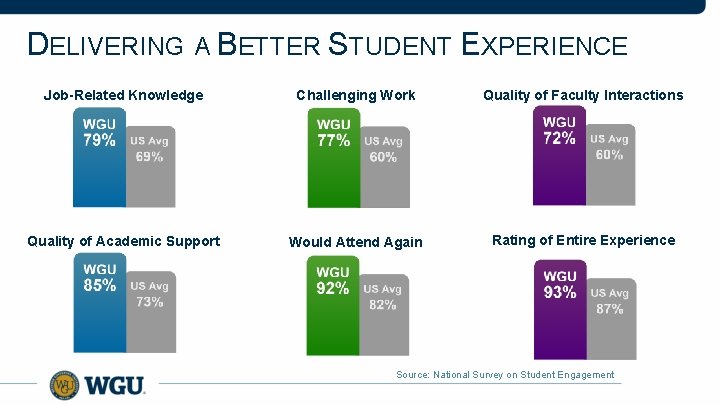
DELIVERING A BETTER STUDENT EXPERIENCE Job-Related Knowledge Challenging Work Quality of Faculty Interactions Quality of Academic Support Would Attend Again Rating of Entire Experience Source: National Survey on Student Engagement
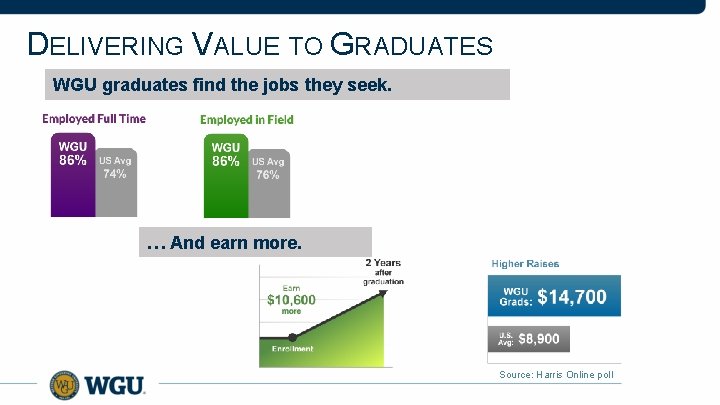
DELIVERING VALUE TO GRADUATES WGU graduates find the jobs they seek. … And earn more. Source: Harris Online poll

GREAT JOBS, GREAT LIVES Source: Gallup
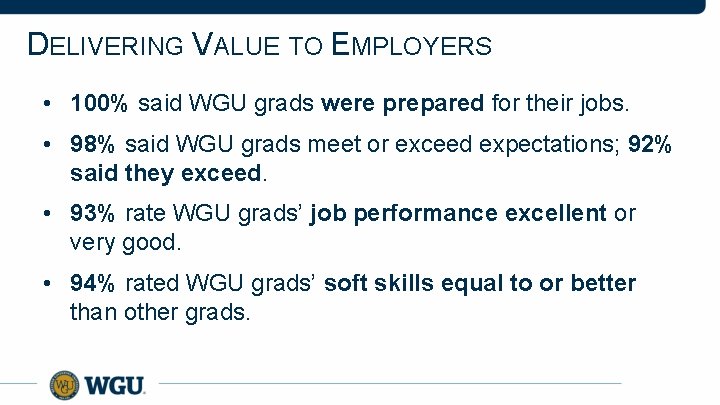
DELIVERING VALUE TO EMPLOYERS • 100% said WGU grads were prepared for their jobs. • 98% said WGU grads meet or exceed expectations; 92% said they exceed. • 93% rate WGU grads’ job performance excellent or very good. • 94% rated WGU grads’ soft skills equal to or better than other grads.
OUTLINE • The Case for Innovation • CBE at Scale • Utilizing Data to Advance Student Outcomes • What We’ve Learned
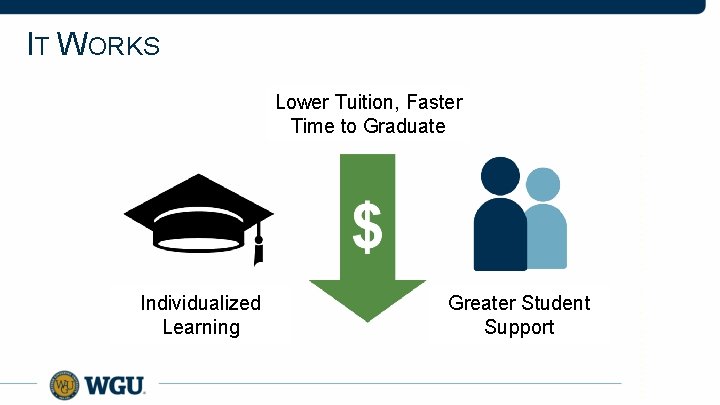
IT WORKS Lower Tuition, Faster Time to Graduate Individualized Learning Greater Student Support
WHAT WE’VE LEARNED • • CBE ≠ Online Education CBE ≠ Direct Assessment CBE is not for everyone; complements existing options Standardization works best – High demand, high volume; Programs and courses • • Outcomes > process Student motivation/engagement vital to success – Challenging, but not impossible, for online model • • Advanced analytics key to advancing experience and outcomes Requires courage – innovation requires sloughing off old methods
QUESTIONS AND DISCUSSION THANK YOU! SARAH DEMARK FRED HURST sarah. demark@wgu. edu fred. hurst@wgu. edu
- Slides: 25