
Wetland Management Wetlands Premier underrated overlooked natural resource









- Slides: 63
Wetland Management
Wetlands • Premier, underrated, overlooked natural resource • Provide habitat to numerous species of plants and animals
Ecological Role • • Controlling flood Act as a filter for pollutants Add to underground water sources Provide habitat for many species – especially waterfowl and amphibians
Ecological Role • Provide recreational use
According to the EPA • More than one third of all threatened and endangered species live only in wetlands • One half of threatened and endangered species use wetlands at some point in their lives
What are Wetlands? • Many types can be found in a variety of habitats across the US • Definitions are unclear, it all depends on what group you ask • Governmental agencies use several differing definitions
Wetlands • Individuals’ and groups’ perspectives and agenda drive what they perceive to be a wetland
Characteristics • Three characteristics • 1 -Prolonged presence of water – an area whose hydrology includes frequent saturation • 2 -Affects how the soil develops and what plants will grow
• Plant types that are attracted to these growing conditions are generally called hydrophytes • Third – because the soil is subjected to frequent saturation and may have a permanent water table close to the surface, it develops into hydric soils
Hydric soils • Tend to be saturated with water most of the time • Usually low in air content • Colored differently than other soils in the same region • Completely different soil structure
• Mottled with white or gray coloring • May be very yellow • Structure may be sticky and wet rather than granular
Definitions • U. S. Army Corps of Engineers defines a jurisdictional wetland: • An area that has frequent flooding or saturation, is covered by hydrophytes, and includes hydric soils • The Corps is responsible for jurisdictional wetlands
Ecological Definition • US Fish and Wildlife Service defines a wetland: • Lands transitional between terrestrial and aquatic systems where the water table is usually at or near the surface or the land is covered by shallow water.
Ecological Definition • The USFWS definition is much broader than the legal definition used by the Corps of Engineers • Ecological Wetlands may not have all three characteristics of the jurisdictional wetland
• The Corps would not consider a mudflat or a coral reef as a wetland but the USFWS would
History of Wetlands in the US • Since the beginning of government in the US wetlands have been perceived as harsh, disgusting places everyone should avoid • Considered a problem rather than an asset until the last half of the 1900’s
• In the 1770’s the District of Columbia was partially covered by swampland • The land was drained and filled in to build the capital
• Southern Louisiana is designated as wetlands • Citizens felt that building a city on a water crossroads site was important • New Orleans is that city
• Still surrounded by various types of wetlands • Leads to constant problems with flooding • Hurricane Katrina
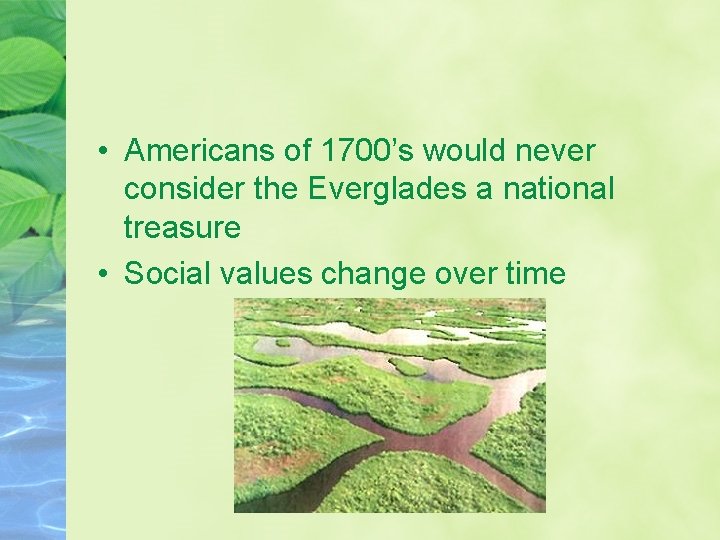
• Americans of 1700’s would never consider the Everglades a national treasure • Social values change over time
Prior to the 1970’s • Government authorized and subsidized draining of wetlands • Practice began in 1849 with passage of the Swamp Lands Act for the state of Louisiana • Later broadened to cover the entire US
• Act gave states permission to fill in and change areas that were “unfit for cultivation” • In 1972 the government changed their policy about wetlands • Took steps to protect and restore
• Requiring permits with Section 404 of the Clean Water Act • Protected wetlands and allowed for restoration of degraded wetlands
Farm bill of 1985 and 1990 • “Swampbuster Provision” • Required farmers to protect wetlands on their farm or ranch to be eligible for USDA farm program benefits
Wetland Identification • Two most common techniques • Off-site identification • On-Site identification
Off-Site Identification • Checking maps and wetland inventories • Used as a screening device to find possible wetland locations • Three principal resources for the landownder
• 1. USFWS • Produces National Wetlands Inventory (NWI) • Maps wetlands every ten years • NWI is concerned with wetlands and open water in the US
• 2. National Resource Conservation Service (NRCS) Soil Survey List • Maintains list of hydric soils • County by county maps
• 3. US Geological Topography Maps • Look at vegetative cover, surface characteristics, bogs, and marshes • Uses specific terminologies • What is growing on the land, standing water
On-Site Identification • Location will determine what agency is responsible • Dredging, filling or discharge – US Army Corps of Engineers • Close to a lake or inland water USFWS
• Agricultural lands and non ag lands that border ag lands – NRCS division of USDA • On site inspection includes study of plants, soils and water supply
Types of Wetlands • • Marshes Throughout the US Freshwater, saltwater and tidal Florida Everglades – well known marsh
Floodplains • Areas that border rivers, lakes and streams • Are flooded periodically • Mississippi River floodplain - most well known • Last serious flood of MS floodplain was in 1993 – 500 year flood
Ponds • • May have wetlands around their edges May turn to marsh in times of drought Permanent body of water Not all lakes and ponds are wetlands
Rivers and Streams • Not all rivers and streams are wetlands • Some may move slow enough to allow certain types of vegetation to take over • Slower and warmer water – more prolific plant life becomes
Swamps • Types – Cypress, southern bottomland, hardwood, shrub, northern • Differs on type of vegetation • Same general characteristics of standing water with trees or shrubs growing in the water
Swamps • Stagnant water tends to be dark and non translucent • Great Dismal and Big Cypress – well known swamps
Bog • Very damp, usually with evergreens present, floor covered with moss or peat • Spongy walk • Most located in the northeast and MI, WI and MN • Acid loving plants • Cranberries
Prairie Potholes • Rely on periodic rainfall • ND, SD, MN and NE • Critical to water fowl habitat and migration
Vernal Pools • May last for only a few months each year • Rely on periodic rainfall • Haven for amphibian species as they lack predators • About 1/3 of all amphibians in the eastern US rely on vernal ponds as breeding sites
Status in the U. S. • Estimated that there were over 200 million Acres of wetlands in the US in the 1600’s • About half that area remains today
Major Causes-Loss of Wetland • • • Urbanization Industry Agriculture Timber harvest Mining operations
Urbanization • Construction of roads, parking lots, and buildings changes runoff patterns • Materials carried by the runoff change water quality
Industry • Increased water demands • Discharge of warm water (thermal pollution) • Change p. H • Pollutants from abandoned industry
Agriculture • Draining wetland • Encouraged producers not to graze wetlands • Wastes contaminate the water
Timber Harvest • Loss is only temporary • Destruction usually lasts 3 -5 years • Use of heavy equipment effects the soil structure
Mining • Mining of peat moss • Used in horticulture industry as a planting medium • Removal of vegetation and draining of water
Preservation • Annual loss of wetlands 70, 000 -90, 000 acres on non federal lands • Amphibian habitat • Early indicators of environmental problems
Natural Wetland Protection • Most regulations are to prevent destruction of natural wetlands • Regulate building of roads bridges and buildings
Construction • Natural structures to treat all forms of water pollution • Most municipalities use a wetland as a secondary treatment after primary removal of solid waste • Wetland construction is less than water treatment facility
Restoration • Some industry is required to restore the land • Provide habitat for large variety of wildlife including mammals, fish, migratory game birds and waterfowl
Wetland Management • Concern of many government and private agencies • Private landowners cannot be forced to manage their wetland in any particular way • Corps is working to tighten policies regarding wetlands
Personal Management • Ideal – Leave the wetland alone • Provide a buffer zone around the wetland • Restoration may involve removal of non native plants, planting native trees, shrubs and other aquatic plants • Create walkways
Other Gov’t Programs • Numerous legislative acts to develop and protect wetlands • 1972 – Clean Water Act - regulates wetlands of the US