
Wet processes Flow chart of material flow within

- Slides: 19
-Wet processes. -Flow chart of material flow within a wet processing mill. -The major processes involved in wet processing Faiza Anwar
Wet processing is carried out by using two techniques Bath process: The total amount of the product is processed as the same time in an appropriate liquor in a suitable machine. The textile is loaded into the machine this load being one batch of material. It will remain in the machine until the process is complete it will then be unloaded.
Wet processing Continuous process: The textile passes continuously through the processing liquid. Typically the textile will then pass-on continuously to the next machine in the sequence to bring about reaction of the absorbed liquor with the textile.
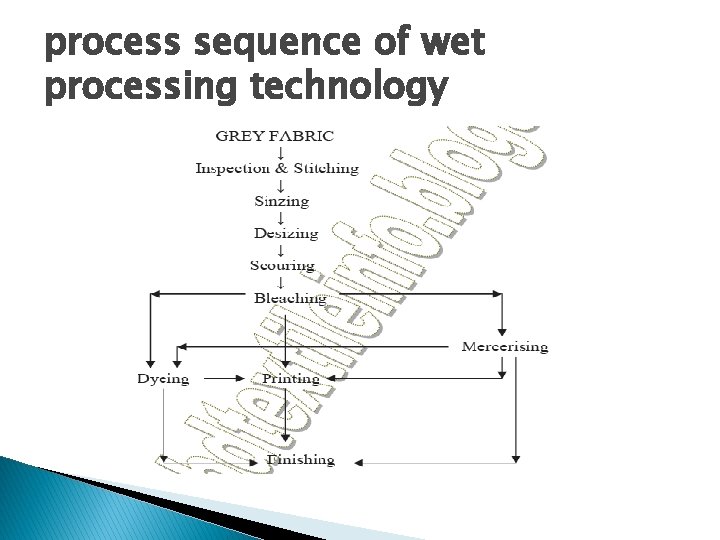
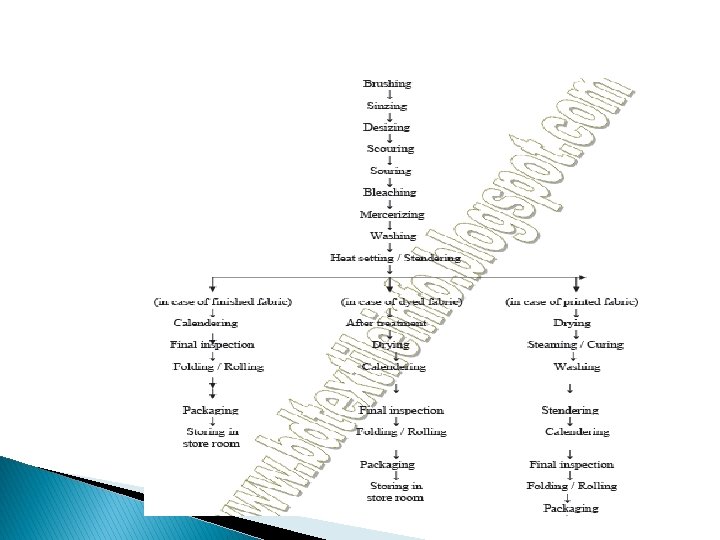
� Process involve in textile wet processing 1. Stitching: To increase the length of the fabric for making suitable for processing is called stitching. It is done by plain sewing m/c. 2. Brushing: To remove the loose fibre & loose ends of the warp & weft threads is known as brushing. 3. Shearing / Cropping: The process by which the attached ends of the warp & weft thread is removed by cutting by the knives or blades is called shearing. Shearing is done for cotton & cropping for jute 4. Singeing: The process by which the protruding / projecting fibres are removed from the fabrics by burning / heat to increase the smoothness of the fabric is called singeing.
5. Desizing: The process by which the sizing materials (starch) are removed from the fabric is known as desizing. 6. Scouring: The process by which the natural impurities (oil, wax, fat etc) & added / external impurities (dirt, dust etc) are removed from the fabric is called scouring. It is done by strong Na. OH. 7. Souring: The process by which the alkali are removed from the scoured fabric with dilute acid solution is known as souring. 8. Bleaching: The process by which the natural colours (nitrogeneous substance) are removed from the fabric to make the fabric pure & permanent white is known as bleaching. It is done by bleaching agent.
9. Mercerizing: The process by which the cellulosic substance are treated with highly conc. Na. OH to impart some properties such as strength, absorbency capacity, lusture is known as mercerizing. It is optional. 10. washing: Washing is done by firstly cold wash, then hot wash (80°C) & finally normal wash. 11. Heat setting: The process by which the width of the fabrics are adjusted by heat is called heat setting. 12. After treatment: The process by which the loose dyes are removed from the dyed fabrics to increase the lusture & fastness property of the fabric is known as after treatment. ◦.
13. Calendaring: It is done to remove the undesirable creese & crinkle. 14. Steaming / Curing: To fix up the dyestuff / pigment with the fabric. Steaming is used for dyestuff & it is done in 100 -105°C. curing is used for pigments & it is done in 120 -180°C. 15. Stentering: It is done to increase / adjust the width of the fabric
process sequence of wet processing technology � introduction: � The selection of correct process sequence is very important. � Precise requirements of fabric preparation depend on ◦ the kind of fibre and ◦ its proportion contained in the blends, ◦ fabric construction, ◦ size ◦ type and ◦ the end use.
Type of Fiber/Fabric � In cotton knitted fabrics singeing and desizing stages are mostly omitted, � whereas for woven fabrics desizing cannot be omitted. � Synthetic fibers are produced under controlled conditions and contain only added impurities, their cleaning is comparatively easy. � Synthetic fibers are used in admixture with natural fibers, the problems become intense.
End requirements � Preparation of fabric also depends on the end requirement. � For example, "full white bleach" is done in the case of goods which are to be supplied white, � 'half bleach' for over dyeing or whenever fully covered designs are to be printed and � 'full bleach' whenever pastel shades are to be dyed.
End requirements � Cotton fabrics to be dyed in deep shades will most likely require mercerization in order to improve their dyeability. � Fabric preparation is a costly series of energy consuming processes. � Economic consideration. � Optimizing the process sequence, conditions and � Development of shorter routes.
New considerations � New types of machineries and � newer processes. � All these factors necessitate the alteration of process sequence to get the optimum results. � The technologists can decide as and when any of the stages are to be by-passed without compromising the quality of the goods.
process sequence of wet processing technology
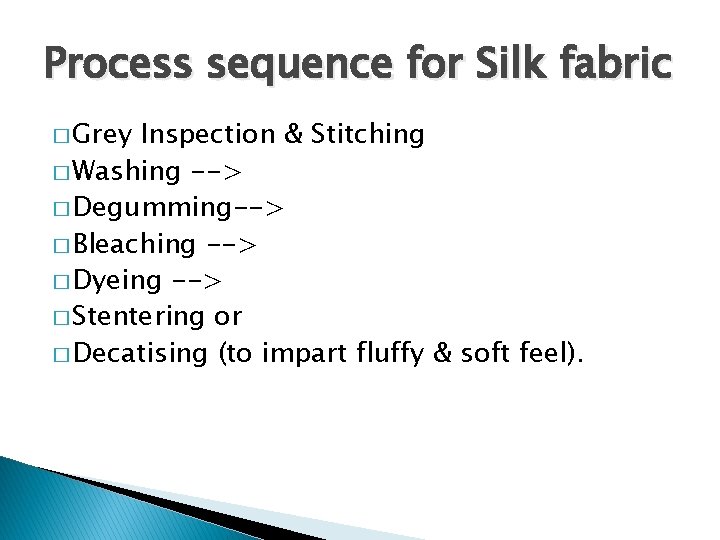
Process sequence for Silk fabric � Grey Inspection & Stitching � Washing --> � Degumming--> � Bleaching --> � Dyeing --> � Stentering or � Decatising (to impart fluffy & soft feel).
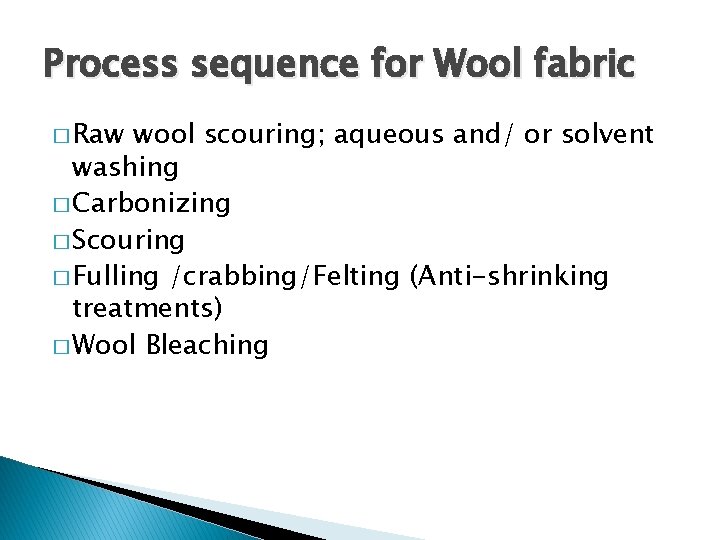
Process sequence for Wool fabric � Raw wool scouring; aqueous and/ or solvent washing � Carbonizing � Scouring � Fulling /crabbing/Felting (Anti-shrinking treatments) � Wool Bleaching
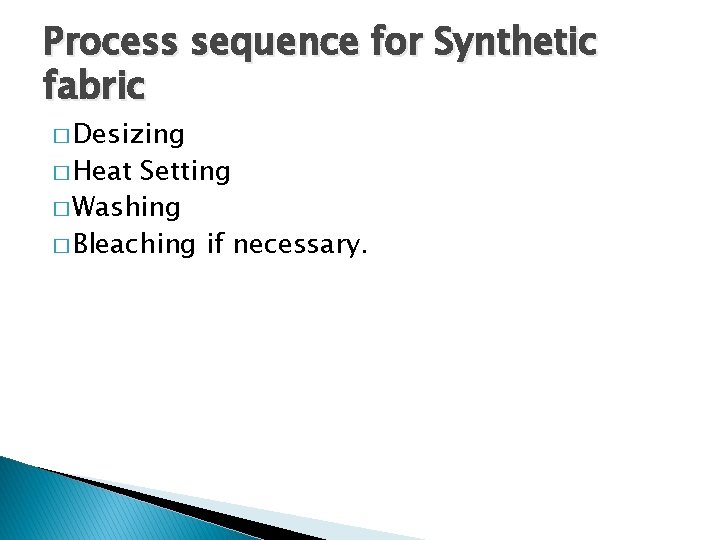
Process sequence for Synthetic fabric � Desizing � Heat Setting � Washing � Bleaching if necessary.
� Reference Eurotex Vol. IV, Textile Wet Processing. Wet processing treatment Moshiour Rahman