
Western Cape Province Sustainable Development Conference Sustainable Human
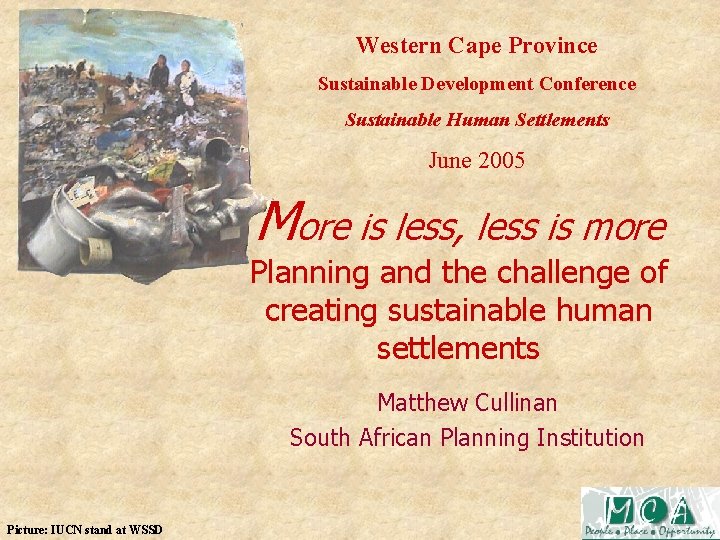
Western Cape Province Sustainable Development Conference Sustainable Human Settlements June 2005 More is less, less is more Planning and the challenge of creating sustainable human settlements Matthew Cullinan South African Planning Institution Picture: IUCN stand at WSSD
Is planning working? • Planning, it appears, is having little impact in bringing about equitable, just and ecologically sustainable settlements or cities. • In spite of the technologies, approaches and legislation and our outstanding success over the past 10 years - we are still seeing no widespread integration of ‘sustainable’ technologies and approaches into everyday development processes. • In one sense we have the solutions – see the range of material presented at this conference. • So what’s the problem?
Factors undermining planning's ability to achieve sustainable settlements • • Tiers not spheres Values and market forces The pressure to deliver Systems of delivery and infrastructural legacy • Legislative turf slicing
Consequences • Delivery is slowed • Delivery is inappropriate and results in long-term costs • Past patterns are perpetuated – with marginalisation and economic/racial separation continuing • Conventional systems of service delivery and resource utilisation are kept • Cities and settlements becoming less sustainable as resource constraints grow • Something will have to give
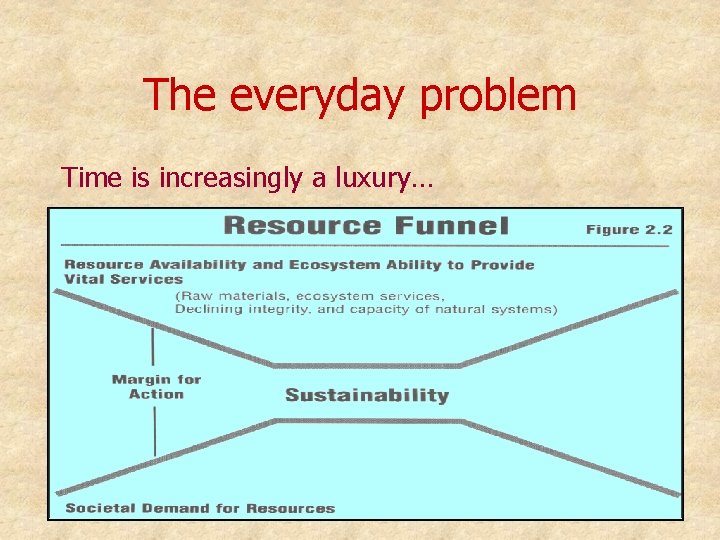
The everyday problem Time is increasingly a luxury…
Sustainability is about freedom, choice, opportunity and equity • Liberty, universal franchise and equality are the foundations of modern democratic and economic systems • Bound-up with this has been the erroneous assumption that economic growth and globalisation ‘automatically’ imply and deliver these same qualities • The irony (and reality) is that our current approaches to economic development and delivery are actually a long-term threat to these freedoms • We have to accept limitations at the level of individual pursuit of freedom, choice and opportunity (consumerism) and recognise that these qualities can only be achieved through our recognition of our interdependence on each other as humans and on the ecological processes that sustain life
What is to be done?
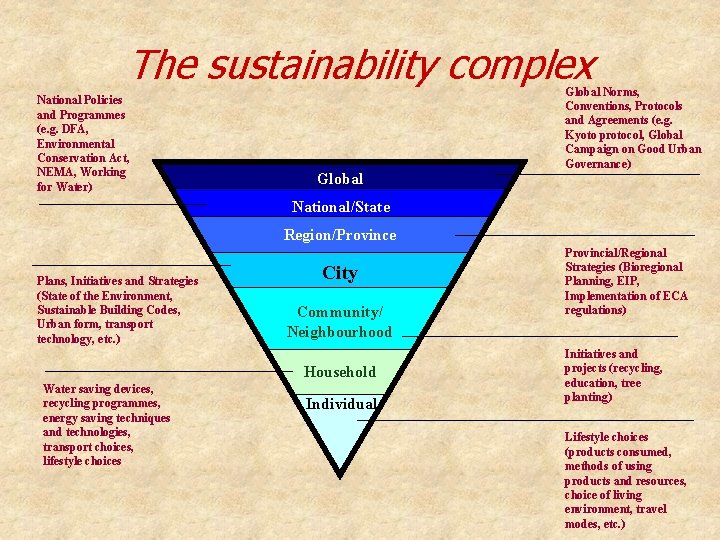
The sustainability complex National Policies and Programmes (e. g. DFA, Environmental Conservation Act, NEMA, Working for Water) Global Norms, Conventions, Protocols and Agreements (e. g. Kyoto protocol, Global Campaign on Good Urban Governance) National/State Region/Province Plans, Initiatives and Strategies (State of the Environment, Sustainable Building Codes, Urban form, transport technology, etc. ) City Community/ Neighbourhood Household Water saving devices, recycling programmes, energy saving techniques and technologies, transport choices, lifestyle choices Individual Provincial/Regional Strategies (Bioregional Planning, EIP, Implementation of ECA regulations) Initiatives and projects (recycling, education, tree planting) Lifestyle choices (products consumed, methods of using products and resources, choice of living environment, travel modes, etc. )
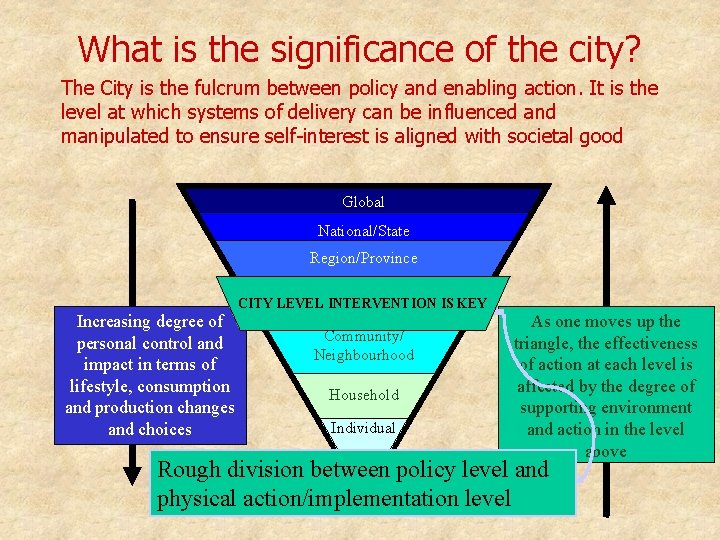
What is the significance of the city? The City is the fulcrum between policy and enabling action. It is the level at which systems of delivery can be influenced and manipulated to ensure self-interest is aligned with societal good Global National/State Region/Province City Increasing degree of personal control and impact in terms of lifestyle, consumption and production changes and choices CITY LEVEL INTERVENTION IS KEY Community/ Neighbourhood Household Individual As one moves up the triangle, the effectiveness of action at each level is affected by the degree of supporting environment and action in the level above Rough division between policy level and physical action/implementation level
Conclusion 1: Re-gear city delivery systems to support sustainability • Allow for low-energy, low resource use and minimum waste lifestyles • Major opportunities exist in terms of urban form and structure – Compact and efficient urban forms • Reuse, reclamation, recycling and growth of labour intensive methods and industries around this • More efficient energy use and production (use of industrial heat for example) • Alternatives to the car
Conclusion 2: Institutional Focus • • National government must trim the plethora of competing legislation, competing constitutional mandates and to drive through reforms that will enable key delivery agencies to conform to national development directives (e. g via NSDP and MTSF). The type of command approach is the only viable option and it has worked elsewhere Long-term result will be greater freedom of choice and greater stability. Number of ways to approach the problem – Take all spatial planning back-up to a National competence (or at least insist on national approvals and approval of amendments) • Removes ability of local Councilors and provinces to ignore plan, gives them authority to deal with long-term issues • Forces all spheres to comply • Will force treasury to acknowledge financial implications of spatial plans – Enact legislation to enable National to drive development in National Interest and (for example) to expropriate and commandeer land from Public Works for these objectives and/or to issue directives to other spheres or sectors where spatial invest is in National Interest. e. g. • Housing • Transport and civil infrastructure (and especially systems of waste management, energy and water provision) • Land reform (urban and rural)

Thank you
- Slides: 12