
WESTERN CAPE EDUCATION DEPARTMENT 12 January 2022 Matric


- Slides: 41
WESTERN CAPE EDUCATION DEPARTMENT 12 January 2022
Matric results
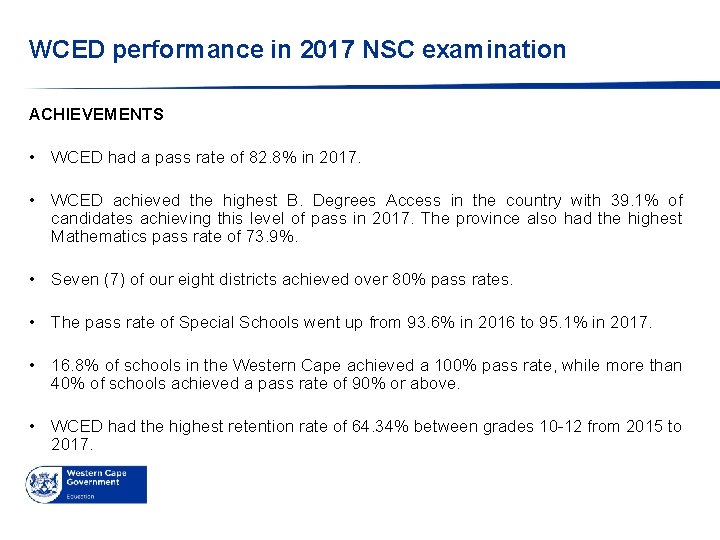
WCED performance in 2017 NSC examination ACHIEVEMENTS • WCED had a pass rate of 82. 8% in 2017. • WCED achieved the highest B. Degrees Access in the country with 39. 1% of candidates achieving this level of pass in 2017. The province also had the highest Mathematics pass rate of 73. 9%. • Seven (7) of our eight districts achieved over 80% pass rates. • The pass rate of Special Schools went up from 93. 6% in 2016 to 95. 1% in 2017. • 16. 8% of schools in the Western Cape achieved a 100% pass rate, while more than 40% of schools achieved a pass rate of 90% or above. • WCED had the highest retention rate of 64. 34% between grades 10 -12 from 2015 to 2017. © Western Cape Government 2012 |
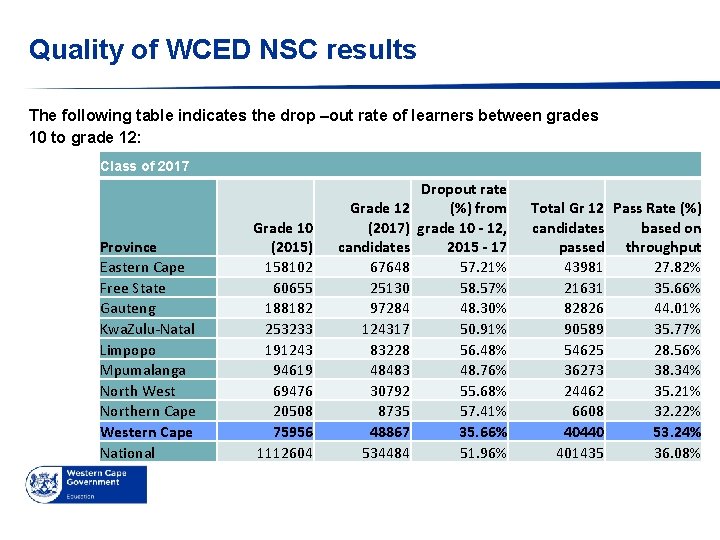
Quality of WCED NSC results The following table indicates the drop –out rate of learners between grades 10 to grade 12: Class of 2017 Province Eastern Cape Free State Gauteng Kwa. Zulu-Natal Limpopo Mpumalanga North West Northern Cape Western Cape National Grade 10 (2015) 158102 60655 188182 253233 191243 94619 69476 20508 75956 1112604 © Western Cape Government 2012 | Grade 12 (2017) candidates 67648 25130 97284 124317 83228 48483 30792 8735 48867 534484 Dropout rate (%) from grade 10 - 12, 2015 - 17 57. 21% 58. 57% 48. 30% 50. 91% 56. 48% 48. 76% 55. 68% 57. 41% 35. 66% 51. 96% Total Gr 12 Pass Rate (%) candidates based on passed throughput 43981 27. 82% 21631 35. 66% 82826 44. 01% 90589 35. 77% 54625 28. 56% 36273 38. 34% 24462 35. 21% 6608 32. 22% 40440 53. 24% 401435 36. 08%
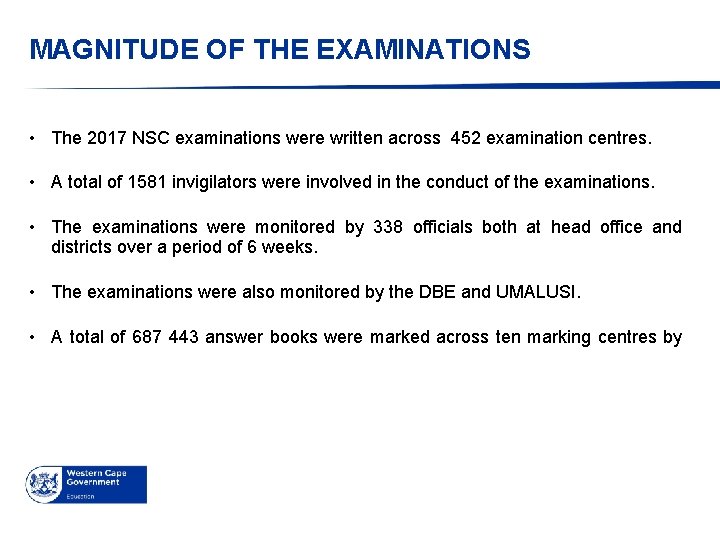
MAGNITUDE OF THE EXAMINATIONS • The 2017 NSC examinations were written across 452 examination centres. • A total of 1581 invigilators were involved in the conduct of the examinations. • The examinations were monitored by 338 officials both at head office and districts over a period of 6 weeks. • The examinations were also monitored by the DBE and UMALUSI. • A total of 687 443 answer books were marked across ten marking centres by © Western Cape Government 2012 |
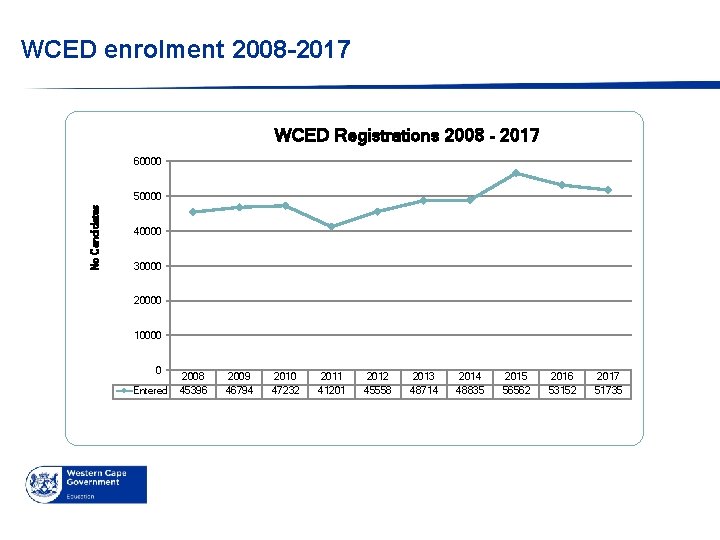
WCED enrolment 2008 -2017 WCED Registrations 2008 - 2017 60000 No Candidates 50000 40000 30000 20000 10000 0 Entered 2008 45396 2009 46794 2010 47232 © Western Cape Government 2012 | 2011 41201 2012 45558 2013 48714 2014 48835 2015 56562 2016 53152 2017 51735
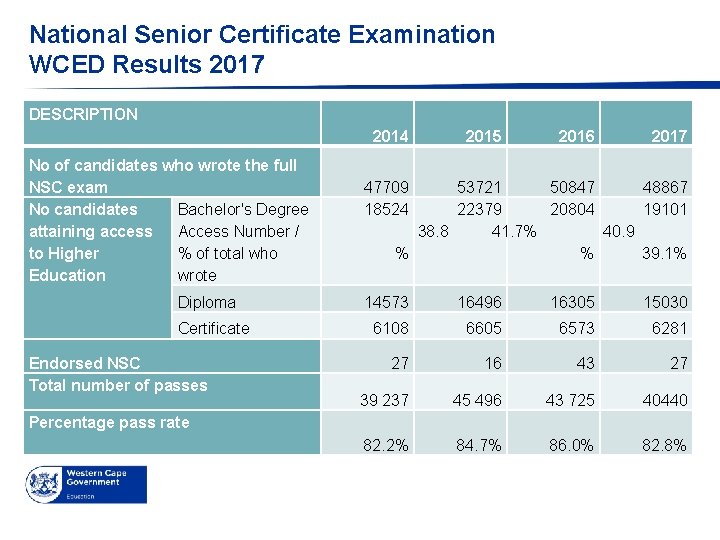
National Senior Certificate Examination WCED Results 2017 DESCRIPTION 2014 No of candidates who wrote the full NSC exam No candidates Bachelor's Degree attaining access Access Number / to Higher % of total who Education wrote Diploma Certificate Endorsed NSC Total number of passes 2015 2016 2017 47709 18524 53721 50847 48867 22379 20804 19101 38. 8 41. 7% 40. 9 % % 39. 1% 14573 16496 16305 15030 6108 6605 6573 6281 27 16 43 27 39 237 45 496 43 725 40440 82. 2% 84. 7% 86. 0% 82. 8% Percentage pass rate © Western Cape Government 2012 |
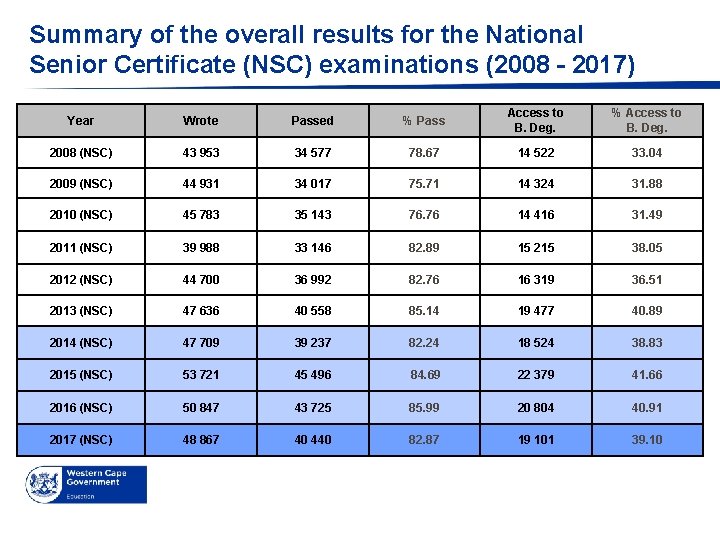
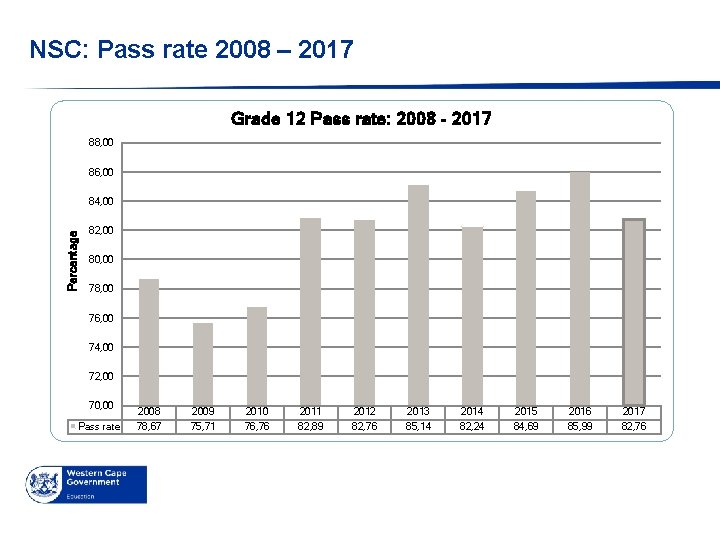
Summary of the overall results for the National Senior Certificate (NSC) examinations (2008 - 2017) Year Wrote Passed % Pass Access to B. Deg. % Access to B. Deg. 2008 (NSC) 43 953 34 577 78. 67 14 522 33. 04 2009 (NSC) 44 931 34 017 75. 71 14 324 31. 88 2010 (NSC) 45 783 35 143 76. 76 14 416 31. 49 2011 (NSC) 39 988 33 146 82. 89 15 215 38. 05 2012 (NSC) 44 700 36 992 82. 76 16 319 36. 51 2013 (NSC) 47 636 40 558 85. 14 19 477 40. 89 2014 (NSC) 47 709 39 237 82. 24 18 524 38. 83 2015 (NSC) 53 721 45 496 84. 69 22 379 41. 66 2016 (NSC) 50 847 43 725 85. 99 20 804 40. 91 2017 (NSC) 48 867 40 440 82. 87 19 101 39. 10 © Western Cape Government 2012 |
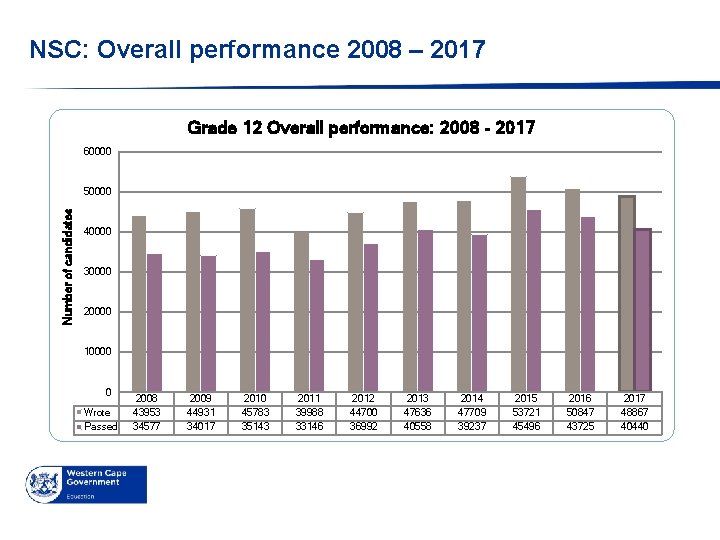
NSC: Overall performance 2008 – 2017 Grade 12 Overall performance: 2008 - 2017 60000 Number of candidates 50000 40000 30000 20000 10000 0 Wrote Passed 2008 43953 34577 2009 44931 34017 2010 45783 35143 2011 39988 33146 © Western Cape Government 2012 | 2012 44700 36992 2013 47636 40558 2014 47709 39237 2015 53721 45496 2016 50847 43725 2017 48867 40440
NSC: Pass rate 2008 – 2017 Grade 12 Pass rate: 2008 - 2017 88, 00 86, 00 Percentage 84, 00 82, 00 80, 00 78, 00 76, 00 74, 00 72, 00 70, 00 Pass rate 2008 78, 67 2009 75, 71 2010 76, 76 2011 82, 89 © Western Cape Government 2012 | 2012 82, 76 2013 85, 14 2014 82, 24 2015 84, 69 2016 85, 99 2017 82, 76
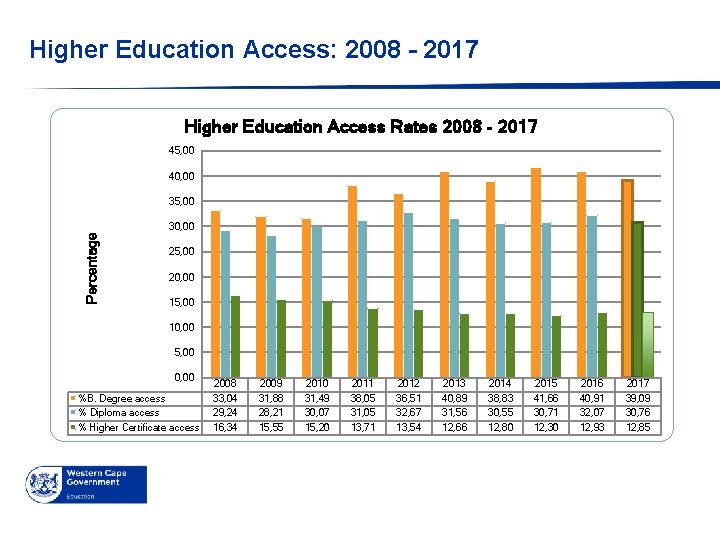
Higher Education Access: 2008 - 2017 Higher Education Access Rates 2008 - 2017 45, 00 40, 00 35, 00 Percentage 30, 00 25, 00 20, 00 15, 00 10, 00 5, 00 0, 00 %B. Degree access % Diploma access % Higher Certificate access 2008 33, 04 29, 24 16, 34 2009 31, 88 28, 21 15, 55 © Western Cape Government 2012 | 2010 31, 49 30, 07 15, 20 2011 38, 05 31, 05 13, 71 2012 36, 51 32, 67 13, 54 2013 40, 89 31, 56 12, 66 2014 38, 83 30, 55 12, 80 2015 41, 66 30, 71 12, 30 2016 40, 91 32, 07 12, 93 2017 39, 09 30, 76 12, 85
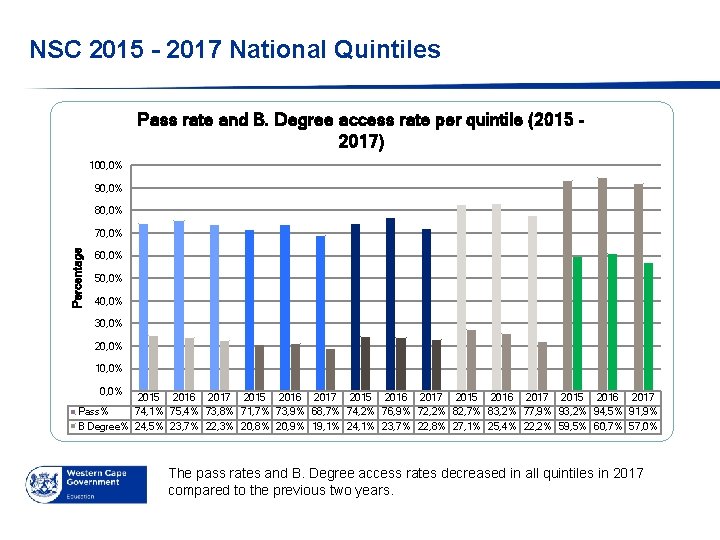
NSC 2015 - 2017 National Quintiles Pass rate and B. Degree access rate per quintile (2015 2017) 100, 0% 90, 0% 80, 0% Percentage 70, 0% 60, 0% 50, 0% 40, 0% 30, 0% 20, 0% 10, 0% 2015 2016 2017 2015 2016 2017 Pass% 74, 1% 75, 4% 73, 8% 71, 7% 73, 9% 68, 7% 74, 2% 76, 9% 72, 2% 82, 7% 83, 2% 77, 9% 93, 2% 94, 5% 91, 9% B Degree% 24, 5% 23, 7% 22, 3% 20, 8% 20, 9% 19, 1% 24, 1% 23, 7% 22, 8% 27, 1% 25, 4% 22, 2% 59, 5% 60, 7% 57, 0% The pass rates and B. Degree access rates decreased in all quintiles in 2017 compared to the previous two years. © Western Cape Government 2012 |
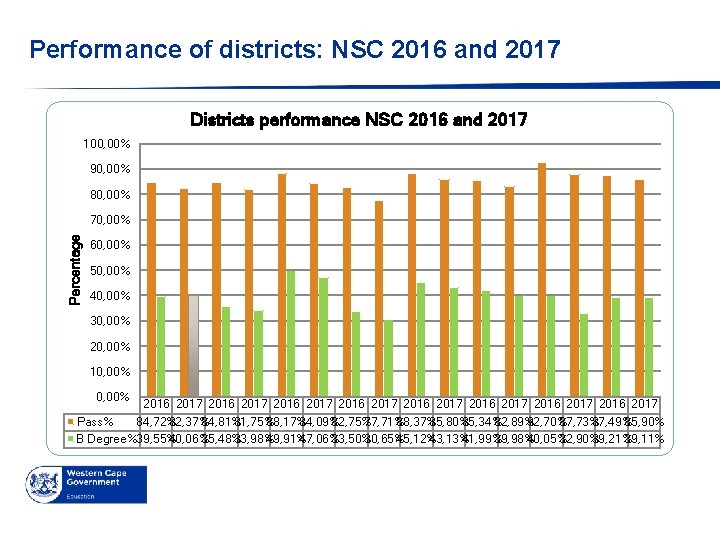
Performance of districts: NSC 2016 and 2017 Districts performance NSC 2016 and 2017 100, 00% 90, 00% 80, 00% Percentage 70, 00% 60, 00% 50, 00% 40, 00% 30, 00% 20, 00% 10, 00% 2016 2017 2016 2017 Pass% 84, 72% 82, 37% 84, 81% 81, 75% 88, 17% 84, 09% 82, 75% 77, 71% 88, 37% 85, 80% 85, 34% 82, 89% 92, 70% 87, 73% 87, 49% 85, 90% B Degree%39, 55% 40, 06% 35, 48% 33, 98% 49, 91% 47, 06% 33, 50% 30, 65% 45, 12% 43, 13% 41, 99% 39, 98% 40, 05% 32, 90% 39, 21% 39, 11% © Western Cape Government 2012 |
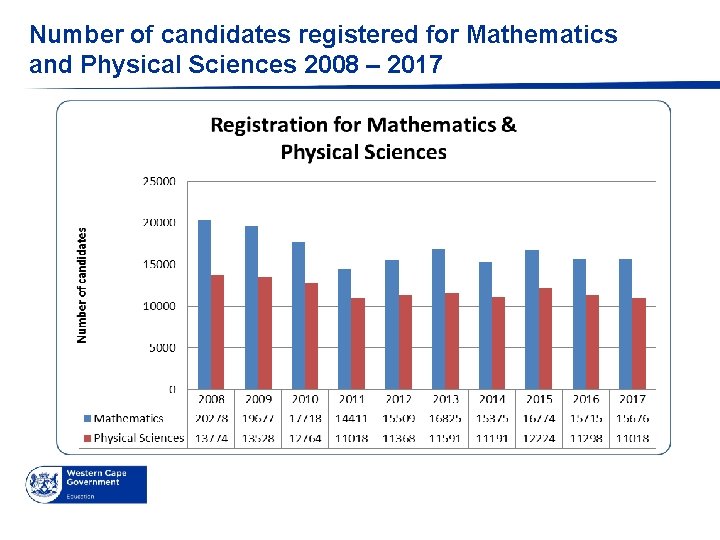
Number of candidates registered for Mathematics and Physical Sciences 2008 – 2017 © Western Cape Government 2012 |
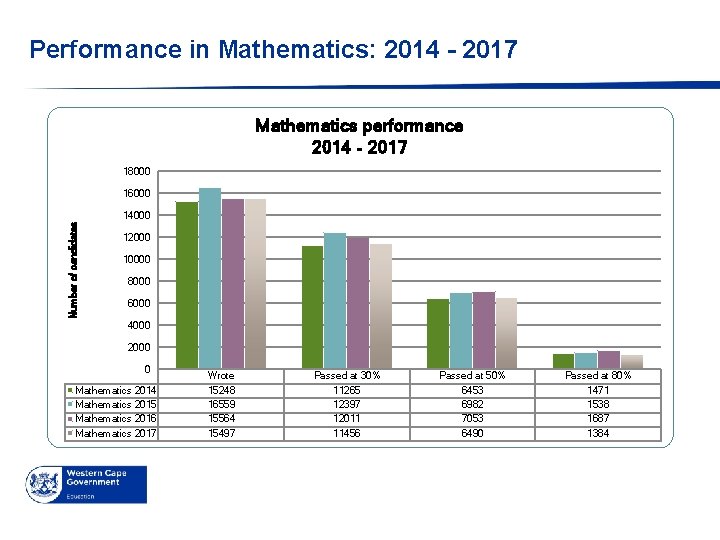
Performance in Mathematics: 2014 - 2017 Mathematics performance 2014 - 2017 18000 16000 Number of candidates 14000 12000 10000 8000 6000 4000 2000 0 Mathematics 2014 Mathematics 2015 Mathematics 2016 Mathematics 2017 Wrote 15248 16559 15564 15497 © Western Cape Government 2012 | Passed at 30% 11265 12397 12011 11456 Passed at 50% 6453 6982 7053 6490 Passed at 80% 1471 1538 1687 1384
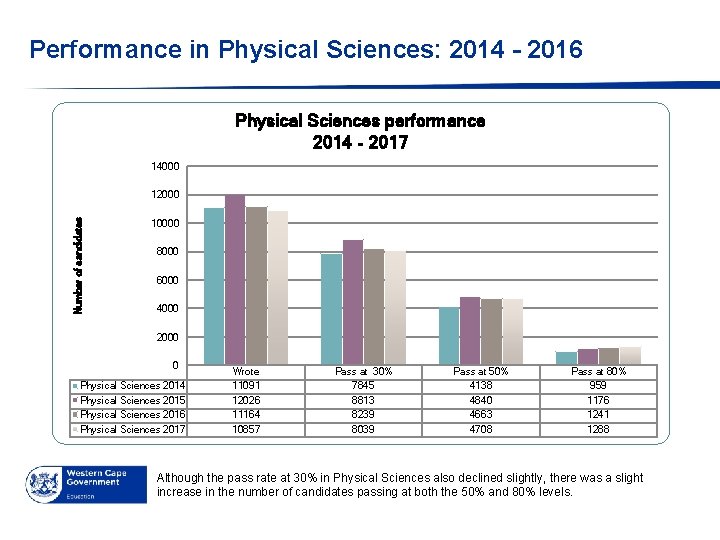
Performance in Physical Sciences: 2014 - 2016 Physical Sciences performance 2014 - 2017 14000 Number of candidates 12000 10000 8000 6000 4000 2000 0 Physical Sciences 2014 Physical Sciences 2015 Physical Sciences 2016 Physical Sciences 2017 Wrote 11091 12026 11164 10857 Pass at 30% 7845 8813 8239 8039 Pass at 50% 4138 4840 4663 4708 Pass at 80% 959 1176 1241 1288 Although the pass rate at 30% in Physical Sciences also declined slightly, there was a slight increase in the number of candidates passing at both the 50% and 80% levels. © Western Cape Government 2012 |
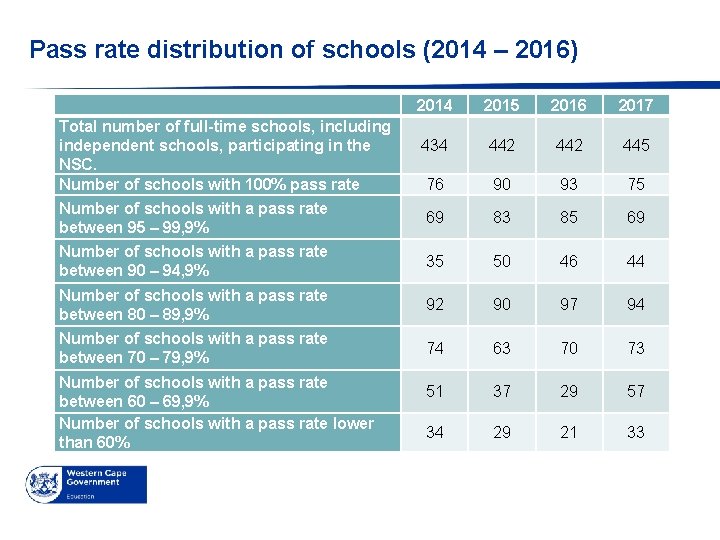
Pass rate distribution of schools (2014 – 2016) 2014 2015 2016 2017 434 442 445 76 90 93 75 69 83 85 69 Number of schools with a pass rate between 90 – 94, 9% 35 50 46 44 Number of schools with a pass rate between 80 – 89, 9% 92 90 97 94 Number of schools with a pass rate between 70 – 79, 9% 74 63 70 73 51 37 29 57 34 29 21 33 Total number of full-time schools, including independent schools, participating in the NSC. Number of schools with 100% pass rate Number of schools with a pass rate between 95 – 99, 9% Number of schools with a pass rate between 60 – 69, 9% Number of schools with a pass rate lower than 60% © Western Cape Government 2012 |
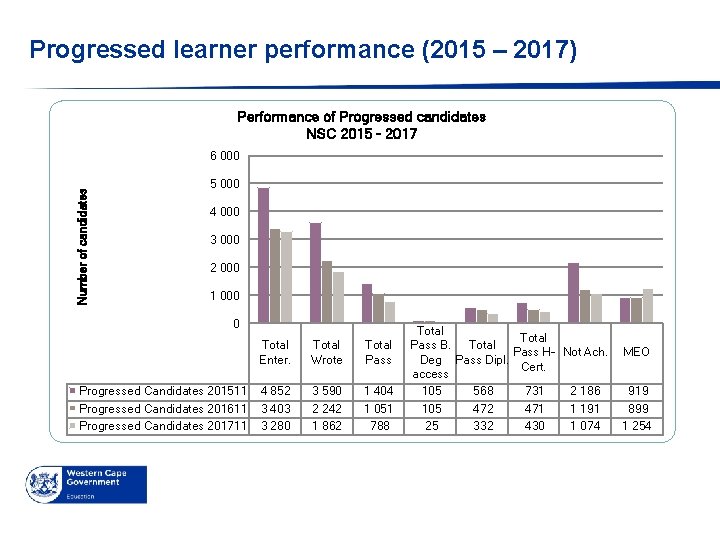
Progressed learner performance (2015 – 2017) Performance of Progressed candidates NSC 2015 - 2017 Number of candidates 6 000 5 000 4 000 3 000 2 000 1 000 0 Progressed Candidates 201511 Progressed Candidates 201611 Progressed Candidates 201711 Total Enter. Total Wrote Total Pass 4 852 3 403 3 280 3 590 2 242 1 862 1 404 1 051 788 © Western Cape Government 2012 | Total Pass B. Total Pass H- Not Ach. Deg Pass Dipl. Cert. access 105 568 731 2 186 105 472 471 1 191 25 332 430 1 074 MEO 919 899 1 254
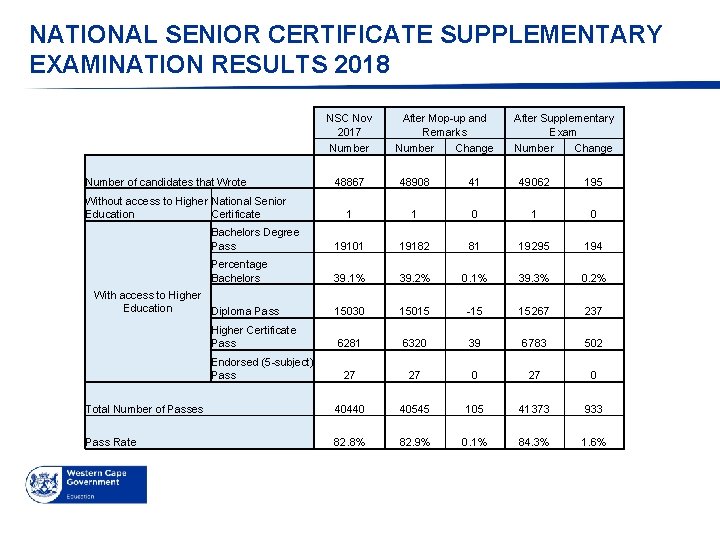
NATIONAL SENIOR CERTIFICATE SUPPLEMENTARY EXAMINATION RESULTS 2018 NSC Nov 2017 Number of candidates that Wrote After Mop-up and Remarks Number Change After Supplementary Exam Number Change 48867 48908 41 49062 195 1 1 0 Bachelors Degree Pass 19101 19182 81 19295 194 Percentage Bachelors 39. 1% 39. 2% 0. 1% 39. 3% 0. 2% 15030 15015 -15 15267 237 6281 6320 39 6783 502 27 27 0 Total Number of Passes 40440 40545 105 41373 933 Pass Rate 82. 8% 82. 9% 0. 1% 84. 3% 1. 6% Without access to Higher National Senior Education Certificate With access to Higher Education Diploma Pass Higher Certificate Pass Endorsed (5 -subject) Pass © Western Cape Government 2012 |
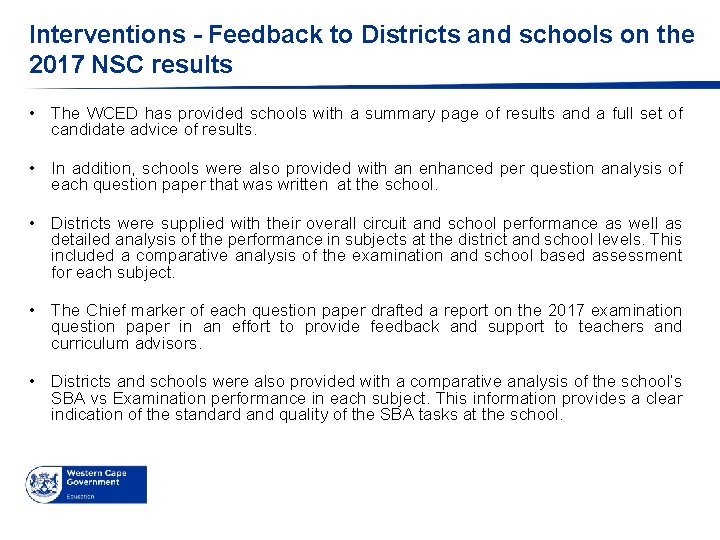
Interventions - Feedback to Districts and schools on the 2017 NSC results • The WCED has provided schools with a summary page of results and a full set of candidate advice of results. • In addition, schools were also provided with an enhanced per question analysis of each question paper that was written at the school. • Districts were supplied with their overall circuit and school performance as well as detailed analysis of the performance in subjects at the district and school levels. This included a comparative analysis of the examination and school based assessment for each subject. • The Chief marker of each question paper drafted a report on the 2017 examination question paper in an effort to provide feedback and support to teachers and curriculum advisors. • Districts and schools were also provided with a comparative analysis of the school’s SBA vs Examination performance in each subject. This information provides a clear indication of the standard and quality of the SBA tasks at the school. © Western Cape Government 2012 |
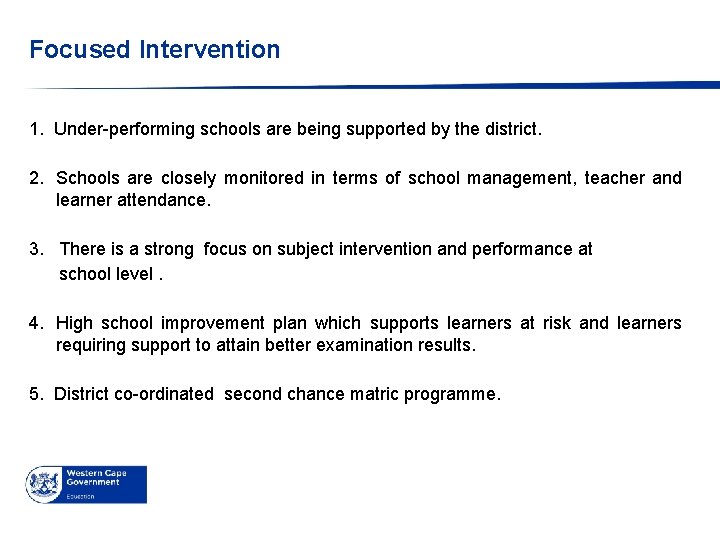
Focused Intervention 1. Under-performing schools are being supported by the district. 2. Schools are closely monitored in terms of school management, teacher and learner attendance. 3. There is a strong focus on subject intervention and performance at school level. 4. High school improvement plan which supports learners at risk and learners requiring support to attain better examination results. 5. District co-ordinated second chance matric programme. © Western Cape Government 2012 |
Challenges 1. Service delivery protests and land invasion have impacted on the writing of examinations especially in June 2018. 2. This has resulted in the shift of examination venues to safer areas and short notice to candidates. 3. Attendance by candidates is generally poor. © Western Cape Government 2012 |
Central LTSM Procurement Systems
CENTRAL PROCUREMENT SYSTEM ADVANTAGES: WCED • The WCED does not make use of central procurement of LTSM • Reasons: Ø Ø Not cost effective; No cost to warehousing of books; Exchange of books quicker without cost; Peace of mind that books are at schools. • Direct liaison with Publishers © Western Cape Government 2012 | 24
TERM CONTRACT SYSTEM • • The WCED uses the Term Contract system. Via open public tender entered into with publishers. The tender includes delivery of LTSM to schools. Prices are pre-determined for the contract period. Bulk buying results in economies of scales for individual schools. More textbooks can be purchased per school due to lower cost. Faster ordering and delivery of textbooks due to the contract. Orders for additional textbooks can be placed without undue delays, especially in January when shortages are discovered. • Replacement of incorrectly ordered books occur without additional costs. • Books are delivered directly to schools, no warehouse costs. • Constant communication with publishers result in greater efficiency in ordering, delivery and the payment processes. © Western Cape Government 2012 | 25
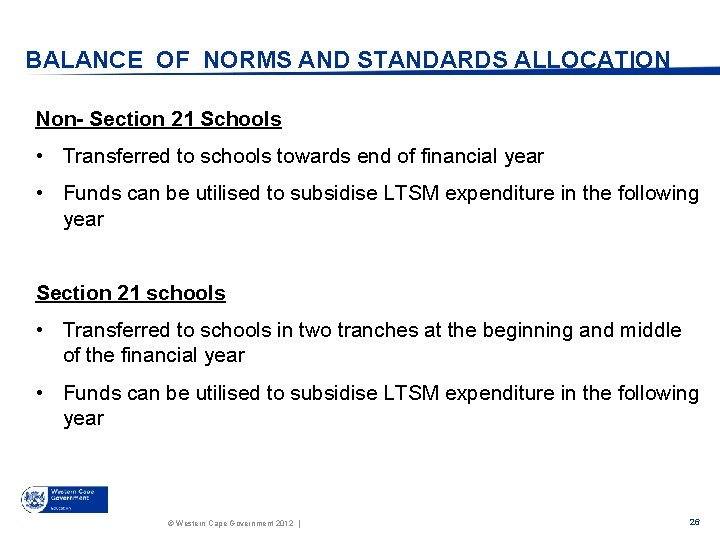
BALANCE OF NORMS AND STANDARDS ALLOCATION Non- Section 21 Schools • Transferred to schools towards end of financial year • Funds can be utilised to subsidise LTSM expenditure in the following year Section 21 schools • Transferred to schools in two tranches at the beginning and middle of the financial year • Funds can be utilised to subsidise LTSM expenditure in the following year © Western Cape Government 2012 | 26
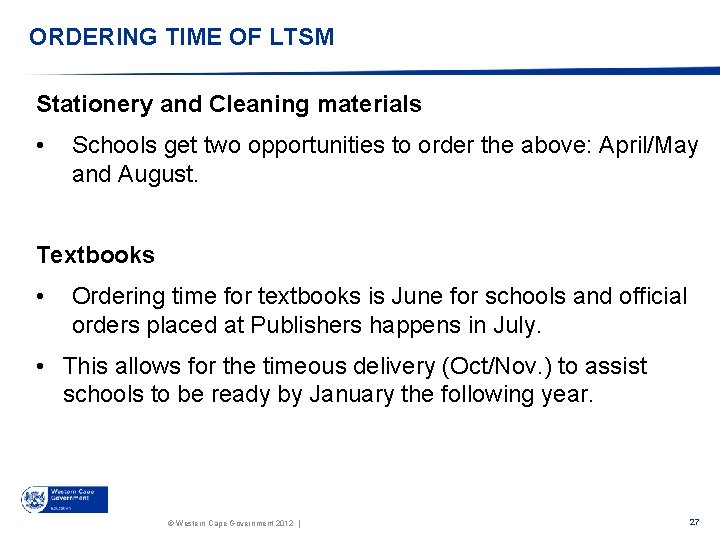
ORDERING TIME OF LTSM Stationery and Cleaning materials • Schools get two opportunities to order the above: April/May and August. Textbooks • Ordering time for textbooks is June for schools and official orders placed at Publishers happens in July. • This allows for the timeous delivery (Oct/Nov. ) to assist schools to be ready by January the following year. © Western Cape Government 2012 | 27
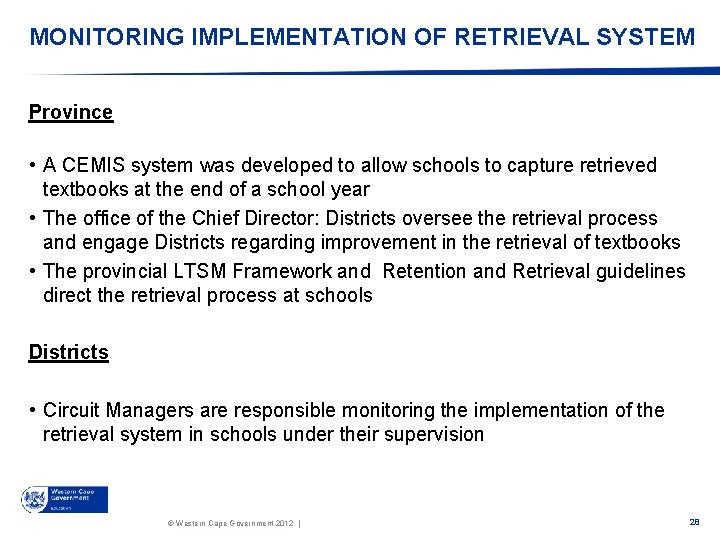
MONITORING IMPLEMENTATION OF RETRIEVAL SYSTEM Province • A CEMIS system was developed to allow schools to capture retrieved textbooks at the end of a school year • The office of the Chief Director: Districts oversee the retrieval process and engage Districts regarding improvement in the retrieval of textbooks • The provincial LTSM Framework and Retention and Retrieval guidelines direct the retrieval process at schools Districts • Circuit Managers are responsible monitoring the implementation of the retrieval system in schools under their supervision © Western Cape Government 2012 | 28
National School Nutrition Programme
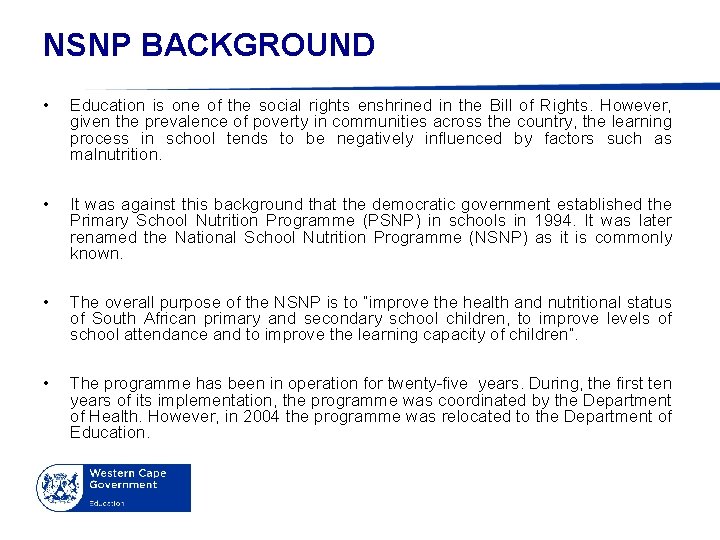
NSNP BACKGROUND • Education is one of the social rights enshrined in the Bill of Rights. However, given the prevalence of poverty in communities across the country, the learning process in school tends to be negatively influenced by factors such as malnutrition. • It was against this background that the democratic government established the Primary School Nutrition Programme (PSNP) in schools in 1994. It was later renamed the National School Nutrition Programme (NSNP) as it is commonly known. • The overall purpose of the NSNP is to “improve the health and nutritional status of South African primary and secondary school children, to improve levels of school attendance and to improve the learning capacity of children”. • The programme has been in operation for twenty-five years. During, the first ten years of its implementation, the programme was coordinated by the Department of Health. However, in 2004 the programme was relocated to the Department of Education.
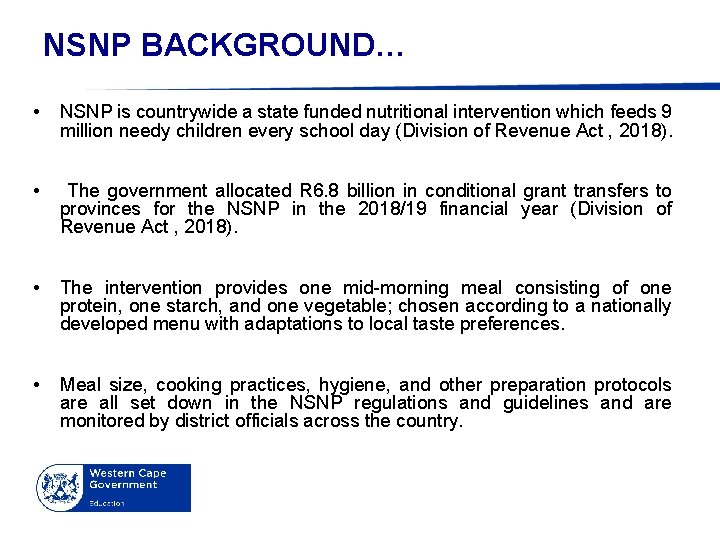
NSNP BACKGROUND… • NSNP is countrywide a state funded nutritional intervention which feeds 9 million needy children every school day (Division of Revenue Act , 2018). • The government allocated R 6. 8 billion in conditional grant transfers to provinces for the NSNP in the 2018/19 financial year (Division of Revenue Act , 2018). • The intervention provides one mid-morning meal consisting of one protein, one starch, and one vegetable; chosen according to a nationally developed menu with adaptations to local taste preferences. • Meal size, cooking practices, hygiene, and other preparation protocols are all set down in the NSNP regulations and guidelines and are monitored by district officials across the country.
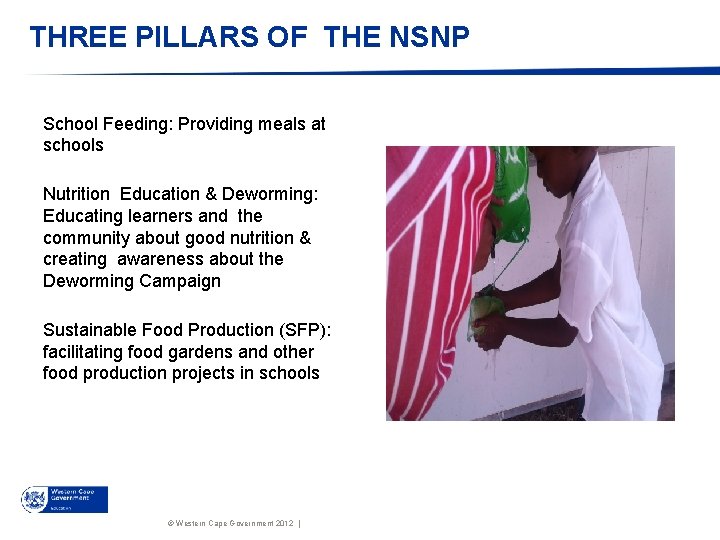
THREE PILLARS OF THE NSNP School Feeding: Providing meals at schools Nutrition Education & Deworming: Educating learners and the community about good nutrition & creating awareness about the Deworming Campaign Sustainable Food Production (SFP): facilitating food gardens and other food production projects in schools © Western Cape Government 2012 |
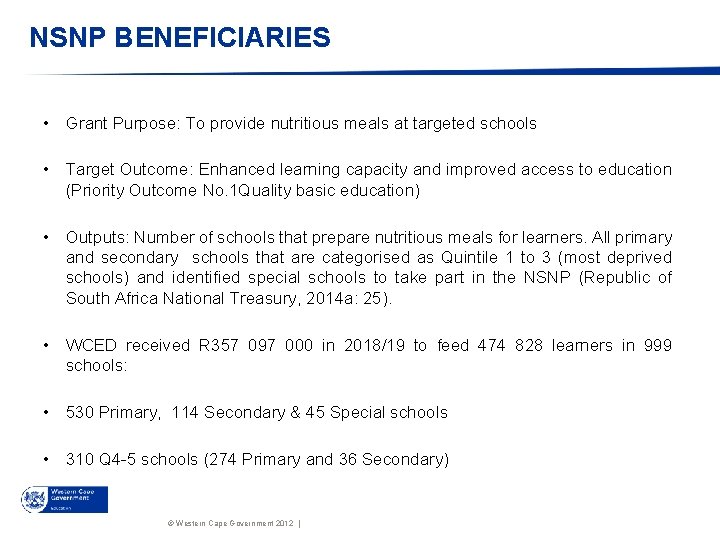
NSNP BENEFICIARIES • Grant Purpose: To provide nutritious meals at targeted schools • Target Outcome: Enhanced learning capacity and improved access to education (Priority Outcome No. 1 Quality basic education) • Outputs: Number of schools that prepare nutritious meals for learners. All primary and secondary schools that are categorised as Quintile 1 to 3 (most deprived schools) and identified special schools to take part in the NSNP (Republic of South Africa National Treasury, 2014 a: 25). • WCED received R 357 097 000 in 2018/19 to feed 474 828 learners in 999 schools: • 530 Primary, 114 Secondary & 45 Special schools • 310 Q 4 -5 schools (274 Primary and 36 Secondary) © Western Cape Government 2012 |
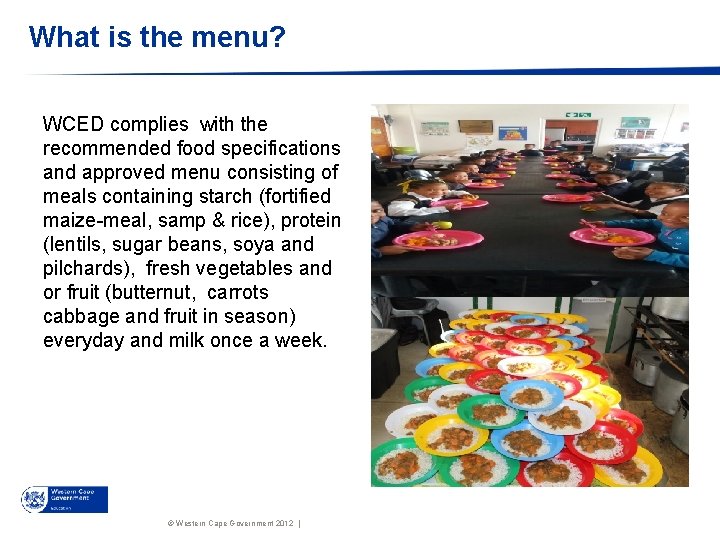
What is the menu? WCED complies with the recommended food specifications and approved menu consisting of meals containing starch (fortified maize-meal, samp & rice), protein (lentils, sugar beans, soya and pilchards), fresh vegetables and or fruit (butternut, carrots cabbage and fruit in season) everyday and milk once a week. © Western Cape Government 2012 |
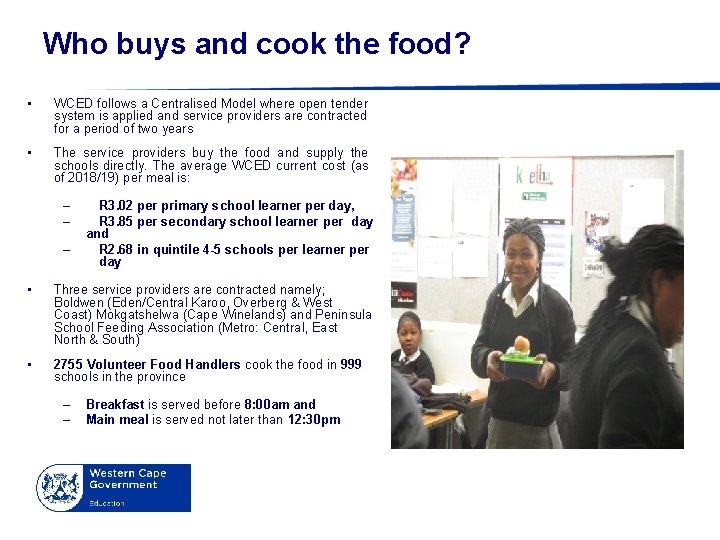
Who buys and cook the food? • WCED follows a Centralised Model where open tender system is applied and service providers are contracted for a period of two years • The service providers buy the food and supply the schools directly. The average WCED current cost (as of 2018/19) per meal is: – – – R 3. 02 per primary school learner per day, R 3. 85 per secondary school learner per day and R 2. 68 in quintile 4 -5 schools per learner per day • Three service providers are contracted namely; Boldwen (Eden/Central Karoo, Overberg & West Coast) Mokgatshelwa (Cape Winelands) and Peninsula School Feeding Association (Metro: Central, East North & South) • 2755 Volunteer Food Handlers cook the food in 999 schools in the province – – Breakfast is served before 8: 00 am and Main meal is served not later than 12: 30 pm
How many Volunteer Food Handlers? • Pay an Honorarium of a minimum of R 1, 188 per month for 12 months plus R 24, 00 to the Unemployment Insurance Fund (UIF) for a Volunteer Food Handler in line to learner ratio of 1: 200 & 1: 120 is recommended for schools where learner enrolment is 250 or fewer (Do. RA, 2018) • 2755 Volunteer Food Handlers get a stipend of R 1, 200 and R 24, 00 for UIF per month in the province
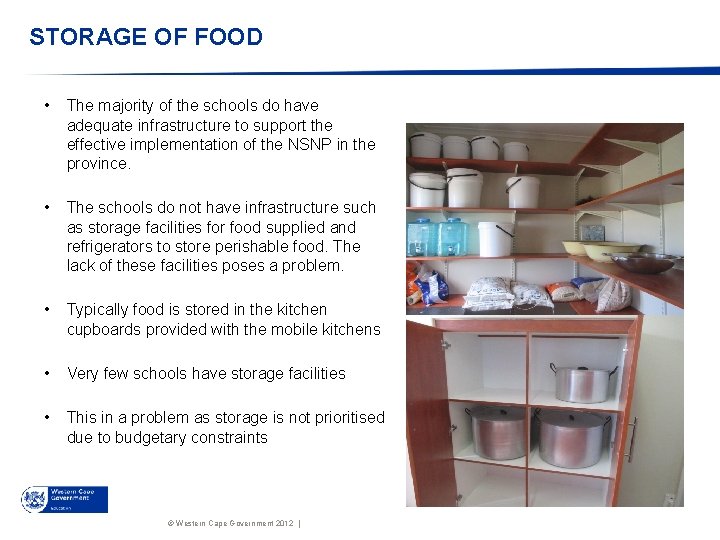
STORAGE OF FOOD • The majority of the schools do have adequate infrastructure to support the effective implementation of the NSNP in the province. • The schools do not have infrastructure such as storage facilities for food supplied and refrigerators to store perishable food. The lack of these facilities poses a problem. • Typically food is stored in the kitchen cupboards provided with the mobile kitchens • Very few schools have storage facilities • This in a problem as storage is not prioritised due to budgetary constraints © Western Cape Government 2012 |
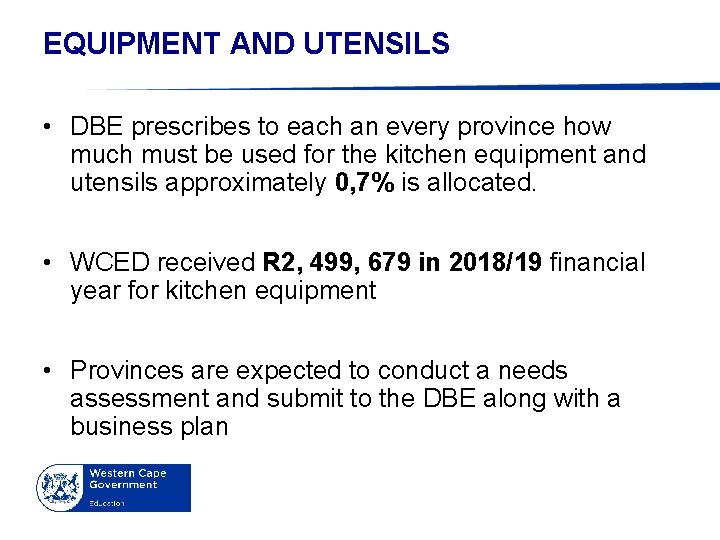
EQUIPMENT AND UTENSILS • DBE prescribes to each an every province how much must be used for the kitchen equipment and utensils approximately 0, 7% is allocated. • WCED received R 2, 499, 679 in 2018/19 financial year for kitchen equipment • Provinces are expected to conduct a needs assessment and submit to the DBE along with a business plan
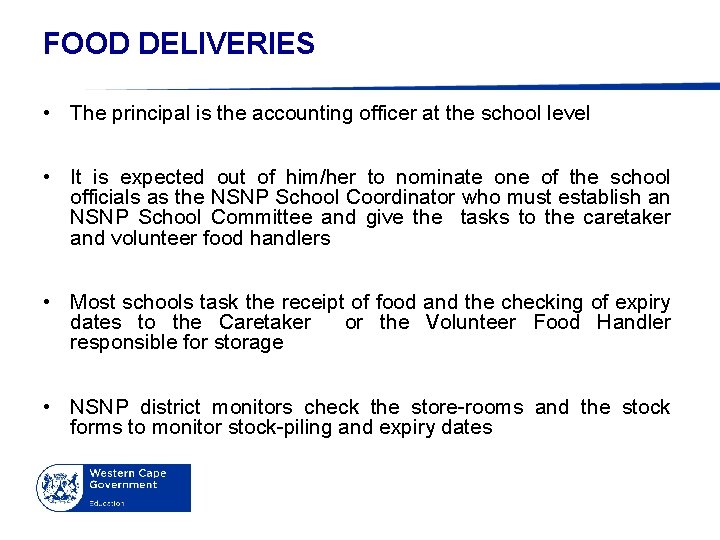
FOOD DELIVERIES • The principal is the accounting officer at the school level • It is expected out of him/her to nominate one of the school officials as the NSNP School Coordinator who must establish an NSNP School Committee and give the tasks to the caretaker and volunteer food handlers • Most schools task the receipt of food and the checking of expiry dates to the Caretaker or the Volunteer Food Handler responsible for storage • NSNP district monitors check the store-rooms and the stock forms to monitor stock-piling and expiry dates
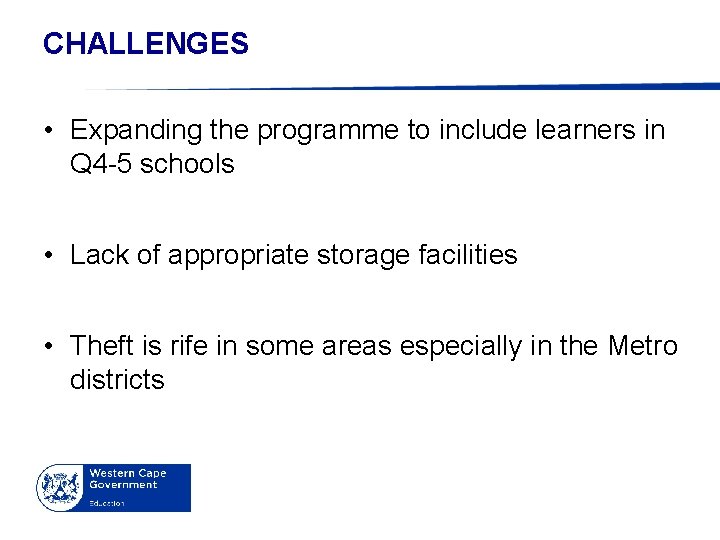
CHALLENGES • Expanding the programme to include learners in Q 4 -5 schools • Lack of appropriate storage facilities • Theft is rife in some areas especially in the Metro districts
Thank you