
Westcoast District Coastal setback lines Presentation Overview West
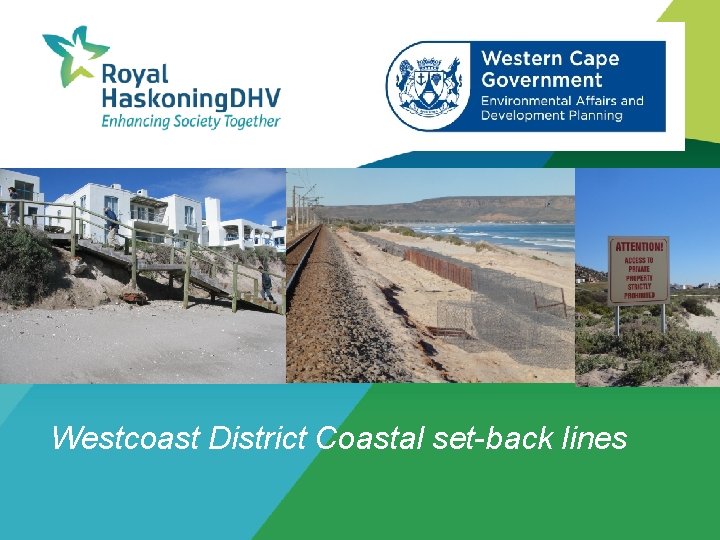
Westcoast District Coastal set-back lines
Presentation Overview • • West Coast District project overview ICM Background Default coastal zone Purpose of coastal set-back determination Determination of risk – open coasts Determination of risk – estuaries Next steps Questions asked of participants
Westcoast Set-back Lines Project - overview • Royal Haskoning. DHV core project team: – Tandi Breetzke, Gerard van Weele, Dr Andrew Mather & Petrie Swart • 8 steps 1. 2. 3. 4. 5. 6. 7. 8. Inception, preliminary work & stakeholder notification � Modelling to determine Coastal Processes / Hazard line � Stakeholder engagement now Draft Set-back line(s) & coastal protection zone determination Stakeholder engagement Draft Final report Stakeholder review Final report
Background • Vulnerability of Coastal Ecosystems / coastal zone • Impacts associated with dynamic processes (Both erosion and accretion) • Global climate change – no longer debated & the coast is bearing the brunt • In response - Integrated Coastal Management – Green Paper – White Paper – ICM Act – specific management tools: – – Coastal Committees Coastal Management Programmes Estuary Management Plans Set-back/management lines • Proactive rather than reactive response to issues
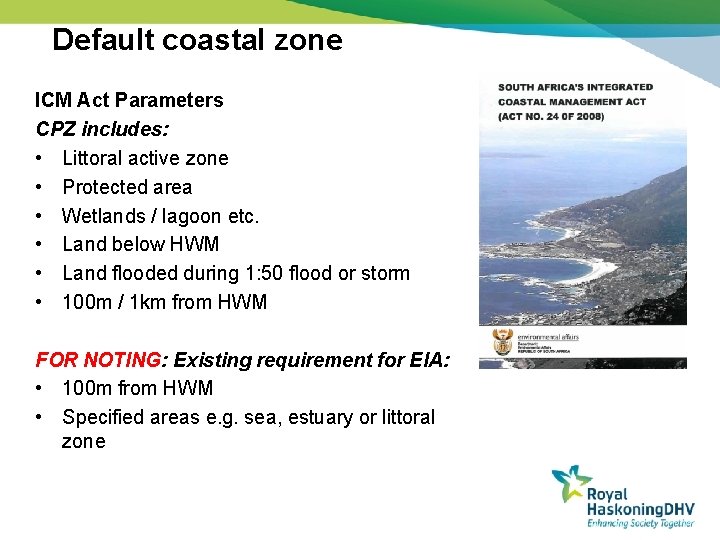
Default coastal zone ICM Act Parameters CPZ includes: • Littoral active zone • Protected area • Wetlands / lagoon etc. • Land below HWM • Land flooded during 1: 50 flood or storm • 100 m / 1 km from HWM FOR NOTING: Existing requirement for EIA: • 100 m from HWM • Specified areas e. g. sea, estuary or littoral zone
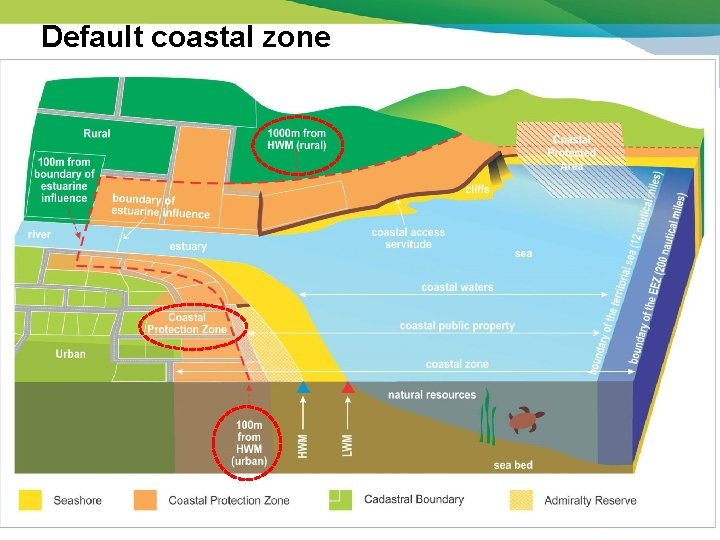
Default coastal zone
Set-back Lines – ICM Act, No 24 of 2008 “An MEC must… (a) establish or change coastal set-back lines— (i) (iii) (iv) to protect coastal public property, private property & public safety; to protect the coastal protection zone; to preserve the aesthetic values of the coastal zone; or for any other reason consistent with the objectives of this Act; & (b) prohibit or restrict the building, erection, alteration or extension of structures that are wholly or partially seaward of that coastal set-back line. ”
Set-back Lines – for noting • ICM Act Coastal set-back lines are proposed to be renamed as Coastal Management Lines to avoid confusion with the EIA Regulations Development Setback Lines • Western Cape set-back methodology developed and extensively presented, tested and reviewed: – Initially at Milnerton and Langebaan – Then in the Overberg District • Different methodology applied by the City of Cape Town • Lessons learnt / direction provided by the implementation all of these studies will be applied in determining the West Coast coastal set-back / management lines
Set-back lines - For noting • Lidar imagery used – excellent topographic data and aerial photos • KMZ files prepared for viewing via Google Earth (access via websites) • Technical report detailing process also available on website • GIS viewer developed to allow easy access to data / images / draft lines • Relevant environmental information was abstracted from the WCD CMP, IDPs and websites and reflected spatially • Risk is depicted in the short, medium and long term
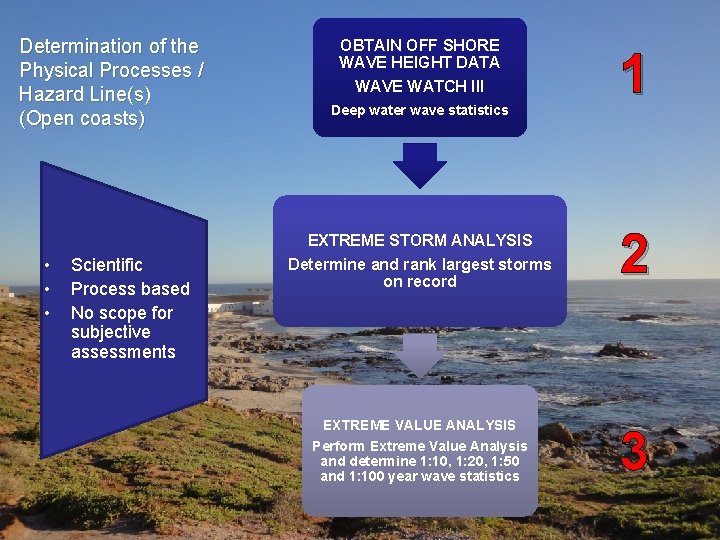
Determination of the Physical Processes / Hazard Line(s) (Open coasts) • • • Scientific Process based No scope for subjective assessments OBTAIN OFF SHORE WAVE HEIGHT DATA WAVE WATCH III Deep water wave statistics EXTREME STORM ANALYSIS Determine and rank largest storms on record EXTREME VALUE ANALYSIS Perform Extreme Value Analysis and determine 1: 10, 1: 20, 1: 50 and 1: 100 year wave statistics 1 2 3
Off-shore Wave Statistics • Technical modeling process using: – Wave Direction – Wind Speed – Significant Wave Height – Peak wave Direction and period • Interesting points to note: – When determining Significant Wave Height 36 individual storm events were identified – 50% of these storms have occurred in the last five years (less than a third of the total record period) – The largest storm on record occurred in Aug 2012
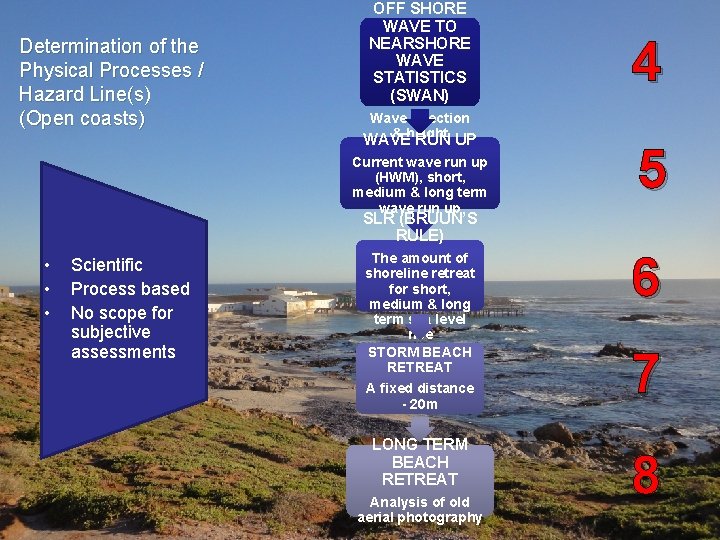
Determination of the Physical Processes / Hazard Line(s) (Open coasts) OFF SHORE WAVE TO NEARSHORE WAVE STATISTICS (SWAN) Wave direction & height WAVE RUN UP Current wave run up (HWM), short, medium & long term wave run up 4 5 SLR (BRUUN’S RULE) • • • Scientific Process based No scope for subjective assessments The amount of shoreline retreat for short, medium & long term sea level rise STORM BEACH RETREAT A fixed distance - 20 m LONG TERM BEACH RETREAT Analysis of old aerial photography 6 7 8
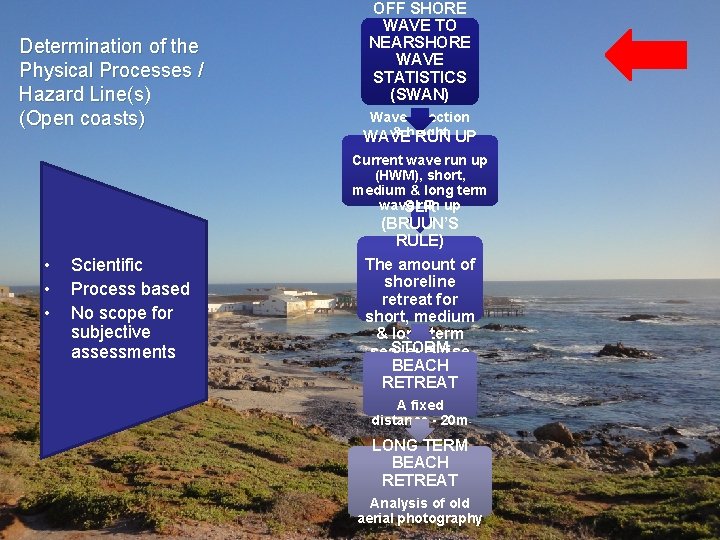
Determination of the Physical Processes / Hazard Line(s) (Open coasts) OFF SHORE WAVE TO NEARSHORE WAVE STATISTICS (SWAN) Wave direction & height WAVE RUN UP Current wave run up (HWM), short, medium & long term wave run up SLR • • • Scientific Process based No scope for subjective assessments (BRUUN’S RULE) The amount of shoreline retreat for short, medium & long term sea. STORM level rise BEACH RETREAT A fixed distance - 20 m LONG TERM BEACH RETREAT Analysis of old aerial photography
Transform Off-shore to In-shore Wave Statistics • Technical modeling process • Use the Delft SWAN (Simulating WAves Nearshore) model (http: //www. swan. tudelft. nl) to transform offshore waves • Take account of bathymetric (sea bottom) changes • Determine the in-shore wave statistics
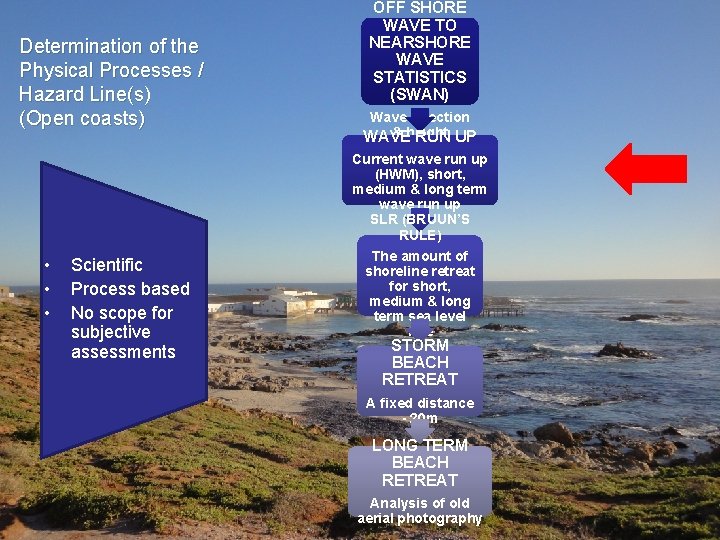
Determination of the Physical Processes / Hazard Line(s) (Open coasts) • • • Scientific Process based No scope for subjective assessments OFF SHORE WAVE TO NEARSHORE WAVE STATISTICS (SWAN) Wave direction & height WAVE RUN UP Current wave run up (HWM), short, medium & long term wave run up SLR (BRUUN’S RULE) The amount of shoreline retreat for short, medium & long term sea level rise STORM BEACH RETREAT A fixed distance - 20 m LONG TERM BEACH RETREAT Analysis of old aerial photography
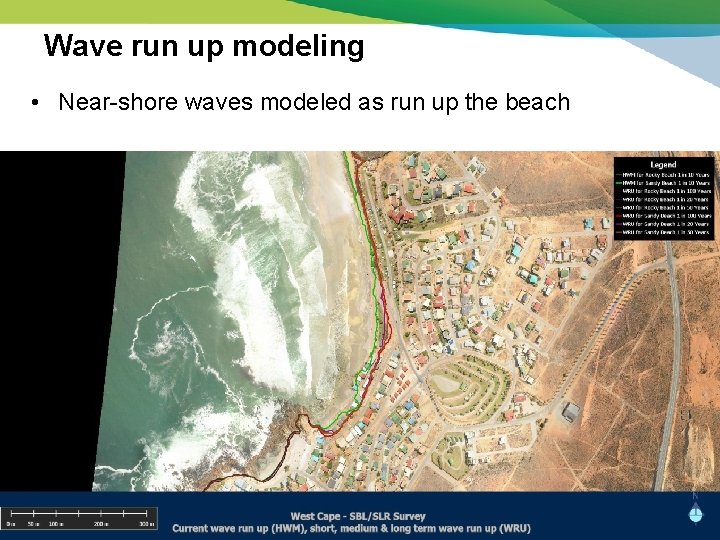
Wave run up modeling • Near-shore waves modeled as run up the beach
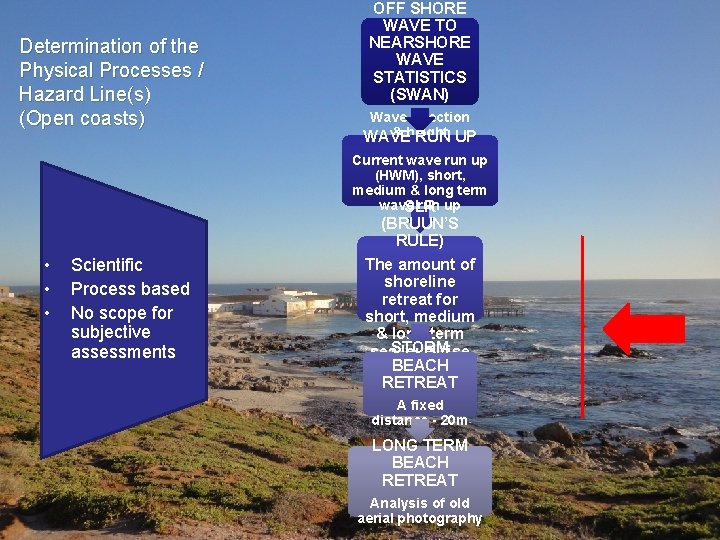
Determination of the Physical Processes / Hazard Line(s) (Open coasts) OFF SHORE WAVE TO NEARSHORE WAVE STATISTICS (SWAN) Wave direction & height WAVE RUN UP Current wave run up (HWM), short, medium & long term wave run up SLR • • • Scientific Process based No scope for subjective assessments (BRUUN’S RULE) The amount of shoreline retreat for short, medium & long term sea. STORM level rise BEACH RETREAT A fixed distance - 20 m LONG TERM BEACH RETREAT Analysis of old aerial photography
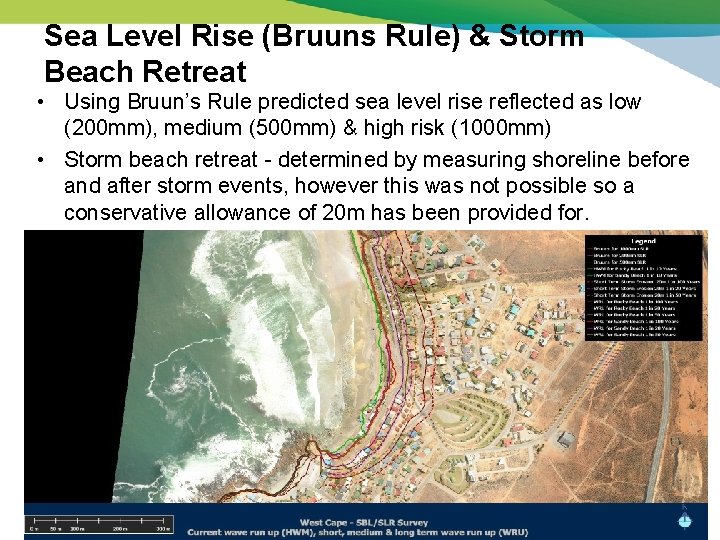
Sea Level Rise (Bruuns Rule) & Storm Beach Retreat • Using Bruun’s Rule predicted sea level rise reflected as low (200 mm), medium (500 mm) & high risk (1000 mm) • Storm beach retreat - determined by measuring shoreline before and after storm events, however this was not possible so a conservative allowance of 20 m has been provided for.
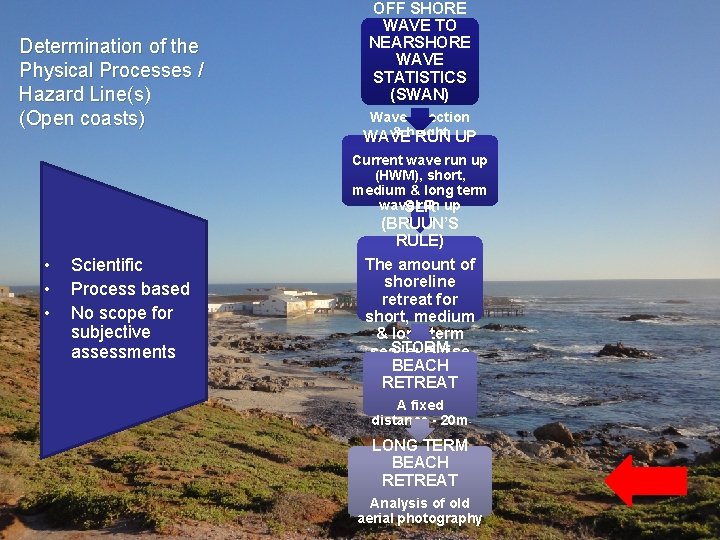
Determination of the Physical Processes / Hazard Line(s) (Open coasts) OFF SHORE WAVE TO NEARSHORE WAVE STATISTICS (SWAN) Wave direction & height WAVE RUN UP Current wave run up (HWM), short, medium & long term wave run up SLR • • • Scientific Process based No scope for subjective assessments (BRUUN’S RULE) The amount of shoreline retreat for short, medium & long term sea. STORM level rise BEACH RETREAT A fixed distance - 20 m LONG TERM BEACH RETREAT Analysis of old aerial photography
Long term beach retreat • Determine the long term erosion based on a detailed analysis of historical shoreline positions from available aerial photography for sandy shorelines only. • Stable coastlines and accreting coastlines will be assumed to require no retreat.
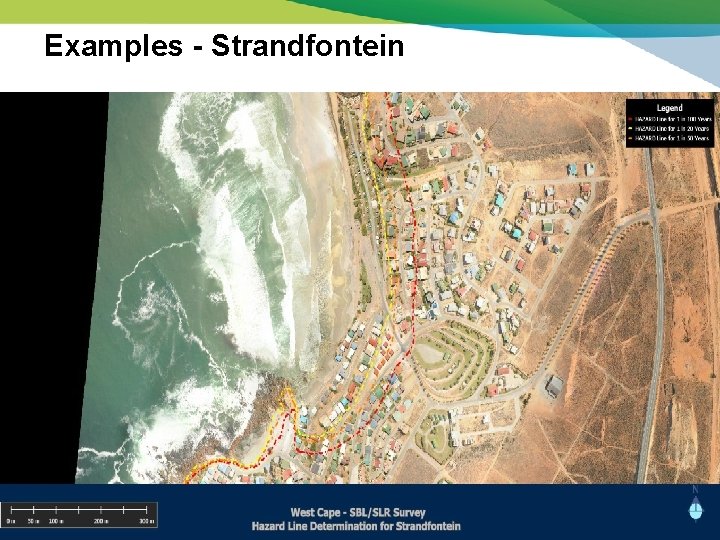
Examples - Strandfontein
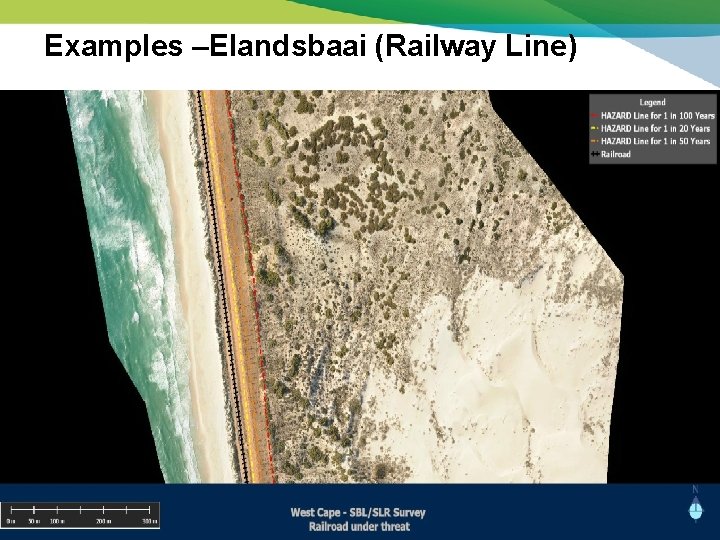
Examples –Elandsbaai (Railway Line) [graphic to be added by Andrew all lines for railway line]
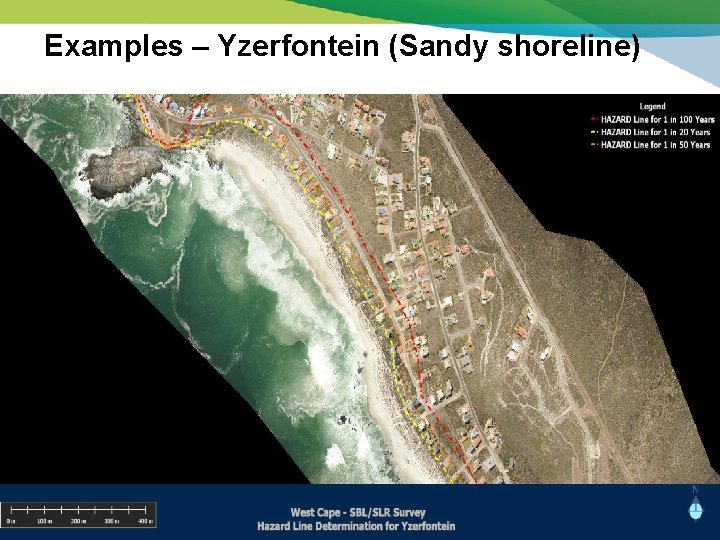
Examples – Yzerfontein (Sandy shoreline)
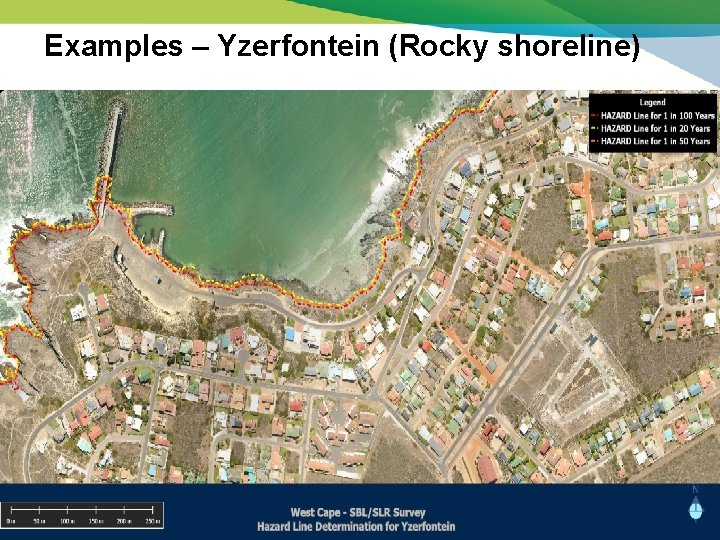
Examples – Yzerfontein (Rocky shoreline)
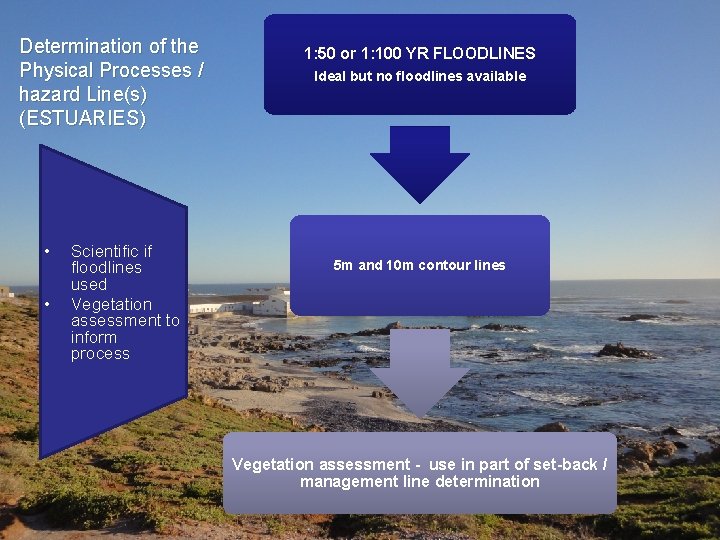
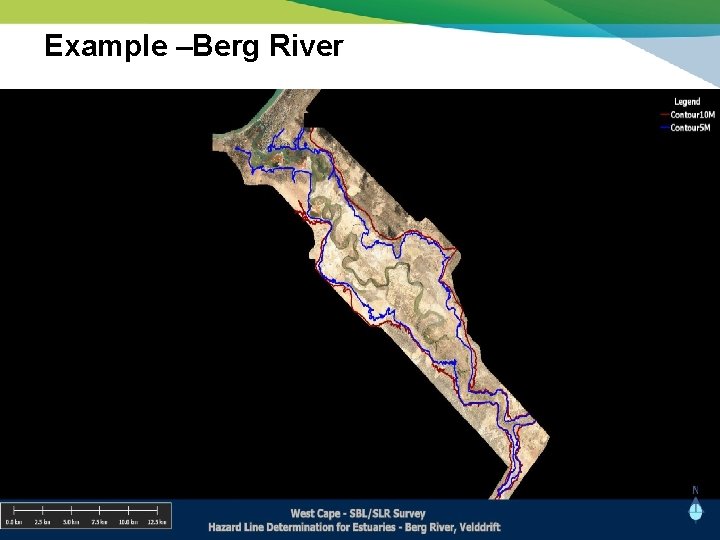
Determination of the Physical Processes / hazard Line(s) (ESTUARIES) • • Scientific if floodlines used Vegetation assessment to inform process 1: 50 or 1: 100 YR FLOODLINES Ideal but no floodlines available 5 m and 10 m contour lines Vegetation assessment - use in part of set-back / management line determination
Hazard line determination for estuaries • Use the existing 1: 50 or 1: 100 floodlines to determine hazard edge • In the event of no suitable 1: 50 and 1: 100 yr floodlines then map the +5 m and +10 m above mean sea level contours. • +5 m is typically the height floodwater will rise to in a closed estuarine system. • +10 m allows a buffer for future SLR as well as estuarine vegetation regeneration areas.
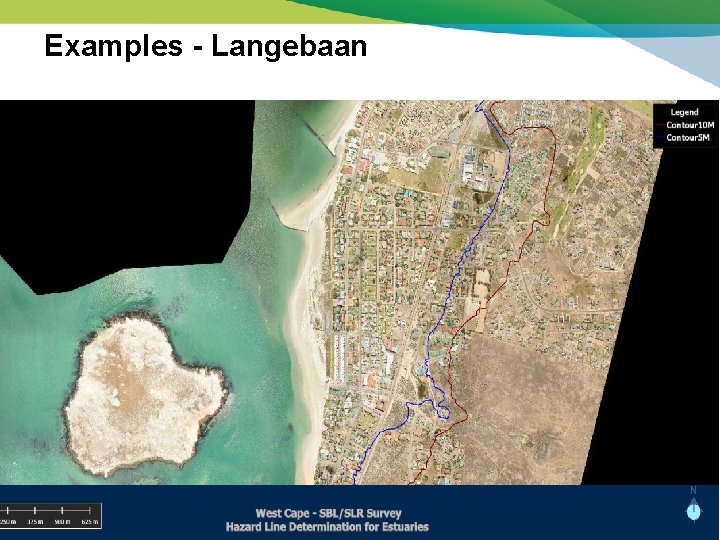
Examples - Langebaan
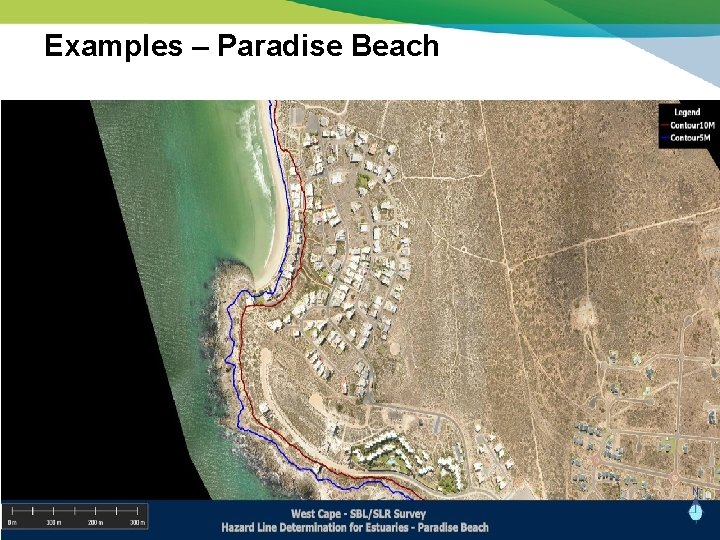
Examples – Paradise Beach
Example –Berg River
Way forward 1. Assess the environmental, heritage & access layers to determine any additional set back allowances. 2. Assess the economic issues to determine any additional or reduction in set-back allowances to accommodate economic nodes/activities 3. Determine the extent of set-back / management line in the study area. 4. Add authority perspective to determine the CPZ boundary
Questions asked • Are you happy with the anticipated storm erosion estimate? • What are the environmental issues that should be considered? • Where are the environmentally sensitive areas? • Where are the wind-blown sand corridors? • How should authorities respond to this determination of risk? • What controls could be included for urban areas seaward of the physical processes / hazard line?
www. rhdhv. com/pages/services/environm ental/current-projects. php Or www. eadp. westerncape. gov. za/calendar/ month (click on calendar, click on these w/s to find documents)
- Slides: 32