
WESTCAS 2018 Fall Conference October 24 2018 Presentation
WESTCAS 2018 Fall Conference October 24, 2018 Presentation Materials Available at: ADWR’s website – new. azwater. gov/lbdcp CAWCD’s website – www. cap-az. com/AZDCP
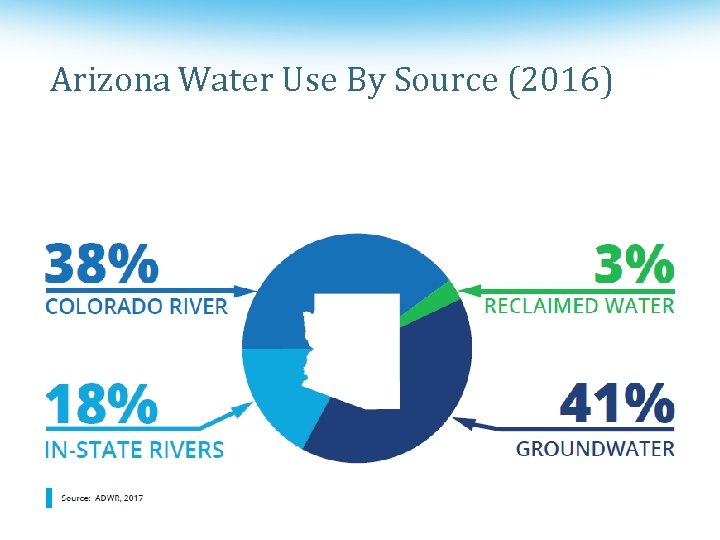
Arizona Water Use By Source (2016)
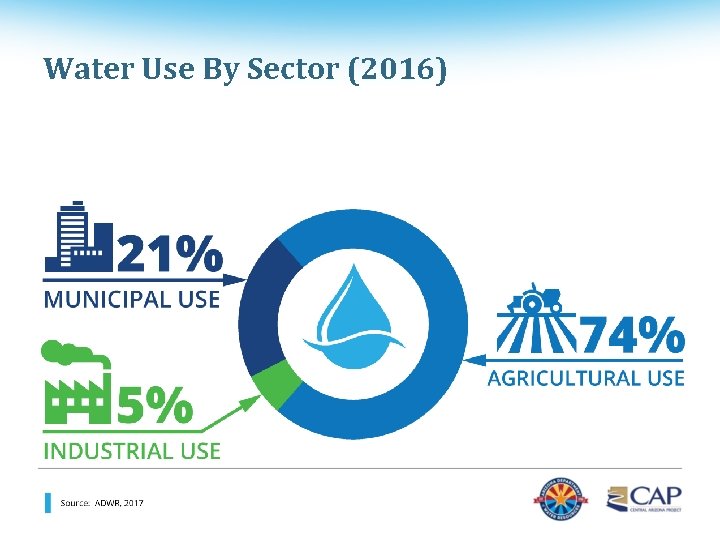
Water Use By Sector (2016)
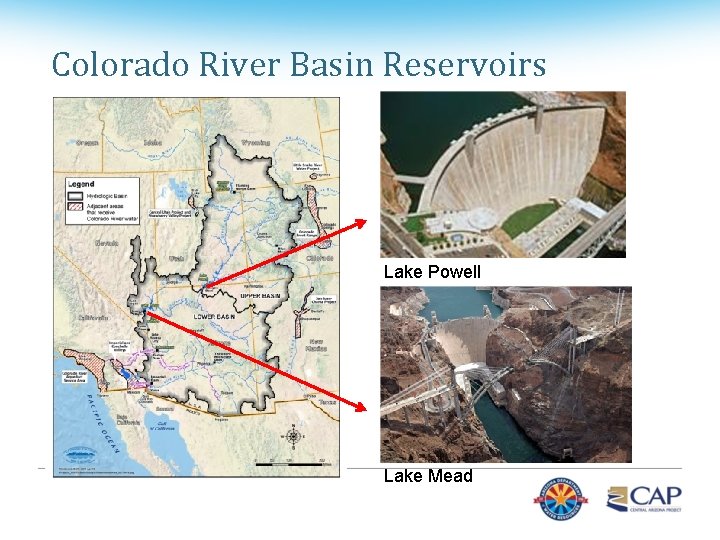
Colorado River Basin Reservoirs Arizona Lake Powell Lake Mead
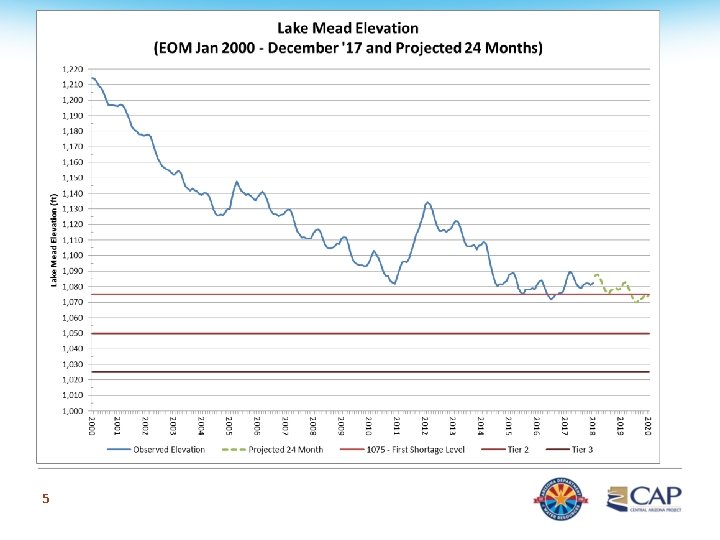
Lake Mead Declines 5
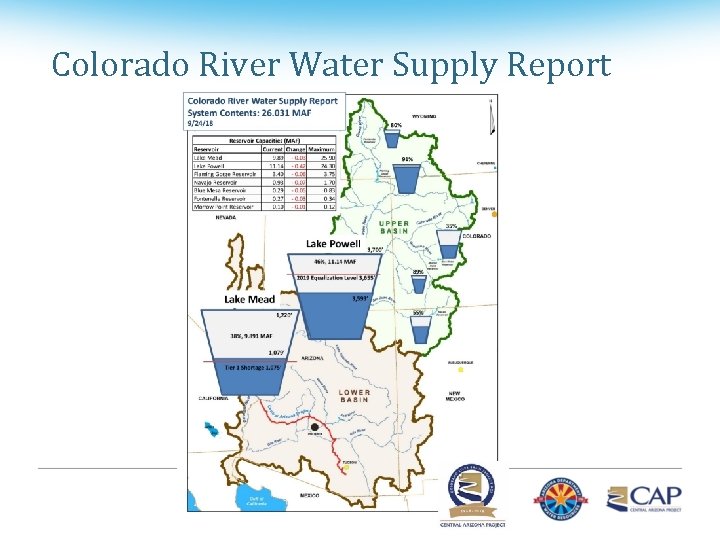
Colorado River Water Supply Report
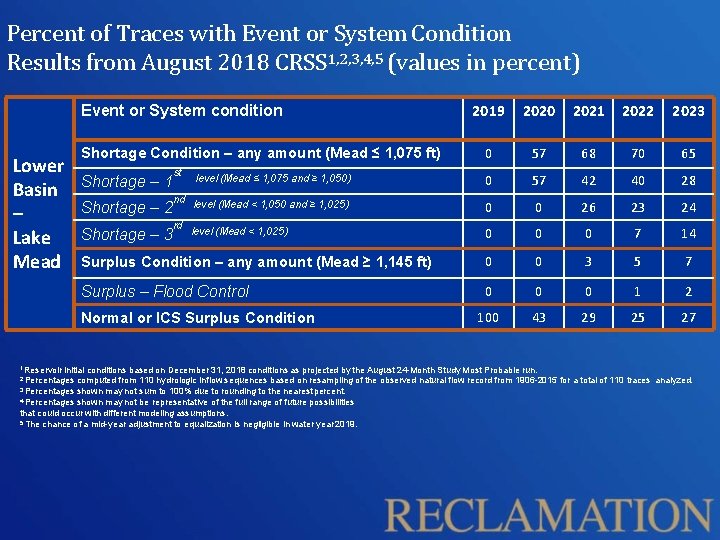
Percent of Traces with Event or System Condition Results from August 2018 CRSS 1, 2, 3, 4, 5 (values in percent) 2019 2020 2021 2022 2023 0 57 68 70 65 level (Mead ≤ 1, 075 and ≥ 1, 050) 0 57 42 40 28 level (Mead < 1, 050 and ≥ 1, 025) 0 0 26 23 24 level (Mead < 1, 025) 0 0 0 7 14 Surplus Condition – any amount (Mead ≥ 1, 145 ft) 0 0 3 5 7 Surplus – Flood Control 0 0 0 1 2 100 43 29 25 27 Event or System condition Lower Basin – Lake Mead Shortage Condition – any amount (Mead ≤ 1, 075 ft) Shortage – 1 Shortage – 2 Shortage – 3 st nd rd Normal or ICS Surplus Condition 1 Reservoir initial conditions based on December 31, 2018 conditions as projected by the August 24 -Month Study Most Probable run. computed from 110 hydrologic inflow sequences based on resampling of the observed natural flow record from 1906 -2015 for a total of 110 traces analyzed. 3 Percentages shown may not sum to 100% due to rounding to the nearest percent. 4 Percentages shown may not be representative of the full range of future possibilities that could occur with different modeling assumptions. 5 The chance of a mid-year adjustment to equalization is negligible in water year 2019. 2 Percentages
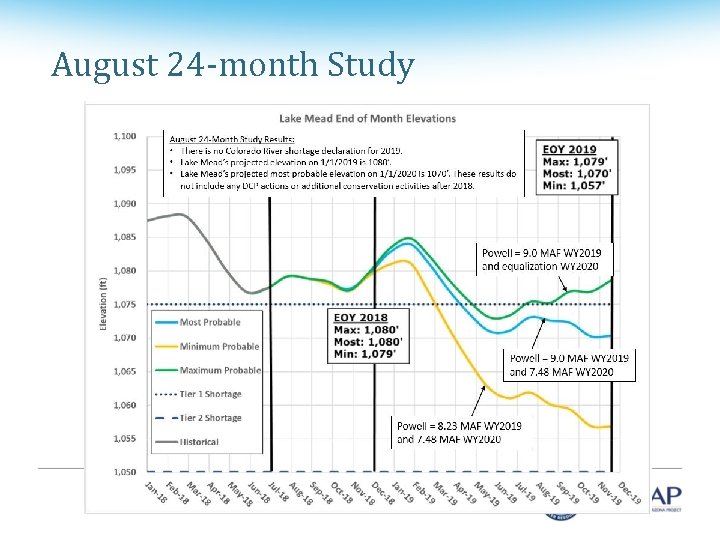
August 24 -month Study
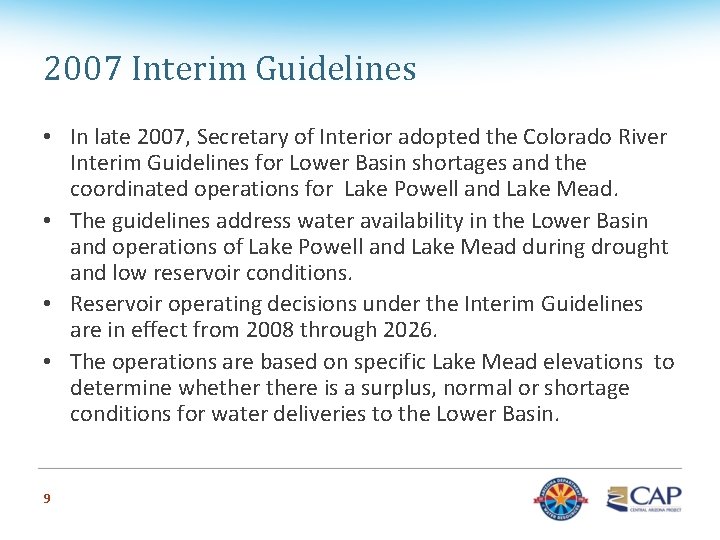
2007 Interim Guidelines • In late 2007, Secretary of Interior adopted the Colorado River Interim Guidelines for Lower Basin shortages and the coordinated operations for Lake Powell and Lake Mead. • The guidelines address water availability in the Lower Basin and operations of Lake Powell and Lake Mead during drought and low reservoir conditions. • Reservoir operating decisions under the Interim Guidelines are in effect from 2008 through 2026. • The operations are based on specific Lake Mead elevations to determine whethere is a surplus, normal or shortage conditions for water deliveries to the Lower Basin. 9
Why LBDCP is Important to Arizona • Increased risks of critically low Lake Mead elevations without additional actions – the ‘ 07 Guidelines aren’t enough • Risks are increasing due to poor hydrology – risk for shortage as early as 2020 • Collective action, among all the 7 Basin States, the United States, and Mexico, reduces risks to everyone 10
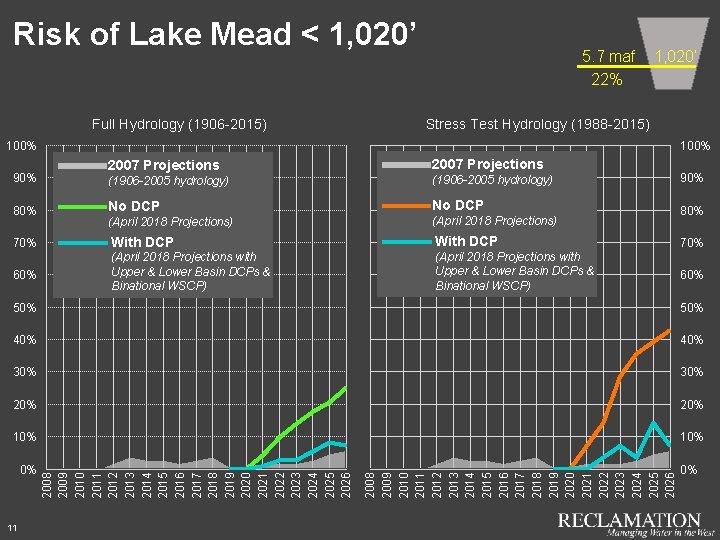
Risk of Lake Mead < 1, 020’ Full Hydrology (1906 -2015) 5. 7 maf 22% 1, 020’ Stress Test Hydrology (1988 -2015) 100% 2007 Projections (1906 -2005 hydrology) 90% 80% No DCP (April 2018 Projections) 80% 70% With DCP 70% 60% (April 2018 Projections with Upper & Lower Basin DCPs & Binational WSCP) 60% 90% 40% 30% 20% 10% 0% 11 2008 2009 2010 2011 2012 2013 2014 2015 2016 2017 2018 2019 2020 2021 2022 2023 2024 2025 2026 50% 0%
LBDCP Purpose • DCP will not prevent a Tier 1 shortage unless Upper Basin Hydrology improves in 2019 and 2020 • DCP reduces the risk that the river system will decline to critically low levels and protects the highest priority water users – Municipal and Industrial and Indian Priority water 12
Steering Committee Mission Discuss and recommend how to adopt and implement the LBDCP in a way that is acceptable to Arizona water users 13
Steering Committee Objectives • Seek broad commitment and support for the implementation of LBDCP in Arizona • Recommend appropriate and sustainable processes and tools to implement LBDCP in AZ • Obtain approval by the Arizona Legislature of a joint resolution authorizing the Director of ADWR to agree to the LBDCP 14
Steering Committee Schedule • Nine total Steering Committee Meeting dates scheduled • These are open to the public and video recorded • Issue workgroups are also being developed; those meetings are not open to the public but their work product is communicated during Steering Committee meetings 15
Implementing LBDCP in Arizona • While there may be other “tier zero” years (1090’ – 1075’) before the end of the Interim Period (2026), 2019 may well be the last year in this condition (there is over a 50% chance of Tier 1 or greater shortage 2020 -2026) • There may be some processes or mechanisms that will focus primarily on “tier zero” years, but we don’t anticipate that these will consume a lot of the Steering Committee’s time 16
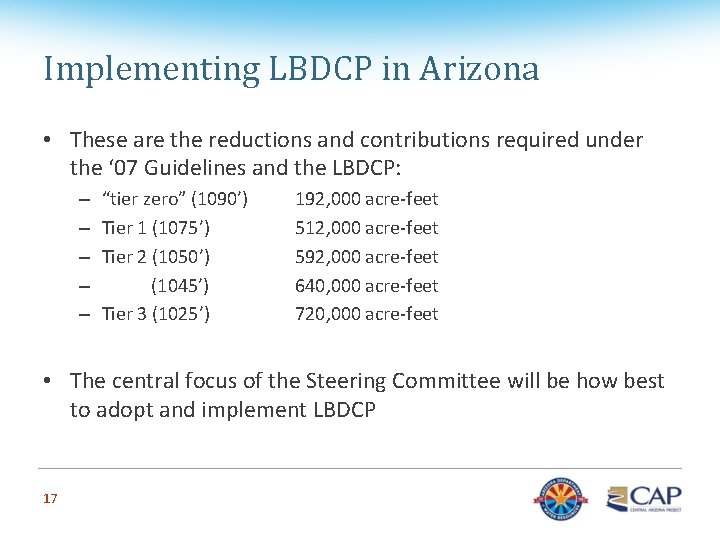
Implementing LBDCP in Arizona • These are the reductions and contributions required under the ‘ 07 Guidelines and the LBDCP: – – – “tier zero” (1090’) Tier 1 (1075’) Tier 2 (1050’) (1045’) Tier 3 (1025’) 192, 000 acre-feet 512, 000 acre-feet 592, 000 acre-feet 640, 000 acre-feet 720, 000 acre-feet • The central focus of the Steering Committee will be how best to adopt and implement LBDCP 17
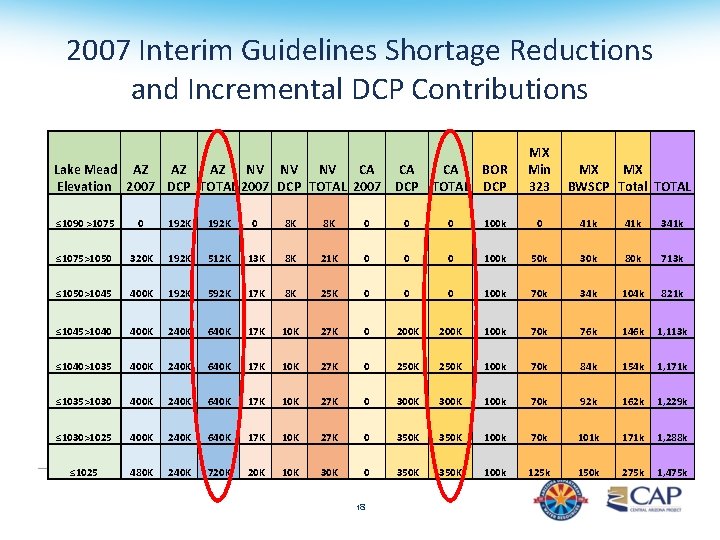
2007 Interim Guidelines Shortage Reductions and Incremental DCP Contributions Lake Mead AZ AZ AZ NV NV NV CA CA CA BOR Elevation 2007 DCP TOTAL DCP MX Min 323 MX MX BWSCP Total TOTAL ≤ 1090 >1075 0 192 K 0 8 K 8 K 0 0 0 100 k 0 41 k 341 k ≤ 1075>1050 320 K 192 K 512 K 13 K 8 K 21 K 0 0 0 100 k 50 k 30 k 80 k 713 k ≤ 1050>1045 400 K 192 K 592 K 17 K 8 K 25 K 0 0 0 100 k 70 k 34 k 104 k 821 k ≤ 1045>1040 400 K 240 K 640 K 17 K 10 K 27 K 0 200 K 100 k 76 k 146 k 1, 113 k ≤ 1040>1035 400 K 240 K 640 K 17 K 10 K 27 K 0 250 K 100 k 70 k 84 k 154 k 1, 171 k ≤ 1035>1030 400 K 240 K 640 K 17 K 10 K 27 K 0 300 K 100 k 70 k 92 k 162 k 1, 229 k ≤ 1030>1025 400 K 240 K 640 K 17 K 10 K 27 K 0 350 K 100 k 70 k 101 k 171 k 1, 288 k ≤ 1025 480 K 240 K 720 K 10 K 30 K 0 350 K 100 k 125 k 150 k 275 k 1, 475 k 18
Implementing LBDCP in Arizona • Reductions under the LBDCP will occur in priority order within Arizona • However, alternative approaches that conform to the existing priority system, to allow reductions in use of higher priority water to flow to lower priority users and into Lake Mead may be developed 19
Implications to CAP Rates • As CAP deliveries are reduced, the Fixed OM&R and overall water delivery rates will increase – For example, 2020 CAP published rates: Fixed OM&R = $98/AF, and delivery (including Fixed OM&R and Pumping Energy) = $152/AF • Current CAP rates assume about 192 KAF of contribution to Lake Mead, equivalent to the first level of the LBDCP • The 2007 Guidelines reductions are estimated to increase the Fixed OM&R rate by ~10 to 25%, and the overall water delivery rate by ~7 to 17% • The incremental LBDCP contributions are estimated to increase the Fixed OM&R rate by an additional ~20 to 30%, and the overall water delivery rate by ~13 to 20% 20
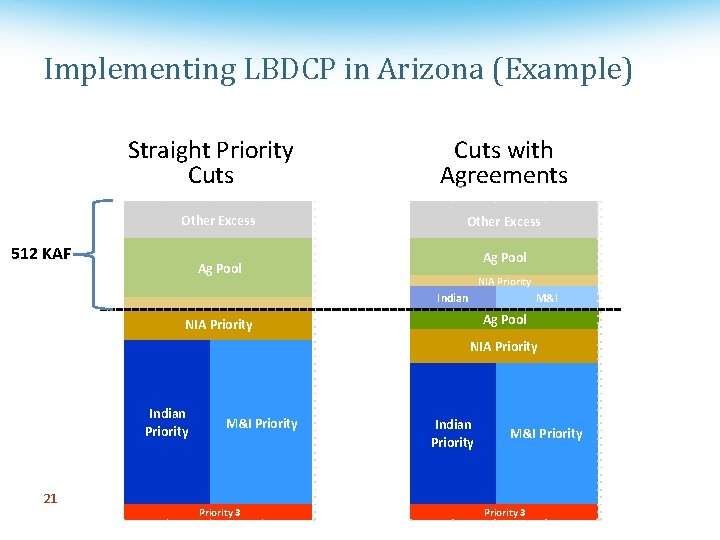
Implementing LBDCP in Arizona (Example) Straight Priority Cuts with Agreements Other Excess Ag Pool Pool Ag 512 KAF NIA Priority Indian Priority 21 M&I Priority 3 M&I Ag Pool NIA Priority Indian Priority M&I Priority Priority 33 Priority
Implementing LBDCP in Arizona 4 Essential Elements • ADWR and CAWCD have identified 4 essential elements to consider as tools to implement LBDCP in Arizona • The tools are focused on mitigating the differential impacts of LBDCP and sustaining collaborative processes within Arizona 22
Implementing LBDCP in Arizona 4 Essential Elements – Basis for Inclusion • CAP Ag Mitigation – The CAP Ag Pool faces reductions under the LBDCP, but receives limited benefits • Tribal ICS – Currently, the NIA Pool is largely held by CAP Tribes with settlements. The Tribal ICS tool provides some flexibility for management of supplies provided from settlements and on-River entitlements. • CAP Excess Water Plan – continuation of the collaborative approach to achieving multiple benefits from the CAP Excess Water supply. The CAP Excess Water supply is the major contributor to “tier zero” reductions • Arizona Conservation Plan – a new collaborative process to foster broader participation to help meet Arizona’s LBDCP reductions 23
Importance of Implementing LBDCP in Arizona • Next step in Arizona legacy of tackling and solving complex water problems • Signal to financial markets, investors, developers and employers that Arizona is “open for business” and on top of its water future • Statement of firm partnership with the other Basin States and Mexico – we are in this together and will deal with ongoing drought and potential shortage together • Protects the highest priority CAP water users and provides a glide path for central Arizona agriculture and ongoing economic development 24
Call to the Public With additional questions contact: ADWR at sslee@azwater. gov CAWCD at cthompson@cap-az. com Presentation Materials Available at: ADWR’s website – new. azwater. gov/lbdcp CAWCD’s website – www. cap-az. com/AZDCP
- Slides: 25