
WEST WING GEOTHERMAL PRESENTATION ENGR 333 DECEMBER 4
WEST WING GEOTHERMAL PRESENTATION ENGR 333 DECEMBER 4, 2012
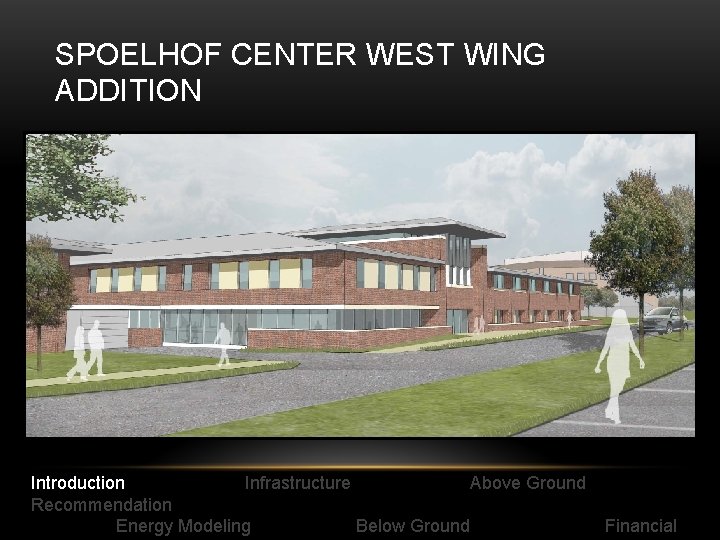
SPOELHOF CENTER WEST WING ADDITION Introduction Infrastructure Above Ground Recommendation Energy Modeling Below Ground Financial

LOCATION Proposed West Wing Addition Introduction Infrastructure Above Ground Recommendation Energy Modeling Below Ground Financial
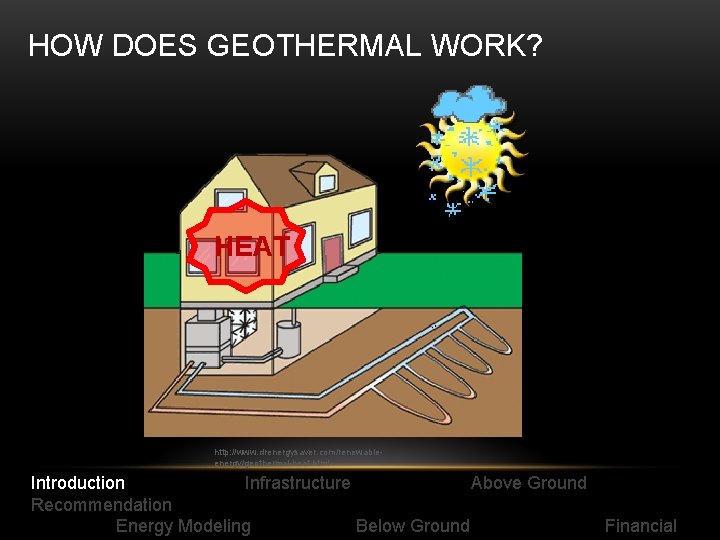
HOW DOES GEOTHERMAL WORK? HEAT http: //www. drenergysaver. com/renewableenergy/geothermal-heat. html Introduction Infrastructure Above Ground Recommendation Energy Modeling Below Ground Financial
GEOTHERMAL BENEFITS AND COSTS Benefits Costs • Reduced energy consumption • More complex • Reduced maintenance • Installation Introduction Infrastructure Above Ground Recommendation Energy Modeling Below Ground Financial
PROJECT OVERVIEW • Objective: • As a class we are to determine what it would take to use a geothermal Heating, Ventilation, and Air Conditioning (HVAC) system in the West Wing Addition • 5 groups for analysis • LEED & Energy Modeling • Infrastructure • Below Ground • Above Ground • Financial Introduction Infrastructure Above Ground Recommendation Energy Modeling Below Ground Financial
LEED & ENERGY MODELING Introduction Infrastructure Above Ground Recommendation Energy Modeling Below Ground Financial
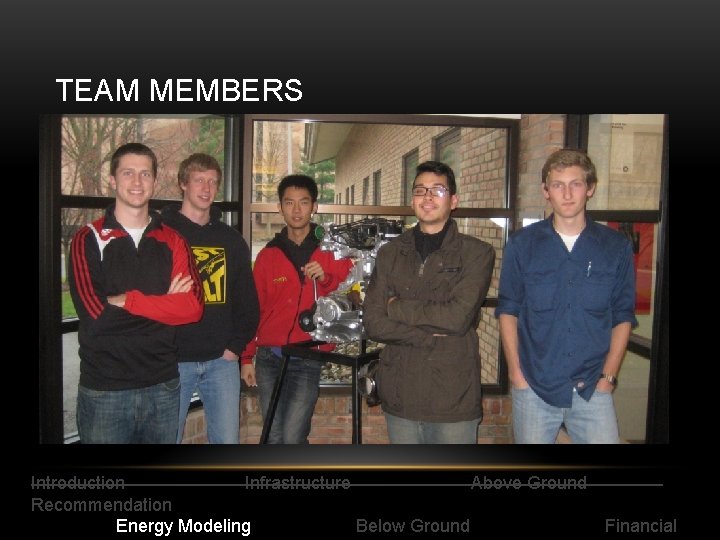
TEAM MEMBERS Introduction Infrastructure Above Ground Recommendation Energy Modeling Below Ground Financial
KEY QUESTIONS • How will a geothermal system contribute to achieving LEED certification? • What are the heating & cooling loads for the West Wing addition? Introduction Infrastructure Above Ground Recommendation Energy Modeling Below Ground Financial
LEED RATING SYSTEM • LEED = Leadership in Energy and Environmental Design • Aiming for LEED silver rating, according to Henry De. Vries • Requires 50 -59 points out of possible 110 points LEED Introduction Infrastructure Above Ground Recommendation Energy Modeling Below Ground Financial
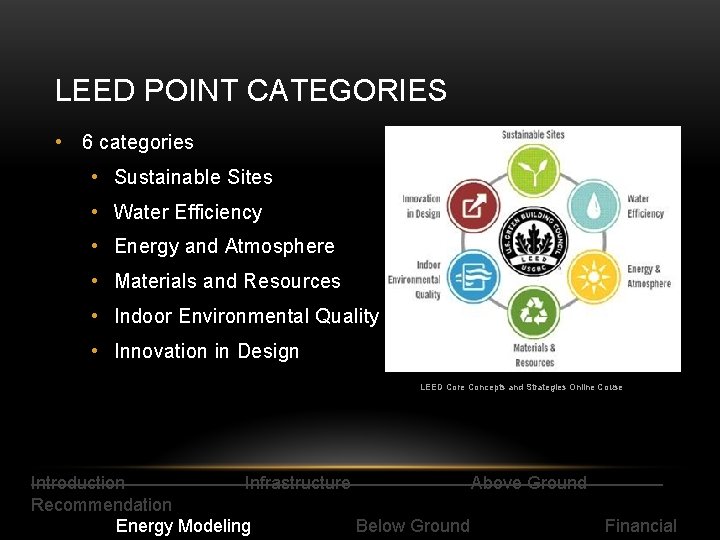
LEED POINT CATEGORIES • 6 categories • Sustainable Sites • Water Efficiency • Energy and Atmosphere • Materials and Resources • Indoor Environmental Quality • Innovation in Design LEED Core Concepts and Strategies Online Couse Introduction Infrastructure Above Ground Recommendation Energy Modeling Below Ground Financial
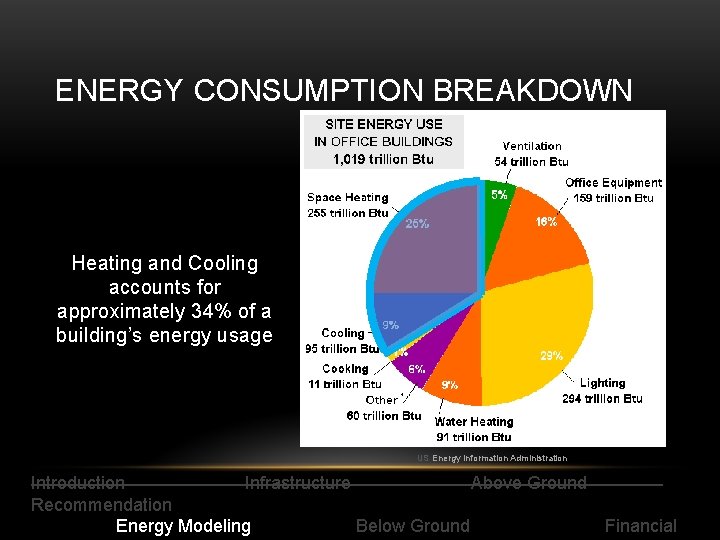
ENERGY CONSUMPTION BREAKDOWN Heating and Cooling accounts for approximately 34% of a building’s energy usage US Energy Information Administration Introduction Infrastructure Above Ground Recommendation Energy Modeling Below Ground Financial
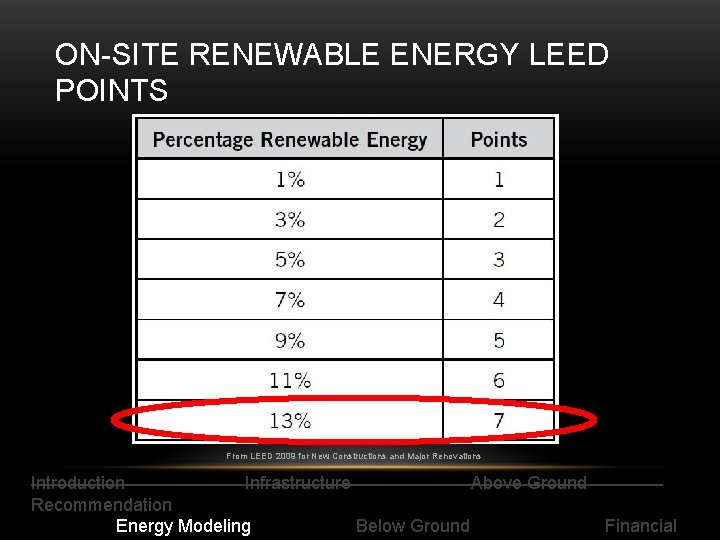
ON-SITE RENEWABLE ENERGY LEED POINTS From LEED 2009 for New Constructions and Major Renovations Introduction Infrastructure Above Ground Recommendation Energy Modeling Below Ground Financial
IMPORTANCE OF HEATING/COOLING LOADS • “Load” is the heat that must be removed in the summer and added in the winter. • Prevent oversized/undersized HVAC system • Directly affect the progress of other teams. Introduction Infrastructure Above Ground Recommendation Energy Modeling Below Ground Financial
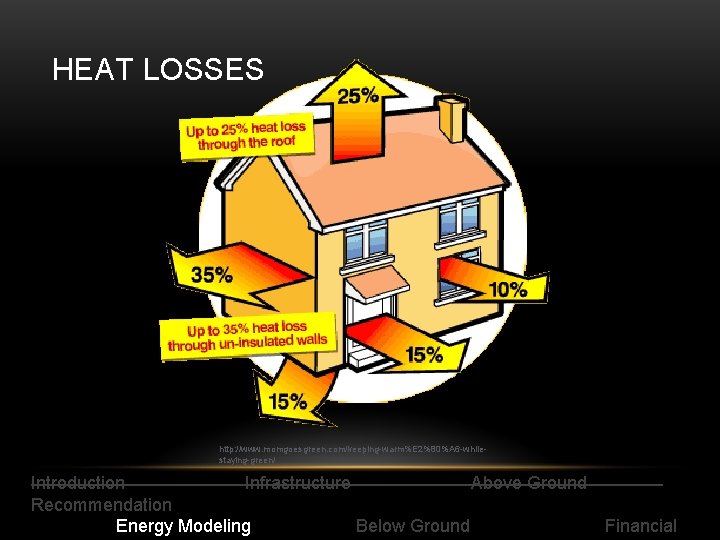
HEAT LOSSES http: //www. momgoesgreen. com/keeping-warm%E 2%80%A 6 -whilestaying-green/ Introduction Infrastructure Above Ground Recommendation Energy Modeling Below Ground Financial
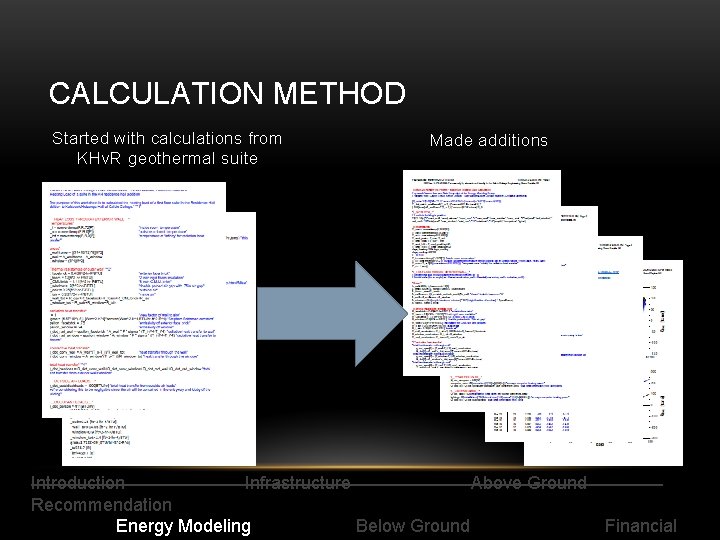
CALCULATION METHOD Started with calculations from KHv. R geothermal suite Made additions Introduction Infrastructure Above Ground Recommendation Energy Modeling Below Ground Financial
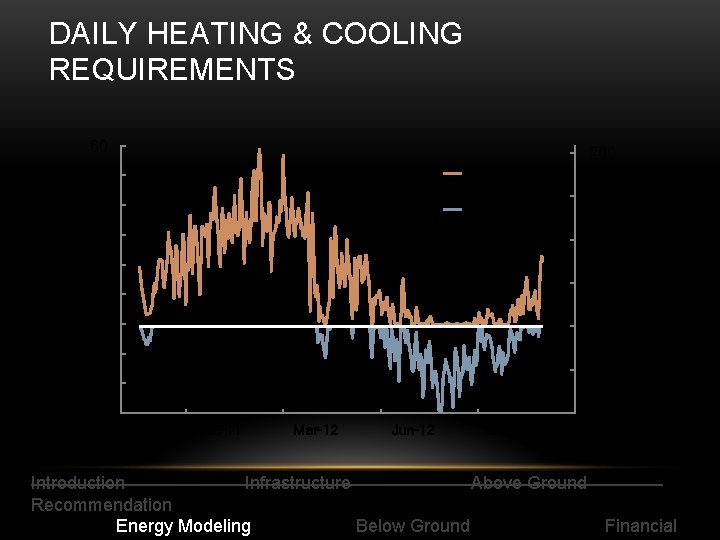
DAILY HEATING & COOLING REQUIREMENTS 60 200 Heating 40 Cooling Millions 30 150 100 20 50 10 0 0 -10 -50 -20 -30 Sep-11 Dec-11 Mar-12 Jun-12 Sep-12 Introduction Infrastructure Above Ground Recommendation Energy Modeling Below Ground Tons of Refridgeration 50 -100 Financial
HEATING & COOLING LOADS BEST ESTIMATE • Heating: 174 Tons • Cooling: 86 Tons • Tons are a standard unit of heating and cooling: 1 ton = 12, 000 Btu/hr Introduction Infrastructure Above Ground Recommendation Energy Modeling Below Ground Financial
FINAL ANSWERS • How will a geothermal system contribute to achieving LEED certification? • 7 points towards the goal of 50 • What are the heating & cooling loads for the West Wing addition? • Heating: 174 Tons • Cooling: 86 Tons Introduction Infrastructure Above Ground Recommendation Energy Modeling Below Ground Financial
INFRASTRUCTURE Introduction Infrastructure Above Ground Recommendation Energy Modeling Below Ground Financial

TEAM MEMBERS Introduction Infrastructure Above Ground Recommendation Energy Modeling Below Ground Financial
KEY QUESTIONS • How will the geothermal system fit in at Calvin College? • What type of loop configuration will be used? • Where will the geothermal ground loop be located? Introduction Infrastructure Above Ground Recommendation Energy Modeling Below Ground Financial
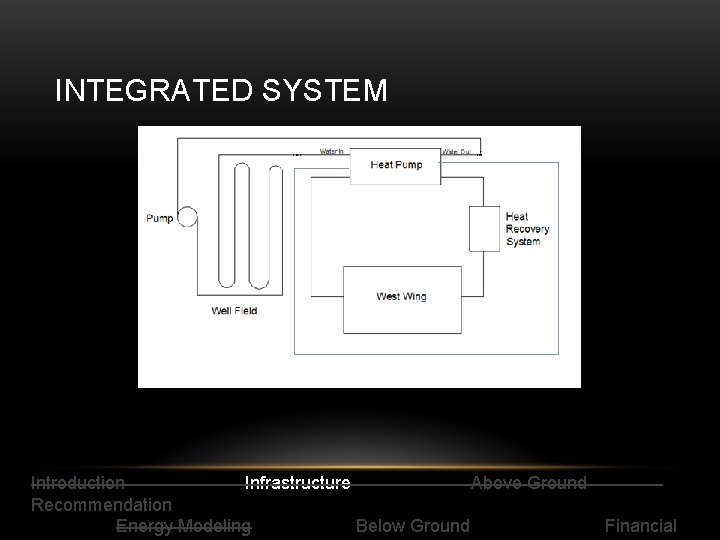
INTEGRATED SYSTEM Introduction Infrastructure Above Ground Recommendation Energy Modeling Below Ground Financial
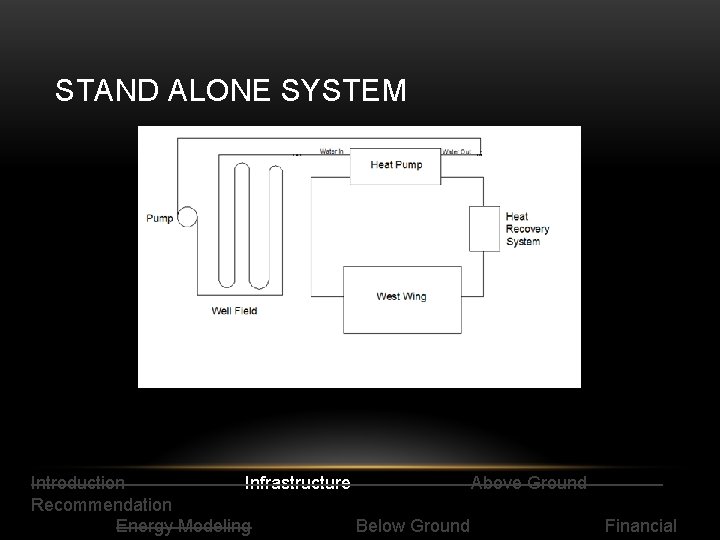
STAND ALONE SYSTEM Introduction Infrastructure Above Ground Recommendation Energy Modeling Below Ground Financial
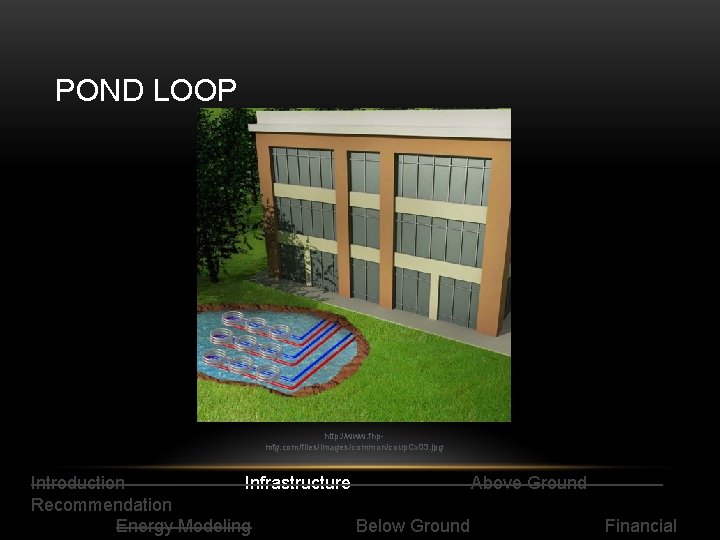
POND LOOP http: //www. fhpmfg. com/files/images/common/coup. Cx 03. jpg Introduction Infrastructure Above Ground Recommendation Energy Modeling Below Ground Financial
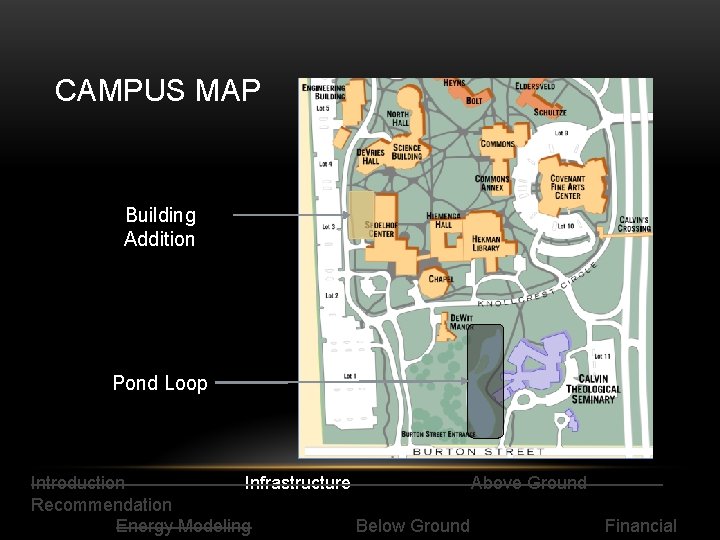
CAMPUS MAP Building Addition Pond Loop Introduction Infrastructure Above Ground Recommendation Energy Modeling Below Ground Financial
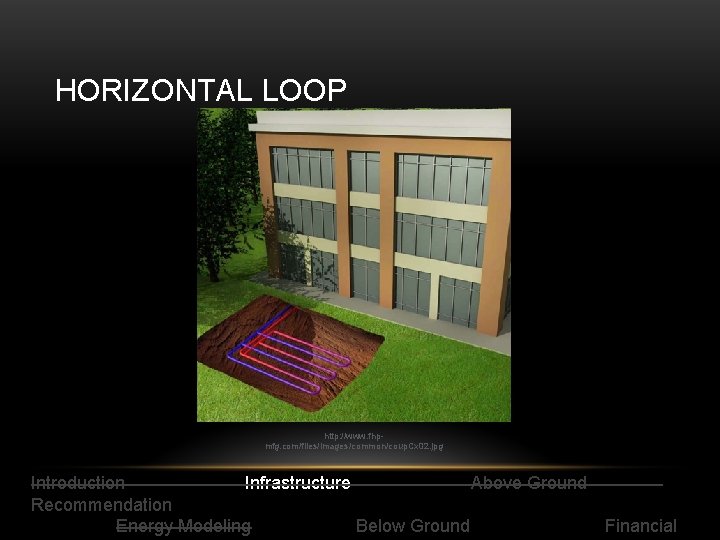
HORIZONTAL LOOP http: //www. fhpmfg. com/files/images/common/coup. Cx 02. jpg Introduction Infrastructure Above Ground Recommendation Energy Modeling Below Ground Financial
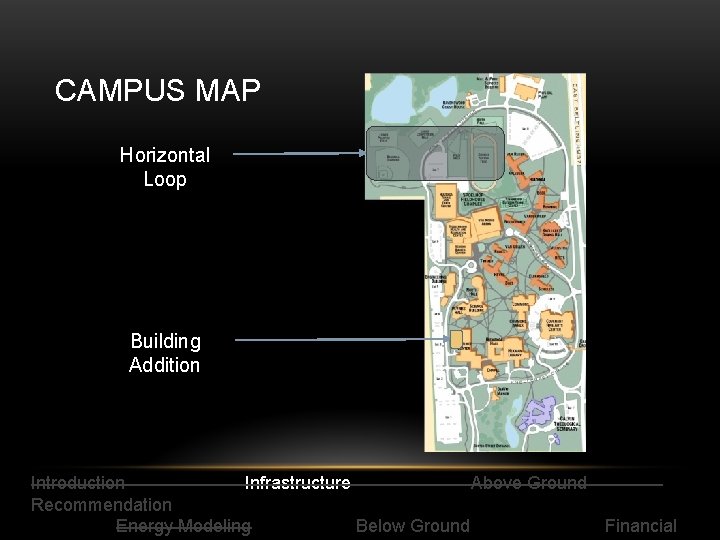
CAMPUS MAP Horizontal Loop Building Addition Introduction Infrastructure Above Ground Recommendation Energy Modeling Below Ground Financial
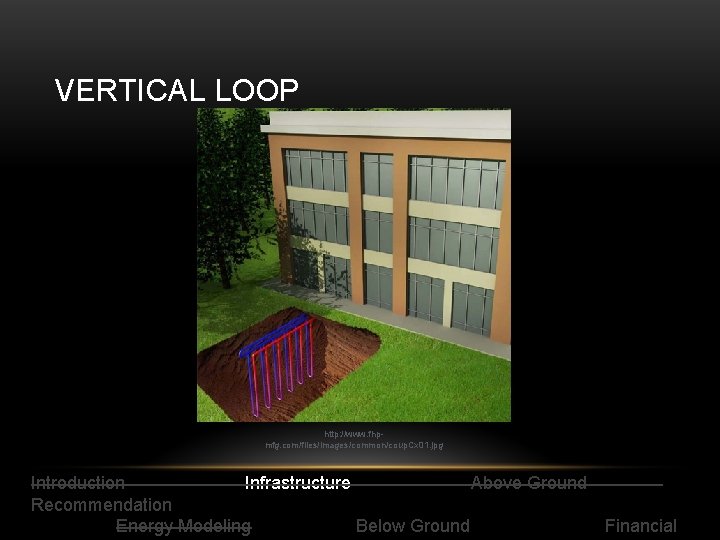
VERTICAL LOOP http: //www. fhpmfg. com/files/images/common/coup. Cx 01. jpg Introduction Infrastructure Above Ground Recommendation Energy Modeling Below Ground Financial
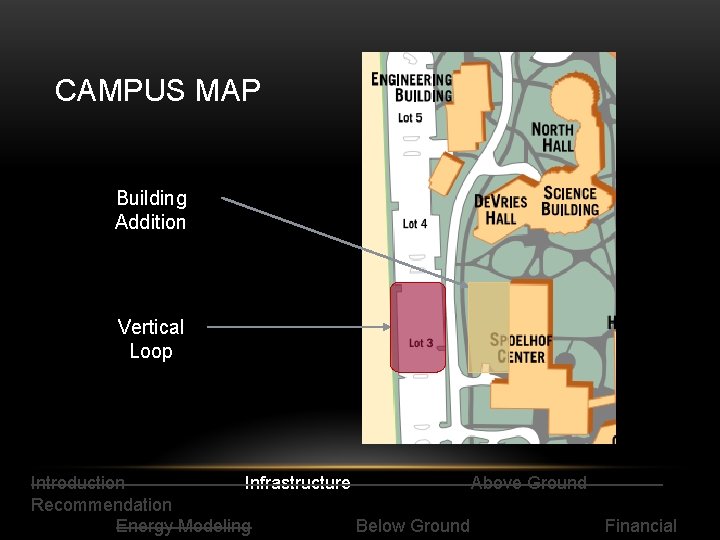
CAMPUS MAP Building Addition Vertical Loop Introduction Infrastructure Above Ground Recommendation Energy Modeling Below Ground Financial
ANSWERS • How will the geothermal system fit in at Calvin College? • Mechanical Separation • What type of loop configuration will be used? • Vertical • Where will the geothermal ground loop be located? • West Parking Lot Introduction Infrastructure Above Ground Recommendation Energy Modeling Below Ground Financial
BELOW GROUND Introduction Infrastructure Above Ground Recommendation Energy Modeling Below Ground Financial

TEAM MEMBERS Introduction Infrastructure Above Ground Recommendation Energy Modeling Below Ground Financial
KEY QUESTIONS • What is the Design of the Borefield? • How many bores? • How deep? • How far apart? • Will local geology affect the design? • How much will it cost? • How long will it last? Introduction Infrastructure Above Ground Recommendation Energy Modeling Below Ground Financial
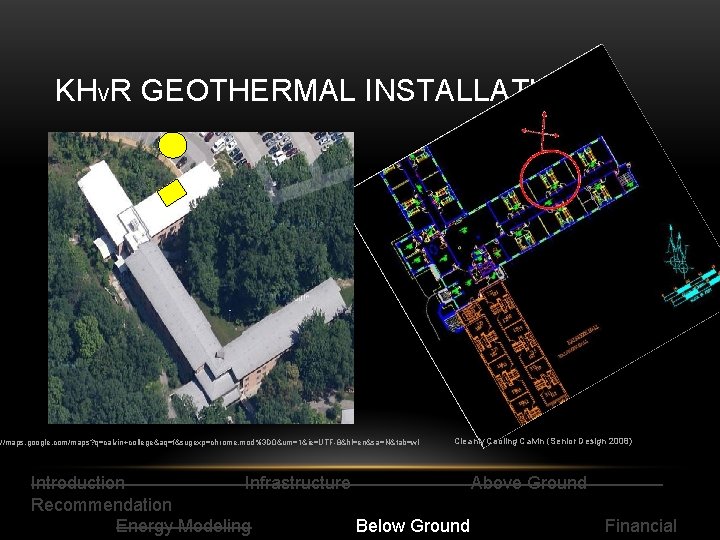
KHVR GEOTHERMAL INSTALLATION : //maps. google. com/maps? q=calvin+college&aq=f&sugexp=chrome, mod%3 D 0&um=1&ie=UTF-8&hl=en&sa=N&tab=wl Cleanly Cooling Calvin (Senior Design 2008) Introduction Infrastructure Above Ground Recommendation Energy Modeling Below Ground Financial
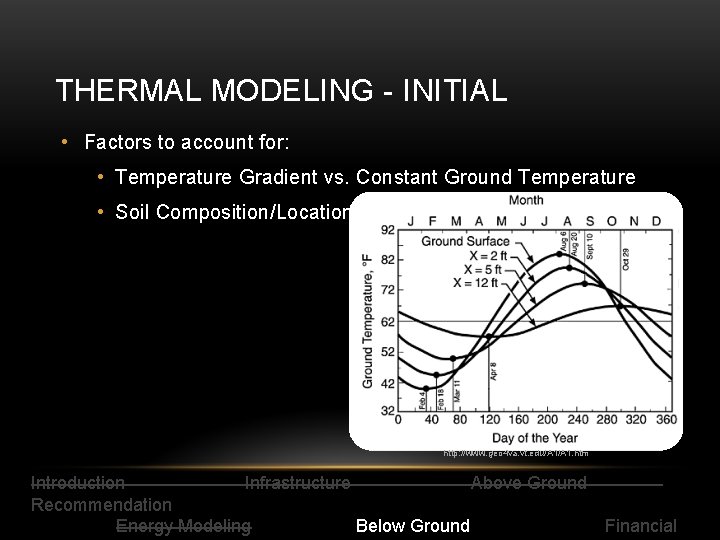
THERMAL MODELING - INITIAL • Factors to account for: • Temperature Gradient vs. Constant Ground Temperature • Soil Composition/Location http: //www. geo 4 va. vt. edu/A 1. htm Introduction Infrastructure Above Ground Recommendation Energy Modeling Below Ground Financial
THERMAL MODELING - INITIAL SUMMARY • Heating Load: 140 ton • Borehole Depth: 300 – 420 feet • Number of Boreholes: 175 – 200 Introduction Infrastructure Above Ground Recommendation Energy Modeling Below Ground Financial

REFINED BOREFIELD DESIGN http: //mwgeothermal. com/ Introduction Infrastructure Above Ground Recommendation Energy Modeling Below Ground Financial
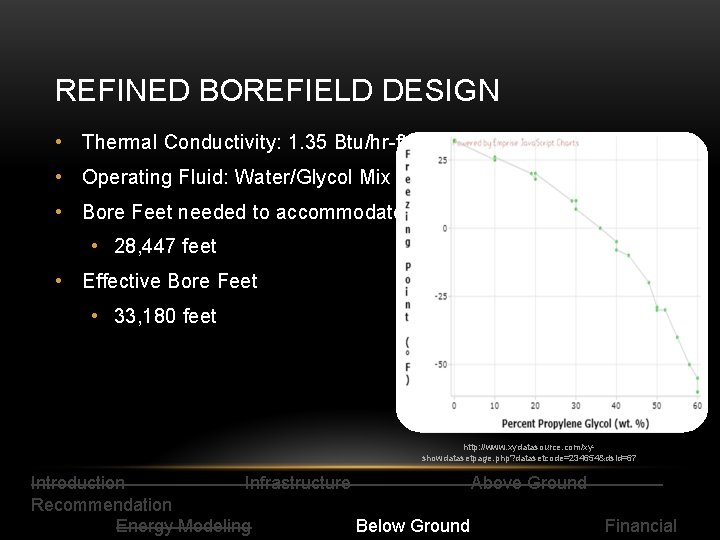
REFINED BOREFIELD DESIGN • Thermal Conductivity: 1. 35 Btu/hr-ft-°F • Operating Fluid: Water/Glycol Mix • Bore Feet needed to accommodate loads • 28, 447 feet • Effective Bore Feet • 33, 180 feet http: //www. xydatasource. com/xyshowdatasetpage. php? datasetcode=234654&dsid=67 Introduction Infrastructure Above Ground Recommendation Energy Modeling Below Ground Financial
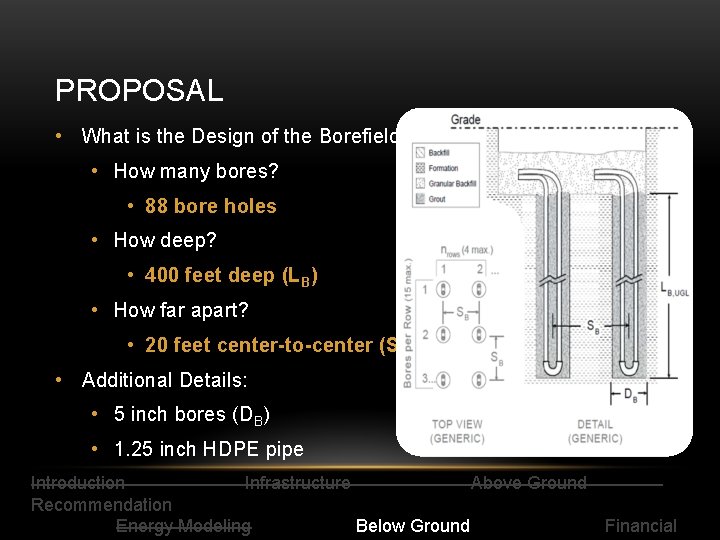
PROPOSAL • What is the Design of the Borefield? • How many bores? • 88 bore holes • How deep? • 400 feet deep (LB) • How far apart? • 20 feet center-to-center (SB) • Additional Details: • 5 inch bores (DB) • 1. 25 inch HDPE pipe Introduction Infrastructure Above Ground Recommendation Energy Modeling Below Ground Financial
REFINED BOREFIELD DESIGN • How must will it cost? • Total Installation Costs = $478, 720 • $13. 60/bore feet • Pipe Costs • Site Costs • How long will it last? • Economic Life • 50 years Introduction Infrastructure Above Ground Recommendation Energy Modeling Below Ground Financial

ABOVE GROUND
TEAM MEMBERS Introduction Infrastructure Above Ground Recommendation Energy Modeling Below Ground Financial
KEY QUESTIONS • What system should be selected to meet the HVAC demands of the new addition? • Water to Air vs Water to Water? • Centralized vs Distributed System? • Energy Recovery Ventilation? Introduction Infrastructure Above Ground Recommendation Energy Modeling Below Ground Financial
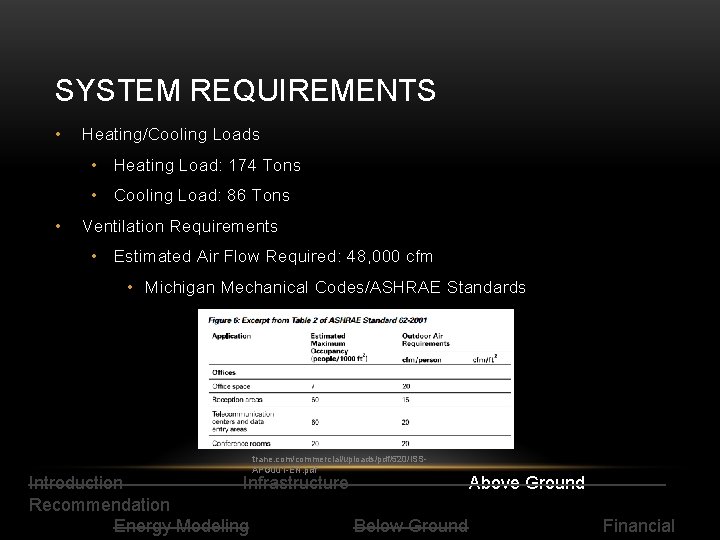
SYSTEM REQUIREMENTS • Heating/Cooling Loads • Heating Load: 174 Tons • Cooling Load: 86 Tons • Ventilation Requirements • Estimated Air Flow Required: 48, 000 cfm • Michigan Mechanical Codes/ASHRAE Standards trane. com/commercial/uploads/pdf/520/ISSAPG 001 -EN. pdf Introduction Infrastructure Above Ground Recommendation Energy Modeling Below Ground Financial
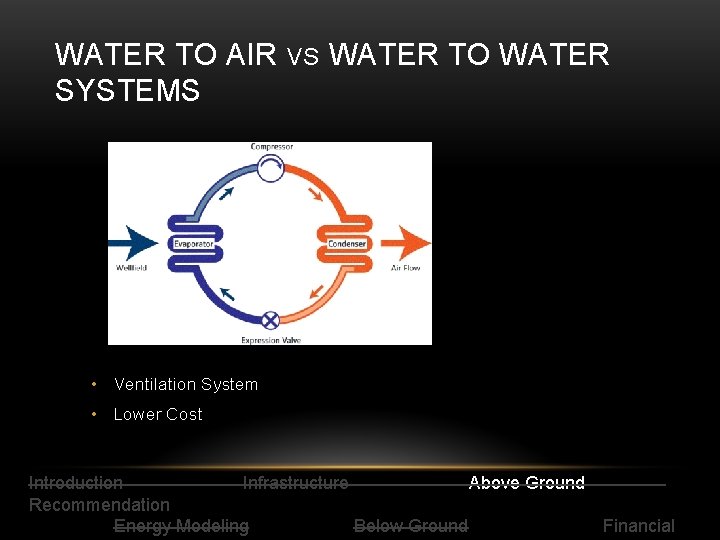
WATER TO AIR SYSTEMS VS WATER TO WATER • Ventilation System • Lower Cost Introduction Infrastructure Above Ground Recommendation Energy Modeling Below Ground Financial
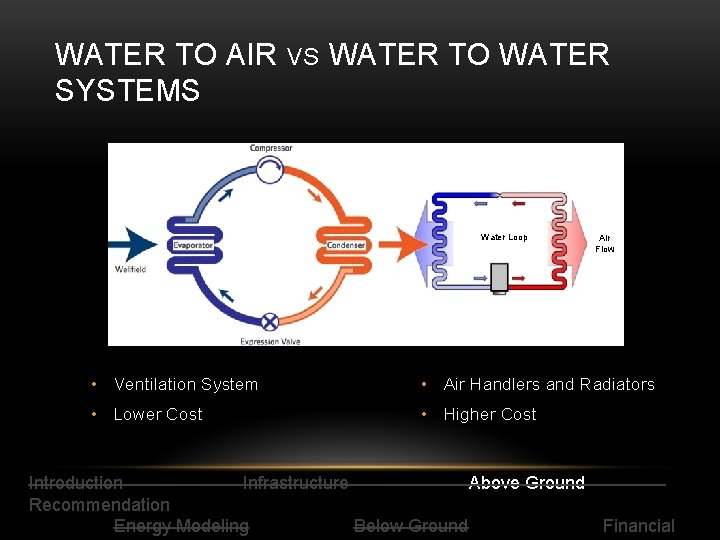
WATER TO AIR SYSTEMS VS WATER TO WATER Water Loop Air Flow • Ventilation System • Air Handlers and Radiators • Lower Cost • Higher Cost Introduction Infrastructure Above Ground Recommendation Energy Modeling Below Ground Financial
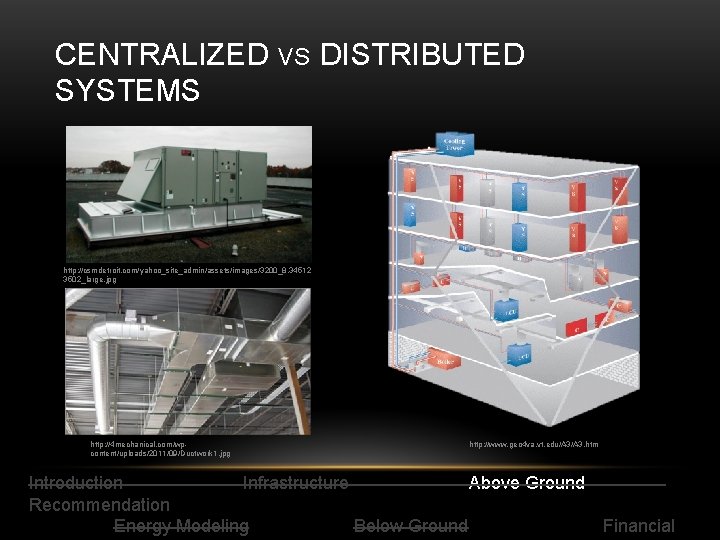
CENTRALIZED SYSTEMS VS DISTRIBUTED http: //csmdetroit. com/yahoo_site_admin/assets/images/3200_8. 34512 3502_large. jpg http: //4 mechanical. com/wpcontent/uploads/2011/09/Ductwork 1. jpg http: //www. geo 4 va. vt. edu/A 3. htm Introduction Infrastructure Above Ground Recommendation Energy Modeling Below Ground Financial
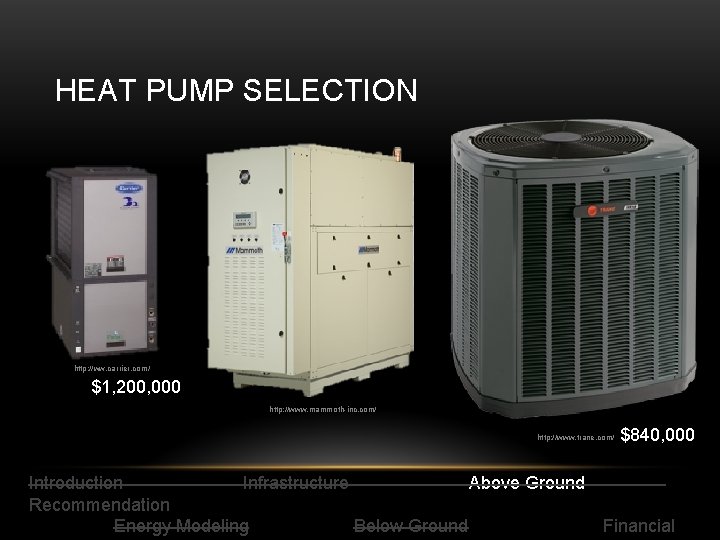
HEAT PUMP SELECTION http: //ww. carrier. com/ $1, 200, 000 http: //www. mammoth-inc. com/ http: //www. trane. com/ $840, 000 Introduction Infrastructure Above Ground Recommendation Energy Modeling Below Ground Financial
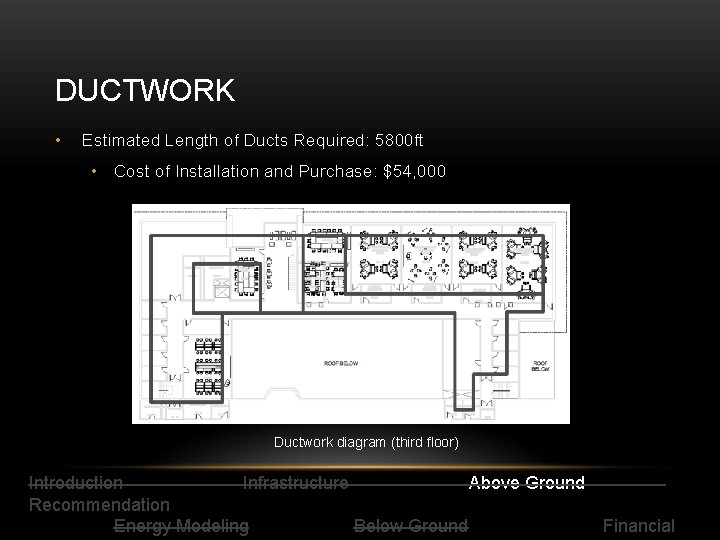
DUCTWORK • Estimated Length of Ducts Required: 5800 ft • Cost of Installation and Purchase: $54, 000 Ductwork diagram (third floor) Introduction Infrastructure Above Ground Recommendation Energy Modeling Below Ground Financial
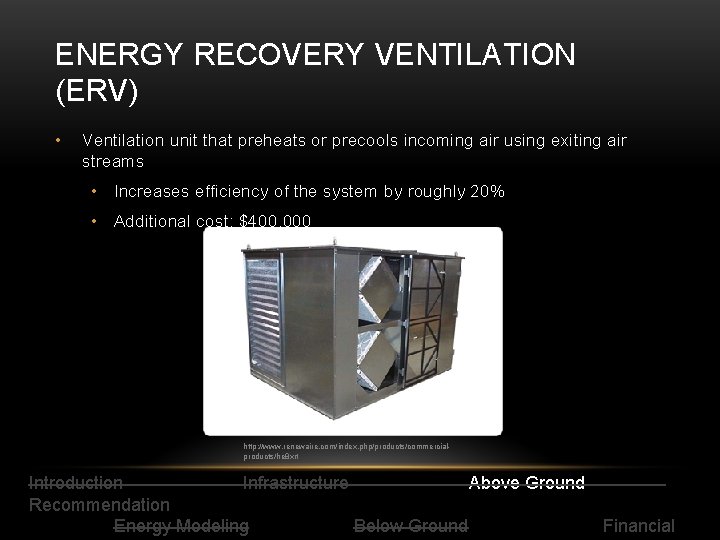
ENERGY RECOVERY VENTILATION (ERV) • Ventilation unit that preheats or precools incoming air using exiting air streams • Increases efficiency of the system by roughly 20% • Additional cost: $400, 000 http: //www. renewaire. com/index. php/products/commercialproducts/he 8 xrt Introduction Infrastructure Above Ground Recommendation Energy Modeling Below Ground Financial
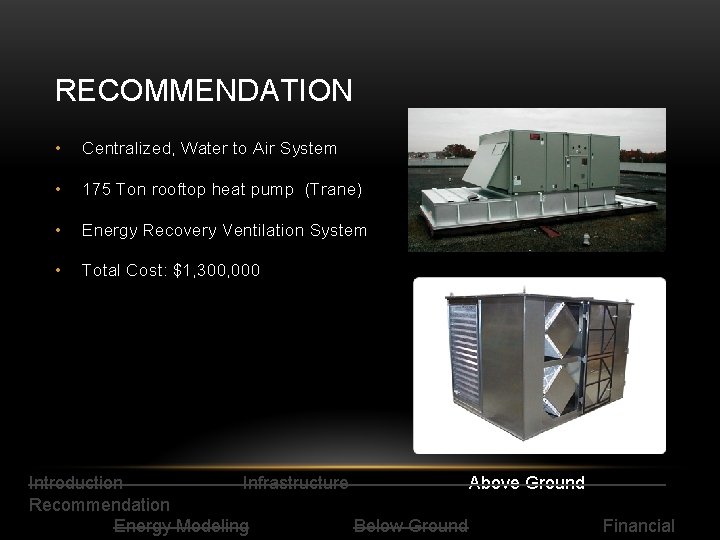
RECOMMENDATION • Centralized, Water to Air System • 175 Ton rooftop heat pump (Trane) • Energy Recovery Ventilation System • Total Cost: $1, 300, 000 Introduction Infrastructure Above Ground Recommendation Energy Modeling Below Ground Financial

FINANCIAL GROUP
TEAM MEMBERS Introduction Infrastructure Above Ground Recommendation Energy Modeling Below Ground Financial
KEY QUESTION Is a geothermal system a financially viable option for the West Wing addition? Introduction Infrastructure Above Ground Recommendation Energy Modeling Below Ground Financial
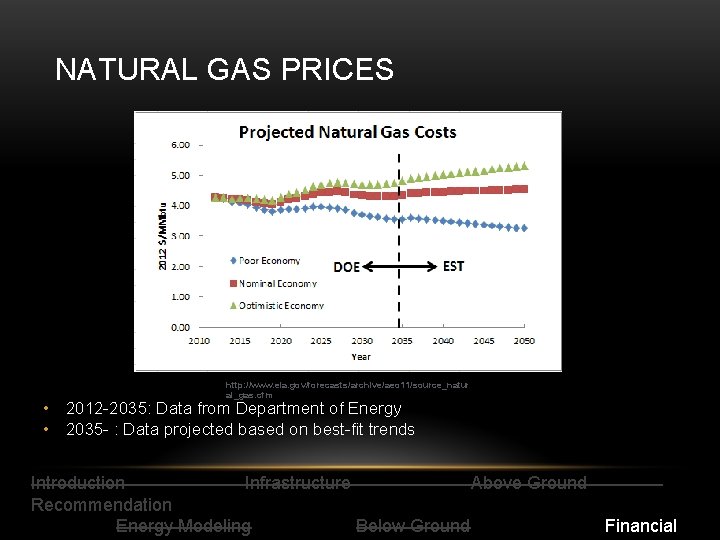
NATURAL GAS PRICES http: //www. eia. gov/forecasts/archive/aeo 11/source_natur al_gas. cfm • 2012 -2035: Data from Department of Energy • 2035 - : Data projected based on best-fit trends Introduction Infrastructure Above Ground Recommendation Energy Modeling Below Ground Financial
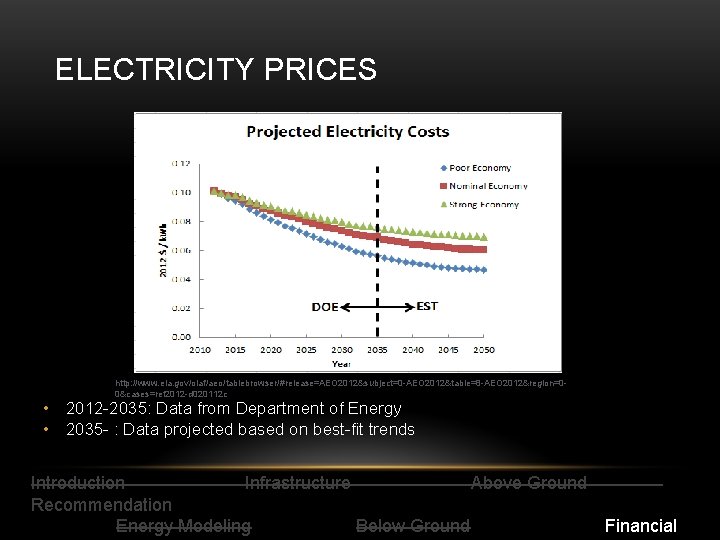
ELECTRICITY PRICES http: //www. eia. gov/oiaf/aeo/tablebrowser/#release=AEO 2012&subject=0 -AEO 2012&table=8 -AEO 2012®ion=00&cases=ref 2012 -d 020112 c • 2012 -2035: Data from Department of Energy • 2035 - : Data projected based on best-fit trends Introduction Infrastructure Above Ground Recommendation Energy Modeling Below Ground Financial
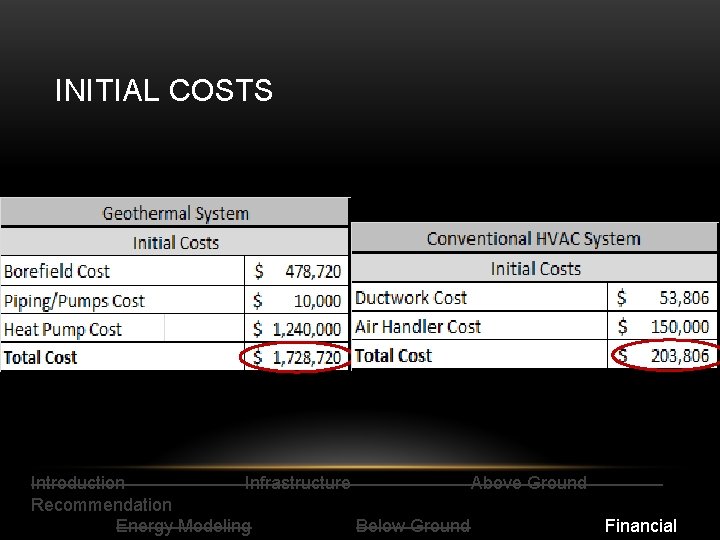
INITIAL COSTS Introduction Infrastructure Above Ground Recommendation Energy Modeling Below Ground Financial
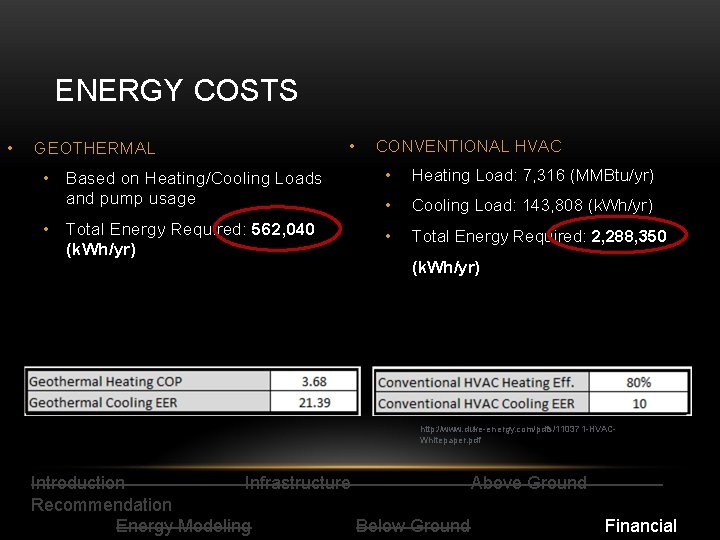
ENERGY COSTS • GEOTHERMAL • CONVENTIONAL HVAC • Based on Heating/Cooling Loads and pump usage • Heating Load: 7, 316 (MMBtu/yr) • Cooling Load: 143, 808 (k. Wh/yr) • Total Energy Required: 562, 040 (k. Wh/yr) • Total Energy Required: 2, 288, 350 (k. Wh/yr) http: //www. duke-energy. com/pdfs/110371 -HVACWhitepaper. pdf Introduction Infrastructure Above Ground Recommendation Energy Modeling Below Ground Financial
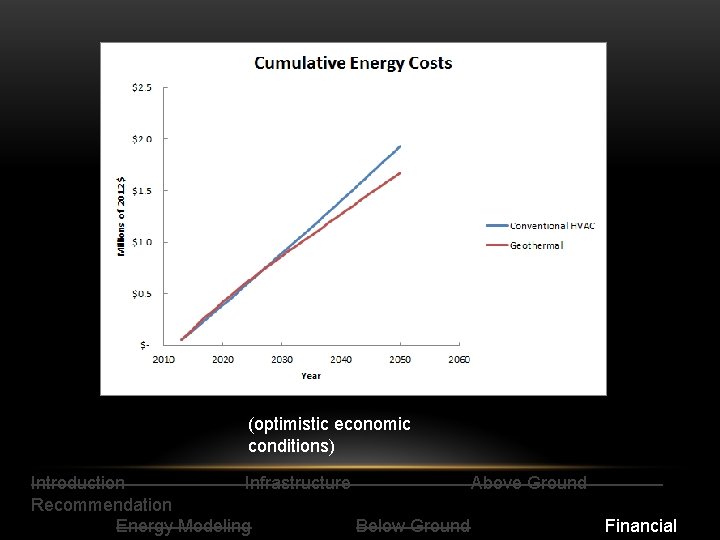
(optimistic economic conditions) Introduction Infrastructure Above Ground Recommendation Energy Modeling Below Ground Financial
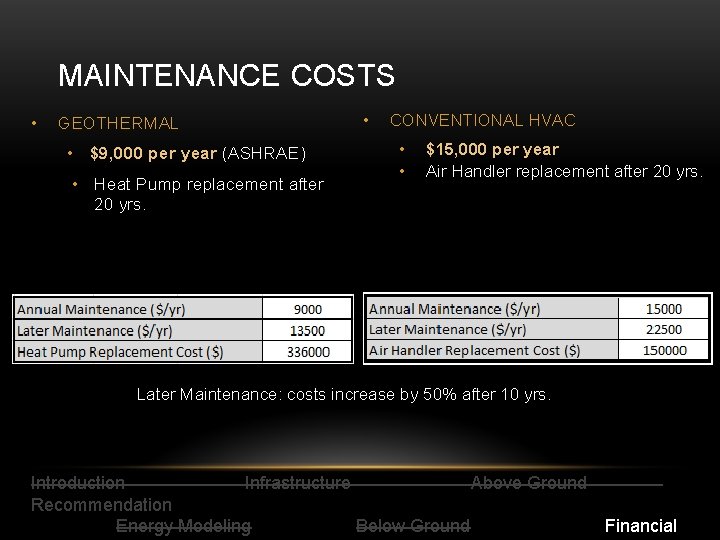
MAINTENANCE COSTS • GEOTHERMAL • $9, 000 per year (ASHRAE) • Heat Pump replacement after 20 yrs. • CONVENTIONAL HVAC • • $15, 000 per year Air Handler replacement after 20 yrs. Later Maintenance: costs increase by 50% after 10 yrs. Introduction Infrastructure Above Ground Recommendation Energy Modeling Below Ground Financial
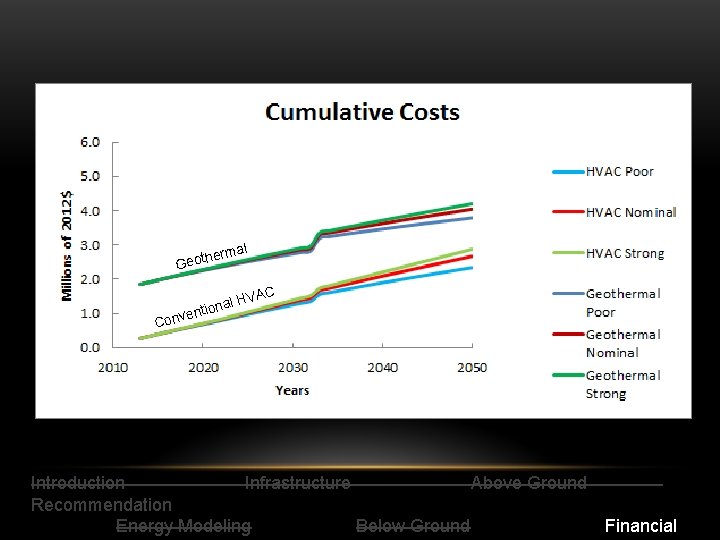
al m r Geothermal e h eot G alal l rrm erem m h t a o h e t Geoetohe GG n. Va. AAVl. CCAC o i t n vetinieootnnioaanll a. HHl. VH n o Coneevnnt Coo. Cnnvv. VAC C H Expanded HVAC Introduction Infrastructure Above Ground Recommendation Energy Modeling Below Ground Financial
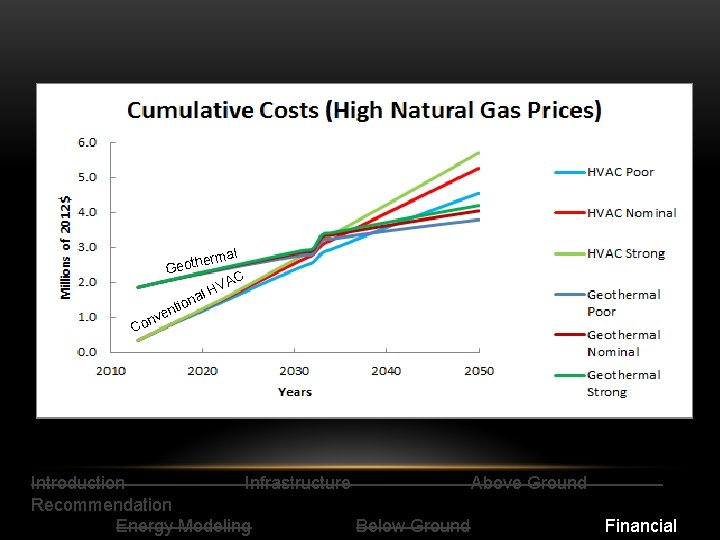
rmal C VA H al he Geot ion nt nve Co Introduction Infrastructure Above Ground Recommendation Energy Modeling Below Ground Financial
FINANCIAL PROPOSAL • As Christians, we have a calling to be stewards of Creation and Money (Luke 14: 28 -30, 1 Corinthians 4: 7) • There is no foreseeable financial payback • From a solely financial standpoint, the financial group recommends a geothermal system not be constructed until such time as: • Natural gas prices rise dramatically • Entire campus considered Introduction Infrastructure Above Ground Recommendation Energy Modeling Below Ground Financial
FINAL RECOMMENDATION – ENGR. 333 CLASS Geothermal Advantages Geothermal Disadvantages • Reduce energy costs • High initial cost • Lower maintenance costs • • Promotes stewardship of creation Additional construction site – well field • Contributes to LEED certification • Small scale example of possible campus wide geothermal • Enhancement of college image • Coordinate with parking lot construction Proposal: Utilize existing HVAC system

ACKNOWLEDGEMENTS Class Advisors • Trent De. Boer • Henry De. Vries • Professor Heun • Paul Pennock Additional Help • Phil Beezhold • Scott Skoog & Kortney Lull, Midwest Geothermal • Dan Pabst • Dean Anderson • Dan Slager

QUESTIONS
HEAT GAINS • Several factors also provide heat gain to a building • Occupants (1 person produces around 400 BTU/day) • Equipment in rooms (computers, projectors, etc) • Lighting Introduction Infrastructure Above Ground Recommendation Energy Modeling Below Ground Financial
![Heat Gains 40000 Heat Gain [BTU/hr] 35000 30000 25000 20000 15000 10000 5000 0](http://slidetodoc.com/presentation_image_h2/6699552638b9b87b469580597f185ad3/image-69.jpg "Heat Gains 40000 Heat Gain [BTU/hr] 35000 30000 25000 20000 15000 10000 5000 0")
Heat Gains 40000 Heat Gain [BTU/hr] 35000 30000 25000 20000 15000 10000 5000 0 People Computers Lights Introduction Infrastructure Above Ground Recommendation Energy Modeling Below Ground Financial
EXTERNAL FUNDING • Direct external funding (tax refunds/incentives) are unavailable as Calvin College is a tax-exempt entity • However, according to Scott Skoog of Midwest Geothermal, indirect incentives are a possibility. • In this case, an architect/engineering firm can apply for a tax deduction for designing or building an energy saving building for a non-profit or government agency. • In this way, the firm saves money on designing/building Calvin’s geothermal, and partially passes these savings on to Calvin.
CALVIN ENERGY RECOVERY FUND (CERF) UTILIZATION • CERF is a revolving fund used to improve energy efficiency and decrease carbon emissions. • CERF is currently growing by investing in smaller scale projects (lighting, computer shutdown) • The scale of this project vs. CERF’s budget (~$65, 000) seems to be a bad fit. • Recommendation: Don’t utilize CERF in this project
- Slides: 71