
West Virginia Tiered System of Support WVTSS Not
- Slides: 18
West Virginia Tiered System of Support (WVTSS): Not a Pathway to Special Education but a System of Support for ALL Students’ Academic, Behavior, and Mental Health Instructional Support Professional Learning Forum Wednesday, August 5, 2020 9: 00 -9: 30 and 2: 00 -2: 30
Housekeeping Procedures • • • Please note that this session will be recorded and shared. Please mute your microphone unless you are speaking. Please keep your camera off during the presentation to preserve bandwidth. Check the volume on your speakers before we begin. Closed captioning is available by hitting the “…” on your horizontal on-screen menu. • To open your chat box, click on the speech bubble button on your horizontal on-screen menu. It should open to the right of your screen. • A PDF of the presentation slides will be shared in the chat box at the end. • If you are having any problems with the items above, please describe your problem in the chat box before we begin so that I can try to assist you. 2
Before we begin… • When returning to school, relationships, social/emotional well-being and physical health of our students and staff is our number one priority along with learning. • Using a variety of tool to communicate with students and families will be key in making re-entry successful. • Students will be at different places emotionally and academically. Educators should use available tools to determine where students are and identify their needs. • Educators should use personal and professional observations, conversations, informal assessments, formative assessments, interim and diagnostics assessments to determine what support students need. • Schools should use vertical teaming with teaching staff to identify gaps in the prerequisite skills needed for students to be successful academically. • In this forum, you will see a variety of sessions that will assist you with inperson, remote and blended learning strategies and best practices. 3
Session Objectives • WVTSS Overview (Academics, Behavior, Mental Health) • WVTSS Tiers (Universal, Targeted, Intensive) • Special Education Implications • Parent Involvement • Professional Learning • Next Steps 4
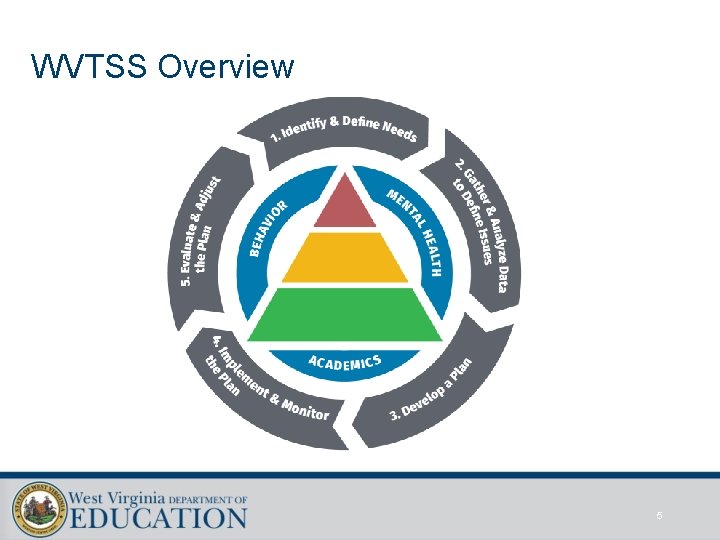
WVTSS Overview 5
Academic Support Universal- All students received instruction and demonstrate learning of the WV College and Career-Readiness Standards. Targeted- Eliminate gap between present achievement and gradelevel standards and between instruction and students’ needs. Intensive- Eliminate or narrow gap between present achievement and grade-level standards and between instruction and students’ needs. 6
Behavioral Support Universal- Policy 2520. 19, West Virginia College- and Career. Readiness Dispositions and Standards for Student Success for Grades K-12 are integrated into daily classroom expectations and instruction. Effective school-wide behavior supports are provided. Targeted- Specialized, targeted positive behavior supports are provided. Intensive- Specialized and intensified positive behavior supports are provided. May include an assessment of student behaviors; Functional Behavior Assessment (FBA), and the development of specialized Behavior Intervention Plans (BIP). 7
Mental Health Support Universal- Mental health support refers to all activities that foster positive social, emotional and behavioral skills and well-being of all students, regardless of whether they are at risk for mental health problems. The West Virginia College- and Career-Readiness Dispositions and Standards for Student Success for Grades K-12 and socialemotional Learning/SEL (teaching students to manage emotions, set and achieve positive goals, feel and show empathy, maintain positive relationships, make responsible decisions, etc. ) are integrated into daily classroom expectations and instruction. Positive school climate is regularly monitored and assessed. 8
Mental Health Support Targeted services and/or strategies are designed to address mental health concerns for students who have been identified through a systematic, equitable process as experiencing mild distress or being at -risk for a given condition or concern. Targeted supports may also be used for students to address targeted needs, low-intensity classroom supports such as check-in/check-out, increased instruction with self-regulation and social skills are emphasized and provided to small groups of students. Outside mental health professionals may provide services within the school setting (Expanded School Mental Health, School-Based Health Centers). 9
Mental Health Supports Intensive services and support interventions are designed to address mental health concerns for students who have not been successful with targeted interventions or who are already experiencing significant distress and impaired functioning. Specialized and intensified mental health support which may include group, individual, or family therapy and/or wrap-around services for identified students. Continuous collaboration with the school supports individual student needs. Outside mental health professionals may provide services within the school setting (Expanded School Mental Health, School-Based Health Centers). 10
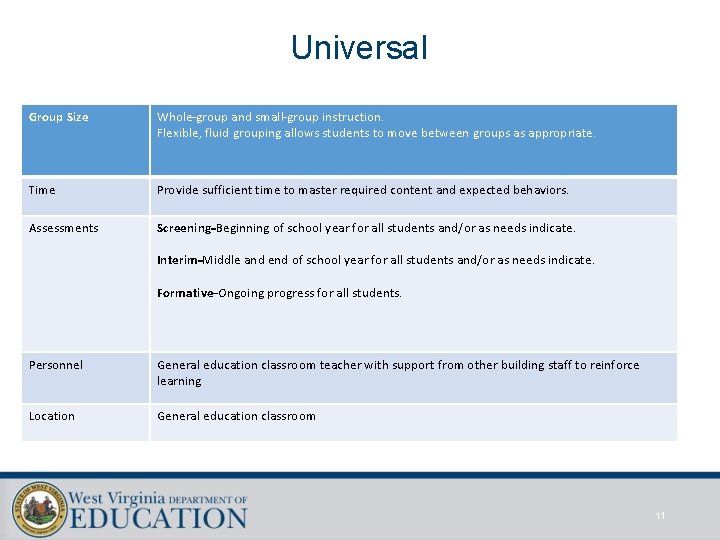
Universal Group Size Whole group and small group instruction. Flexible, fluid grouping allows students to move between groups as appropriate. Time Provide sufficient time to master required content and expected behaviors. Assessments Screening-Beginning of school year for all students and/or as needs indicate. Interim-Middle and end of school year for all students and/or as needs indicate. Formative-Ongoing progress for all students. Personnel General education classroom teacher with support from other building staff to reinforce learning Location General education classroom 11
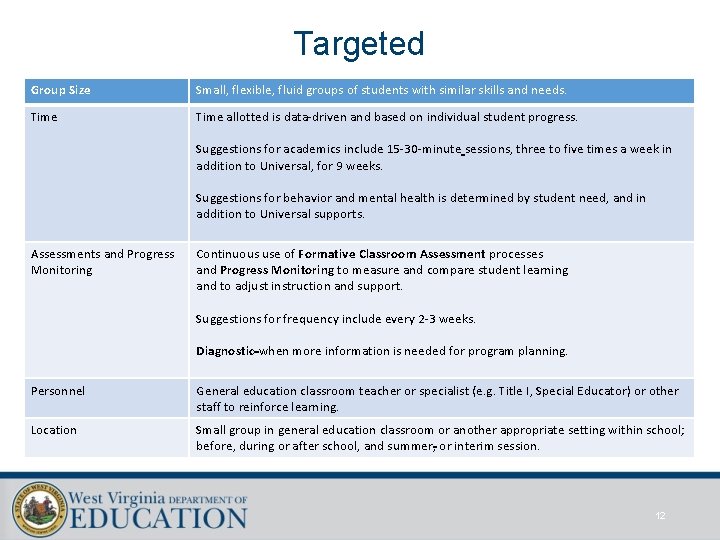
Targeted Group Size Small, flexible, fluid groups of students with similar skills and needs. Time allotted is data-driven and based on individual student progress. Suggestions for academics include 15 -30 -minute sessions, three to five times a week in addition to Universal, for 9 weeks. Suggestions for behavior and mental health is determined by student need, and in addition to Universal supports. Assessments and Progress Monitoring Continuous use of Formative Classroom Assessment processes and Progress Monitoring to measure and compare student learning and to adjust instruction and support. Suggestions for frequency include every 2 -3 weeks. Diagnostic-when more information is needed for program planning. Personnel General education classroom teacher or specialist (e. g. Title I, Special Educator) or other staff to reinforce learning. Location Small group in general education classroom or another appropriate setting within school; before, during or after school, and summer, or interim session. 12
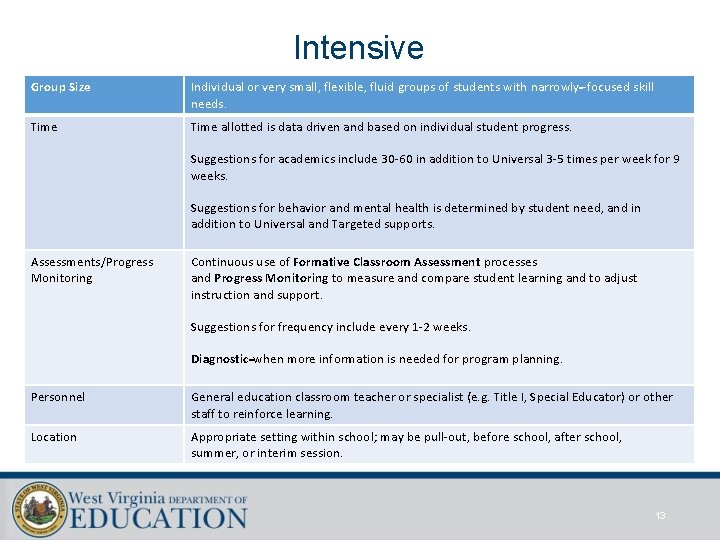
Intensive Group Size Individual or very small, flexible, fluid groups of students with narrowly -focused skill needs. Time allotted is data driven and based on individual student progress. Suggestions for academics include 30 -60 in addition to Universal 3 -5 times per week for 9 weeks. Suggestions for behavior and mental health is determined by student need, and in addition to Universal and Targeted supports. Assessments/Progress Monitoring Continuous use of Formative Classroom Assessment processes and Progress Monitoring to measure and compare student learning and to adjust instruction and support. Suggestions for frequency include every 1 -2 weeks. Diagnostic-when more information is needed for program planning. Personnel General education classroom teacher or specialist (e. g. Title I, Special Educator) or other staff to reinforce learning. Location Appropriate setting within school; may be pull-out, before school, after school, summer, or interim session. 13
WVTSS Not a Pathway to Special Education 14
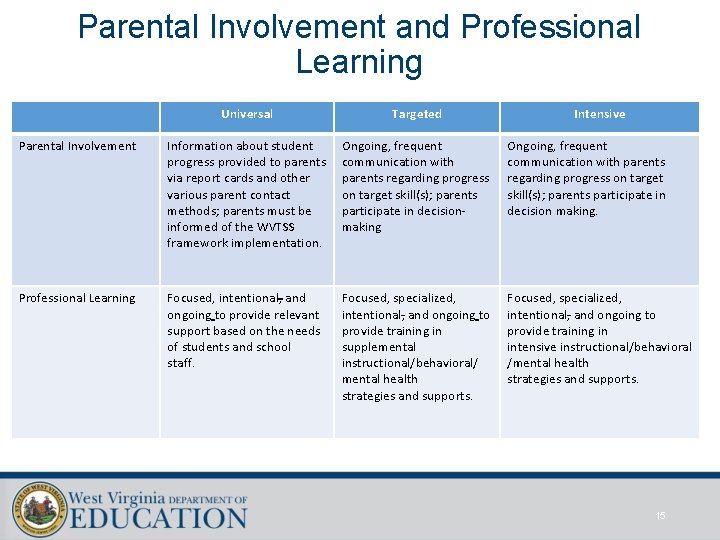
Parental Involvement and Professional Learning Universal Targeted Intensive Parental Involvement Information about student progress provided to parents via report cards and other various parent contact methods; parents must be informed of the WVTSS framework implementation. Ongoing, frequent communication with parents regarding progress on target skill(s); parents participate in decisionmaking Ongoing, frequent communication with parents regarding progress on target skill(s); parents participate in decision making. Professional Learning Focused, intentional, and ongoing to provide relevant support based on the needs of students and school staff. Focused, specialized, intentional, and ongoing to provide training in supplemental instructional/behavioral/ mental health strategies and supports. Focused, specialized, intentional, and ongoing to provide training in intensive instructional/behavioral /mental health strategies and supports. 15
16
Action Steps/Conclusion Problem Solving Process Policy 2520. 19, West Virginia College- and Career-Readiness Dispositions and Standards for Student Success Functional Behavior Assessment/ Behavior Intervention Plans Check-in/Check-out WV Expanded School Mental Health Parent Involvement Professional Learning (PLCs) 17
Sara Hutchinson Office of Early & Elementary Learning shutchinson@k 12. wv. us Joseph Mastracci Office of Middle & Secondary Learning jmastracci@k 12. wv. us Dawn Embrey-King Office of Special Education dembreyking@k 12. wv. us Please complete this survey before 5: 00 pm today in order to receive credit for attendance. https: //forms. office. com/Pages/Response. Page. aspx? id=S 7 AZ 4 Awzeka. Lrgn 7 Fzd. Nap. EOszzk 9 RJg. S 7 C 6 clj. CXd. UMVc 3 VUoy. S 1 cx. MDRGWVZRMTMz. Mk. Ja. TVU 5 MC 4 u 18