
West Lothian Council Building Services Occupational Health and
West Lothian Council – Building Services Occupational Health and Safety Initial Induction
Legal Requirements Health and Safety at Work Act 1974 Management of Health and Safety at work Regulations Work at Height Regs Manual handling Regs Asbestos Regs Other
Safety Policy More than five employees, • employer must have a written policy • which is made up of three parts: • Statement of employers policy • Details of the organisation set up to make it happen • Arrangements of how health & safety will be managed Policy will also detail employer and employees duties
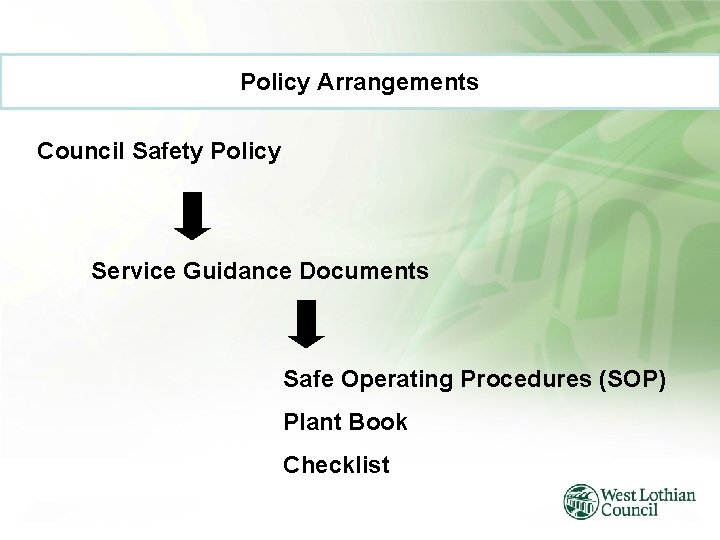
Policy Arrangements Council Safety Policy Service Guidance Documents Safe Operating Procedures (SOP) Plant Book Checklist
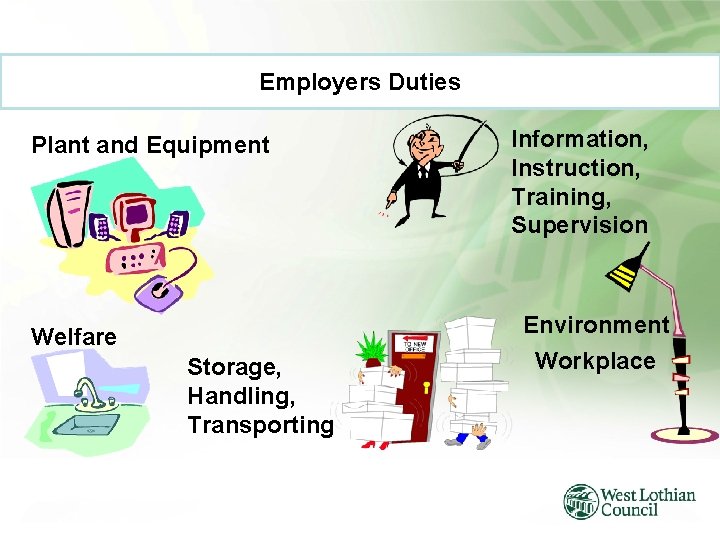
Employers Duties Plant and Equipment Welfare Storage, Handling, Transporting Information, Instruction, Training, Supervision Environment Workplace
Employees Duties • Comply with safe systems and instructions • Don’t misuse anything provided • Inform management of danger / shortcomings • Take care of self and others
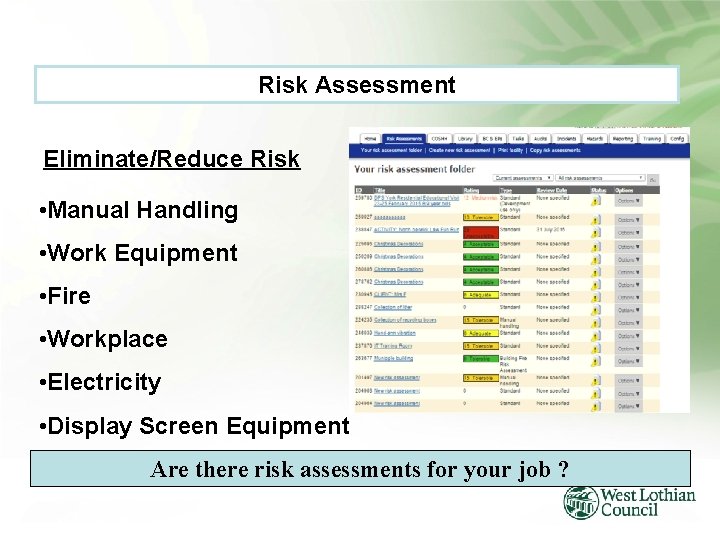
Risk Assessment Eliminate/Reduce Risk • Manual Handling • Work Equipment • Fire • Workplace • Electricity • Display Screen Equipment Are there risk assessments for your job ?
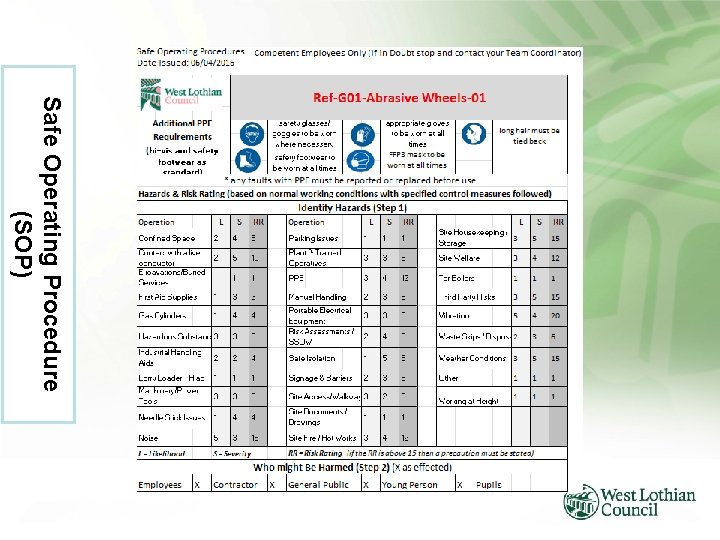
Safe Operating Procedure (SOP)
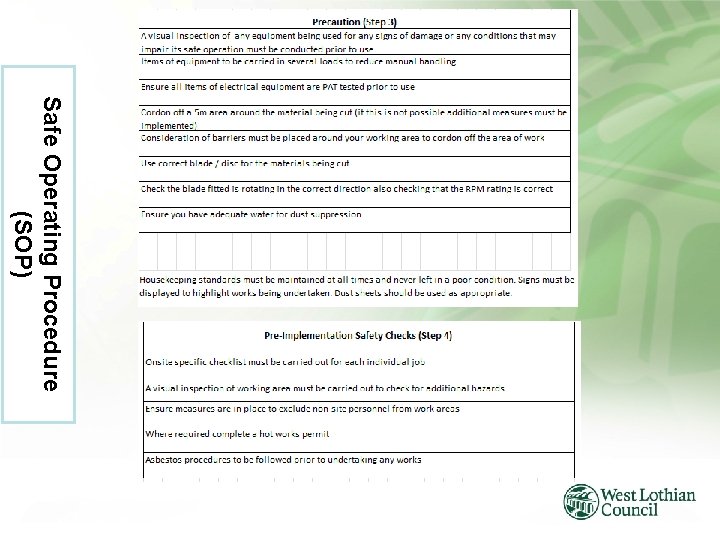
Safe Operating Procedure (SOP)
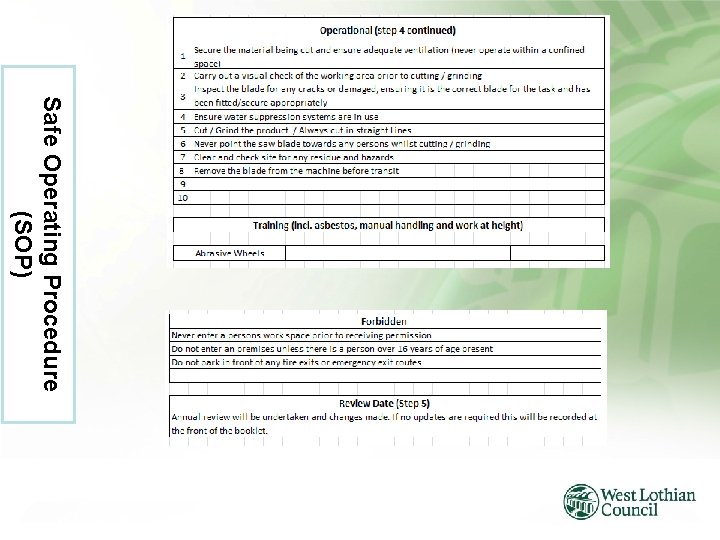
Safe Operating Procedure (SOP)
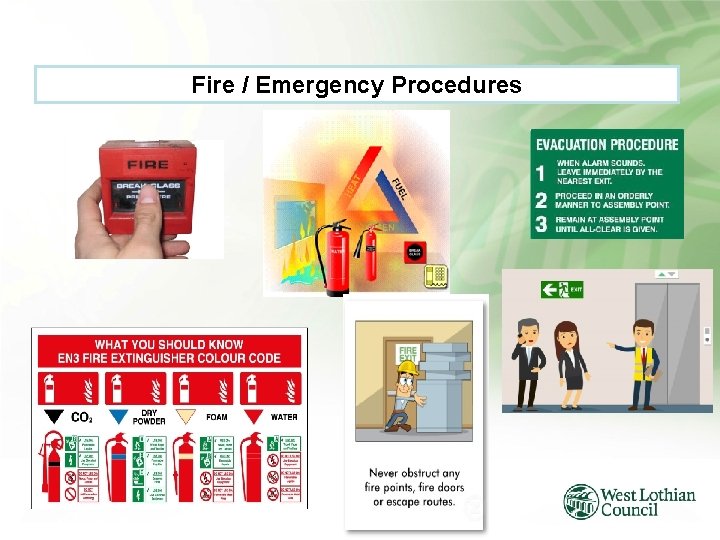
Fire / Emergency Procedures
First Aid • Do you know who the First Aiders are ? • Do you know where the First Aid Treatment Room is? • Checked First Aid kit in the works vehicle, get a replacement or top up • Serious injuries - may require Emergency Services
Personal Protective Equipment (PPE) • Safety Footwear, Hi-Viz. Jacket/Vest & Hard-hat, MUST be worn on all HCBS sites. (Bump Caps for specific tasks) • For job specific PPE, refer to your Safe Operating Procedures & COSHH Assessments. • If you are unsure consult your Team Leader / Coordinator
Lone Working / Personal Safety Additional information provided but you should consider the following basic points, • Tell colleagues where you are going and how long you’ll be • Past / recent history associated with the site / area • Assess the situation as you approach or enter a property • Do you have a mobile phone / radio / contact numbers ? • Do not hesitate to call for help / assistance • Report problems to your TL or TC as soon as possible
Slips Trips and Falls Major Cause of Accidents What to do to avoid: • Keep workplaces and gangways clear - good house keeping on site and in vehicles • Keep your footwear clean and free from oil/mud etc. . • Be aware of what others are doing around you • Clean up spillage immediately • Always close drawers on desks
Incident Reporting & Violent Incident Reporting * Additional information / handout provided Report all incidents, no matter how minor they may seem WHY ? • Because the law says so • To prevent further accidents • To identify trends HOW? • Ask your Team Leader / Coordinator for an incident form
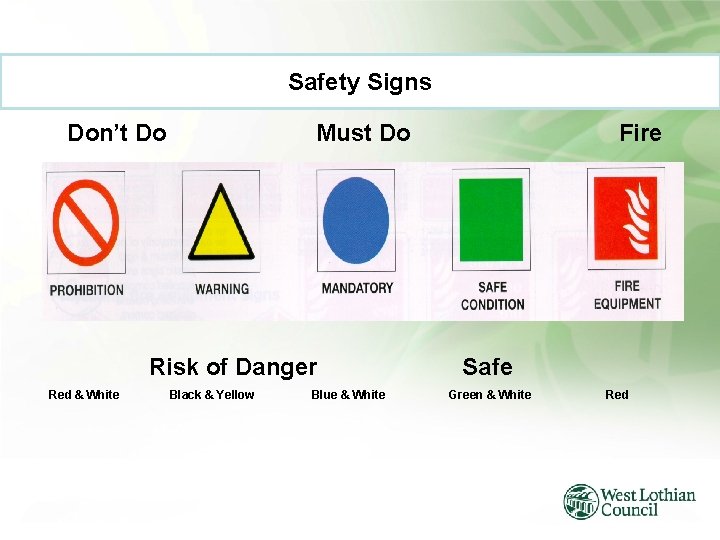
Safety Signs Don’t Do Must Do Risk of Danger Red & White Black & Yellow Blue & White Fire Safe Green & White Red
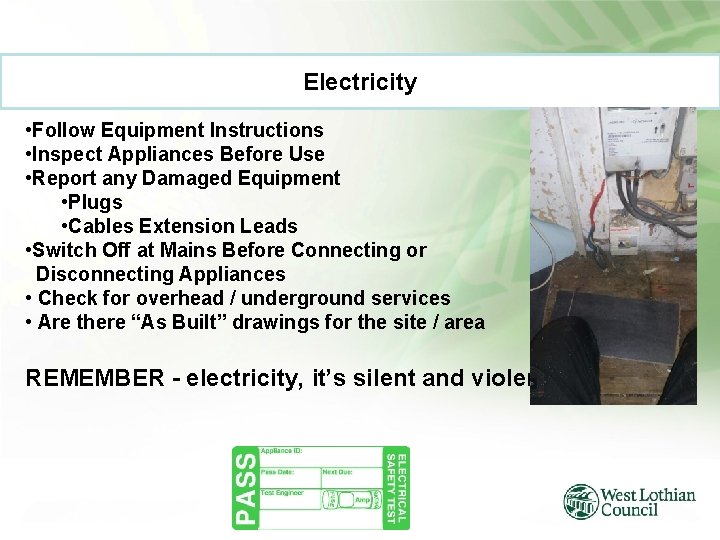
Electricity • Follow Equipment Instructions • Inspect Appliances Before Use • Report any Damaged Equipment • Plugs • Cables Extension Leads • Switch Off at Mains Before Connecting or Disconnecting Appliances • Check for overhead / underground services • Are there “As Built” drawings for the site / area REMEMBER - electricity, it’s silent and violent !!!!
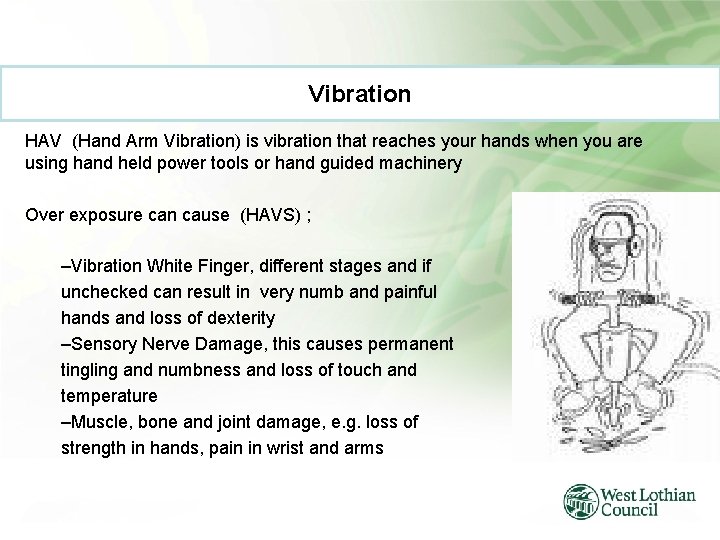
Vibration HAV (Hand Arm Vibration) is vibration that reaches your hands when you are using hand held power tools or hand guided machinery Over exposure can cause (HAVS) ; –Vibration White Finger, different stages and if unchecked can result in very numb and painful hands and loss of dexterity –Sensory Nerve Damage, this causes permanent tingling and numbness and loss of touch and temperature –Muscle, bone and joint damage, e. g. loss of strength in hands, pain in wrist and arms
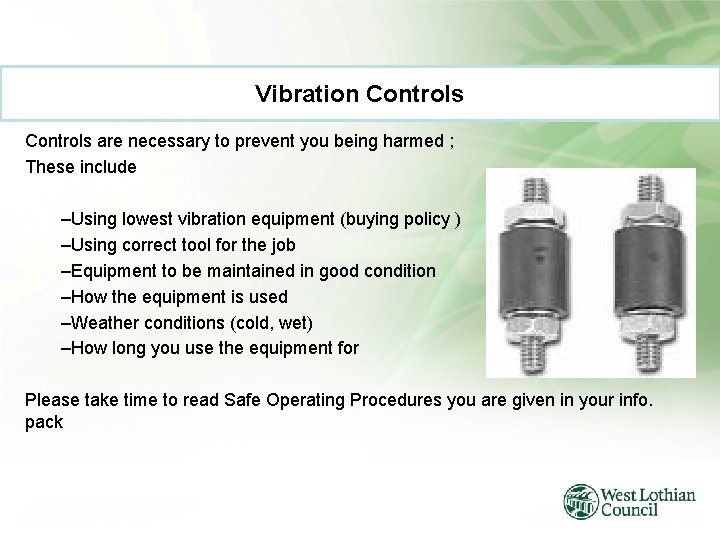
Vibration Controls are necessary to prevent you being harmed ; These include –Using lowest vibration equipment (buying policy ) –Using correct tool for the job –Equipment to be maintained in good condition –How the equipment is used –Weather conditions (cold, wet) –How long you use the equipment for Please take time to read Safe Operating Procedures you are given in your info. pack
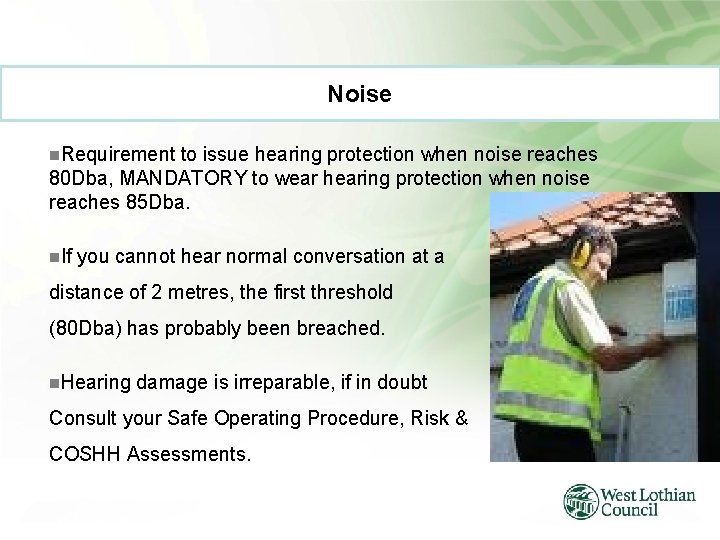
Noise n. Requirement to issue hearing protection when noise reaches 80 Dba, MANDATORY to wear hearing protection when noise reaches 85 Dba. n. If you cannot hear normal conversation at a distance of 2 metres, the first threshold (80 Dba) has probably been breached. n. Hearing damage is irreparable, if in doubt Consult your Safe Operating Procedure, Risk & COSHH Assessments.
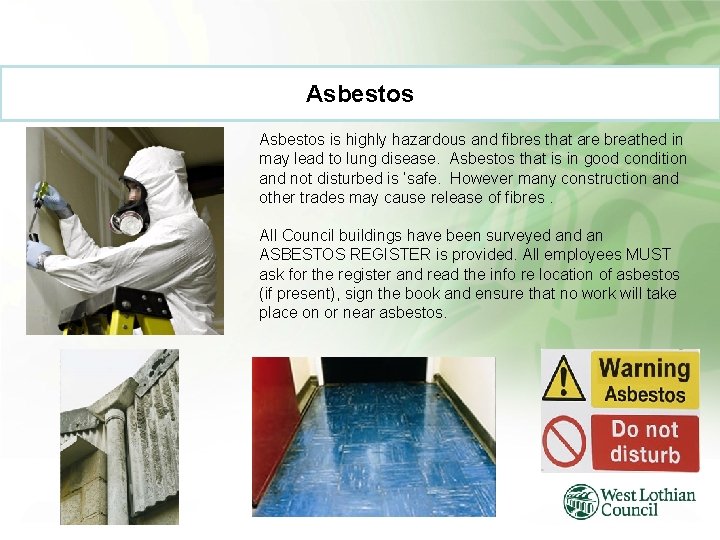
Asbestos is highly hazardous and fibres that are breathed in may lead to lung disease. Asbestos that is in good condition and not disturbed is ‘safe. However many construction and other trades may cause release of fibres. All Council buildings have been surveyed an ASBESTOS REGISTER is provided. All employees MUST ask for the register and read the info re location of asbestos (if present), sign the book and ensure that no work will take place on or near asbestos.
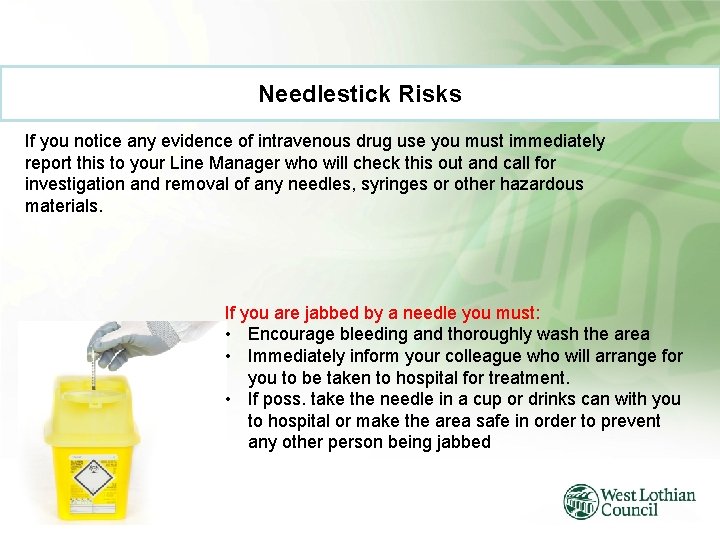
Needlestick Risks If you notice any evidence of intravenous drug use you must immediately report this to your Line Manager who will check this out and call for investigation and removal of any needles, syringes or other hazardous materials. If you are jabbed by a needle you must: • Encourage bleeding and thoroughly wash the area • Immediately inform your colleague who will arrange for you to be taken to hospital for treatment. • If poss. take the needle in a cup or drinks can with you to hospital or make the area safe in order to prevent any other person being jabbed
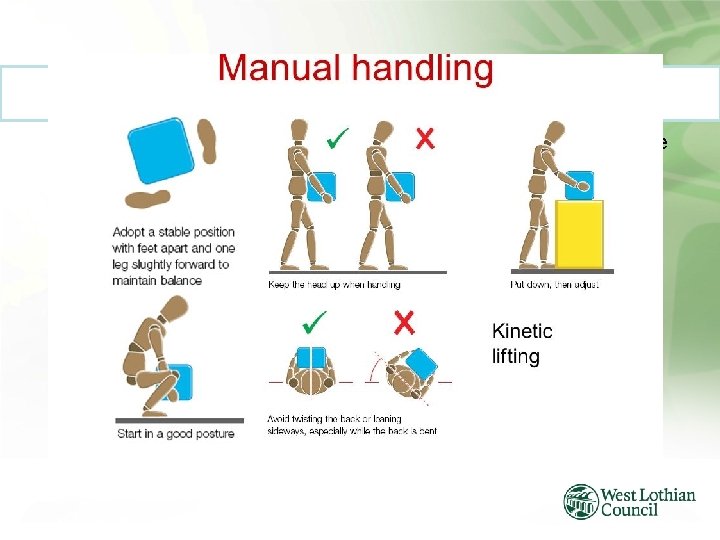
Manual Handling n. Utilise Mechanical means wherever possible. (Sack trucks, JCB, Tele -Handler, etc. ) n. Always adopt the proper lifting method. n. Assess the load. n. Warm-up hands, shoulders, legs, etc. . n. Feet shoulder width apart, adopt a firm grip. n. Lift utilising the legs, not the back. n. Keep back natural and bend knees. n**(Personal Physique, Age, Condition, Techniques and Practice will determine)
COSHH The Control of Substances Hazardous to Health n. Substances include corrosive, irritant, toxic, biological, dusts, fumes, etc. . n. Refer to Product Safety Data Sheets, for any substance in use. n. Always read the label. NO LABEL, NO USE! n. Always wear the appropriate PPE. n. Use substance only as directed on data sheet.
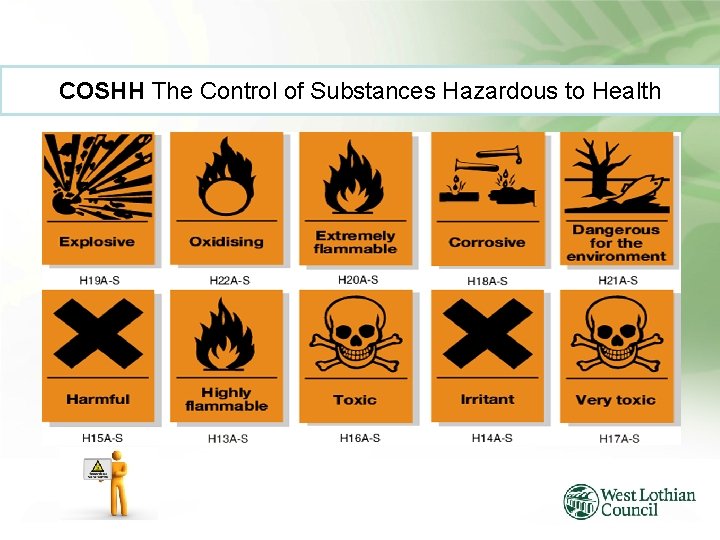
COSHH The Control of Substances Hazardous to Health
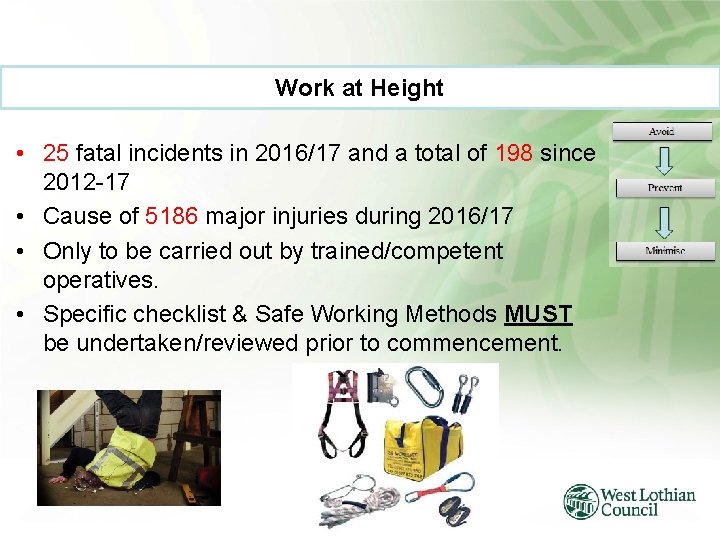
Work at Height • 25 fatal incidents in 2016/17 and a total of 198 since 2012 -17 • Cause of 5186 major injuries during 2016/17 • Only to be carried out by trained/competent operatives. • Specific checklist & Safe Working Methods MUST be undertaken/reviewed prior to commencement.
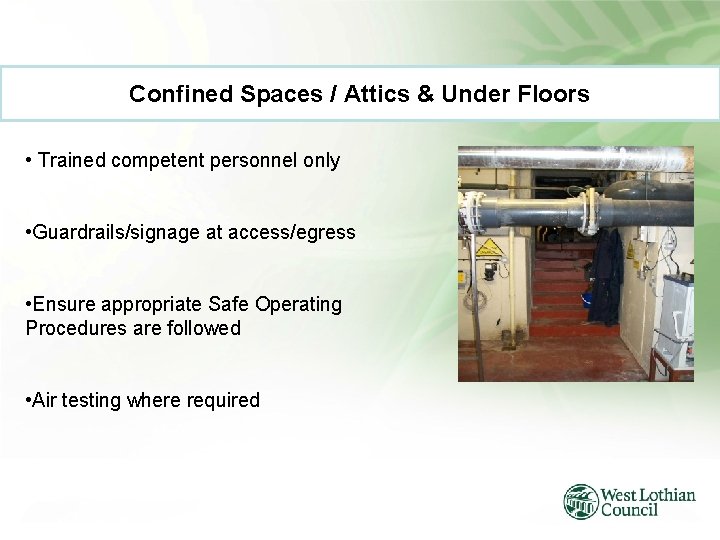
Confined Spaces / Attics & Under Floors • Trained competent personnel only • Guardrails/signage at access/egress • Ensure appropriate Safe Operating Procedures are followed • Air testing where required
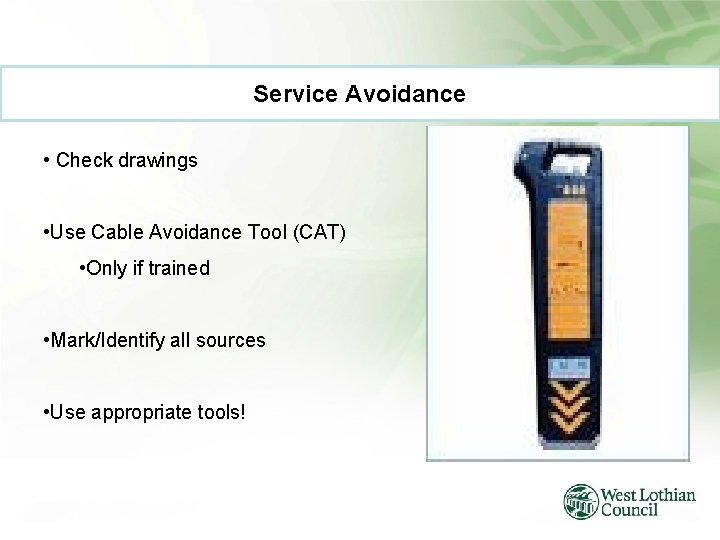
Service Avoidance • Check drawings • Use Cable Avoidance Tool (CAT) • Only if trained • Mark/Identify all sources • Use appropriate tools!
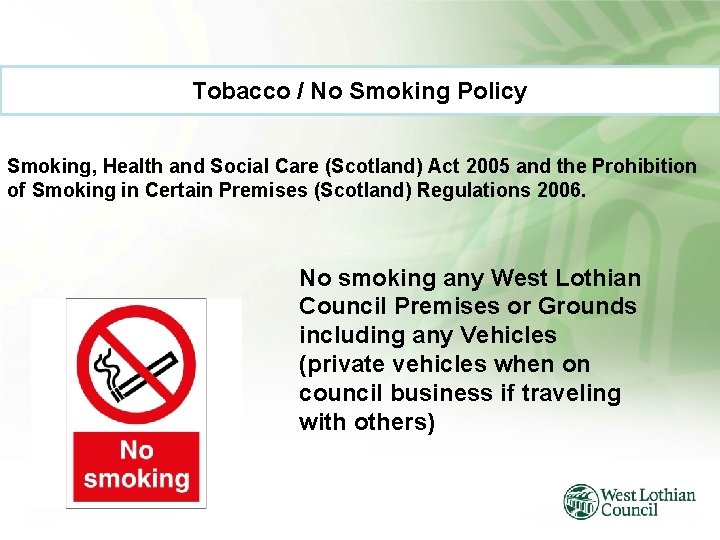
Tobacco / No Smoking Policy Smoking, Health and Social Care (Scotland) Act 2005 and the Prohibition of Smoking in Certain Premises (Scotland) Regulations 2006. No smoking any West Lothian Council Premises or Grounds including any Vehicles (private vehicles when on council business if traveling with others)
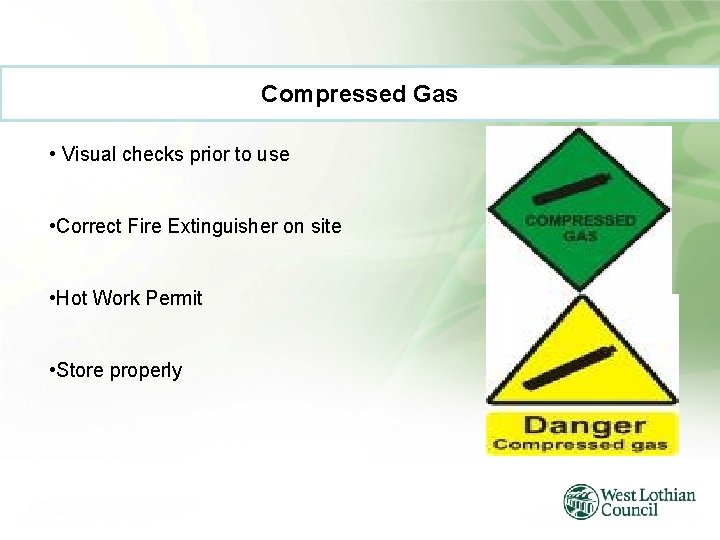
Compressed Gas • Visual checks prior to use • Correct Fire Extinguisher on site • Hot Work Permit • Store properly
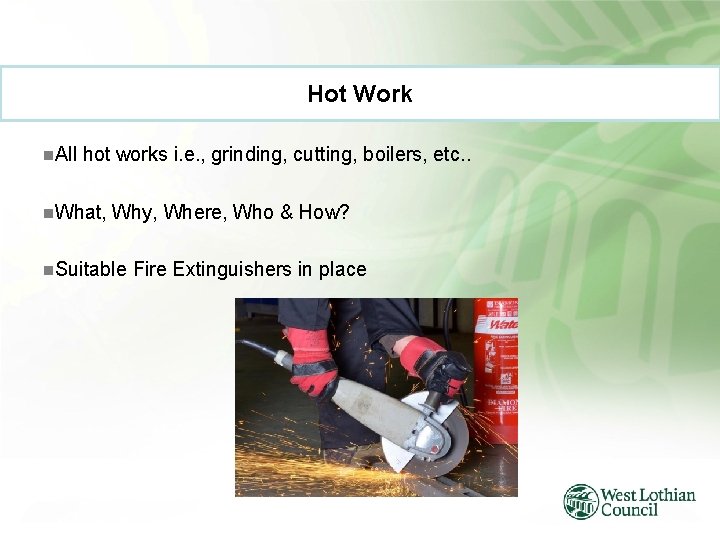
Hot Work n. All hot works i. e. , grinding, cutting, boilers, etc. . n. What, Why, Where, Who & How? n. Suitable Fire Extinguishers in place
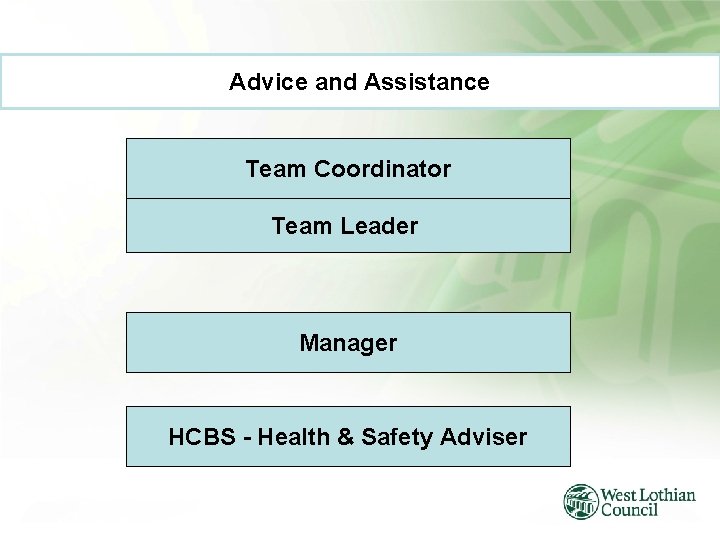
Advice and Assistance Team Coordinator Team Leader Manager HCBS - Health & Safety Adviser
Safety Checklist • Fire Alarm Sound, Drill, Route • Site & Office • Welfare / Toilet • Incident & VI Report Pads • First Aider / Box • Location of Risk Assessments • Health and Safety Concerns • Location of Asbestos Register • SOP • Housekeeping • Contact Nos.
Other Considerations • Medical conditions • Body piercing • Driving at Work • Football strips • Mobile phones • Other contractors • Long Hair • SOP • Substance Use
- Slides: 35