
West Ford Ibrahim Strategic Marketing 3 rd edition
West, Ford, & Ibrahim Strategic Marketing, 3 rd edition Chapter 7: Relational and sustainability strategies © Douglas West, John Ford, and Essam Ibrahim, 2015. All rights reserved.
Learning Objectives Ø Understand the importance of developing relationships with customers. Ø Discover ways in which marketers can assess customer desirability and rank customers in terms of customer value to the firm. Ø Be able to identify the various ways in which marketers can build loyalty with customers. Ø Understand the importance of customer relationship management systems and grasp the differences between CRM for consumer marketers (B 2 C) and industrial marketers (B 2 B). Ø Be aware of various approaches to the building of customer databases with which to strategically address customer relationship building strategies while also explaining the potential pitfalls inherent in illdesigned and ill-conceived data mining approaches and relationship management systems. Ø Be able to explain the strategies that will help the firm to create long-term relationships with its customers that can create competitive advantage and which can be sustained. West, Ford, & Ibrahim: Strategic Marketing, 3 rd edition
Introduction • Companies have moved their focus from transaction based to relationship centered • One time purchases alone do not keep companies in business, repeat purchases are the key to success • 80/20 rule does have merit – 80% of the revenue comes from 20% of the customers – 20% of the revenue comes from 80% of the customers West, Ford, & Ibrahim: Strategic Marketing, 3 rd edition
Introduction • Customer Lifetime Value – Happy customers spend increasing amounts on the purchase of a specific product/service over time – CLTV is the present value of future profits that will accrue from customers lifetime purchase – Determine CLTV for each individual customer or group of customers to determine the proper investments that will be necessary to build meaningful relationships – Customer relationship programs & strategies is a very hot topic in the B 2 C world, B 2 B have been practicing it for over fifty years West, Ford, & Ibrahim: Strategic Marketing, 3 rd edition
Relationship Marketing West, Ford, & Ibrahim: Strategic Marketing, 3 rd edition
Relationship Marketing in the B 2 C Context • Long term and intimate relationships between buyers and sellers • Open communication and the ability to know the customers • Anticipate changes in wants & needs • One of the best frameworks to discuss the nature of different customers is the loyalty ladder, see Fig 7. 1 West, Ford, & Ibrahim: Strategic Marketing, 3 rd edition
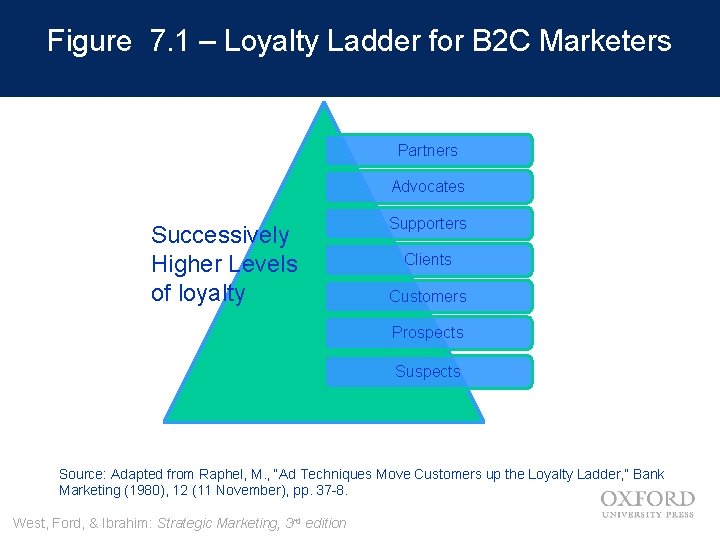
Figure 7. 1 – Loyalty Ladder for B 2 C Marketers Partners Advocates Successively Higher Levels of loyalty Supporters Clients Customers Prospects Suspects Source: Adapted from Raphel, M. , “Ad Techniques Move Customers up the Loyalty Ladder, ” Bank Marketing (1980), 12 (11 November), pp. 37 -8. West, Ford, & Ibrahim: Strategic Marketing, 3 rd edition
Suspects • Not yet even mildly warm leads for the selling company • Are not yet interested in your products or services • Companies should not spend too much time or effort on this group of consumers • The firm must develop some kind of mechanism to determine whether the suspect is worth spending time with • One such approach is customer equity as posited by Blattberg and Deighton (1996) West, Ford, & Ibrahim: Strategic Marketing, 3 rd edition
Customer Equity • Each customer’s expected contribution to offset the company’s fixed costs over their expected lifetime • Expected contributions to net present value are discounted • Add together all of the discounted expected contributions across all of the company’s current customers • From the customer equity standpoint, the suspect is probably a poor candidate for the time and effort that would be required for acquisition, and there would be little guarantee of profitability (see Figure 7. 2). West, Ford, & Ibrahim: Strategic Marketing, 3 rd edition
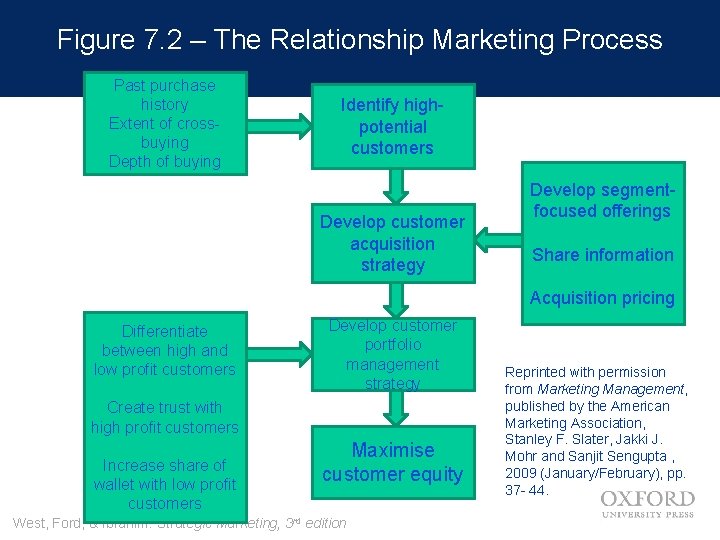
Figure 7. 2 – The Relationship Marketing Process Past purchase history Extent of crossbuying Depth of buying Identify highpotential customers Develop customer acquisition strategy Develop segmentfocused offerings Share information Acquisition pricing Differentiate between high and low profit customers Develop customer portfolio management strategy Create trust with high profit customers Increase share of wallet with low profit customers Maximise customer equity West, Ford, & Ibrahim: Strategic Marketing, 3 rd edition Reprinted with permission from Marketing Management, published by the American Marketing Association, Stanley F. Slater, Jakki J. Mohr and Sanjit Sengupta , 2009 (January/February), pp. 37 - 44.
Prospects • • • A better candidate would be found in a prospect This is warm lead Customer equity would be higher than for the suspect Interest is not a guarantee for purchase Too much time should not be spent on prospects West, Ford, & Ibrahim: Strategic Marketing, 3 rd edition
Customers • He is one who has actually bought your product/service • The game is to increase his purchase frequency and volume • Are all customers are “good” customers? • Compatibility management looks to minimize exposure to inappropriate customers. • Some companies adjust for different customers by using different pricing and venues • Zeithaml Rust and Lemon’s (2001) customer profitability pyramid is an important approach to rank & prioritize customers, on the bases of the impact of the group of customers on the firm’s profitability West, Ford, & Ibrahim: Strategic Marketing, 3 rd edition
Clients • They are regular customers • They have some level of trust in the seller • Some clients may feel that they are hostages to the seller • Some clients may be “mercenaries” • Some clients can act as terrorists if they become unsatisfied • Monitoring client satisfaction becomes important • Frequency marketing • After-marketing West, Ford, & Ibrahim: Strategic Marketing, 3 rd edition
Supporters • They buy everything you produce that they can use • You can convert a client into a supporter through great service • Reward clients for their purchases and loyalty and move them to supporters West, Ford, & Ibrahim: Strategic Marketing, 3 rd edition
Advocates • They buy the products and services and actively recruit others to do the same • They are the most valuable • The company must try and keep them happy • Loyalty schemes – Loyalty schemes can neutralize competitors, broaden brand distribution, enhance brand image and increase value – Nunes and Dreze (2006) suggest that loyalty schemes can reasonably be expected to do five things for the companies that use them: • • (1) keep customers from defecting, (2) win a greater share of the wallet, (3) prompt customers to make additional purchases, (4) provide insight into customer behaviour and preferences, and • (5) create profit West, Ford, & Ibrahim: Strategic Marketing, 3 rd edition
Partners • Partnership is when the buyer and seller enter into a joint position of commitment and the buyer often has to modify the ways in which he/she works to accommodate the seller • Both parties have a vested interest in the partnership owing to trust and commitment West, Ford, & Ibrahim: Strategic Marketing, 3 rd edition
Customer Love Building Customer Love It is no longer enough just to have a relationship with your customer, you need to develop the “love” of your customer There are seven important steps in building customer love (see Figure 7. 3) The following are the benefits from achieving customer love – Customers who love you take care of you – Customers not only recommend you, they insist – Customers forgive our mistakes – They will give you candid feedback – They will not take legal action against you – They will pay more for what you offer West, Ford, & Ibrahim: Strategic Marketing, 3 rd edition
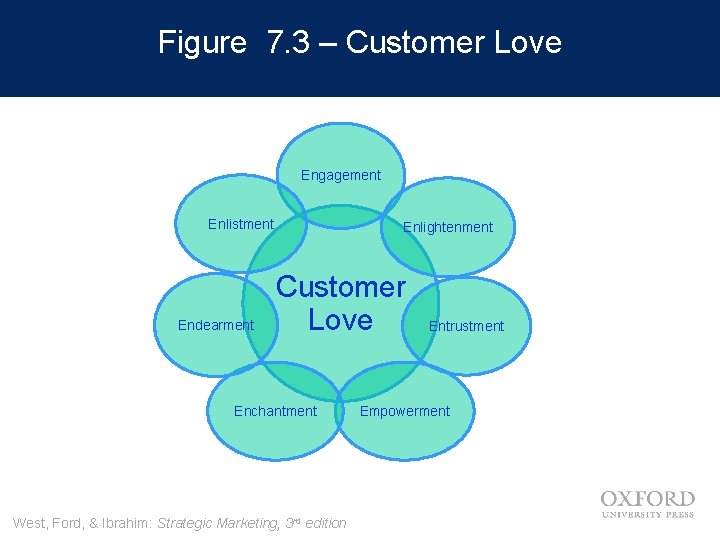
Figure 7. 3 – Customer Love Engagement Enlistment Endearment Enlightenment Customer Love Enchantment West, Ford, & Ibrahim: Strategic Marketing, 3 rd edition Entrustment Empowerment
Relationship Marketing in the B 2 B Context When compared to B 2 C markets, B 2 B markets are characterized as: dealing with fewer customers, larger transactions, customized products, negotiated prices, values are often determined by usages, and brands are not as critical as often as the relationships that are built between the buyers and the sellers. In this case, selling is far more complex as buyers may be groups instead of individuals and selling teams may be important, although often there is a key sales person who deals with a key customer. The problem is that using the same types of mechanisms as are used in B 2 C markets to build relationships often are not effective in B 2 B market situations. West, Ford, & Ibrahim: Strategic Marketing, 3 rd edition
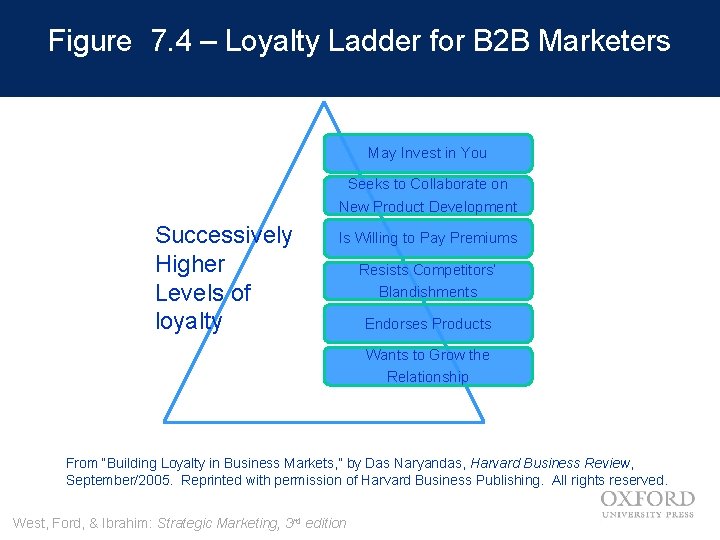
Figure 7. 4 – Loyalty Ladder for B 2 B Marketers May Invest in You Seeks to Collaborate on New Product Development Successively Higher Levels of loyalty Is Willing to Pay Premiums Resists Competitors’ Blandishments Endorses Products Wants to Grow the Relationship From “Building Loyalty in Business Markets, ” by Das Naryandas, Harvard Business Review, September/2005. Reprinted with permission of Harvard Business Publishing. All rights reserved. West, Ford, & Ibrahim: Strategic Marketing, 3 rd edition
Customer Relationship Management West, Ford, & Ibrahim: Strategic Marketing, 3 rd edition
Customer relationship management • Customer retention is an important goal for any company – It is more expensive to acquire a new customer as opposed to keeping one • The corporate solution is the creation of customer relationship management (or CRM) system. • CRM is a process by which a firm gathers information about the wants and needs of its customers to enable it to adjust its offerings to better fit those wants and needs • It involves data gathering, storage and dissemination to those who need it • This becomes complex in a B 2 C situation, involving large numbers of consumers West, Ford, & Ibrahim: Strategic Marketing, 3 rd edition
Customer relationship management • The foundation of the CRM is the development of a customer information file. • Winer (2004) suggests that these must contain: – – – Basic customer descriptions Customer purchase histories Customer contact histories Customer response information Customer value • Successful companies monitor all customer touch points (Favilla 2004) and find ways to offer superior service. • While touch points are important, Rawson et al. (2013) suggest that the company should not lose sight of the overall journey that the customer makes. • The company must set up appropriate mechanisms for data collection, which will allow the company to build customer trust and ensure commitment. West, Ford, & Ibrahim: Strategic Marketing, 3 rd edition
Customer relationship management • Data mining is an important tool in customer relationship management • Data collected for the sake of data collection will do very little • The relationship must be carefully nurtured West, Ford, & Ibrahim: Strategic Marketing, 3 rd edition
CRM pitfalls to avoid • Implementing CRM before a customer strategy is developed • Implementing a CRM program before the organization has become customer focused • The assumption that more CRM technology is always preferred • “Don’t stalk your consumer, woo them” West, Ford, & Ibrahim: Strategic Marketing, 3 rd edition
Conclusion • Once the company has gone through the process of segmentation, processing and positioning they must look to the creation of meaningful relationships with the customers. • Customer acquisition is far more costly that customer retention. • Building an intimate relationship with the customer allows the company to keep in step the changes in the customers needs & wants. • CRM is an important approach to managing customer relationships. • Committing to CRM requires careful preplanning and a commitment throughout the organization to being customer oriented. West, Ford, & Ibrahim: Strategic Marketing, 3 rd edition
- Slides: 26