
Werner Herzog Born Sept 8 1942 in Munich
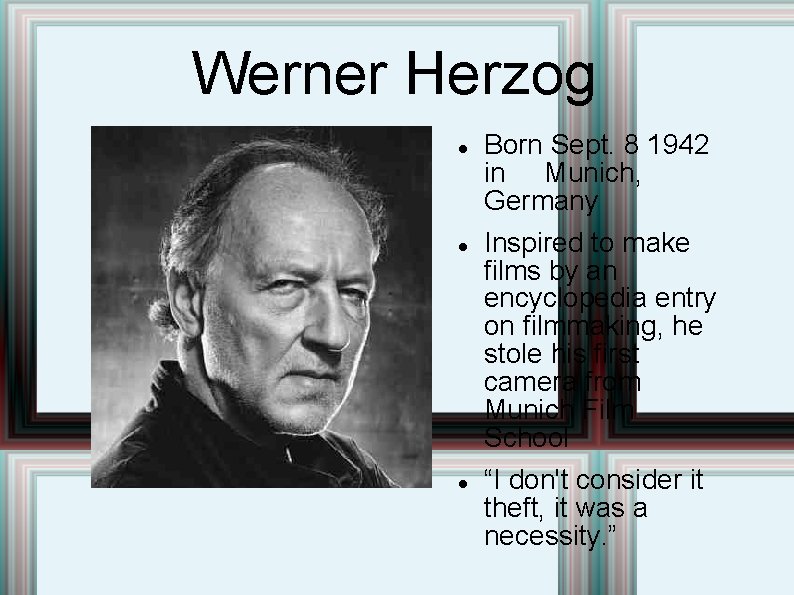
Werner Herzog Born Sept. 8 1942 in Munich, Germany Inspired to make films by an encyclopedia entry on filmmaking, he stole his first camera from Munich Film School “I don't consider it theft, it was a necessity. ”
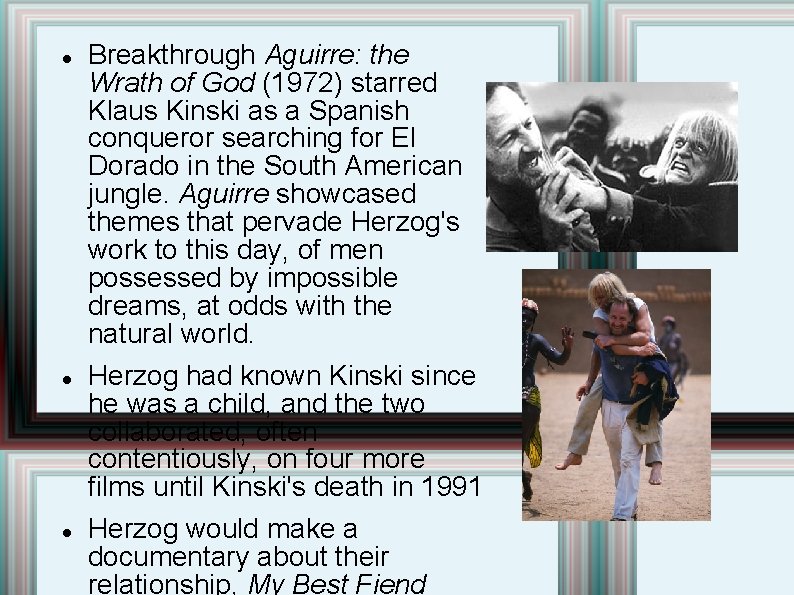
Breakthrough Aguirre: the Wrath of God (1972) starred Klaus Kinski as a Spanish conqueror searching for El Dorado in the South American jungle. Aguirre showcased themes that pervade Herzog's work to this day, of men possessed by impossible dreams, at odds with the natural world. Herzog had known Kinski since he was a child, and the two collaborated, often contentiously, on four more films until Kinski's death in 1991 Herzog would make a documentary about their relationship, My Best Fiend
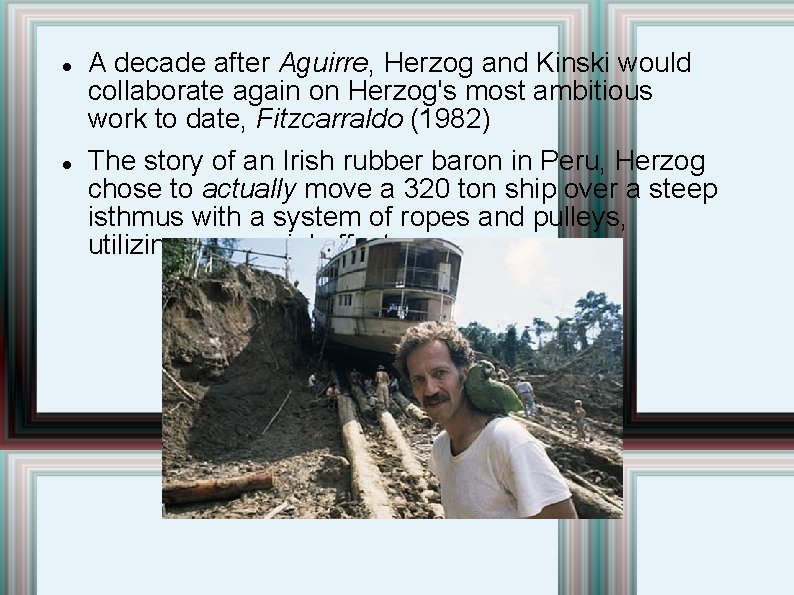
A decade after Aguirre, Herzog and Kinski would collaborate again on Herzog's most ambitious work to date, Fitzcarraldo (1982) The story of an Irish rubber baron in Peru, Herzog chose to actually move a 320 ton ship over a steep isthmus with a system of ropes and pulleys, utilizing no special effects
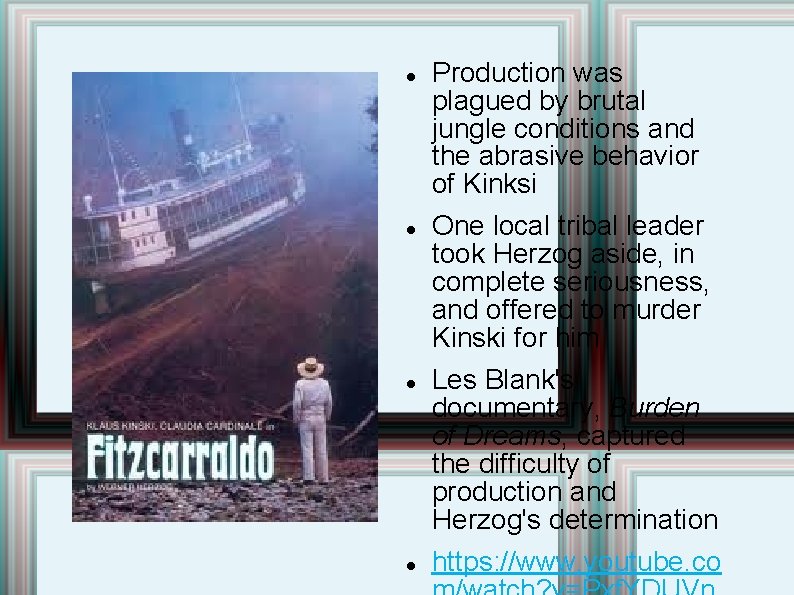
Production was plagued by brutal jungle conditions and the abrasive behavior of Kinksi One local tribal leader took Herzog aside, in complete seriousness, and offered to murder Kinski for him Les Blank's documentary, Burden of Dreams, captured the difficulty of production and Herzog's determination https: //www. youtube. co
Ecstatic Truth and Unusual Methods Rejecting the ideas of cinema verite, Herzog uses a good deal of artifice in his narrative films, seeking what he calls “ecstatic truth, ” a poetic understanding of the realities of life. Herzog has utilized nontraditional methods, including putting the cast of Heart of Glass (1976) under hypnosis to induce dreamlike performances which suggest a trancelike state in the characters. One of his early films, Even Dwarfs Started Small (1972) featured a cast of little people who overtake an asylum. After a spate of injuries by the actors Herzog offered to jump into a cactus patch once production finished. He followed through on his promise. Interview highlights discussing his worldview:
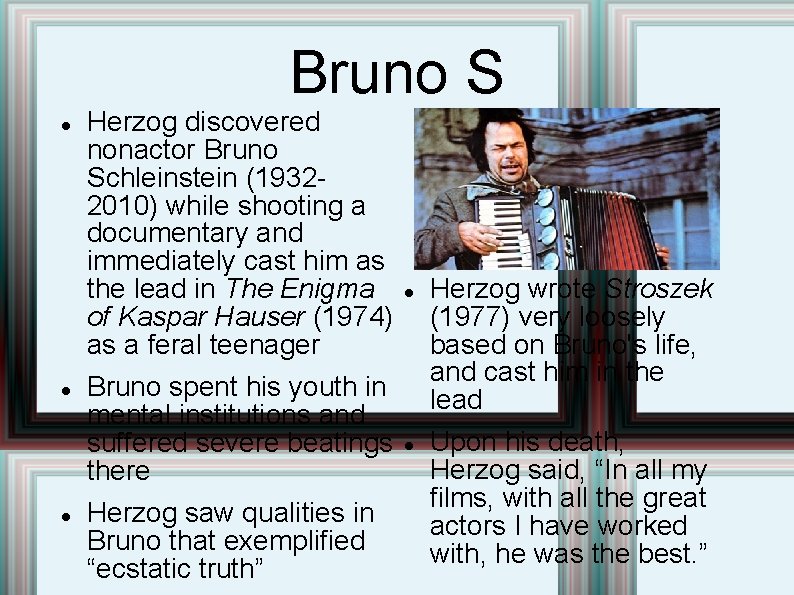
Bruno S Herzog discovered nonactor Bruno Schleinstein (19322010) while shooting a documentary and immediately cast him as the lead in The Enigma of Kaspar Hauser (1974) as a feral teenager Bruno spent his youth in mental institutions and suffered severe beatings there Herzog saw qualities in Bruno that exemplified “ecstatic truth” Herzog wrote Stroszek (1977) very loosely based on Bruno's life, and cast him in the lead Upon his death, Herzog said, “In all my films, with all the great actors I have worked with, he was the best. ”
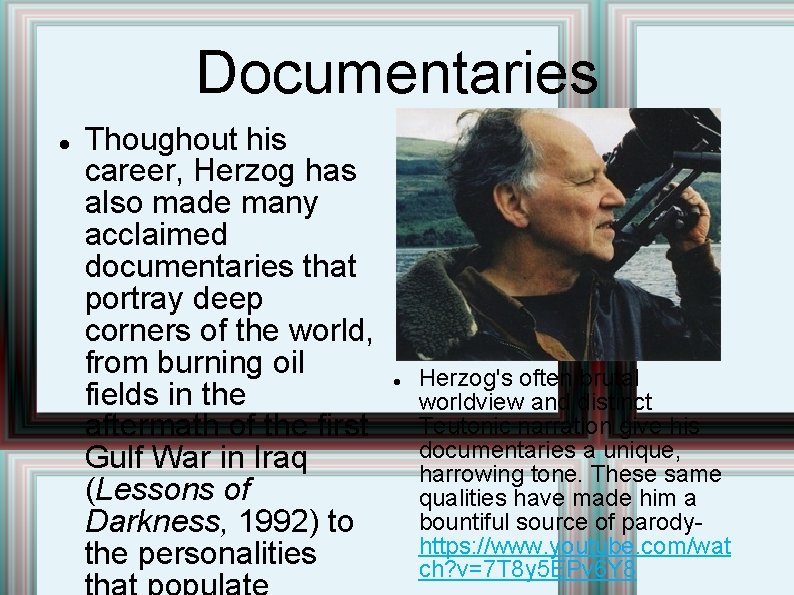
Documentaries Thoughout his career, Herzog has also made many acclaimed documentaries that portray deep corners of the world, from burning oil fields in the aftermath of the first Gulf War in Iraq (Lessons of Darkness, 1992) to the personalities Herzog's often brutal worldview and distinct Teutonic narration give his documentaries a unique, harrowing tone. These same qualities have made him a bountiful source of parodyhttps: //www. youtube. com/wat ch? v=7 T 8 y 5 EPv 6 Y 8

Selected Quotes “I believe the common denominator of the Universe is not harmony, but chaos, hostility and murder. ” (from Grizzly Man, 2005) https: //www. youtube. com/ watch? v=k. PPZSJ 4 v. C 3 U “Academia is the death of cinema. Film is not the art of scholars, but of illiterates. ” “Someone like Jean-Luc Godard is for me intellectual counterfeit money when compared to a good Kung-
Filmography – Feature Narrative Signs of Life (1968) Even Dwarfs Started Small (1970) Fata Morgana (1972) Aguirre, the Wrath of God (1972) The Enigma of Kaspar Hauser (1974) Heart of Glass (1976) Stroszek (1977) Nosferatu the Vampyre (1979) Woyzeck (1979) Fitzcarraldo (1982) Where the Green Ants Dream (1984) Scream of Stone (1991) Invincible (2001) The Wild Blue Yonder (2005) Rescue Dawn (2007) Bad Lieutenant: Port of Call New Orleans (2009) My Son, What Have Ye Done? (2009)
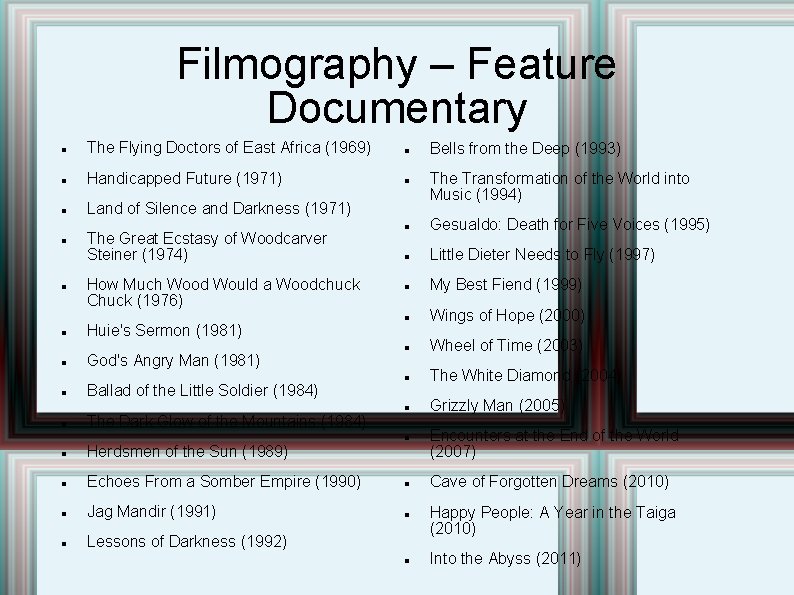
Filmography – Feature Documentary The Flying Doctors of East Africa (1969) Handicapped Future (1971) Land of Silence and Darkness (1971) The Great Ecstasy of Woodcarver Steiner (1974) How Much Wood Would a Woodchuck Chuck (1976) Huie's Sermon (1981) God's Angry Man (1981) Ballad of the Little Soldier (1984) The Dark Glow of the Mountains (1984) Bells from the Deep (1993) The Transformation of the World into Music (1994) Gesualdo: Death for Five Voices (1995) Little Dieter Needs to Fly (1997) My Best Fiend (1999) Wings of Hope (2000) Wheel of Time (2003) The White Diamond (2004) Grizzly Man (2005) Herdsmen of the Sun (1989) Echoes From a Somber Empire (1990) Jag Mandir (1991) Lessons of Darkness (1992) Encounters at the End of the World (2007) Cave of Forgotten Dreams (2010) Happy People: A Year in the Taiga (2010) Into the Abyss (2011)
Sources Herzog, W. , & Cronin, P. (2002). Herzog on Herzog. London: Faber and Faber. http: //www. germanculture. com. ua/library/weekl y/werner_herzog. htm https: //mubi. com/topics/herzog-welles-andbergman-on-godard https: //mubi. com/topics/contemporarycontemplative-cinema-the-default-style-for-lazy -hacks? page=15
- Slides: 11