
Were doing MS next Introduction to Mass Spectroscopy


- Slides: 14
We’re doing MS next !!
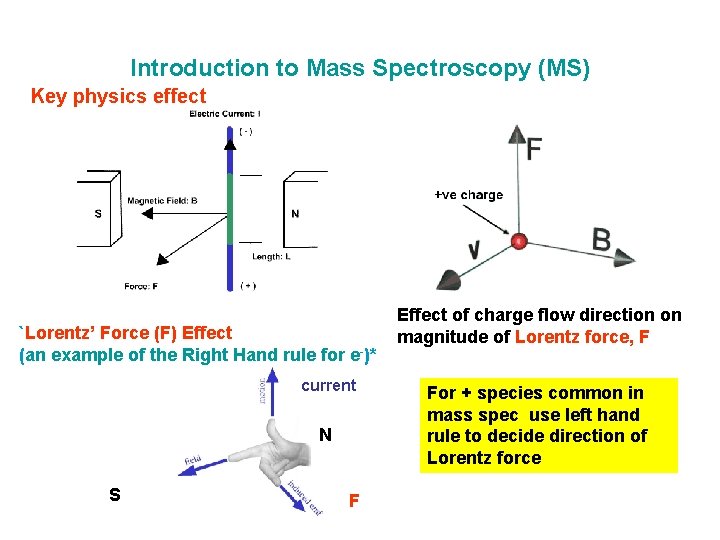
Introduction to Mass Spectroscopy (MS) Key physics effect `Lorentz’ Force (F) Effect (an example of the Right Hand rule for e-)* current N S F Effect of charge flow direction on magnitude of Lorentz force, F For + species common in mass spec use left hand rule to decide direction of Lorentz force
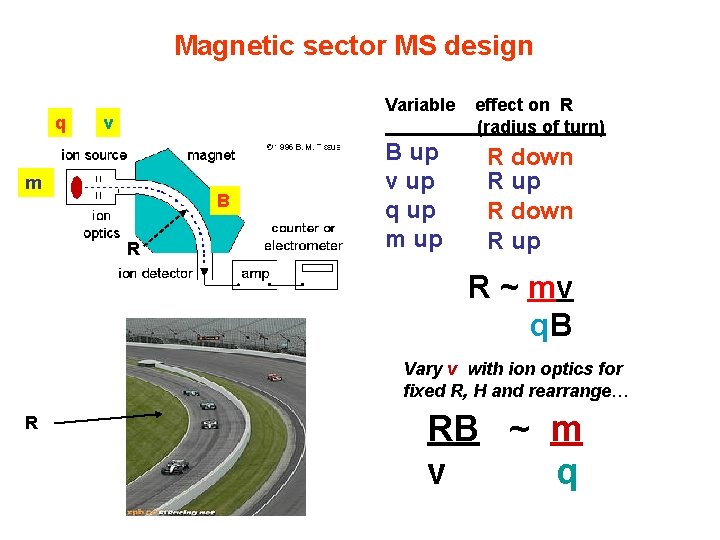
Magnetic sector MS design q Variable v m B R B up v up q up m up effect on R (radius of turn) R down R up R ~ mv q. B Vary v with ion optics for fixed R, H and rearrange… R RB ~ m v q
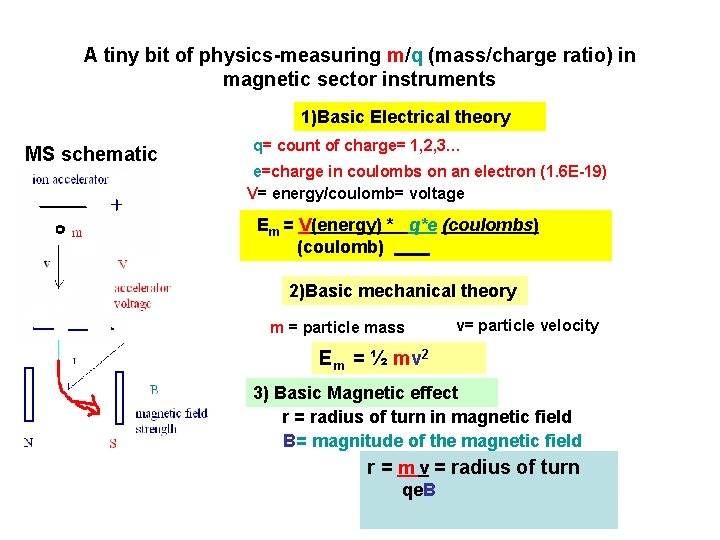
A tiny bit of physics-measuring m/q (mass/charge ratio) in magnetic sector instruments 1)Basic Electrical theory MS schematic q= count of charge= 1, 2, 3… e=charge in coulombs on an electron (1. 6 E-19) V= energy/coulomb= voltage Em = V(energy) * q*e (coulombs) (coulomb) 2)Basic mechanical theory m = particle mass v= particle velocity Em = ½ mv 2 3) Basic Magnetic effect r = radius of turn in magnetic field B= magnitude of the magnetic field r = m v = radius of turn qe. B
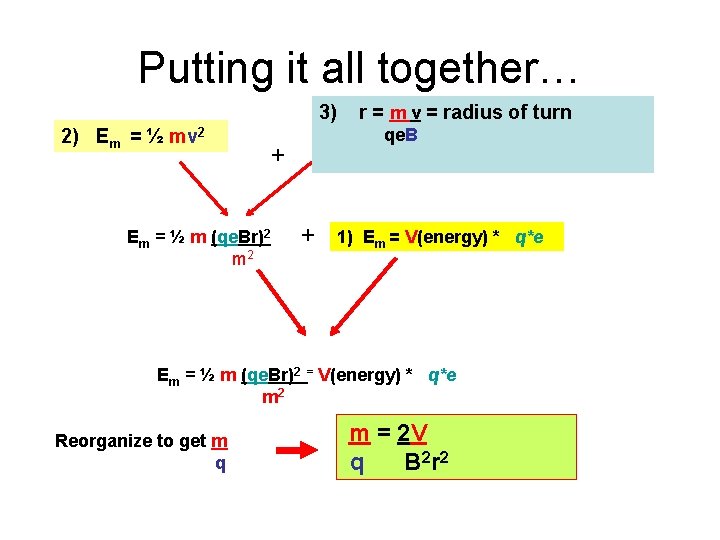
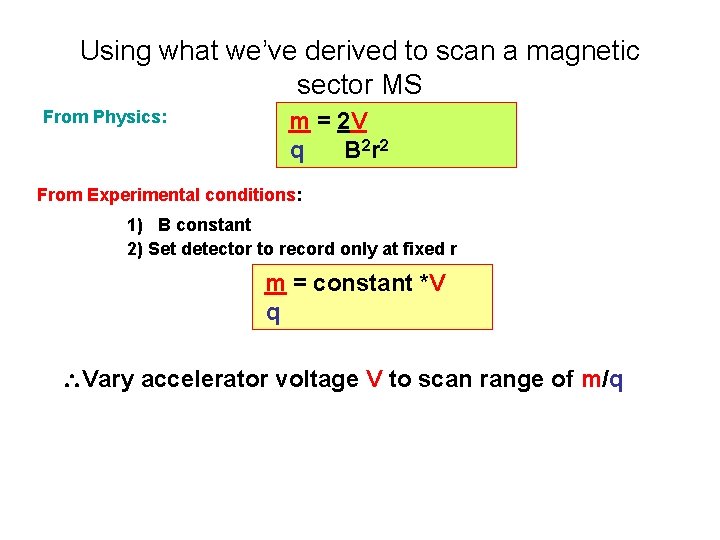
Putting it all together… 3) 2) Em = ½ mv 2 Em = ½ m (qe. Br)2 m 2 r = m v = radius of turn qe. B + + 1) Em = V(energy) * q*e Em = ½ m (qe. Br)2 = V(energy) * q*e m 2 Reorganize to get m q m = 2 V q B 2 r 2
Using what we’ve derived to scan a magnetic sector MS From Physics: m = 2 V q B 2 r 2 From Experimental conditions: 1) B constant 2) Set detector to record only at fixed r m = constant *V q Vary accelerator voltage V to scan range of m/q
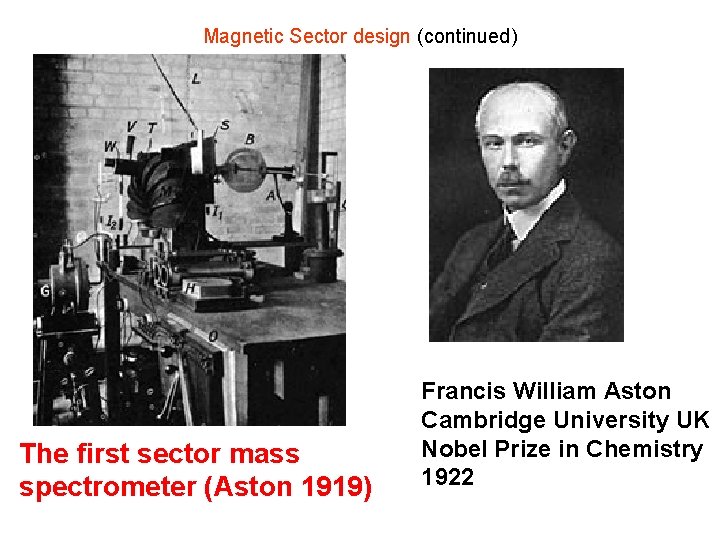
Magnetic Sector design (continued) The first sector mass spectrometer (Aston 1919) Francis William Aston Cambridge University UK Nobel Prize in Chemistry 1922
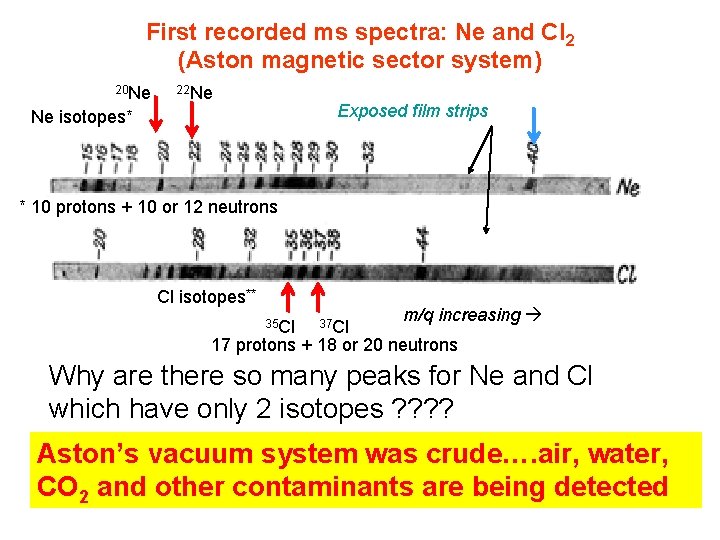
First recorded ms spectra: Ne and Cl 2 (Aston magnetic sector system) 20 Ne 22 Ne Exposed film strips Ne isotopes* * 10 protons + 10 or 12 neutrons Cl isotopes** 35 Cl 37 Cl m/q increasing 17 protons + 18 or 20 neutrons Why are there so many peaks for Ne and Cl which have only 2 isotopes ? ? Aston’s vacuum system was crude…. air, water, CO 2 and other contaminants are being detected
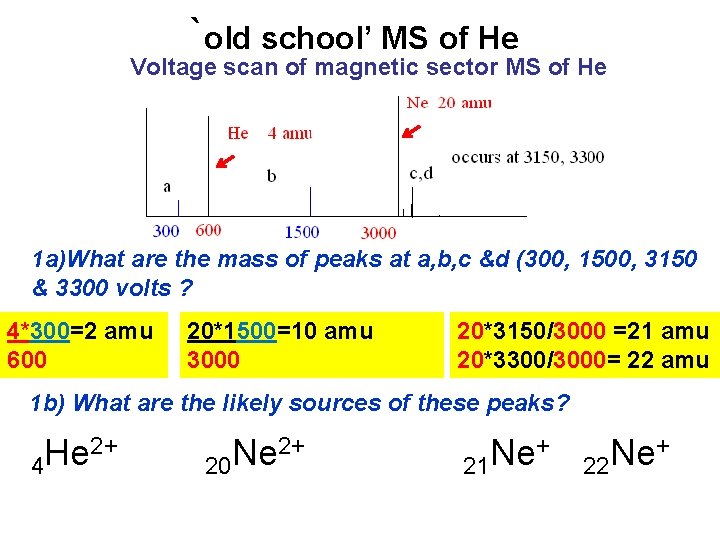
`old school’ MS of He Voltage scan of magnetic sector MS of He 1 a)What are the mass of peaks at a, b, c &d (300, 1500, 3150 & 3300 volts ? 4*300=2 amu 600 20*1500=10 amu 3000 20*3150/3000 =21 amu 20*3300/3000= 22 amu 1 b) What are the likely sources of these peaks? 2+ He 4 2+ Ne 20 + Ne 21 + Ne 22
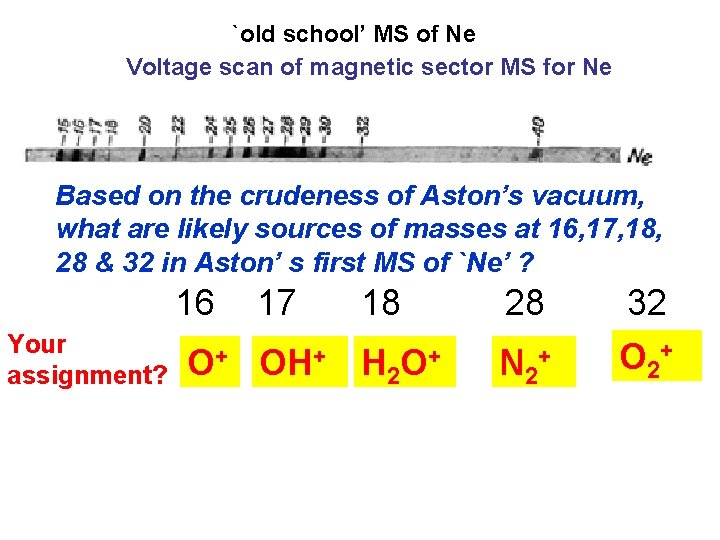
`old school’ MS of Ne Voltage scan of magnetic sector MS for Ne Based on the crudeness of Aston’s vacuum, what are likely sources of masses at 16, 17, 18, 28 & 32 in Aston’ s first MS of `Ne’ ? 16 Your assignment? 17 18 O+ OH+ H 2 O+ 28 N 2+ 32 O 2+
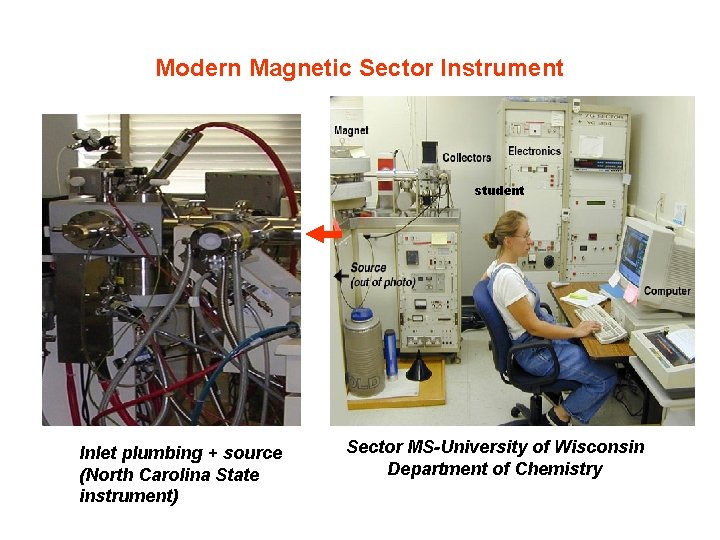
Modern Magnetic Sector Instrument student Inlet plumbing + source (North Carolina State instrument) Sector MS-University of Wisconsin Department of Chemistry
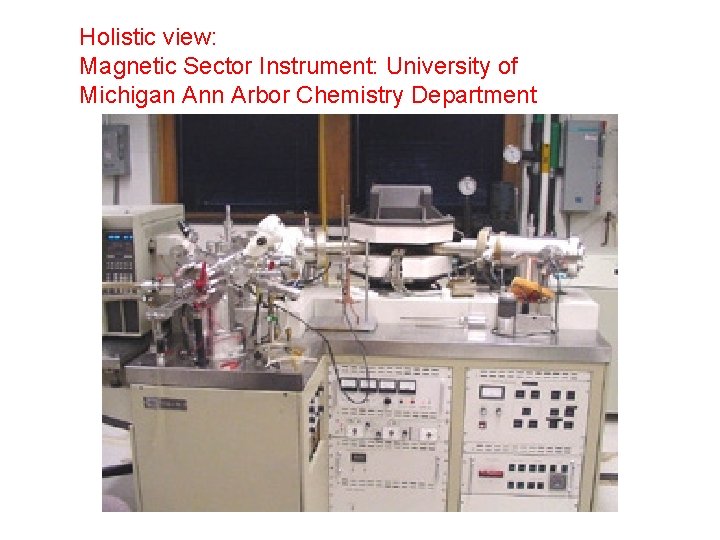
Holistic view: Magnetic Sector Instrument: University of Michigan Ann Arbor Chemistry Department
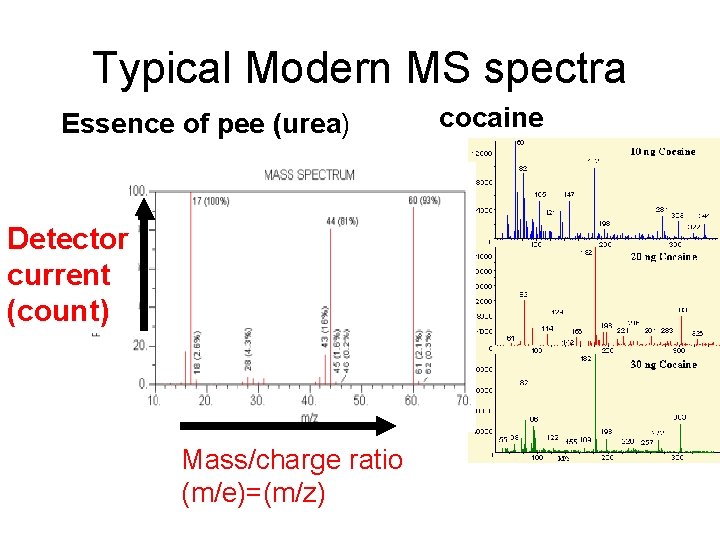
Typical Modern MS spectra Essence of pee (urea) Detector current (count) Mass/charge ratio (m/e)=(m/z) cocaine