
WERE ACCREDITED NOW WHAT MAINTAINING ACCREDITATION AND SUSTAINING

- Slides: 22
WE’RE ACCREDITED…. NOW WHAT? MAINTAINING ACCREDITATION AND SUSTAINING QUALITY Presented by: Julie Leslie & Kim St. Marie
SESSION GOALS • Approaches to sustaining quality over term of accreditation • • • NAEYC MAAP NECPA 5 years 3 years Accreditation tools and criteria for quality improvement Formal requirements to maintain accreditation Related resources
QUALITY • Quality is complex • Multi-dimensional • Shaped and experienced by different stakeholders • Quality is dynamic • Quality can decline if not tended • New challenges arise • Quality must be sustained and improved over time
FOR DISCUSSION… What changes has your program experienced since earning accreditation that could affect your ability to sustain the accreditation standards?
Strategies for Sustaining Quality q Maintain a “self-study” mindset & engage in continuous quality improvement q Look to your Accreditation Decision Report for guidance on areas to improve q Maintain up to date documentation of quality q Conduct routine observations q Continue to engage staff & stakeholders
DEFINING SELF STUDY What is Self-Study? – Reflective Practice – Collaborative Process Why is it important? – Necessary for making improvements and sustaining quality “Self Study Never Ends”
ONGOING SELF-STUDY TASKS 1. 2. 3. 4. 5. 6. Build shared understandings of what are best practices Gather evidence of your practices Determine strengths & weaknesses Develop improvement plans Make improvements & document progress Evaluate results & next steps
Accreditation Decision Report % Met Criteria by Standard, % Met Criteria by Group/Classroom, Commendations on Standards, Topic Areas for Ongoing Improvement, and Portfolio Feedback
DETERMINE AREAS OF STRENGTHS AND WEAKNESSES v Refer to Accreditation Decision Report for v v v Improvement Areas Use observations and survey data Take an honest look at current practices Celebrate strengths Are we fully meeting accreditation standards? Identifying areas for improvement
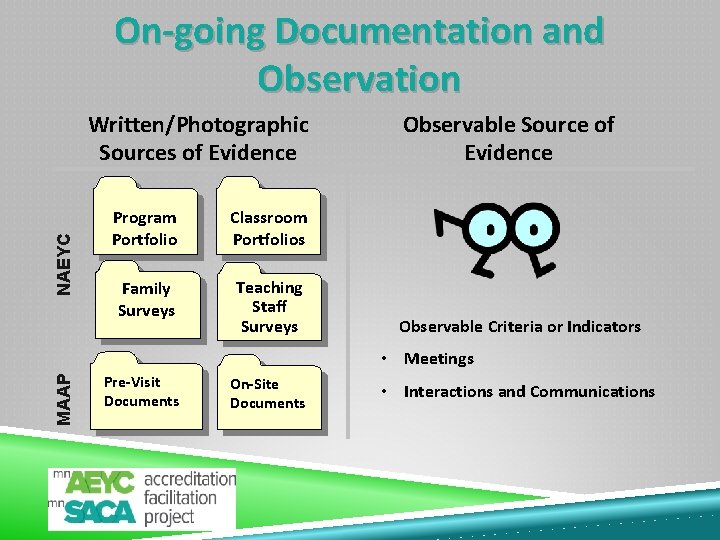
On-going Documentation and Observation NAEYC Written/Photographic Sources of Evidence Program Portfolio Classroom Portfolios Family Surveys Teaching Staff Surveys Observable Source of Evidence Observable Criteria or Indicators MAAP • Meetings Pre-Visit Documents On-Site Documents • Interactions and Communications
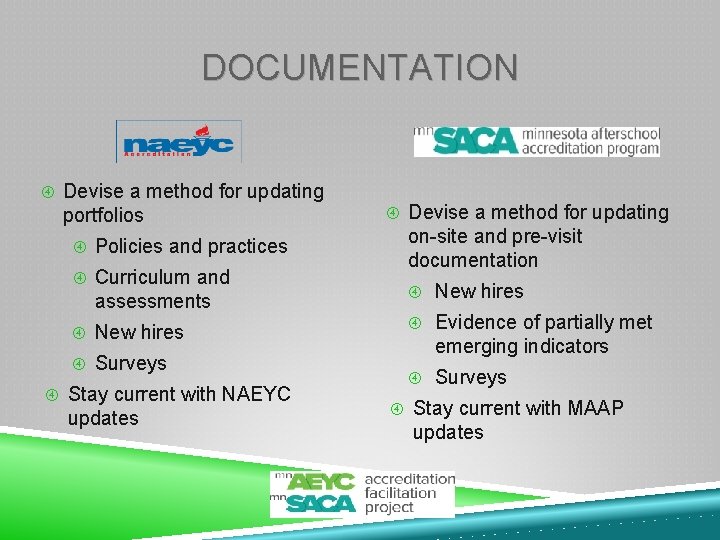
DOCUMENTATION Devise a method for updating portfolios Policies and practices Curriculum and assessments New hires Surveys Stay current with NAEYC updates Devise a method for updating on-site and pre-visit documentation New hires Evidence of partially met emerging indicators Surveys Stay current with MAAP updates
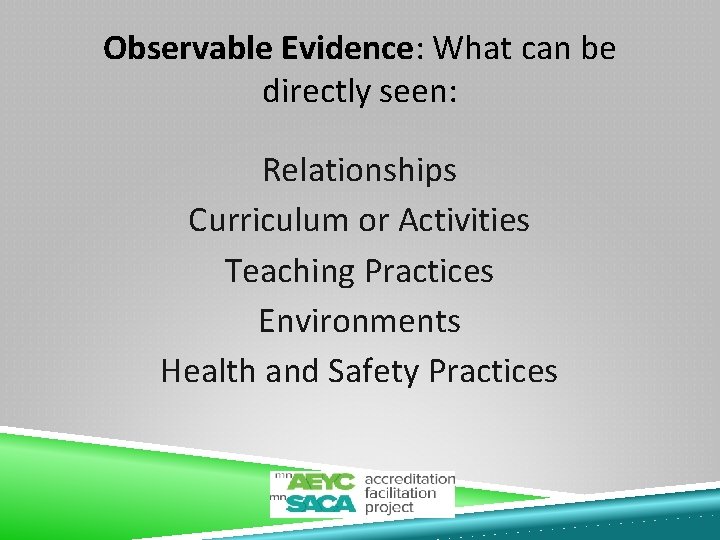
Observable Evidence: What can be directly seen: Relationships Curriculum or Activities Teaching Practices Environments Health and Safety Practices
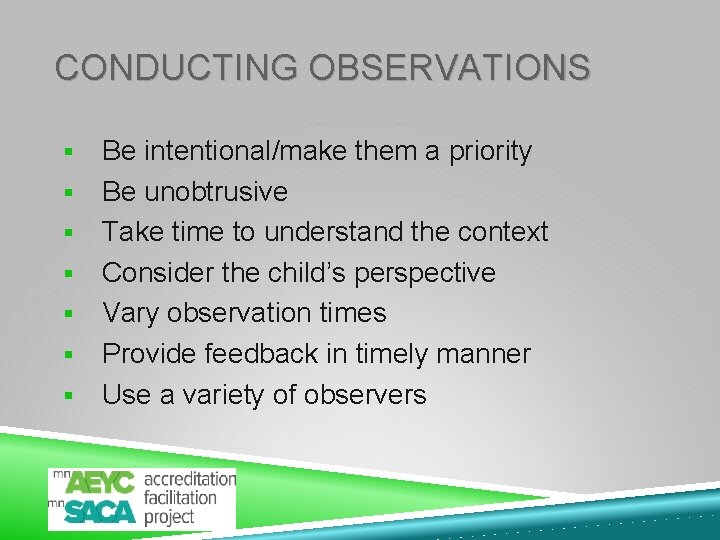
CONDUCTING OBSERVATIONS § § § § Be intentional/make them a priority Be unobtrusive Take time to understand the context Consider the child’s perspective Vary observation times Provide feedback in timely manner Use a variety of observers
Engage Staff • New Staff: • Hiring expectations : professionalism, excellence • New staff orientation to best practices • Mentoring • All Staff : Professional development goal setting • Individual • Teams, program-wide • Linked to annual staff evaluations
Engage Staff o Staff/Team meetings o Joint problem-solving to improve specific practices o Keep up-to-date on emerging best practices o Update portfolios and documents together o Use NAEYC & MAAP resources o Staff Surveys – program evaluation o Teaching Young Children o Professional development resources (Mn. AEYC/Mn. SACA trainings, videos, Youtube)
Program Evaluation & Accountability NAEYC Topic Area 10. F: Sustaining and enhancing quality through formal program assessments MAAP- I. 4. D. The program leadership conducts routine assessments of the environment and activities to identify areas of improvement and to celebrate program strengths. Program Evaluation should be: Regular – at least annually Collaborative – at a minimum include administrators, families, and staff Comprehensive – inclusive of all standards Based on valid and reliable processes for gathering data and evidence
Engage Families Evaluation: Use NAEYC/MAAP’s Family Survey (or other means) to assess families’ views of program at least annually Policies and procedures Program quality Children’s progress and learning Family involvement and satisfaction Accountability: Report findings to families Continuous Improvement: Involve families in goal-setting for your program participating in the creation of a community of learners
Engage Other Stakeholders Use NAEYC/MAAP’s resources to communicate what ECE and SA quality means Make your program visible in your community; coordinate actions with others Keep informed & advocate for ECE and SA programming with your state and local governments
Maintaining Accreditation Ensures programs continue to meet Standards & Criteria/Indicators Increases the accountability of the accreditation system Provides NAEYC/MAAP with up-to-date program information
Evidence of Maintaining Accreditation Annual Reports Self Reports 72 Hour Notification Random Unannounced Visits Responding to Complaints Verification Visits
CONGRATULATIONS ON ACHIEVING YOUR ACCREDITATION!
Success is a journey not a destination. The doing is often more important than the outcome. -Arthur Ashe