
WEPTS 081 An Analytic Approach To Emittance Growth
- Slides: 1
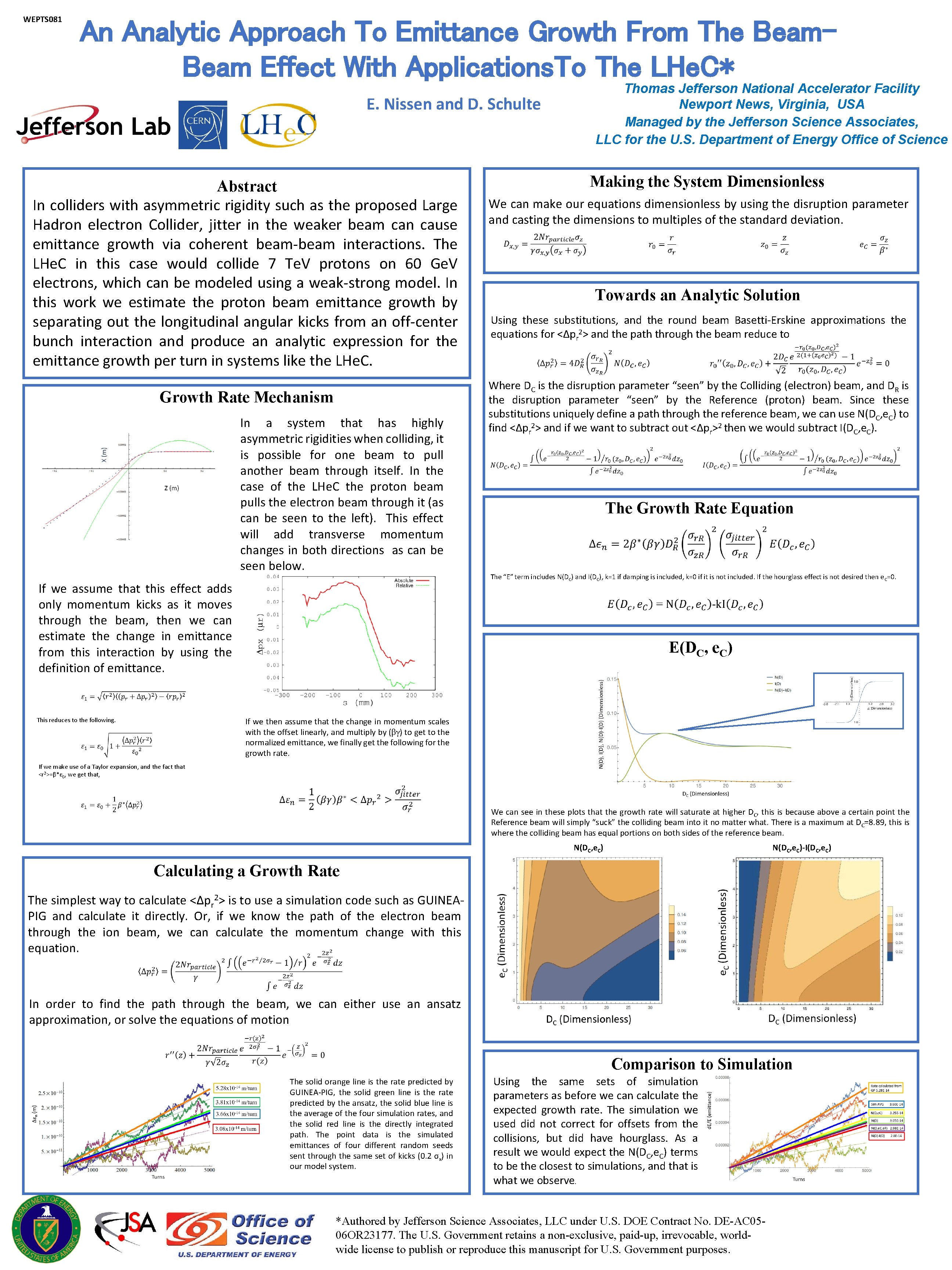
WEPTS 081 An Analytic Approach To Emittance Growth From The Beam Effect With Applications. To The LHe. C* E. Nissen and D. Schulte Abstract In colliders with asymmetric rigidity such as the proposed Large Hadron electron Collider, jitter in the weaker beam can cause emittance growth via coherent beam-beam interactions. The LHe. C in this case would collide 7 Te. V protons on 60 Ge. V electrons, which can be modeled using a weak-strong model. In this work we estimate the proton beam emittance growth by separating out the longitudinal angular kicks from an off-center bunch interaction and produce an analytic expression for the emittance growth per turn in systems like the LHe. C. Growth Rate Mechanism In a system that has highly asymmetric rigidities when colliding, it is possible for one beam to pull another beam through itself. In the case of the LHe. C the proton beam pulls the electron beam through it (as can be seen to the left). This effect will add transverse momentum changes in both directions as can be seen below. If we assume that this effect adds only momentum kicks as it moves through the beam, then we can estimate the change in emittance from this interaction by using the definition of emittance. Thomas Jefferson National Accelerator Facility Newport News, Virginia, USA Managed by the Jefferson Science Associates, LLC for the U. S. Department of Energy Office of Science Making the System Dimensionless We can make our equations dimensionless by using the disruption parameter and casting the dimensions to multiples of the standard deviation. Towards an Analytic Solution Using these substitutions, and the round beam Basetti-Erskine approximations the equations for <Δpr 2> and the path through the beam reduce to Where DC is the disruption parameter “seen” by the Colliding (electron) beam, and DR is the disruption parameter “seen” by the Reference (proton) beam. Since these substitutions uniquely define a path through the reference beam, we can use N(DC, e. C) to find <Δpr 2> and if we want to subtract out <Δpr>2 then we would subtract I(DC, e. C). The Growth Rate Equation The “E” term includes N(DC) and I(DC), k=1 if damping is included, k=0 if it is not included. If the hourglass effect is not desired then e C=0. E(DC, e. C) If we then assume that the change in momentum scales with the offset linearly, and multiply by (βγ) to get to the normalized emittance, we finally get the following for the growth rate. This reduces to the following. If we make use of a Taylor expansion, and the fact that <r 2>=β*ε 0, we get that, We can see in these plots that the growth rate will saturate at higher DC, this is because above a certain point the Reference beam will simply “suck” the colliding beam into it no matter what. There is a maximum at DC=8. 89, this is where the colliding beam has equal portions on both sides of the reference beam. N(DC, e. C)-I(DC, e. C) Calculating a Growth Rate The simplest way to calculate <Δpr 2> is to use a simulation code such as GUINEAPIG and calculate it directly. Or, if we know the path of the electron beam through the ion beam, we can calculate the momentum change with this equation. In order to find the path through the beam, we can either use an ansatz approximation, or solve the equations of motion Comparison to Simulation The solid orange line is the rate predicted by GUINEA-PIG, the solid green line is the rate predicted by the ansatz, the solid blue line is the average of the four simulation rates, and the solid red line is the directly integrated path. The point data is the simulated emittances of four different random seeds sent through the same set of kicks (0. 2 σx) in our model system. Using the same sets of simulation parameters as before we can calculate the expected growth rate. The simulation we used did not correct for offsets from the collisions, but did have hourglass. As a result we would expect the N(DC, e. C) terms to be the closest to simulations, and that is what we observe. *Authored by Jefferson Science Associates, LLC under U. S. DOE Contract No. DE-AC 0506 OR 23177. The U. S. Government retains a non-exclusive, paid-up, irrevocable, worldwide license to publish or reproduce this manuscript for U. S. Government purposes.