
WEPositive Dynamics Scheme Teacher Workshop Secondary School The
- Slides: 31
“WE”Positive Dynamics Scheme Teacher Workshop (Secondary School) The Key to Giving Appreciation Effectively
Psychological Quiz Your partner said sweetly, “I saw six beautiful moons last night!” How would you respond? 2
Choices A. Really? Where? I’d love to see them. B. Really? Give me one of those! C. Are you out of your mind? Go to see a doctor! 3
Results A. You are very romantic and have high hopes for the future. B. You are somewhat romantic but can also be realistic. C. You are very rational. You are very likely a long-time wife/husband or mother/father. 4
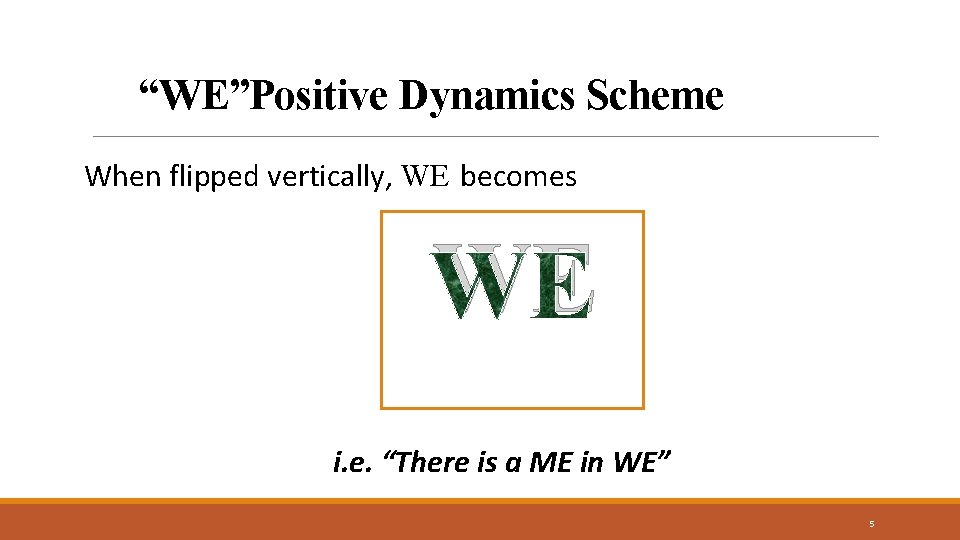
“WE”Positive Dynamics Scheme When flipped vertically, WE becomes WE i. e. “There is a ME in WE” 5
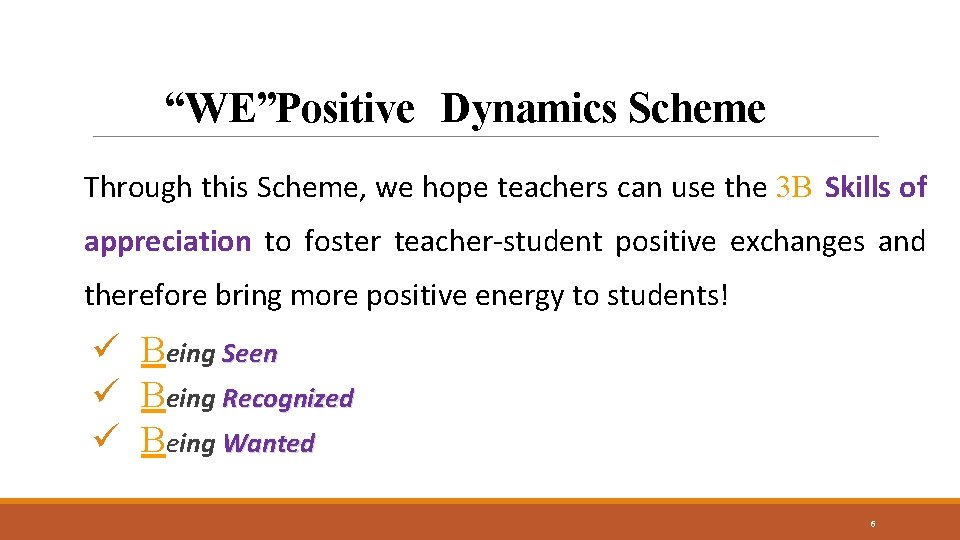
“WE”Positive Dynamics Scheme Through this Scheme, we hope teachers can use the 3 B Skills of appreciation to foster teacher-student positive exchanges and therefore bring more positive energy to students! ü Being Seen ü Being Recognized ü Being Wanted 6
Think about the last time you appreciated your students… • When was it? • What for? 7
Popular myths of giving appreciation … Appreciate students and still won’t change anything! Why should I praise students who are just doing their part? They’ll become arrogant! 8
What’s Appreciation? From Praisage online platform https: //www. youtube. com/watch? v=APCy. C 6 Gy. Rk. U 9
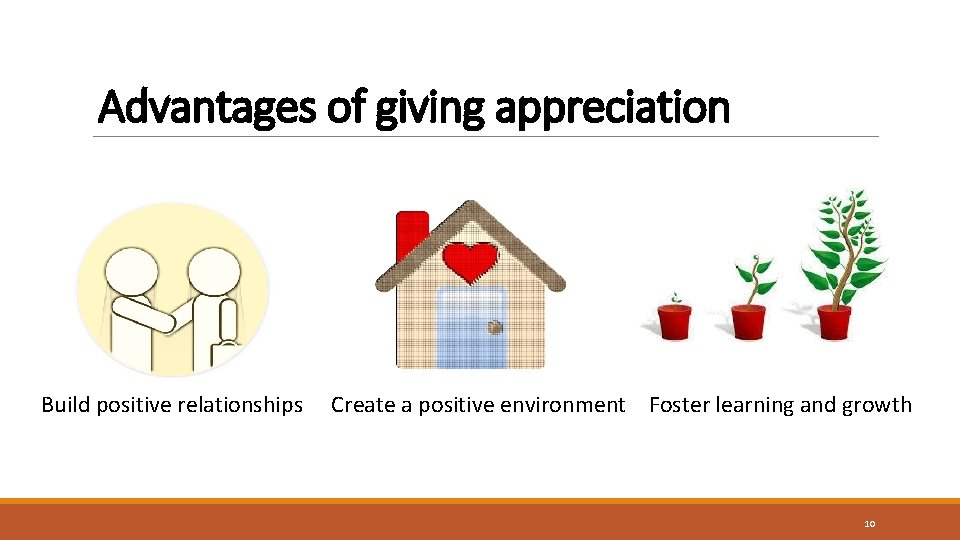
Advantages of giving appreciation Build positive relationships Create a positive environment Foster learning and growth 10
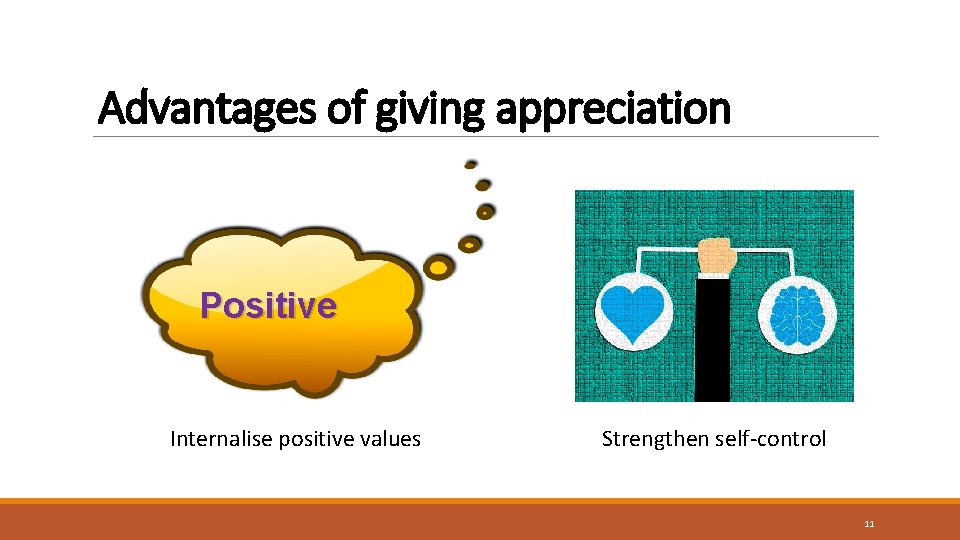
Advantages of giving appreciation Positive Internalise positive values Strengthen self-control 11
What’s good about these two examples? 1. “Well done last night!” 2. “Jim, I was really impressed yesterday. You were swamped with orders since 3 pm but when I got back at 4 pm, you got it all done! You’re amazing!」 12
Applying the skills of “Being Seen” “Get to the point” A clear description of students’ good behaviour or attitude shows that you care about them and recognize their behaviour, which in turn helps them understand their character strengths. Giving them a sense of accomplishment also reinforces their appropriate behaviour. 13
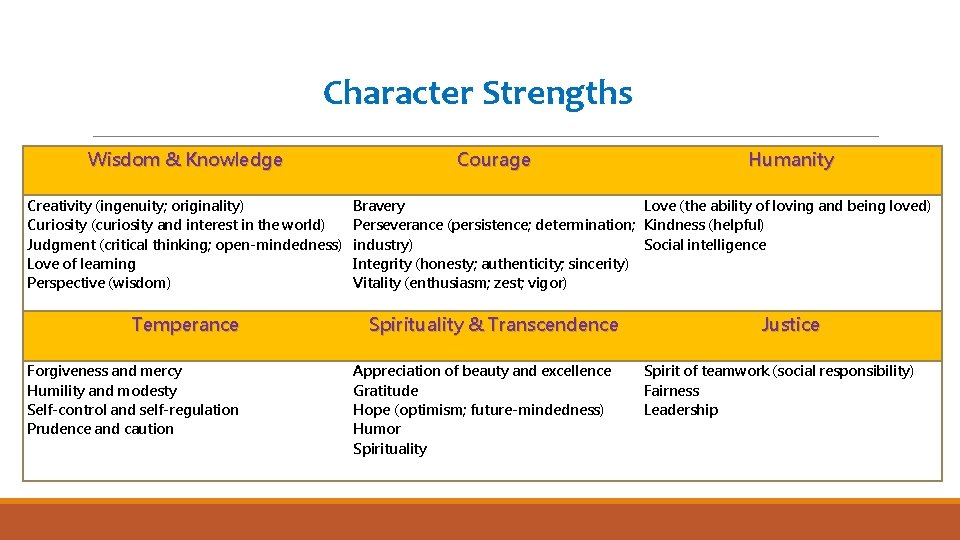
Character Strengths Wisdom & Knowledge Creativity (ingenuity; originality) Curiosity (curiosity and interest in the world) Judgment (critical thinking; open-mindedness) Love of learning Perspective (wisdom) Temperance Forgiveness and mercy Humility and modesty Self-control and self-regulation Prudence and caution Courage Humanity Bravery Love (the ability of loving and being loved) Perseverance (persistence; determination; Kindness (helpful) industry) Social intelligence Integrity (honesty; authenticity; sincerity) Vitality (enthusiasm; zest; vigor) Spirituality & Transcendence Appreciation of beauty and excellence Gratitude Hope (optimism; future-mindedness) Humor Spirituality Justice Spirit of teamwork (social responsibility) Fairness Leadership
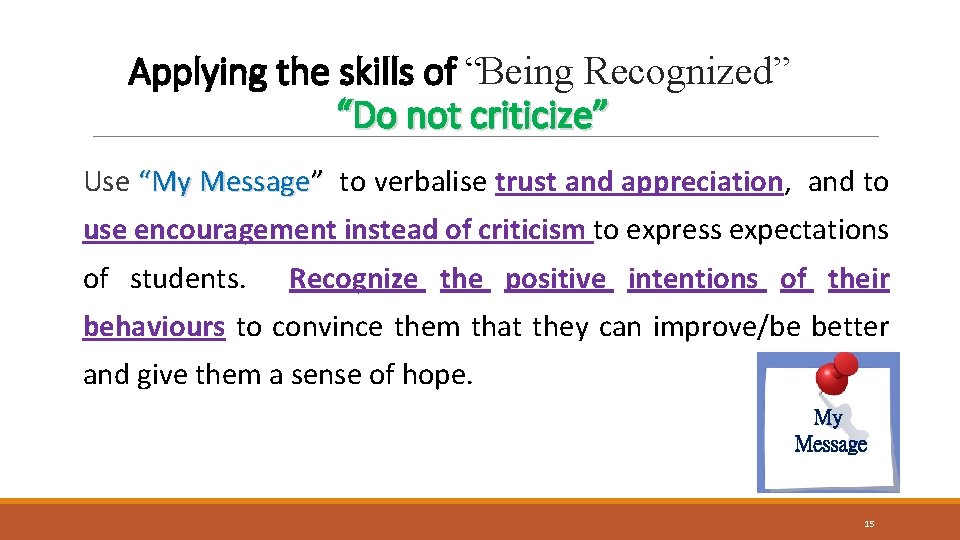
Applying the skills of “Being Recognized” “Do not criticize” Use “My Message” to verbalise trust and appreciation, and to use encouragement instead of criticism to express expectations of students. Recognize the positive intentions of their behaviours to convince them that they can improve/be better and give them a sense of hope. My Message 15
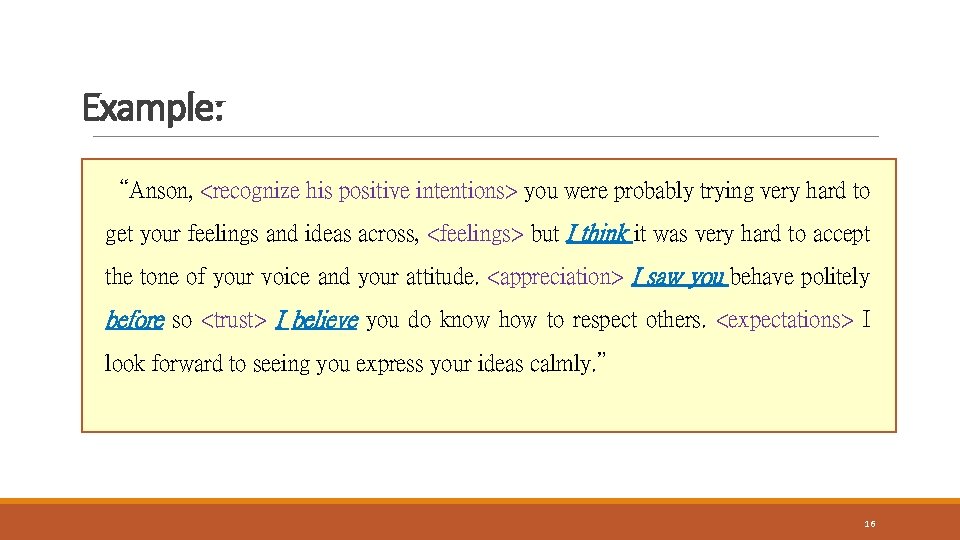
Example: “Anson, <recognize his positive intentions> you were probably trying very hard to get your feelings and ideas across, <feelings> but I think it was very hard to accept the tone of your voice and your attitude. <appreciation> I saw you behave politely before so <trust> I believe you do know how to respect others. <expectations> I look forward to seeing you express your ideas calmly. ” 16
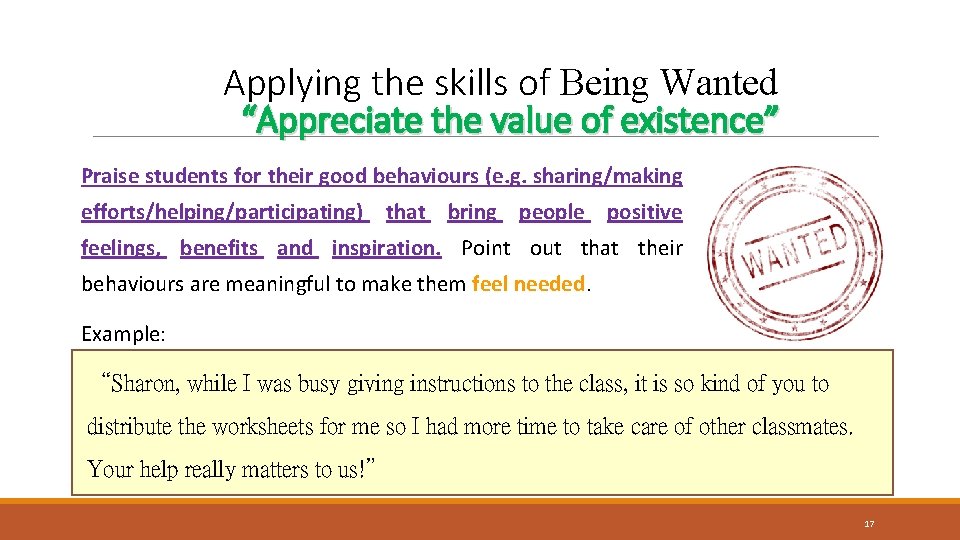
Applying the skills of Being Wanted “Appreciate the value of existence” Praise students for their good behaviours (e. g. sharing/making efforts/helping/participating) that bring people positive feelings, benefits and inspiration. Point out that their behaviours are meaningful to make them feel needed. Example: “Sharon, while I was busy giving instructions to the class, it is so kind of you to distribute the worksheets for me so I had more time to take care of other classmates. Your help really matters to us!” 17
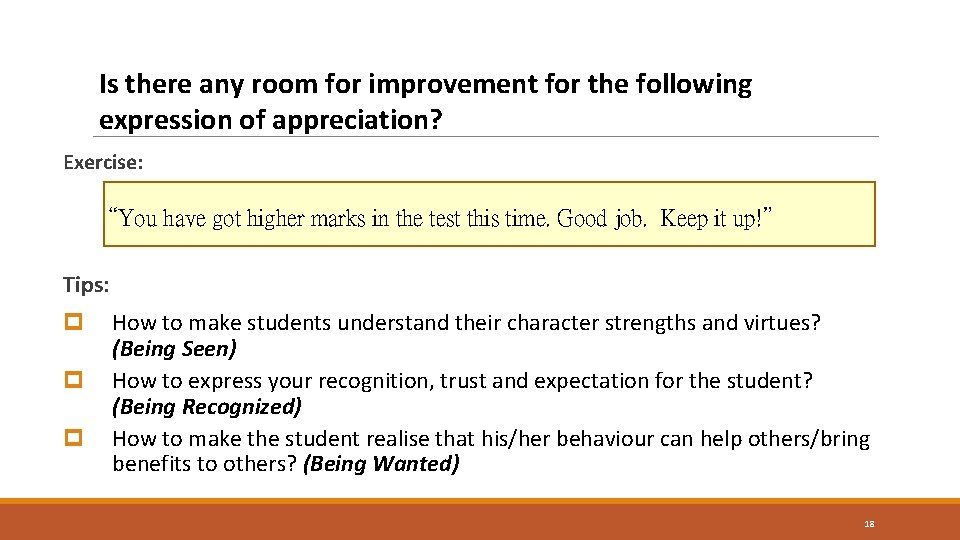
Is there any room for improvement for the following expression of appreciation? Exercise: “You have got higher marks in the test this time. Good job. Keep it up!” Tips: p p p How to make students understand their character strengths and virtues? (Being Seen) How to express your recognition, trust and expectation for the student? (Being Recognized) How to make the student realise that his/her behaviour can help others/bring benefits to others? (Being Wanted) 18
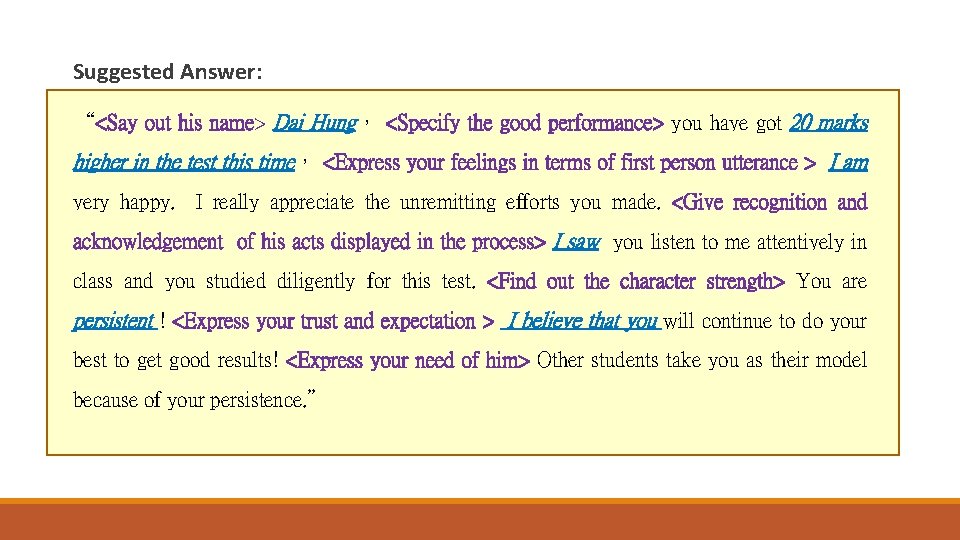
Suggested Answer: “<Say out his name> Dai Hung, <Specify the good performance> you have got 20 marks higher in the test this time, <Express your feelings in terms of first person utterance > I am very happy. I really appreciate the unremitting efforts you made. <Give recognition and acknowledgement of his acts displayed in the process> I saw you listen to me attentively in class and you studied diligently for this test. <Find out the character strength> You are persistent ! <Express your trust and expectation > I believe that you will continue to do your best to get good results! <Express your need of him> Other students take you as their model because of your persistence. ” 19
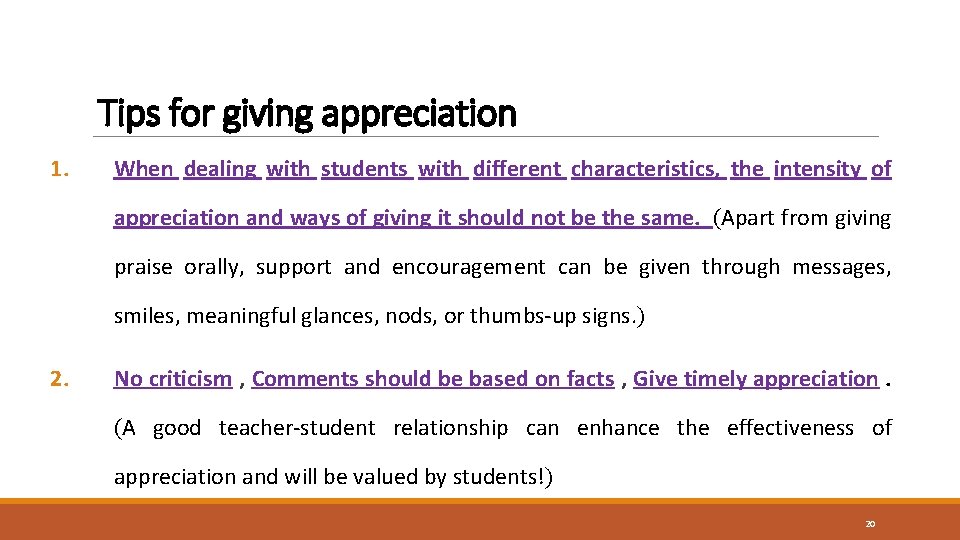
Tips for giving appreciation 1. When dealing with students with different characteristics, the intensity of appreciation and ways of giving it should not be the same. (Apart from giving praise orally, support and encouragement can be given through messages, smiles, meaningful glances, nods, or thumbs-up signs. ) 2. No criticism , Comments should be based on facts , Give timely appreciation. (A good teacher-student relationship can enhance the effectiveness of appreciation and will be valued by students!) 20
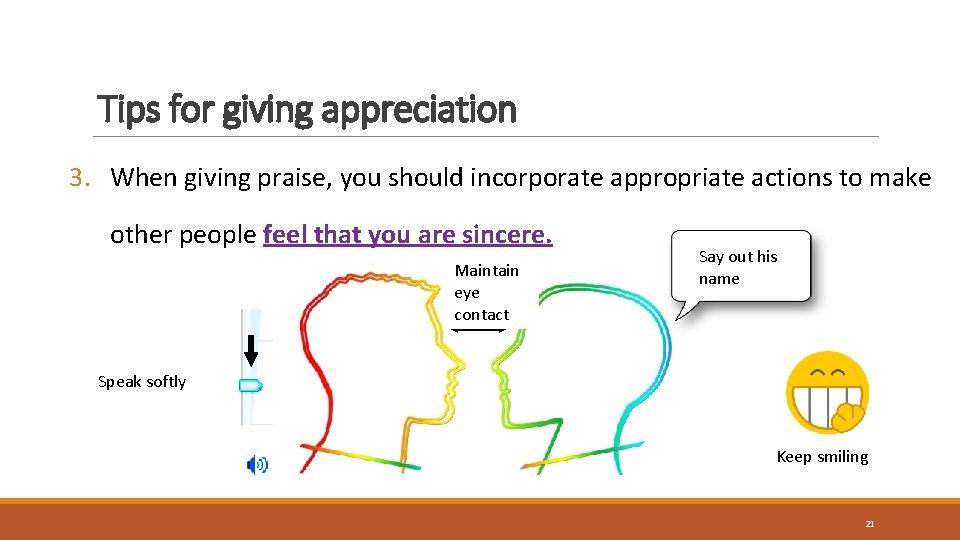
Tips for giving appreciation 3. When giving praise, you should incorporate appropriate actions to make other people feel that you are sincere. Maintain eye contact Say out his name Speak softly Keep smiling 21
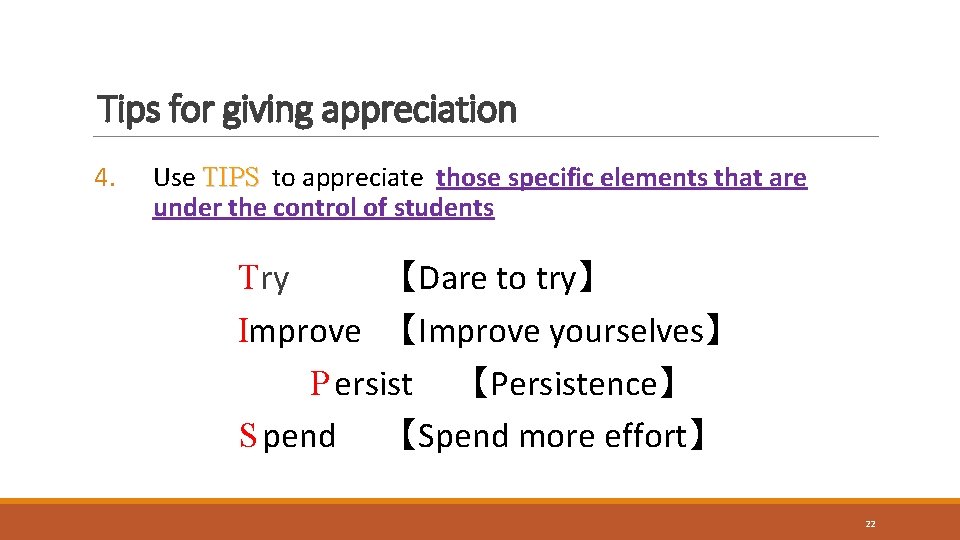
Tips for giving appreciation 4. Use TIPS to appreciate those specific elements that are under the control of students Try 【Dare to try】 Improve 【Improve yourselves】 P ersist 【Persistence】 S pend 【Spend more effort】 22
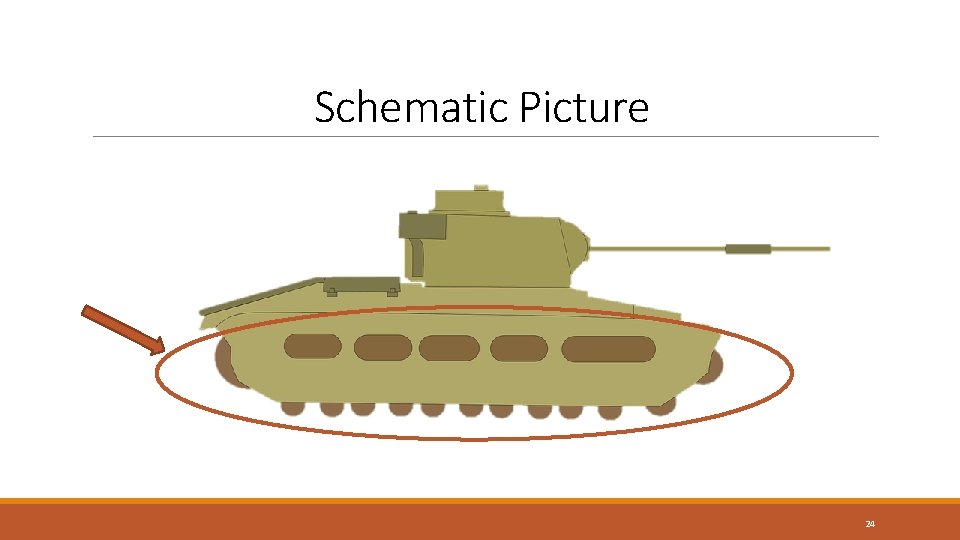
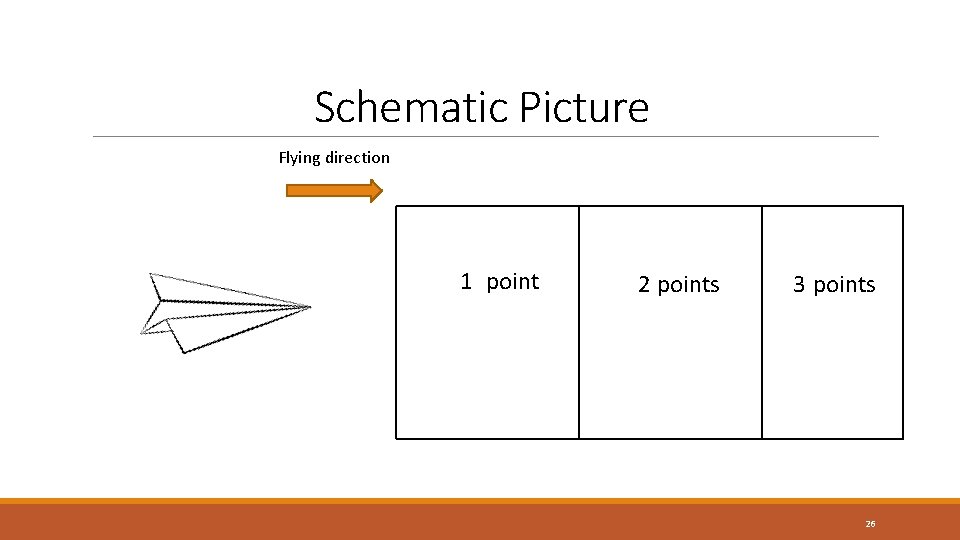
Activity 1【Human-shaped Tank】 (5 to 6 people per group is recommended) Materials received by each group: 3 copies of newspaper + 1 roll of adhesive tape Rules of the Game : Each group has to make an imitated band of tank track in 15 minutes and imagine themselves are the wheels of the tank. They have to move forward in unison without breaking the track. (The fastest team that reaches the finish line wins) 23
Schematic Picture 24
Schematic Picture Flying direction 1 point 2 points 3 points 26
Mutual Appreciation Everybody must try to apply 3 B skills of praise to praise fellow team members according to their performance in the game and their character strengths displayed so that everybody feels he/she is being seen , being recognized and being wanted. 27
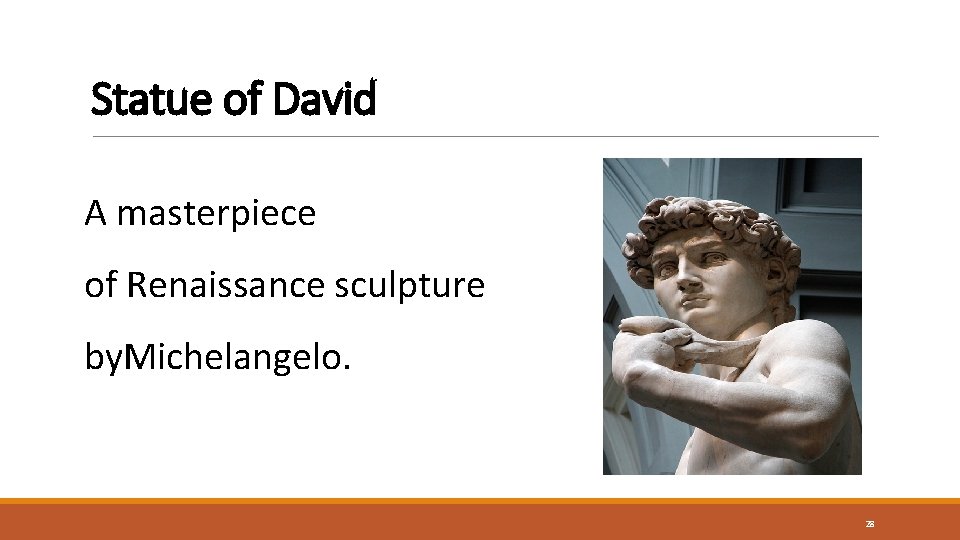
Statue of David A masterpiece of Renaissance sculpture by. Michelangelo. 28
When being asked where did his inspiration for this masterpiece come from, Michelangelo said, “I saw the angel in the marble and carved until I set him free. ” 29
Don’t underestimate your influence on others Video source: Life Vest Inside - Kindness Boomerang - "One Day" https: //www. youtube. com/watch? v=nw. AYp. LVye. FU 30
Conclusion To express your support and encouragement by giving appreciation, the person being appreciated feel they are being seen, being recognized and being wanted. It is also a panacea for enhancing students’ resilience . However, you must remember that when giving appreciation, the appreciation “must be specific”, with ”no criticism” , and “you must commend their value”! 31
~ Thank You~ You have to practice the art of giving praise on purpose and keep practicing! You are the one who can make happy students in the future! 32