
Wendy Mejia Customer Success Manager B S BME
Wendy Mejia Customer Success Manager ● B. S. BME at the University of Texas ● I like to dance �� ● Zello//Rev. com ● Experience with clients in higher education and e. Learning
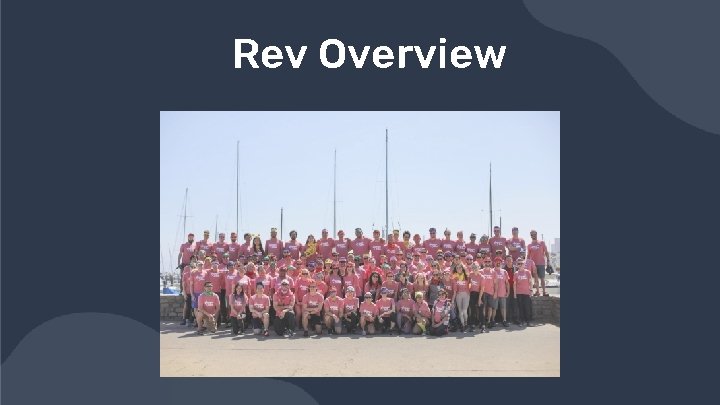
Rev Overview
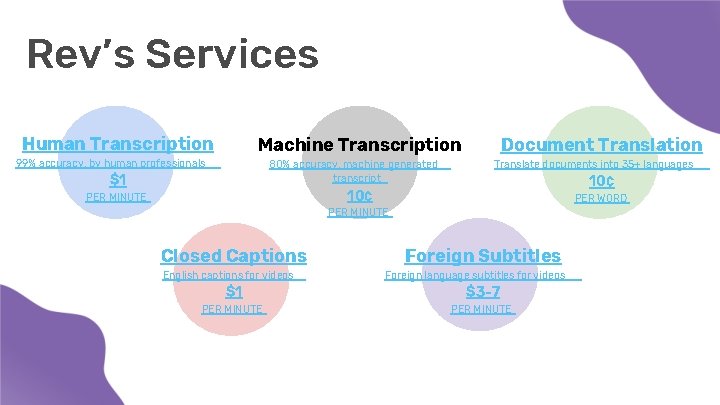
Rev’s Services Human Transcription Machine Transcription 99% accuracy, by human professionals 80% accuracy, machine generated transcript $1 Document Translation Translate documents into 35+ languages 10¢ PER MINUTE PER WORD PER MINUTE Closed Captions English captions for videos Foreign Subtitles Foreign language subtitles for videos $1 $3 -7 PER MINUTE
The Impact of Captions On Learning
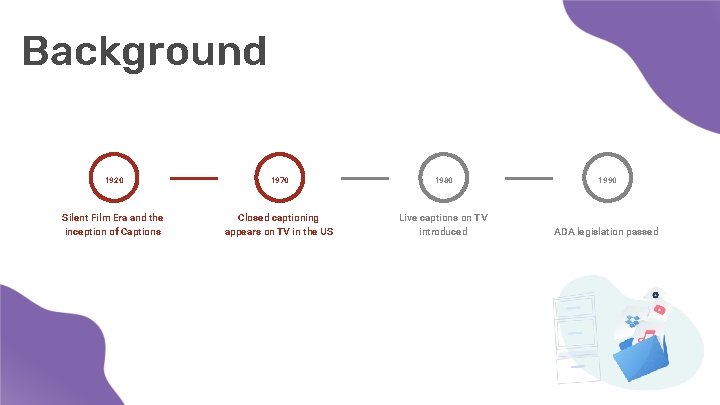
Background 1920 1970 1980 1990 Silent Film Era and the inception of Captions Closed captioning appears on TV in the US Live captions on TV introduced ADA legislation passed
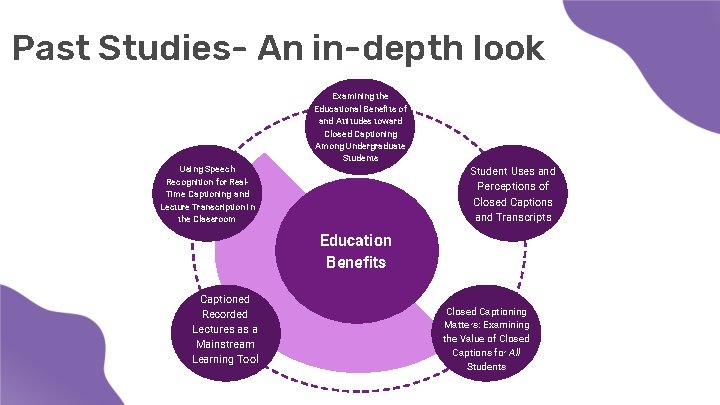
Past Studies- An in-depth look Examining the Educational Benefits of and Attitudes toward Closed Captioning Among Undergraduate Students Using Speech Recognition for Real. Time Captioning and Lecture Transcription in the Classroom Student Uses and Perceptions of Closed Captions and Transcripts Vestibulum Education congue tempu Benefits Captioned Recorded Lectures as a Mainstream Learning Tool Lorem ipsum dolor sit amet, consectetur adipiscing elit, sed do eiusmod tempor. Closed Captioning Matters: Examining the Value of Closed Captions for All Students
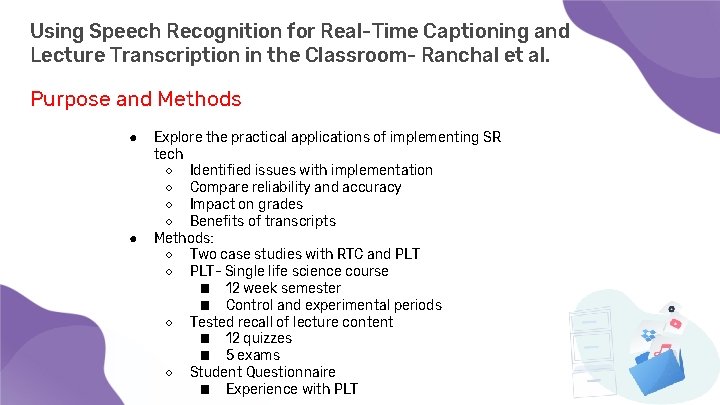
Using Speech Recognition for Real-Time Captioning and Lecture Transcription in the Classroom- Ranchal et al. Purpose and Methods ● ● Explore the practical applications of implementing SR tech ○ Identified issues with implementation ○ Compare reliability and accuracy ○ Impact on grades ○ Benefits of transcripts Methods: ○ Two case studies with RTC and PLT ○ PLT- Single life science course ■ 12 week semester ■ Control and experimental periods ○ Tested recall of lecture content ■ 12 quizzes ■ 5 exams ○ Student Questionnaire ■ Experience with PLT
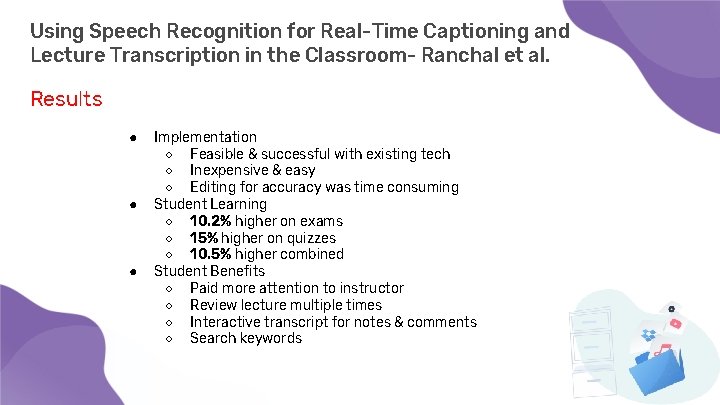
Using Speech Recognition for Real-Time Captioning and Lecture Transcription in the Classroom- Ranchal et al. Results ● ● ● Implementation ○ Feasible & successful with existing tech ○ Inexpensive & easy ○ Editing for accuracy was time consuming Student Learning ○ 10. 2% higher on exams ○ 15% higher on quizzes ○ 10. 5% higher combined Student Benefits ○ Paid more attention to instructor ○ Review lecture multiple times ○ Interactive transcript for notes & comments ○ Search keywords
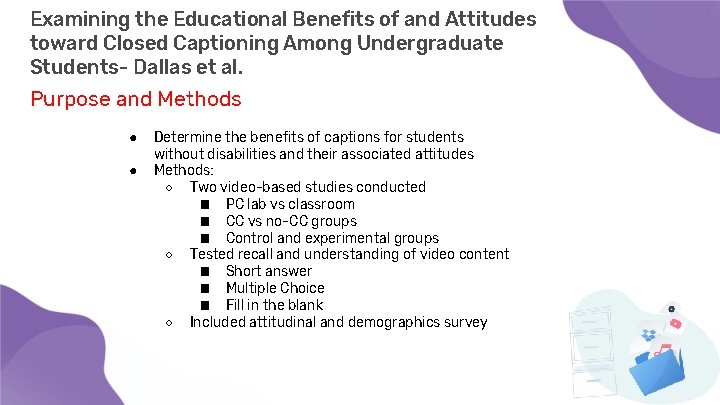
Examining the Educational Benefits of and Attitudes toward Closed Captioning Among Undergraduate Students- Dallas et al. Purpose and Methods ● ● Determine the benefits of captions for students without disabilities and their associated attitudes Methods: ○ Two video-based studies conducted ■ PC lab vs classroom ■ CC vs no-CC groups ■ Control and experimental groups ○ Tested recall and understanding of video content ■ Short answer ■ Multiple Choice ■ Fill in the blank ○ Included attitudinal and demographics survey
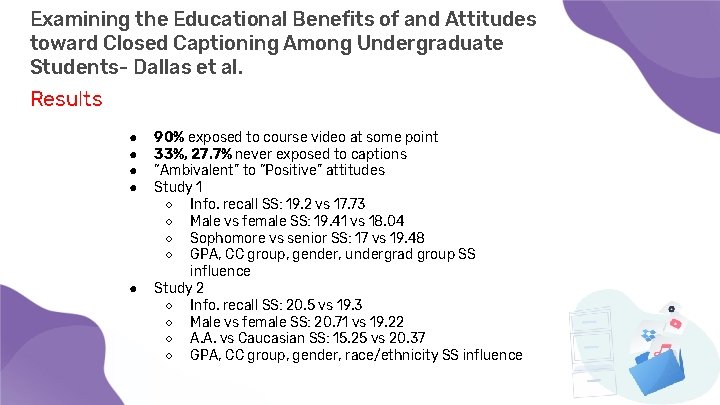
Examining the Educational Benefits of and Attitudes toward Closed Captioning Among Undergraduate Students- Dallas et al. Results ● ● ● 90% exposed to course video at some point 33%, 27. 7% never exposed to captions “Ambivalent” to “Positive” attitudes Study 1 ○ Info. recall SS: 19. 2 vs 17. 73 ○ Male vs female SS: 19. 41 vs 18. 04 ○ Sophomore vs senior SS: 17 vs 19. 48 ○ GPA, CC group, gender, undergrad group SS influence Study 2 ○ Info. recall SS: 20. 5 vs 19. 3 ○ Male vs female SS: 20. 71 vs 19. 22 ○ A. A. vs Caucasian SS: 15. 25 vs 20. 37 ○ GPA, CC group, gender, race/ethnicity SS influence
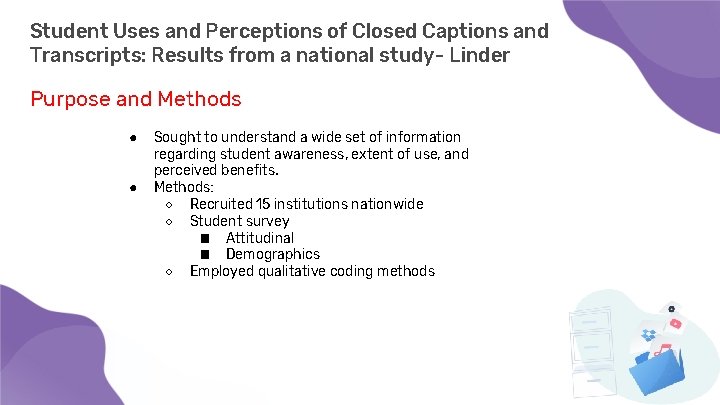
Student Uses and Perceptions of Closed Captions and Transcripts: Results from a national study- Linder Purpose and Methods ● ● Sought to understand a wide set of information regarding student awareness, extent of use, and perceived benefits. Methods: ○ Recruited 15 institutions nationwide ○ Student survey ■ Attitudinal ■ Demographics ○ Employed qualitative coding methods
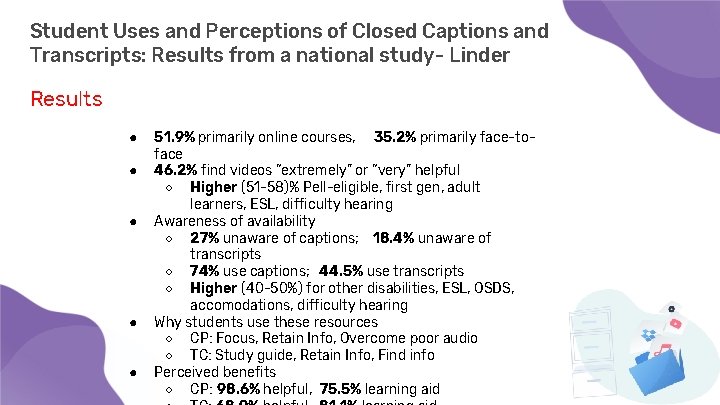
Student Uses and Perceptions of Closed Captions and Transcripts: Results from a national study- Linder Results ● ● ● 51. 9% primarily online courses, 35. 2% primarily face-toface 46. 2% find videos “extremely” or “very” helpful ○ Higher (51 -58)% Pell-eligible, first gen, adult learners, ESL, difficulty hearing Awareness of availability ○ 27% unaware of captions; 18. 4% unaware of transcripts ○ 74% use captions; 44. 5% use transcripts ○ Higher (40 -50%) for other disabilities, ESL, OSDS, accomodations, difficulty hearing Why students use these resources ○ CP: Focus, Retain Info, Overcome poor audio ○ TC: Study guide, Retain Info, Find info Perceived benefits ○ CP: 98. 6% helpful, 75. 5% learning aid
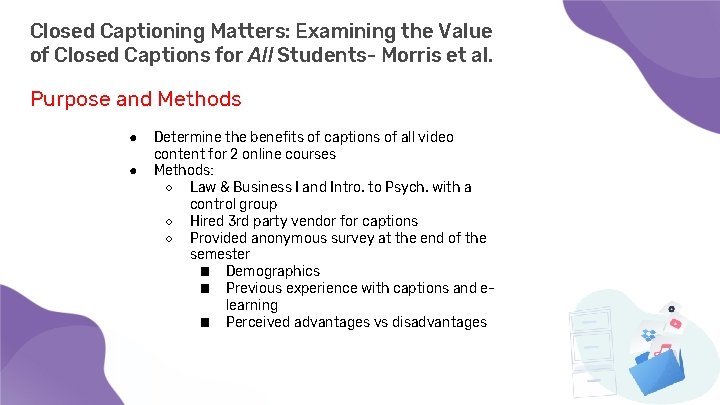
Closed Captioning Matters: Examining the Value of Closed Captions for All Students- Morris et al. Purpose and Methods ● ● Determine the benefits of captions of all video content for 2 online courses Methods: ○ Law & Business I and Intro. to Psych. with a control group ○ Hired 3 rd party vendor for captions ○ Provided anonymous survey at the end of the semester ■ Demographics ■ Previous experience with captions and elearning ■ Perceived advantages vs disadvantages
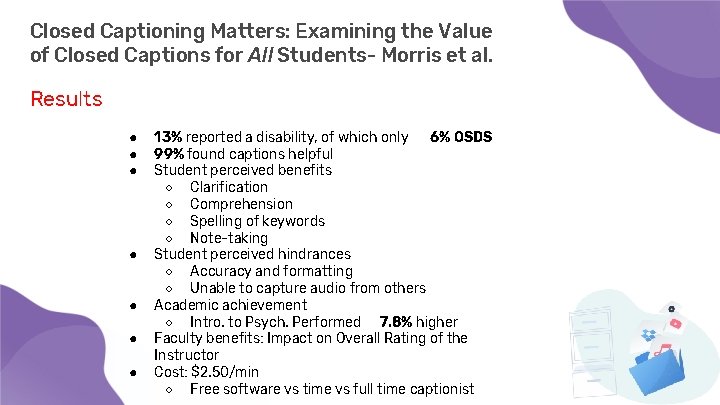
Closed Captioning Matters: Examining the Value of Closed Captions for All Students- Morris et al. Results ● ● ● ● 13% reported a disability, of which only 6% OSDS 99% found captions helpful Student perceived benefits ○ Clarification ○ Comprehension ○ Spelling of keywords ○ Note-taking Student perceived hindrances ○ Accuracy and formatting ○ Unable to capture audio from others Academic achievement ○ Intro. to Psych. Performed 7. 8% higher Faculty benefits: Impact on Overall Rating of the Instructor Cost: $2. 50/min ○ Free software vs time vs full time captionist
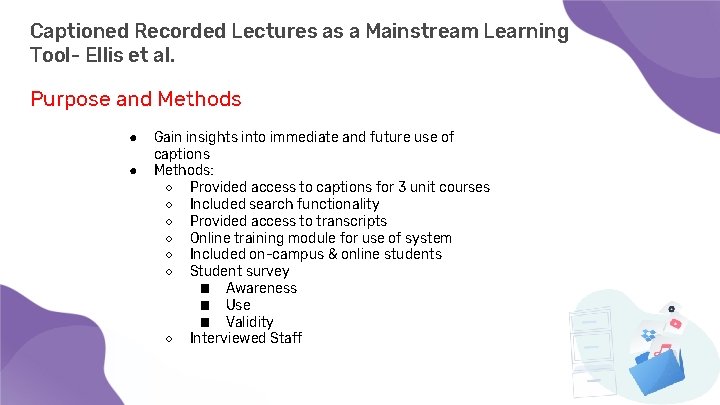
Captioned Recorded Lectures as a Mainstream Learning Tool- Ellis et al. Purpose and Methods ● ● Gain insights into immediate and future use of captions Methods: ○ Provided access to captions for 3 unit courses ○ Included search functionality ○ Provided access to transcripts ○ Online training module for use of system ○ Included on-campus & online students ○ Student survey ■ Awareness ■ Use ■ Validity ○ Interviewed Staff
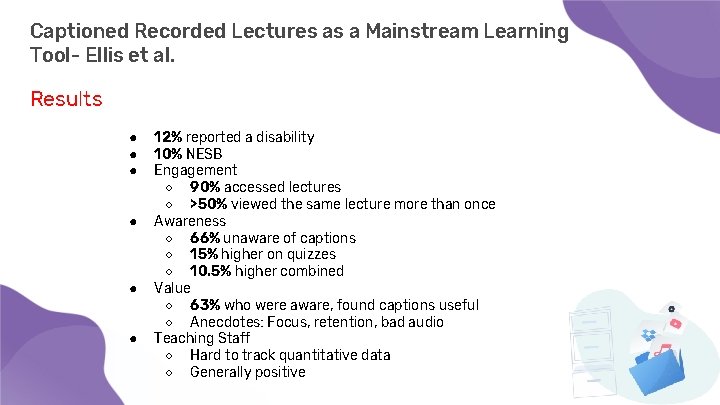
Captioned Recorded Lectures as a Mainstream Learning Tool- Ellis et al. Results ● ● ● 12% reported a disability 10% NESB Engagement ○ 90% accessed lectures ○ >50% viewed the same lecture more than once Awareness ○ 66% unaware of captions ○ 15% higher on quizzes ○ 10. 5% higher combined Value ○ 63% who were aware, found captions useful ○ Anecdotes: Focus, retention, bad audio Teaching Staff ○ Hard to track quantitative data ○ Generally positive

Statistics 98. 6% of students find captions helpful 75% of students that use captions said they use captions as a learning aid 71% of students without hearing difficulties use captions at least some of the time 66% of ESL students find captions “very” or “extremely” helpful 60% of lecture information is missed during note taking
Discussion
The Value of Captions and Transcripts
Student Benefits Helpful for all populations ● ● ● Disability Traditional Students Non-traditional Students International Students ESL and NESB Students Overall improvements in: ● ● ● Comprehension Learning retention Engagement Grades Accuracy

Faculty Benefits Provide Study Tools ● ● Online videos as supplements Recorded lectures ○ Transcripts and/or captions Improve: ● ● ● Course completion rates Course evaluation ratings Improved pedagogy

Administration Benefits Mitigate Litigation Risks ● ● ● 1, 800+ complaints against higher education institutions Reactive captions/transcripts may not be ADA compliant $23, 000 -$800, 000 lawsuit results Improve Key Performance Indicators ● ● Retention and graduation rates Attrition of online courses Average course experience Distance learning enrollment
Future Plans and Directions
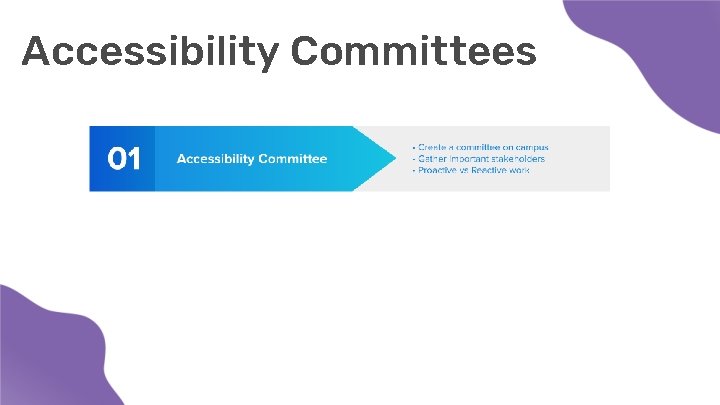
Accessibility Committees
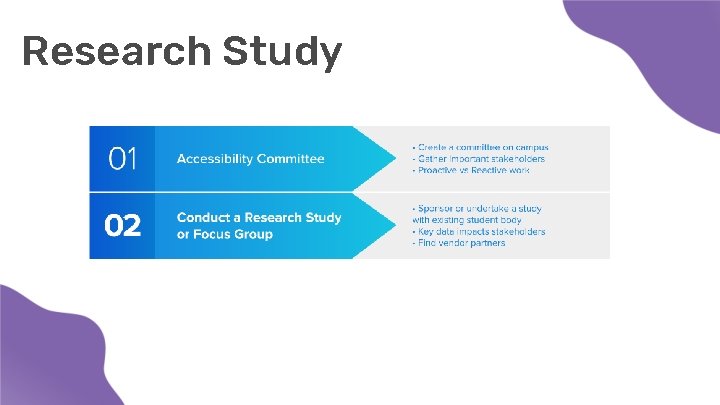
Research Study
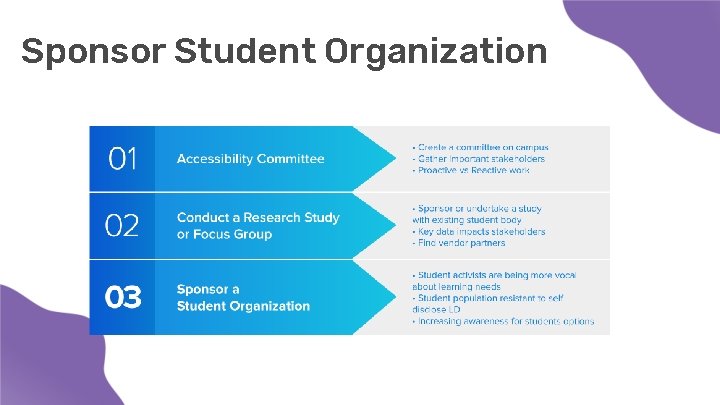
Sponsor Student Organization
Discussion
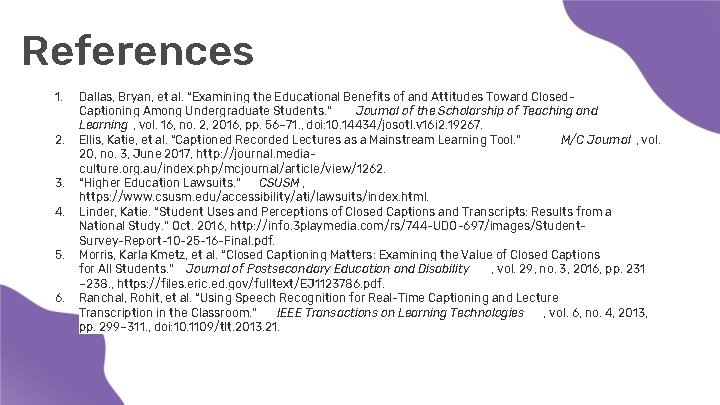
References 1. 2. 3. 4. 5. 6. Dallas, Bryan, et al. “Examining the Educational Benefits of and Attitudes Toward Closed. Captioning Among Undergraduate Students. ” Journal of the Scholarship of Teaching and Learning , vol. 16, no. 2, 2016, pp. 56– 71. , doi: 10. 14434/josotl. v 16 i 2. 19267. Ellis, Katie, et al. “Captioned Recorded Lectures as a Mainstream Learning Tool. ” M/C Journal , vol. 20, no. 3, June 2017, http: //journal. mediaculture. org. au/index. php/mcjournal/article/view/1262. “Higher Education Lawsuits. ” CSUSM , https: //www. csusm. edu/accessibility/ati/lawsuits/index. html. Linder, Katie. “Student Uses and Perceptions of Closed Captions and Transcripts: Results from a National Study. ” Oct. 2016, http: //info. 3 playmedia. com/rs/744 -UDO-697/images/Student. Survey-Report-10 -25 -16 -Final. pdf. Morris, Karla Kmetz, et al. “Closed Captioning Matters: Examining the Value of Closed Captions for All Students. ” Journal of Postsecondary Education and Disability , vol. 29, no. 3, 2016, pp. 231 – 238. , https: //files. eric. ed. gov/fulltext/EJ 1123786. pdf. Ranchal, Rohit, et al. “Using Speech Recognition for Real-Time Captioning and Lecture Transcription in the Classroom. ” IEEE Transactions on Learning Technologies , vol. 6, no. 4, 2013, pp. 299– 311. , doi: 10. 1109/tlt. 2013. 21.
Thank You!
- Slides: 31