
Wendy Blount DVM SpayNeuter Update What is the

Wendy Blount, DVM Spay-Neuter Update What *is* the Right Thing to Do?
Something New in the Air! • Growing trend for alternatives to OHE for Spay • Fad or real trend? ? The Good • Rather than continuing to regurgitate the long held dogmas that there are no negatives to gonadectomy, we are considering the consequences, and having an honest conversation The Bad ? ?
Something New in the Air! Ovary Sparing Spay - Why? ? Aging Cell. 2009 Dec; 8(6): 752 -5. Epub 2009 Sep 2. Exploring mechanisms of sex differences in longevity: lifetime ovary exposure and exceptional longevity in dogs. Waters D et al. • to determine whether lifetime duration of ovary exposure was associated with exceptional longevity • lifetime medical histories, age at death, and cause of death for a cohort of canine 'centenarians'--exceptionally long-lived Rottweiler dogs (13 years)
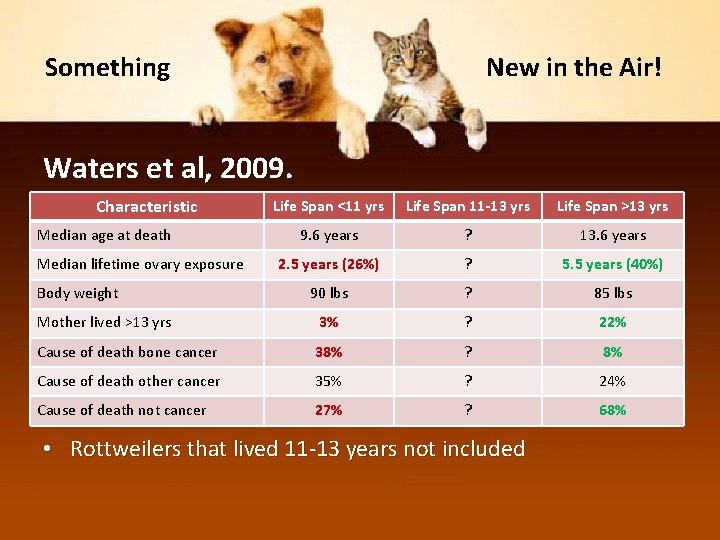
Something New in the Air! Waters et al, 2009. Characteristic Life Span <11 yrs Life Span 11 -13 yrs Life Span >13 yrs 9. 6 years ? 13. 6 years 2. 5 years (26%) ? 5. 5 years (40%) 90 lbs ? 85 lbs Mother lived >13 yrs 3% ? 22% Cause of death bone cancer 38% ? 8% Cause of death other cancer 35% ? 24% Cause of death not cancer 27% ? 68% Median age at death Median lifetime ovary exposure Body weight • Rottweilers that lived 11 -13 years not included
Something New in the Air! Waters et al, 2009. Conclusion? ? ? • removal of ovaries during the first 4 years of life erased the female survival advantage in Rotts Far Fetched Independent Conclusion Leaving an ovary will make them live longer Why not just spay them after 4 years of age? Would still get significant protection against mammary cancer and pyometra • Can anything that happens to 13 year old Rotts be extrapolated to dogs in general? ? • • •
Something New in the Air! Neutering dogs: effects on joint disorders and cancers in golden retrievers. De la Riva et al, 2013 • 759 client-owned dogs were examined for diagnoses of hip dysplasia (HD), cranial cruciate ligament tear (CCL), lymphosarcoma (LSA), hemangiosarcoma (HSA), and mast cell tumor (MCT). • Patients were classified as intact (IF, IM), neutered early (ENM, ENF) at <12 mo or neutered late (LNM, LNF) at ≥ 12 mo
Something New in the Air! Neutering dogs: effects on joint disorders and cancers in golden retrievers. De la Riva et al, 2013 Condition ENM LNM IM ENF LNF IF Hip Dysplasia 10% 1% 5% 3% Ruptured Anterior Cruciate Ligament 5% 1% 0% 8% 0% 0% Lymphoma 10% 0% 3% 6% 1% 1% Hemangiosarcoma 3% 1% 3% 2% 7% 2% Mast Cell Tumor 2% 4% 3% 2% 6% 0% • Mammary tumors were not assessed • EN gave disadvantage of 5 -9% for CCL in both sexes, and HD & LSA in males; LN gave similar disadvantage for HSA & MCT in
Something New in the Air! Endogenous gonadal hormone exposure and bone sarcoma risk. Cancer Epidemiol Biomarkers Prev. Nov 2002; 11(11): 1434 -40. Dawn M Cooley et al • 683 Rottweiler dogs • Male and female dogs that underwent gonadectomy before 1 year of age were much more likely to get bone sarcomas than sexually intact Rotts (lifetime risk 1 in 4) • Rotts that did not die of bone sarcoma live an average of 8 -9 months longer than those that died of bone sarcoma
Something New in the Air! Endogenous gonadal hormone exposure and bone Cohort Mean Age at Death Dx OSA No OSA sarcoma risk. Intact Male 9. 4 yrs 8% 92% Castrated Male < 1 yr 7. 7 yrs 28% 72% Castrated Male 1 -3. 5 yrs 8. 0 yrs 13% 87% Castrated Male > 3. 5 yrs 9. 8 yrs 10% 90% Intact Female 7. 5 yrs 7% 93% Spayed Female < 1 yr 8. 0 yrs 25% 75% Spayed female 1 -5 yrs 8. 6 yrs 11% 89% Spayed female > 5 yrs 10. 1 yrs 9% 91% Lifetime Gonadal Exposure male 4. 4 yrs 5. 9 yrs Lifetime gonadal exposure female 3. 4 yrs 4. 6 yrs
Something New in the Air! Endogenous gonadal hormone exposure and bone sarcoma risk. Independent Conclusions? ? • while bone cancer rates are lowest in IF, lifespan is also the shortest, by 2 -3 years. • Cohorts that live longest and have the lowest rates of bone cancer are males castrated > 3. 5 yrs & females spayed > 5 yrs • Agreed: Rotts speutered at < 1 yr are much more likely to get bone cancer (25% lifetime risk, 2 -3 x more likely than above) • Speuter < 1 yr in giant dogs leads to increased rates of orthopedic problems, including bone cancer • Historical Howe studies followed only 2 years

Something New in the Air! Long-Term Health Effects of Neutering Dogs: Comparison of Labrador Retrievers with Golden Retrievers. Benjamin L. Hart. PLOS ONE July 2014. • Retrospective study breaking retrievers down into neutering at < 6 mos, 6 -11 mos, year 1, years 2 -8. • Looked at rates of hip dysplasia, cranial cruciate rupture, and elbow dysplasia • Also looked at rates of lymphoma, hemangiosarcoma, mast cell tumor and mammary cancer
Something New in the Air! Long-Term Health Effects of Neutering Dogs: Comparison of Labrador Retrievers with Golden Retrievers. Benjamin L. Hart. PLOS ONE July 2014. • Speutering Labs < 6 mos doubled risk of orthopedic problems • Speutering Goldens < 6 mos quadrupled risk of orthopedic problems • Minimal increase in cancer due to spay in Labradors • Spaying Goldens at any age increased risk of cancer 3 -4 x • No increase in cancer risk for neutering male retrievers • Prostate cancer not looked at
Canine Mammary Gland Tumor • Most common tumor in intact female dogs (42%) – 50% of them are malignant • Rare in dogs less than 5 years old • duration of exposure to ovarian hormones early in life determines the overall mammary cancer risk (Dorn et al, 1968). – 0. 5% if OHE prior to the first heat – 8% if OHE prior to the 2 nd heat – 26% if OHE after the 2 nd heat

Allison Vignes - Orange TX
Canine Mammary Gland Tumor • tumor risk increases incrementally each year and plateaus around 11– 13 (Schneider, 1970) • intact females are more likely to have an anaplastic tumor type, compared to dogs spayed early or late in life, prior to MGT (Ogilvie, 2006)
Canine Mammary Gland Tumor The effect of neutering on the risk of mammary tumours in dogs--a systematic review. J Small Anim Pract. June 2012; 53(6): 314 -22. W Beauvais 1; J M Cardwell; D C Brodbelt Due to the limited evidence available and the risk of bias in the published results, the evidence that neutering reduces the risk of mammary neoplasia, and the evidence that age at neutering has an effect, are judged to be weak and are not a sound basis for firm recommendations.
Canine Mammary Gland Tumor • Review article – not a clinical study at all • Conclusions: – 9/13 were judged to have a high risk of bias, and though they all showed a connection between MGT and failure to spay, they were not considered as evidence. – The remaining four were classified as having a moderate risk of bias. • One study found an association between neutering and a reduced risk of mammary tumors. • Two studies found no evidence of an association. • One reported to have "some protective effect" of neutering on the risk of mammary tumors. • NO STUDIES SHOWED INCREASED RISK FOR MGT by OHE
Canine Mammary Gland Tumor BMJ. 2003 Dec 20; 327(7429): 1459 -61. Parachute use to prevent death and major trauma related to gravitational challenge: systematic review of randomised controlled trials. Smith GC 1, Pell JP. OBJECTIVES: To determine whether parachutes are effective in preventing major trauma related to gravitational challenge. DESIGN: Systematic review of randomised controlled trials. RESULTS: We were unable to identify any randomised controlled trials of parachute intervention.
Canine Mammary Gland Tumor CONCLUSIONS: As with many interventions intended to prevent ill health, the effectiveness of parachutes has not been subjected to rigorous evaluation by using randomised controlled trials. Advocates of evidence based medicine have criticised the adoption of interventions evaluated by using only observational data. We think that everyone might benefit if the most radical protagonists of evidence based medicine organised and participated in a double blind, randomised, placebo controlled, crossover trial of the parachute.

Let’s Come to Our Senses! Do we get an accurate picture of how gonadectomy correlates with lifespan by isolating a few variables from the rest? Do purebred studies apply to all dogs? • There at least 2 large lifetime studies looking at entire health records, and all variables that are in the practice management software • Both show that neutered dogs that go to the vet happen to live longer than intact dogs that go to the vet • Remember – this does not prove cause and effect • So why are we leaving ovaries in dogs?
Let’s Come to Our Senses! Reproductive capability is associated with lifespan and cause of death in companion dogs. PLo. S ONE. January 2013; 8(4): e 61082. Jessica M Hoffman et al • University of Georgia • compared causes of death among over 40, 000 sterilized and sexually intact domestic dogs (189 breeds) • Sterilization associated with increase in lifespan by 14% in males and 26% in females
Let’s Come to Our Senses! Reproductive capability is associated with lifespan and cause of death in companion dogs. PLo. S ONE. January 2013; 8(4): e 61082. Jessica M Hoffman et al • Diseases with increased risk in speutered dogs: – Transitional cell carcinoma (cancer with highest relative risk) – Osteosarcoma (2 nd highest relative risk) – Lymphoma, mast cell tumor, prostate cancer – mildly increased risk – Immune mediated disease
Let’s Come to Our Senses! Reproductive capability is associated with lifespan and cause of death in companion dogs. PLo. S ONE. January 2013; 8(4): e 61082. Jessica M Hoffman et al • Diseases with decreased risk in speutered dogs: – – melanoma Mammary cancer Degenerative diseases, vascular diseases Infectious disease and trauma • Heartworm disease, GI parasites, fungal, canine distemper virus, canine parvovirus
Let’s Come to Our Senses! Banfield State of Pet Health Report - 2013 • More than 2 million animals in the Banfield database • Not peer reviewed • Castrated cats lived 62% longer than intact males • Spayed cats lived 39% longer than intact females • Castrated dogs lived 18% longer than intact males • Spayed dogs lived 23% longer than intact females
Let’s Come to Our Senses! Banfield State of Pet Health Report - 2013 • Intact dogs are more than twice as likely to be hit by a car as neutered dogs. • Intact cats are 4 times as likely to be hit by a car as neutered cats • Intact dogs are more than twice as likely to bitten by another animal as neutered dogs • Intact cats are 3 times as likely to brought to a veterinarian for treatment of animal bites as neutered cats
Let’s Review! Speuter Cons: • Ruptured cruciate, hip Dysplasia, elbow dysplasia more common especially in males if neutered < 1 yr – Even when BCS controlled for • Transitional cell carcinoma (1% - 2 -4 x) and bone cancer (0. 2% - 1. 5 -2 x) are significantly increased in speutered dogs, especially giant breeds < 1 yr • prostate cancer, lymphoma and mast cell tumor are mildly increased speutered dogs – Prostate cancer 0. 2 -0. 6% (2 -3 x more likely in castrated dog) • Goldens are at increased risk of cancers if speutered – Hemangiosarcoma (0. 2% - 2. 2 -5 x)
Let’s Review! Speuter Cons: • Urinary incontinence more common when female neutered < 12 weeks (Beauvais, 2012) • Immune mediated disease and hypothyroidism more common in speutered dogs • Some trainers think dogs and cats who undergo pediatric speuter remain prepubertal/adolescents and are more difficult to train • Pediatric speuter changes conformation – legs grow longer before growth plates close, and some secondary sex characteristics never fully develop
Let’s Review! Speuter Pros: • Female Rottweilers live 2 -3 years longer if spayed > 5 years; males live 1 -2 yrs longer if castrated > 3. 5 yrs • Sterilized dogs & cats live 14 -62% longer than intact dogs & cats • Objectionable behaviors are reduced: – Urine marking, roaming, fighting, aggression • Melanoma and mammary cancer are reduced • Cancer of ovaries, uterus and testicles (0. 9%) are virtually eliminated
Let’s Review! Speuter Pros: • Risk of some diseases are drastically reduced: – Degenerative and vascular diseases – Trauma and infectious disease • Some medical conditions are improved or risk reduced – Demodicosis, Alopecia X – Prostatitis (BPH 50% at 2. 5 yrs, 80% at 6 yrs, 95% at 9 yrs) – perianal tumors, mammary hyperplasia • Potentially life threatening conditions can be cured: – seizures, diabetes – pyometra (24% of intact females)
Let’s Review! Speuter Pros: • • R. O. A. D. Syndrome - Will Evans, Gardendale TX Real Olfactory Androgen Desire Something smells sweet over yonder and kersplat High risk disease, high mortality rate
Let’s Review! Questions: • What is the likelihood of a puppy/kitten eventually dying of euthanasia at the local animal shelter, and how is that balanced against other causes of death? • Breed predispositions for cancer are clearly different. What about mixed breed dogs? Does size matter? • What about cats? • Is there any evidence that leaving an ovary in females is the right thing to do? • Should ovary sparing spay be done at a young age, and then the ovary removed prior to old age? • Is quality of life for owner of a cycling female dog considered?
Let’s Come to Our Senses! • There is no increase in urethral obstruction in castrated cats compared to tom cats • It is probably wise to allow dogs and cats to mature prior to performing gonadectomy • But this must be weighed against local excess pet population and risk of death by euthanasia at a shelter • The vet’s role – discuss options with the client, and come to the best solution for owner and pet
Summary – Power. Point Handouts – Vet Handouts • • Banfield State of Pet Health 2013 Cooley Paper – Rottweiler Longevity De. La. Riva Paper – Golden Cancer and Orthopedics Hart Paper – Retriever Cancer and Orthopedics Hoffman Paper – U of Georgia Longevity Study Waters Paper – Rottweiler Longevity Study Beauvais Papers – Mammary Tumors & Urinary Incontinence

Summary – Client Handouts • • Spaying Your Dog Neutering Your Dog Spaying Your Cat Neutering Your Cat
Acknowledgements Phil Bushby, DVM, MS, DACVS • Marcia Lane Endowed Chair of Humane Ethics and Animal Welfare, College of Veterinary Medicine, Mississippi State University
- Slides: 35