
Welsh writing in in English A Peasant by
Welsh writing in in English A Peasant – by R S Thomas– Choose a task based on the poem. Activity A Activity B Activity C Activity D Activity E Activity F Activity G Glossary
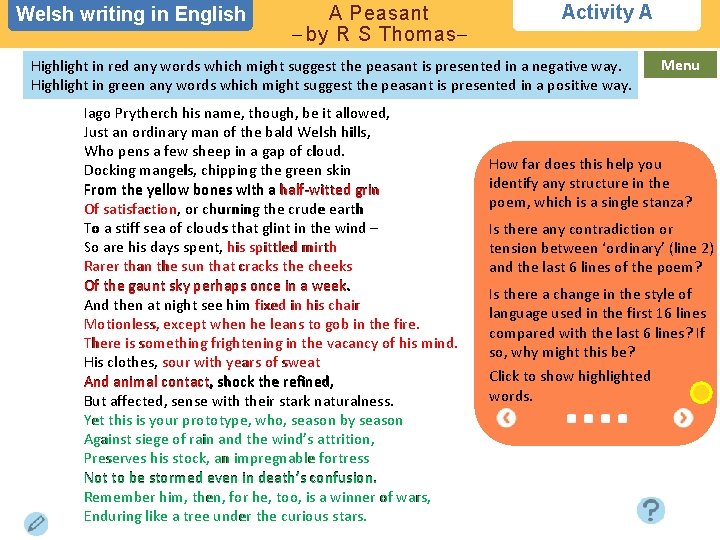
Welsh writing in in English A Peasant – by R S Thomas– Activity A Highlight in red any words which might suggest the peasant is presented in a negative way. Highlight in green any words which might suggest the peasant is presented in a positive way. Iago Prytherch his name, though, be it allowed, Just an ordinary man of the bald Welsh hills, Who pens a few sheep in a gap of cloud. Docking mangels, chipping the green skin From the yellow bones with a half-witted grin Of satisfaction, or churning the crude earth To a stiff sea of clouds that glint in the wind – So are his days spent, his spittled mirth Rarer than the sun that cracks the cheeks Of the gaunt sky perhaps once in a week. And then at night see him fixed in his chair Motionless, except when he leans to gob in the fire. There is something frightening in the vacancy of his mind. His clothes, sour with years of sweat And animal contact, shock the refined, But affected, sense with their stark naturalness. Yet this is your prototype, who, season by season Against siege of rain and the wind’s attrition, Preserves his stock, an impregnable fortress Not to be stormed even in death’s confusion. Remember him, then, for he, too, is a winner of wars, Enduring like a tree under the curious stars. Menu How far does this help you identify any structure in the poem, which is a single stanza? Is there any contradiction or tension between ‘ordinary’ (line 2) and the last 6 lines of the poem? Is there a change in the style of language used in the first 16 lines compared with the last 6 lines? If so, why might this be? Click to show highlighted words.
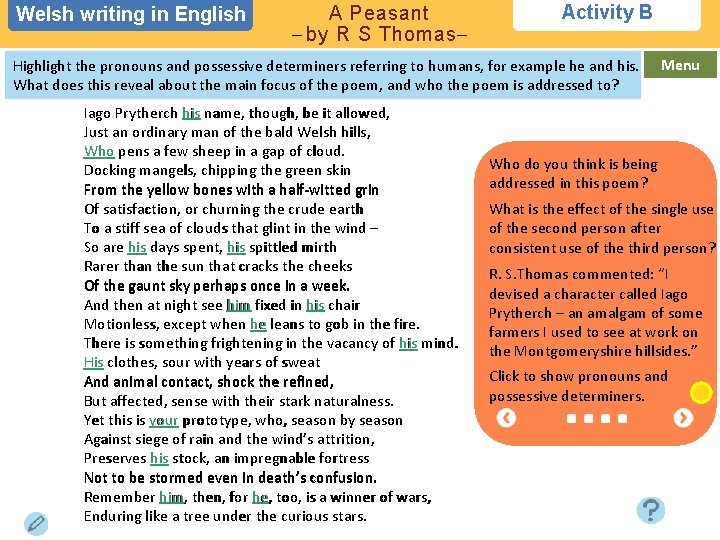
Welsh writing in in English A Peasant – by R S Thomas– Activity B Highlight the pronouns and possessive determiners referring to humans, for example he and his. What does this reveal about the main focus of the poem, and who the poem is addressed to? Iago Prytherch his name, though, be it allowed, Just an ordinary man of the bald Welsh hills, Who pens a few sheep in a gap of cloud. Docking mangels, chipping the green skin From the yellow bones with a half-witted grin Of satisfaction, or churning the crude earth To a stiff sea of clouds that glint in the wind – So are his days spent, his spittled mirth Rarer than the sun that cracks the cheeks Of the gaunt sky perhaps once in a week. And then at night see him fixed in his chair Motionless, except when he leans to gob in the fire. There is something frightening in the vacancy of his mind. His clothes, sour with years of sweat And animal contact, shock the refined, But affected, sense with their stark naturalness. Yet this is your prototype, who, season by season Against siege of rain and the wind’s attrition, Preserves his stock, an impregnable fortress Not to be stormed even in death’s confusion. Remember him, then, for he, too, is a winner of wars, Enduring like a tree under the curious stars. Menu Who do you think is being addressed in this poem? What is the effect of the single use of the second person after consistent use of the third person? R. S. Thomas commented: “I devised a character called Iago Prytherch – an amalgam of some farmers I used to see at work on the Montgomeryshire hillsides. ” Click to show pronouns and possessive determiners.
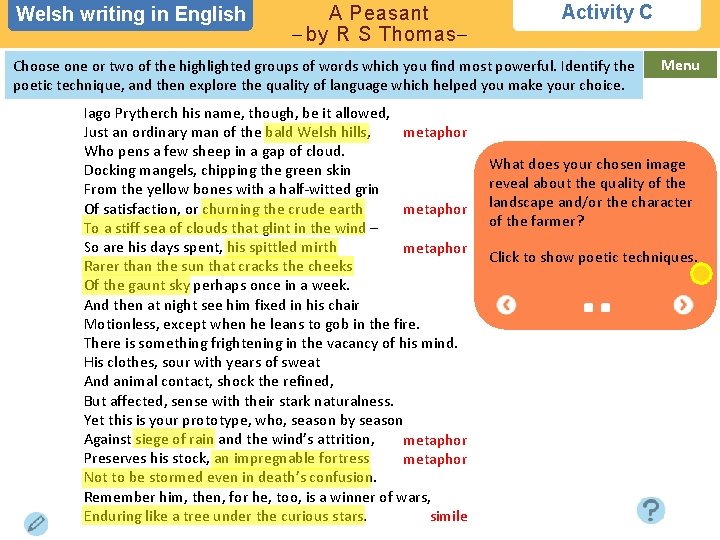
Welsh writing in in English A Peasant – by R S Thomas– Activity C Choose one or two of the highlighted groups of words which you find most powerful. Identify the poetic technique, and then explore the quality of language which helped you make your choice. Iago Prytherch his name, though, be it allowed, Just an ordinary man of the bald Welsh hills, metaphor Who pens a few sheep in a gap of cloud. Docking mangels, chipping the green skin From the yellow bones with a half-witted grin Of satisfaction, or churning the crude earth metaphor To a stiff sea of clouds that glint in the wind – So are his days spent, his spittled mirth metaphor Rarer than the sun that cracks the cheeks Of the gaunt sky perhaps once in a week. And then at night see him fixed in his chair Motionless, except when he leans to gob in the fire. There is something frightening in the vacancy of his mind. His clothes, sour with years of sweat And animal contact, shock the refined, But affected, sense with their stark naturalness. Yet this is your prototype, who, season by season Against siege of rain and the wind’s attrition, metaphor Preserves his stock, an impregnable fortress metaphor Not to be stormed even in death’s confusion. Remember him, then, for he, too, is a winner of wars, Enduring like a tree under the curious stars. simile Menu What does your chosen image reveal about the quality of the landscape and/or the character of the farmer? Click to show poetic techniques.
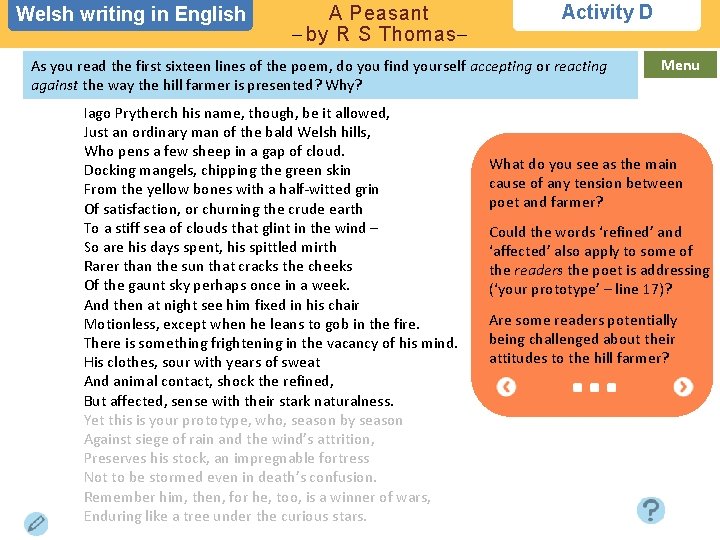
Welsh writing in in English A Peasant – by R S Thomas– Activity D As you read the first sixteen lines of the poem, do you find yourself accepting or reacting against the way the hill farmer is presented? Why? Iago Prytherch his name, though, be it allowed, Just an ordinary man of the bald Welsh hills, Who pens a few sheep in a gap of cloud. Docking mangels, chipping the green skin From the yellow bones with a half-witted grin Of satisfaction, or churning the crude earth To a stiff sea of clouds that glint in the wind – So are his days spent, his spittled mirth Rarer than the sun that cracks the cheeks Of the gaunt sky perhaps once in a week. And then at night see him fixed in his chair Motionless, except when he leans to gob in the fire. There is something frightening in the vacancy of his mind. His clothes, sour with years of sweat And animal contact, shock the refined, But affected, sense with their stark naturalness. Yet this is your prototype, who, season by season Against siege of rain and the wind’s attrition, Preserves his stock, an impregnable fortress Not to be stormed even in death’s confusion. Remember him, then, for he, too, is a winner of wars, Enduring like a tree under the curious stars. Menu What do you see as the main cause of any tension between poet and farmer? Could the words ‘refined’ and ‘affected’ also apply to some of the readers the poet is addressing (‘your prototype’ – line 17)? Are some readers potentially being challenged about their attitudes to the hill farmer?
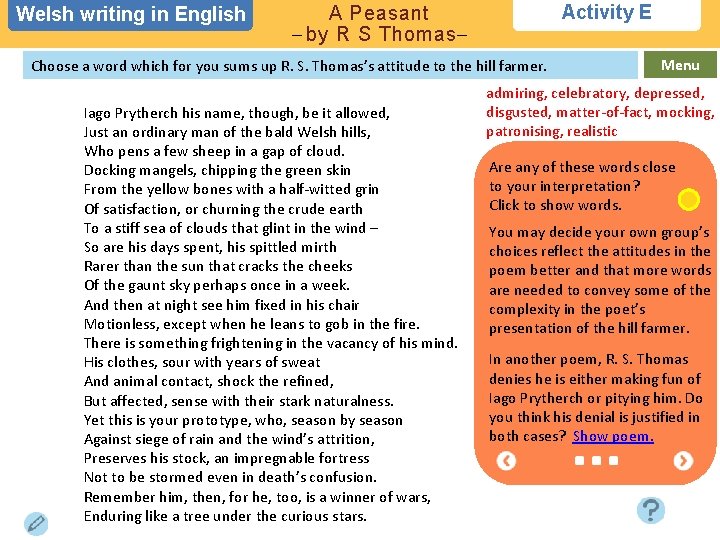
Welsh writing in in English Activity E A Peasant – by R S Thomas– Choose a word which for you sums up R. S. Thomas’s attitude to the hill farmer. Iago Prytherch his name, though, be it allowed, Just an ordinary man of the bald Welsh hills, Who pens a few sheep in a gap of cloud. Docking mangels, chipping the green skin From the yellow bones with a half-witted grin Of satisfaction, or churning the crude earth To a stiff sea of clouds that glint in the wind – So are his days spent, his spittled mirth Rarer than the sun that cracks the cheeks Of the gaunt sky perhaps once in a week. And then at night see him fixed in his chair Motionless, except when he leans to gob in the fire. There is something frightening in the vacancy of his mind. His clothes, sour with years of sweat And animal contact, shock the refined, But affected, sense with their stark naturalness. Yet this is your prototype, who, season by season Against siege of rain and the wind’s attrition, Preserves his stock, an impregnable fortress Not to be stormed even in death’s confusion. Remember him, then, for he, too, is a winner of wars, Enduring like a tree under the curious stars. Menu admiring, celebratory, depressed, disgusted, matter-of-fact, mocking, patronising, realistic Are any of these words close to your interpretation? Click to show words. You may decide your own group’s choices reflect the attitudes in the poem better and that more words are needed to convey some of the complexity in the poet’s presentation of the hill farmer. In another poem, R. S. Thomas denies he is either making fun of Iago Prytherch or pitying him. Do you think his denial is justified in both cases? Show poem.
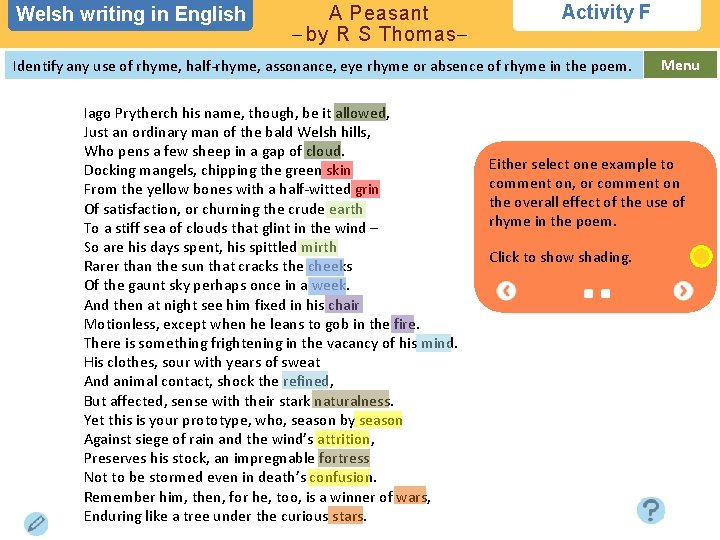
Welsh writing in in English A Peasant – by R S Thomas– Activity F Identify any use of rhyme, half-rhyme, assonance, eye rhyme or absence of rhyme in the poem. Iago Prytherch his name, though, be it allowed, Just an ordinary man of the bald Welsh hills, Who pens a few sheep in a gap of cloud. Docking mangels, chipping the green skin From the yellow bones with a half-witted grin Of satisfaction, or churning the crude earth To a stiff sea of clouds that glint in the wind – So are his days spent, his spittled mirth Rarer than the sun that cracks the cheeks Of the gaunt sky perhaps once in a week. And then at night see him fixed in his chair Motionless, except when he leans to gob in the fire. There is something frightening in the vacancy of his mind. His clothes, sour with years of sweat And animal contact, shock the refined, But affected, sense with their stark naturalness. Yet this is your prototype, who, season by season Against siege of rain and the wind’s attrition, Preserves his stock, an impregnable fortress Not to be stormed even in death’s confusion. Remember him, then, for he, too, is a winner of wars, Enduring like a tree under the curious stars. Menu Either select one example to comment on, or comment on the overall effect of the use of rhyme in the poem. Click to show shading.
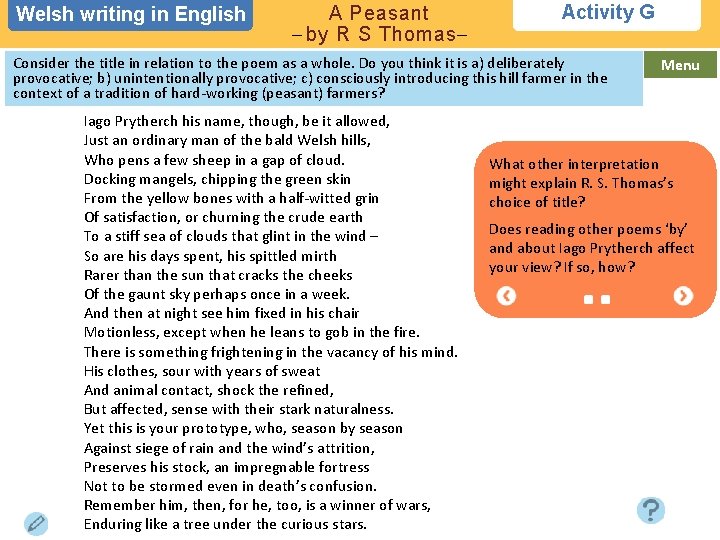
Welsh writing in in English A Peasant – by R S Thomas– Activity G Consider the title in relation to the poem as a whole. Do you think it is a) deliberately provocative; b) unintentionally provocative; c) consciously introducing this hill farmer in the context of a tradition of hard-working (peasant) farmers? Iago Prytherch his name, though, be it allowed, Just an ordinary man of the bald Welsh hills, Who pens a few sheep in a gap of cloud. Docking mangels, chipping the green skin From the yellow bones with a half-witted grin Of satisfaction, or churning the crude earth To a stiff sea of clouds that glint in the wind – So are his days spent, his spittled mirth Rarer than the sun that cracks the cheeks Of the gaunt sky perhaps once in a week. And then at night see him fixed in his chair Motionless, except when he leans to gob in the fire. There is something frightening in the vacancy of his mind. His clothes, sour with years of sweat And animal contact, shock the refined, But affected, sense with their stark naturalness. Yet this is your prototype, who, season by season Against siege of rain and the wind’s attrition, Preserves his stock, an impregnable fortress Not to be stormed even in death’s confusion. Remember him, then, for he, too, is a winner of wars, Enduring like a tree under the curious stars. Menu What other interpretation might explain R. S. Thomas’s choice of title? Does reading other poems ‘by’ and about Iago Prytherch affect your view? If so, how?

Welsh writing in in English Click on the highlighted words to show their meaning A Peasant – by R S Thomas– Glossary Menu Iago Prytherch his name, though, be it allowed, Just an ordinary man of the bald Welsh hills, puts (the sheep) in an enclosure Who pens a few sheep in a gap of cloud. cutting off Docking mangels, chipping the green skin variety of beet used as cattle feed part of (the From the yellow bones with a half-witted grin mangels) Of satisfaction, or churning the crude earth (here) ploughing To a stiff sea of clouds that glint in the wind – laughter So are his days spent, his spittled mirth Rarer than the sun that cracks the cheeks empty and lonely Of the gaunt sky perhaps once in a week. And then at night see him fixed in his chair Motionless, except when he leans to gob in the fire. over-respectable, There is something frightening in the vacancy of his mind. bourgeois, His clothes, sour with years of sweat well-mannered, very polite pretentious or And animal contact, shock the refined, plain, unembellished emotionally But affected, sense with their stark naturalness. stirred original from which copies are made Yet this is your prototype, who, season by season Against siege of rain and the wind’s attrition, relentless wearing down livestock; Preserves his stock, an impregnable fortress undefeatable ancestry Not to be stormed even in death’s confusion. Remember him, then, for he, too, is a winner of wars, Enduring like a tree under the curious stars.
- Slides: 9