
Wells Primary Schools Big Adventure in RTI Presented
Wells Primary School’s Big Adventure in RTI Presented by: Liz Allison, Kim Couch, Beth Mines, Sandy Tout, and Claudia Weathers
Wells Primary School Demographics Serves Pre. K-2 nd grade with 403 students 58% White 40 % African American 2% Multiracial 58% Free or Reduced Lunch-Title I school
Response-to-Intervention: Ten Questions Parents Should Ask 1. Is the school district currently using an RTI process to provide additional support to struggling students? If not, do they plan to? 2. What screening procedures are used to identify students in need of intervention? 3. What are the interventions and instructional programs being used? What research supports their effectiveness? 4. What process is used to determine the intervention that will be provided? 5. What length of time is allowed for an intervention before determining if the student is making adequate progress?
Questions Continued 6. What strategy is being used to monitor student progress? What are the types of data that will be collected and how will student progress be conveyed to parents? 7. Is a written intervention plan provided to parents as part of the RTI process? 8. Is the teacher or other person responsible for providing the interventions trained in using them? 9. When and how will information about a student’s performance and progress be provided? 10. At what point in the RTI process are students who are suspected of having a learning disability referred formal evaluation?
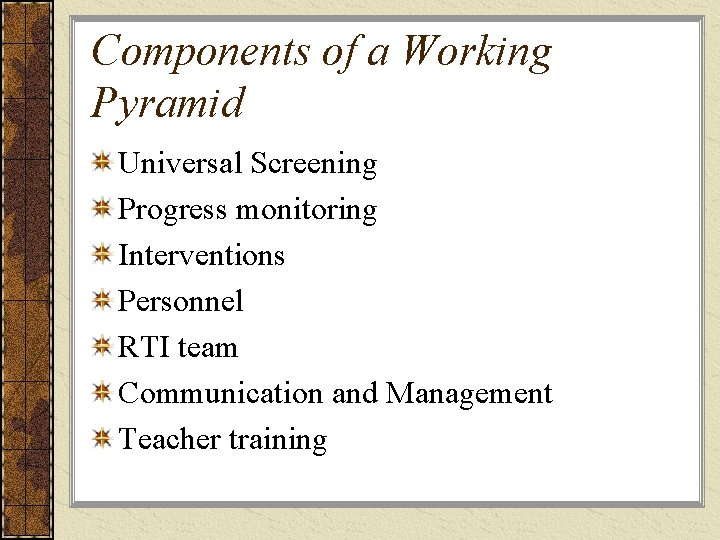
Components of a Working Pyramid Universal Screening Progress monitoring Interventions Personnel RTI team Communication and Management Teacher training
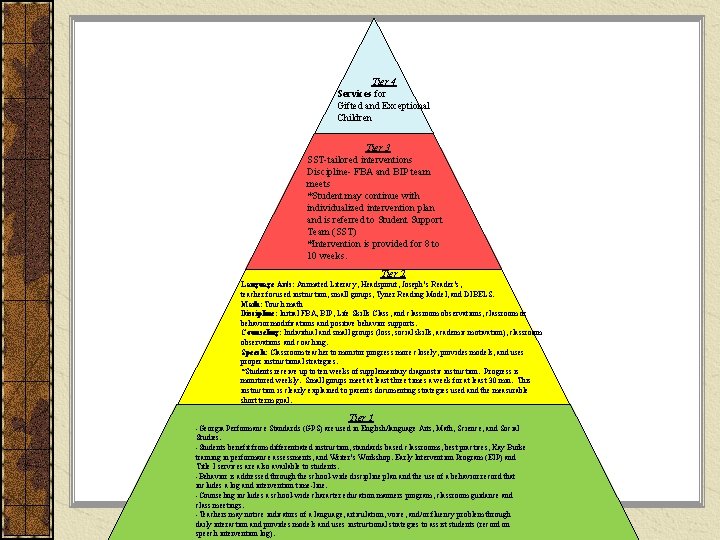
Tier 4 Services for Gifted and Exceptional Children Tier 3 SST-tailored interventions Discipline- FBA and BIP team meets *Student may continue with individualized intervention plan and is referred to Student Support Team (SST) *Intervention is provided for 8 to 10 weeks. Tier 2 Language Arts: Animated Literacy, Headsprout, Joseph’s Reader’s, teacher focused instruction, small groups, Tyner Reading Model, and DIBELS. Math: Touch math Discipline: Initial FBA, BIP, Life Skills Class, and classroom observations, classroom or behavior modifications and positive behavior supports. Counseling: Individual and small groups (loss, social skills, academic motivation), classroom observations and coaching. Speech: Classroom teacher to monitor progress more closely, provides models, and uses proper instructional strategies. *Students receive up to ten weeks of supplementary diagnostic instruction. Progress is monitored weekly. Small groups meet at least three times a week for at least 30 min. This instruction is clearly explained to parents documenting strategies used and the measurable short term goal. Tier 1 -Georgia Performance Standards (GPS) are used in English/language Arts, Math, Science, and Social Studies. -Students benefit from differentiated instruction, standards based classrooms, best practices, Kay Burke training in performance assessments, and Writer’s Workshop. Early Intervention Program (EIP) and Title I services are also available to students. -Behavior is addressed through the school-wide discipline plan and the use of a behavior record that includes a log and intervention time-line. -Counseling includes a school-wide character education manners program, classroom guidance and class meetings. -Teachers may notice indicators of a language, articulation, voice, and/or fluency problem through daily interaction and provides models and uses instructional strategies to assist students (record on speech intervention log).
Academics SSTAGE Conference January 24 th, 2008 Presented by: Claudia Weathers
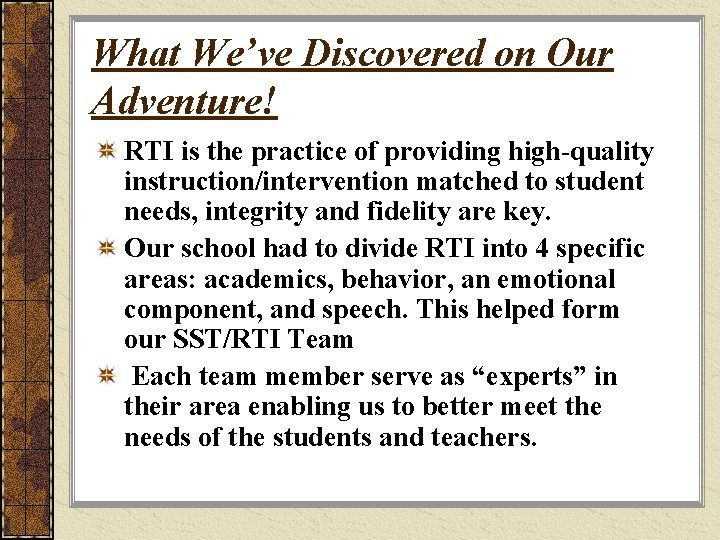
What We’ve Discovered on Our Adventure! RTI is the practice of providing high-quality instruction/intervention matched to student needs, integrity and fidelity are key. Our school had to divide RTI into 4 specific areas: academics, behavior, an emotional component, and speech. This helped form our SST/RTI Team Each team member serve as “experts” in their area enabling us to better meet the needs of the students and teachers.
More Discoveries!!! Our team meets monthly to discuss specific students and interventions. Behavior & Social Emotional representatives also meet bimonthly with administration. Teachers know who they need to contact depending upon the type of assistance they need. This has been critical. Each area uses the core principals that guide the RTI process as defined by the state.
Current Formal Assessments Georgia CRCT GKAP New County Benchmark Tests (all content areas) Pre-K Screening Lexia CRT (K Readiness, Phonics & Decoding Skills, Dolch Words)
Current Informal Assessments Informal Reading Inventories Qualitative Reading Inventories (Fluency rates & comprehension skills) Teacher Observations/Anecdotal Records Spelling Inventories ( Developmental spelling stages) Monthly GPS Math Performance Tasks
What screening procedures are used to identify students in need of intervention? Kindergarten: Lexia, County Benchmarks, GKAP First Grade: Lexia, County Benchmarks Second Grade: CRCT, Lexia, County Benchmarks
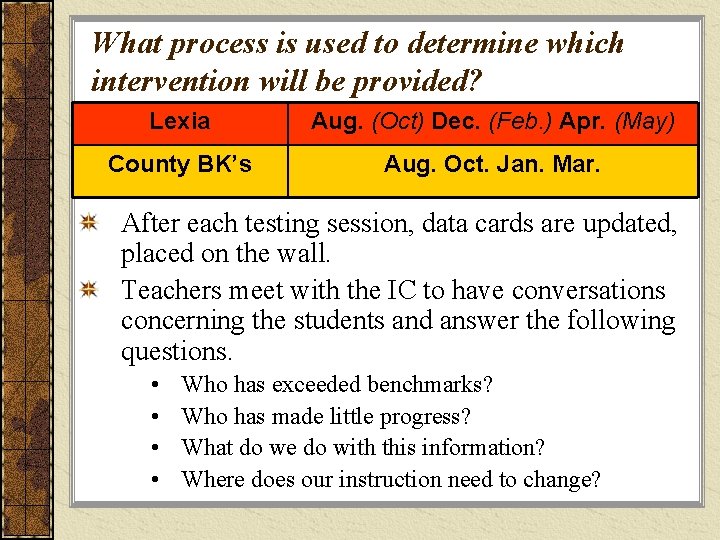
What process is used to determine which intervention will be provided? Lexia Aug. (Oct) Dec. (Feb. ) Apr. (May) County BK’s Aug. Oct. Jan. Mar. After each testing session, data cards are updated, placed on the wall. Teachers meet with the IC to have conversations concerning the students and answer the following questions. • • Who has exceeded benchmarks? Who has made little progress? What do we do with this information? Where does our instruction need to change?
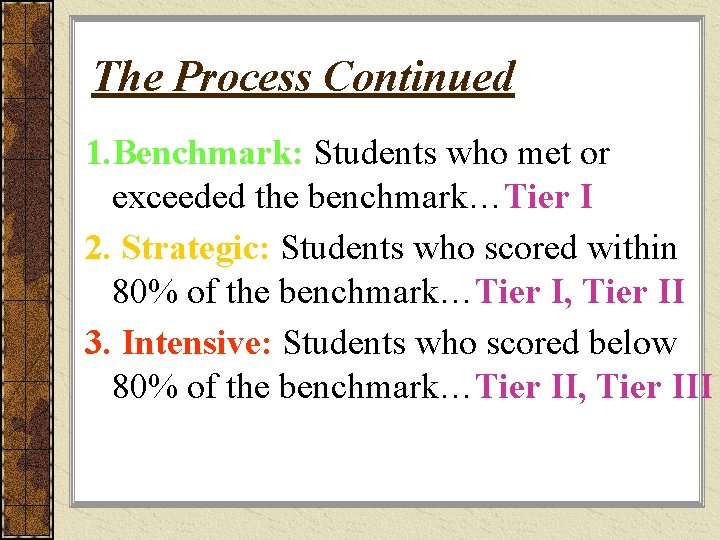
The Process Continued 1. Benchmark: Students who met or exceeded the benchmark…Tier I 2. Strategic: Students who scored within 80% of the benchmark…Tier I, Tier II 3. Intensive: Students who scored below 80% of the benchmark…Tier II, Tier III
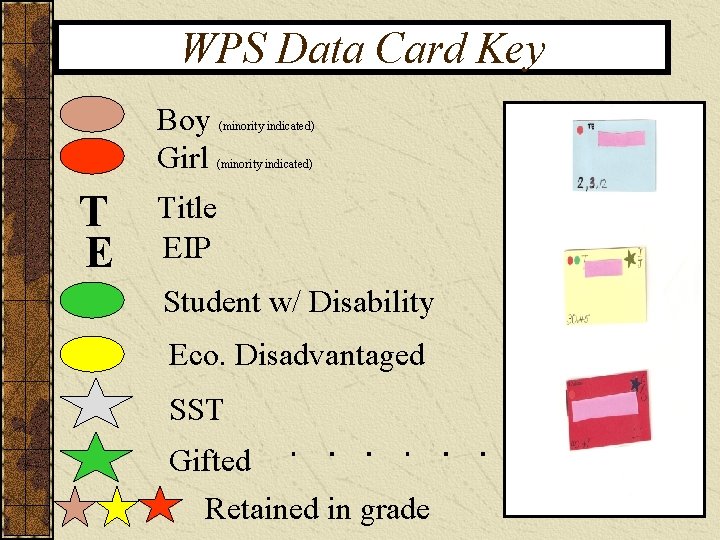
WPS Data Card Key Boy Girl T E (minority indicated) Title EIP Student w/ Disability Eco. Disadvantaged SST Gifted Retained in grade
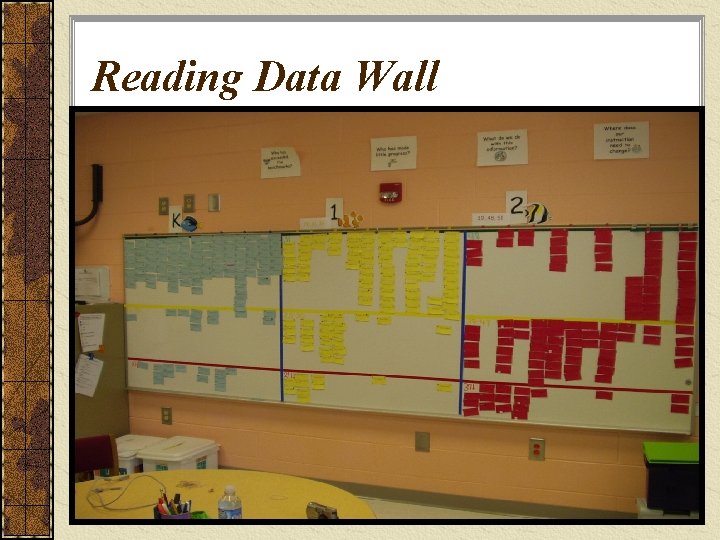
Reading Data Wall
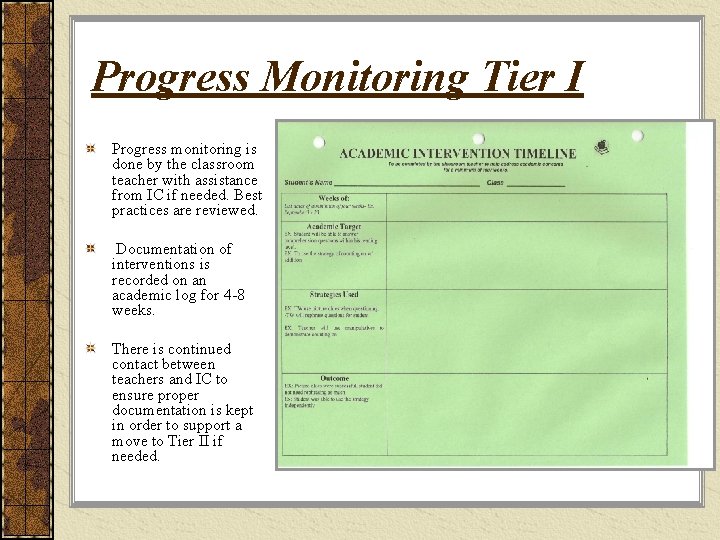
Progress Monitoring Tier I Progress monitoring is done by the classroom teacher with assistance from IC if needed. Best practices are reviewed. Documentation of interventions is recorded on an academic log for 4 -8 weeks. There is continued contact between teachers and IC to ensure proper documentation is kept in order to support a move to Tier II if needed.
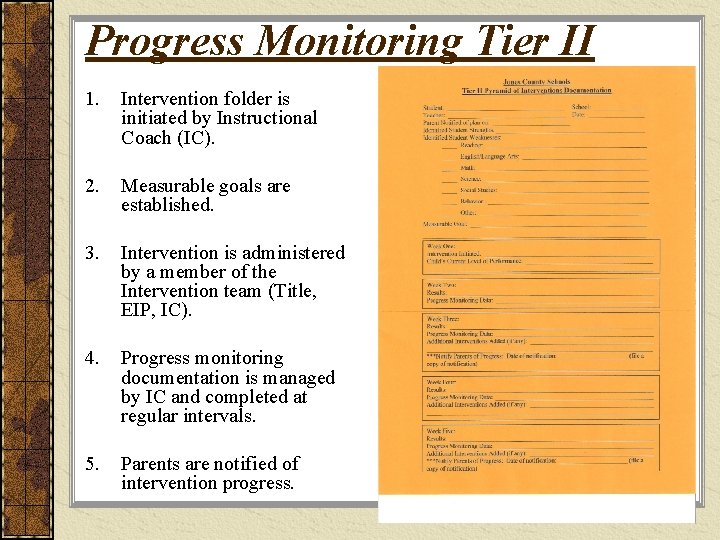
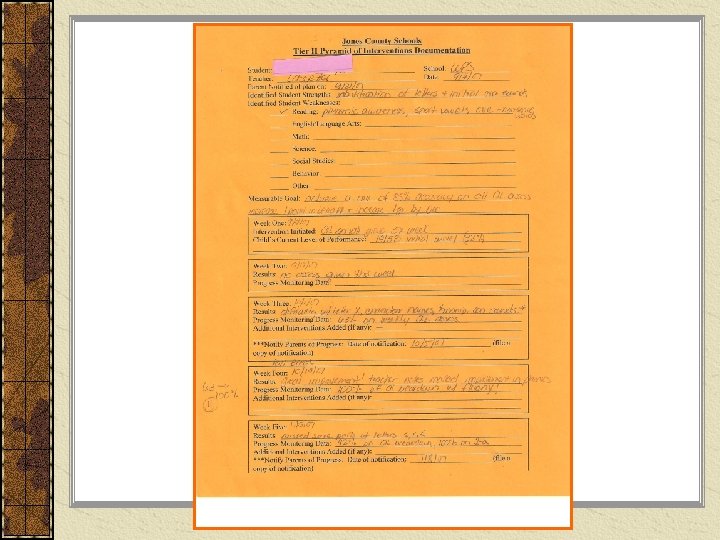
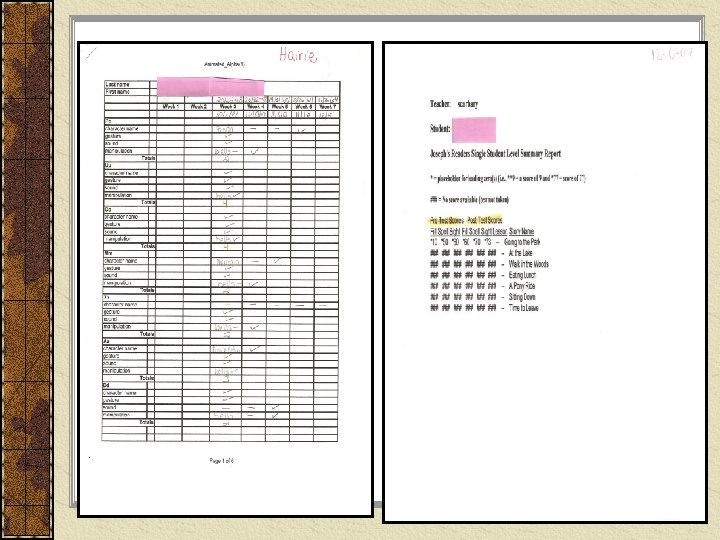
Progress Monitoring Tier II 1. Intervention folder is initiated by Instructional Coach (IC). 2. Measurable goals are established. 3. Intervention is administered by a member of the Intervention team (Title, EIP, IC). 4. Progress monitoring documentation is managed by IC and completed at regular intervals. 5. Parents are notified of intervention progress.
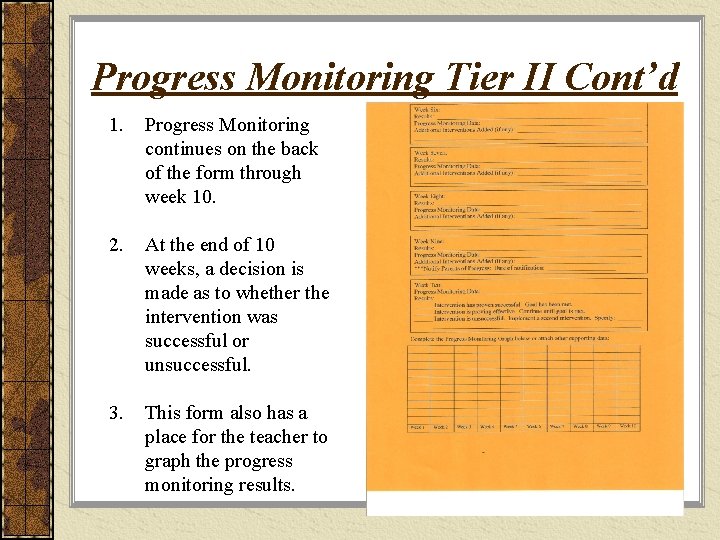
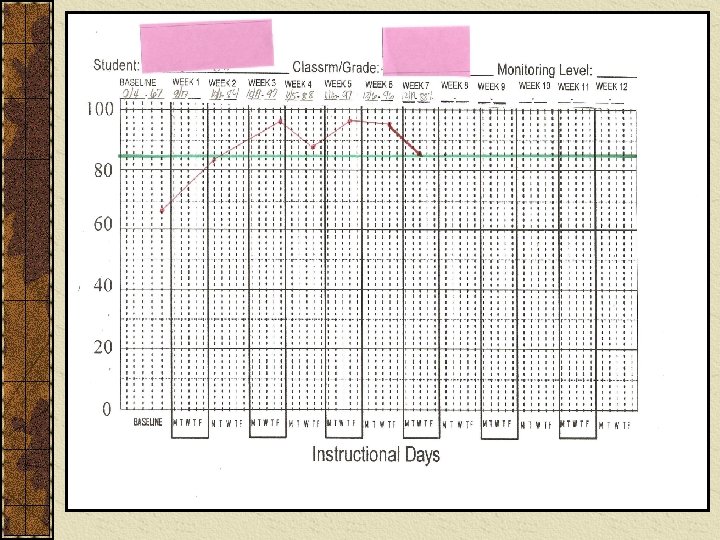
Progress Monitoring Tier II Cont’d 1. Progress Monitoring continues on the back of the form through week 10. 2. At the end of 10 weeks, a decision is made as to whether the intervention was successful or unsuccessful. 3. This form also has a place for the teacher to graph the progress monitoring results.
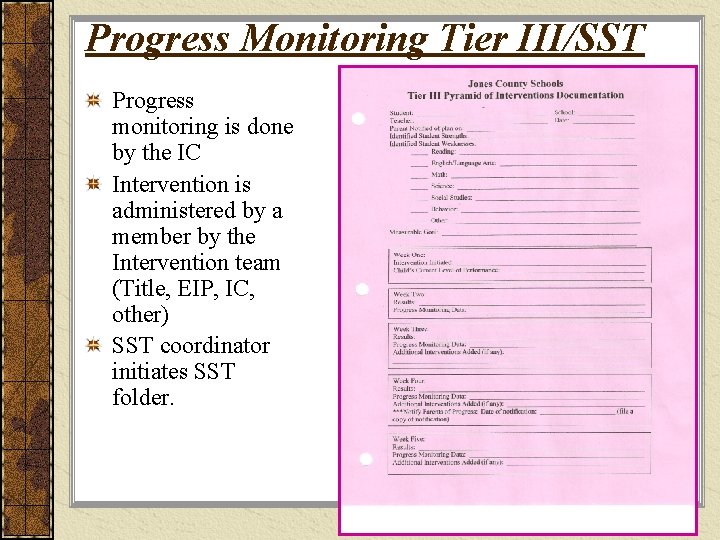
Progress Monitoring Tier III/SST Progress monitoring is done by the IC Intervention is administered by a member by the Intervention team (Title, EIP, IC, other) SST coordinator initiates SST folder.
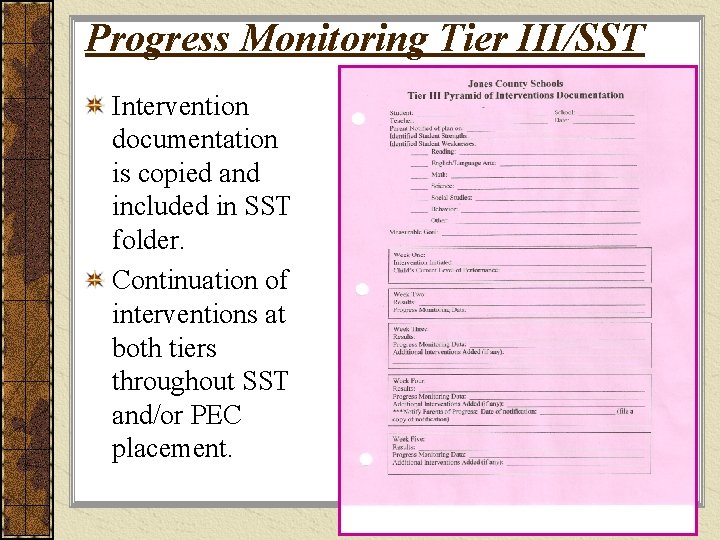
Progress Monitoring Tier III/SST Intervention documentation is copied and included in SST folder. Continuation of interventions at both tiers throughout SST and/or PEC placement.
What are the interventions and instructional programs being used? Title I, EIP, reduced size, best practices Animated Literacy Headsprout Joseph’s Readers Road to the Code Touch Math Writer’s Workshop DIBELS CBM Math Tasks
RTI and Behavior Presented by Kim Couch, Ed. D. 1. 2. 3. 4. Screeners Interventions Progress Monitoring--embedded Personnel--RTI behavior person and teacher
The First Step: Screening Procedures In the area of behavior, Wells Primary School uses the following screeners: Behavior Record--started on Tier I and maintained through Tiers II, III, and IV by teacher. Observations-- used for all tiers, part of school wide discipline plan Functional Behavior Assessment (FBA) may be used as a screener on Tiers II, III, and IV.
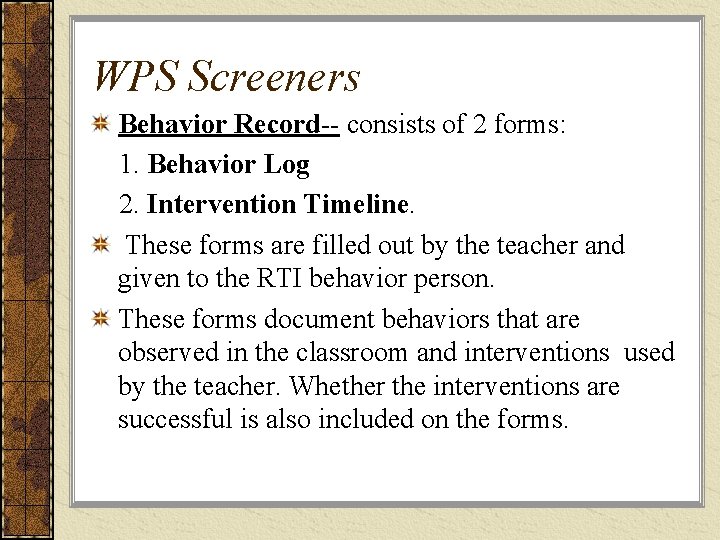
WPS Screeners Behavior Record-- consists of 2 forms: 1. Behavior Log 2. Intervention Timeline. These forms are filled out by the teacher and given to the RTI behavior person. These forms document behaviors that are observed in the classroom and interventions used by the teacher. Whether the interventions are successful is also included on the forms.

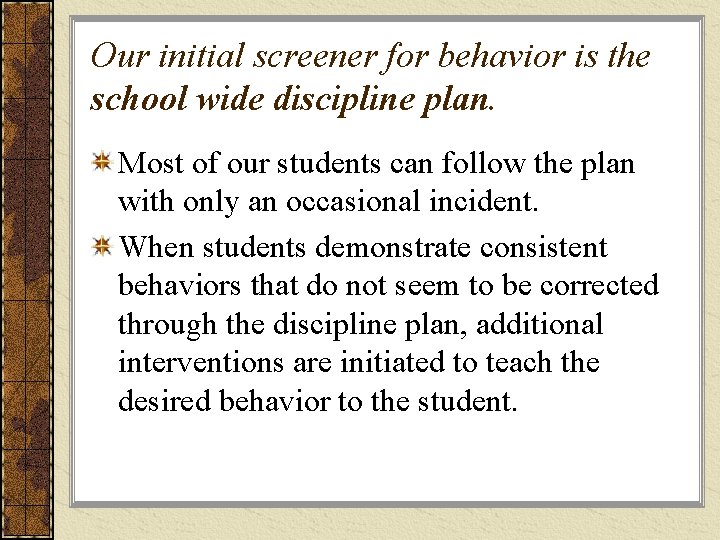
Our initial screener for behavior is the school wide discipline plan. Most of our students can follow the plan with only an occasional incident. When students demonstrate consistent behaviors that do not seem to be corrected through the discipline plan, additional interventions are initiated to teach the desired behavior to the student.
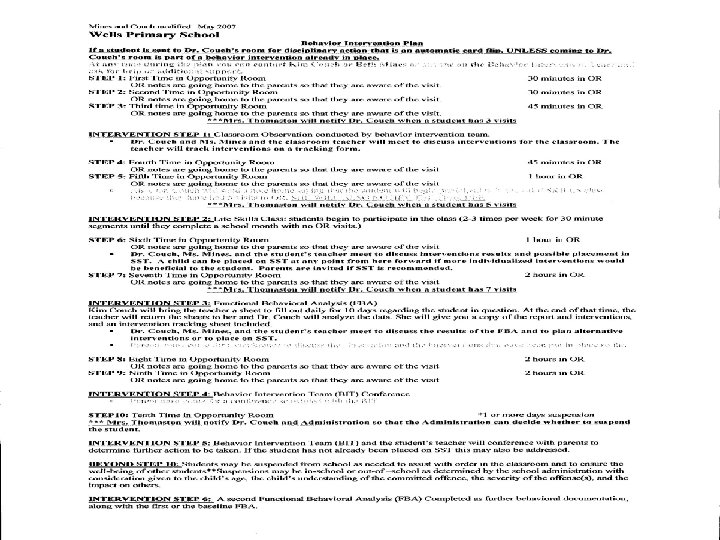
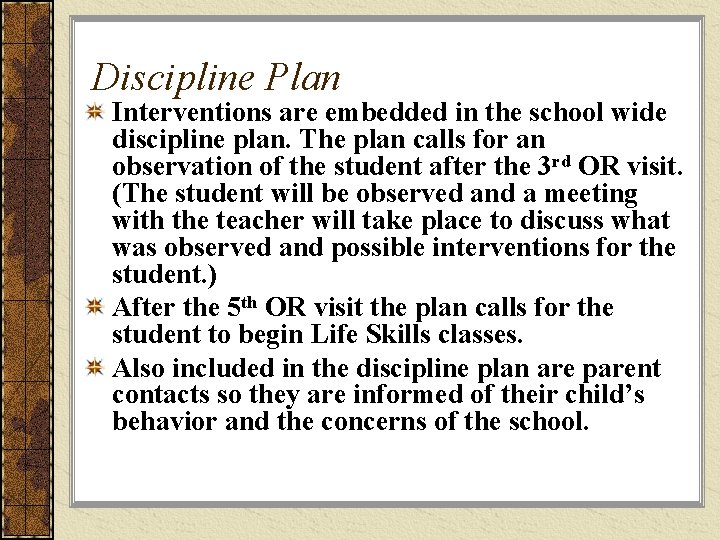
Discipline Plan Interventions are embedded in the school wide discipline plan. The plan calls for an observation of the student after the 3 rd OR visit. (The student will be observed and a meeting with the teacher will take place to discuss what was observed and possible interventions for the student. ) After the 5 th OR visit the plan calls for the student to begin Life Skills classes. Also included in the discipline plan are parent contacts so they are informed of their child’s behavior and the concerns of the school.
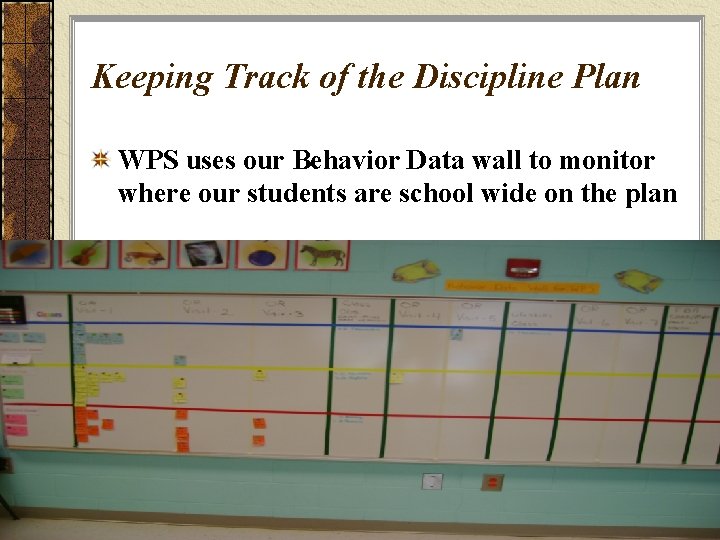
Keeping Track of the Discipline Plan WPS uses our Behavior Data wall to monitor where our students are school wide on the plan
Behavioral Interventions Tier I interventions such as student positive behavior training are based on programs by child psychologists Dr. John Rosemond and Dr. James Dobson. Our Tier I and II interventions including use of a timeout area or calm down place also come from Rosemond and Dobson programs.
Interventions Continued Our Tier II, III, and IV interventions including “behavioral retraining” come from the Boys Town Model. (teaching students EXACTLY how they are to walk in a line, sit in a chair, or greet an adult) Our life skills class teaches appropriate classroom and school behavior. It’s developed from the “Discipline Success” strategies developed by Dr. Terry Alderman, and is a Tier II and III intervention.
Starting the Tiers To move a student from Tier I to Tier II the teacher contacts me (RTI behavior person) to let me know there is an issue with a student. I give the teacher the Behavior Log forms. She documents behavior for 10 days. We meet and discuss the documentation. The documentation done by the teacher allows us to target a behavior and determine the appropriate intervention to use.
Tiers Continued The teacher and RTI behavior person decide which behavior to target and what intervention. Parents and/or counselor may be included as well. The teacher will use the intervention and document results for 3 -4 weeks -- progress monitoring We reconvene to discuss results and decide if the student should be moved to Tier II or if another intervention should be tried first.
Moving to Tier II The RTI Behavior person and the teacher meet and discuss documentation the teacher has collected -Progress monitoring. The Teacher and RTI behavior person decide a student needs to be moved to tier II only after they have tried and documented various interventions for targeted behavior. YOU MUST HAVE DOCUMENTATION THAT SUPPORTS YOUR DECISION. At this meeting a specific targeted behavior and a specific intervention are decided upon for Tier II (other RTI members and the parents may be invited to the meeting).
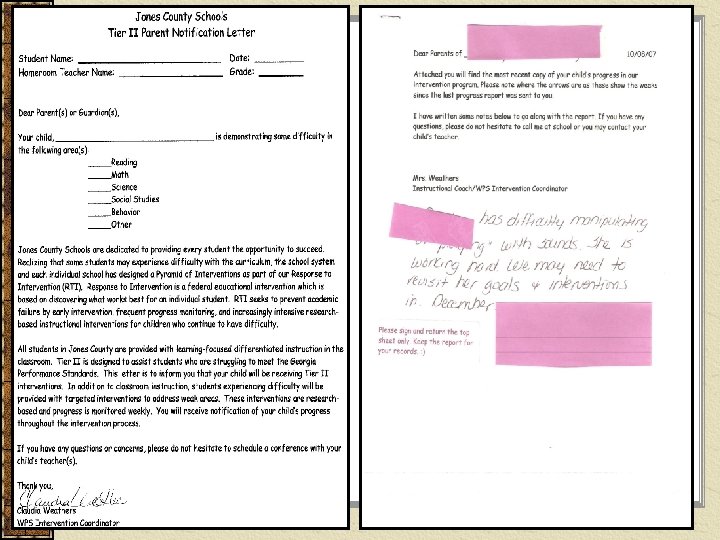
Tier II Continued Tier II forms are filled out and maintained by RTI behavior person (this is done for each area of RTI). The other members of RTI team and parents of the student are notified– if not at meeting. A formal letter is sent to the parents. The teacher should continue to maintain behavior log -- documenting behaviors she continues to observe and her interventions– progress monitoring.
Moving to Tier III/SST The student should remain on Tier II for 6 -8 weeks. The Tier II intervention forms show that specific behaviors were targeted and specific interventions were used and unsuccessful –progress monitoring. There is parent contact which is documented.
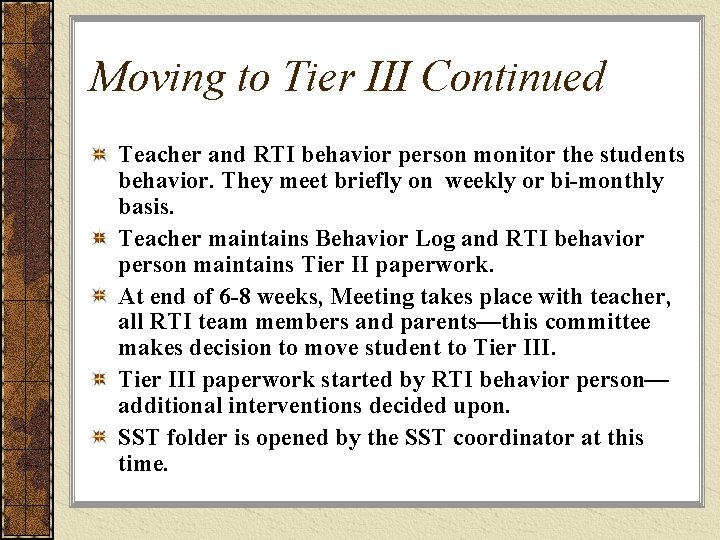
Moving to Tier III Continued Teacher and RTI behavior person monitor the students behavior. They meet briefly on weekly or bi-monthly basis. Teacher maintains Behavior Log and RTI behavior person maintains Tier II paperwork. At end of 6 -8 weeks, Meeting takes place with teacher, all RTI team members and parents—this committee makes decision to move student to Tier III paperwork started by RTI behavior person— additional interventions decided upon. SST folder is opened by the SST coordinator at this time.
- Slides: 42