
WELLNESS CHAMPION RETREAT BURNOUT FROM A SYSTEMIC APPROACH
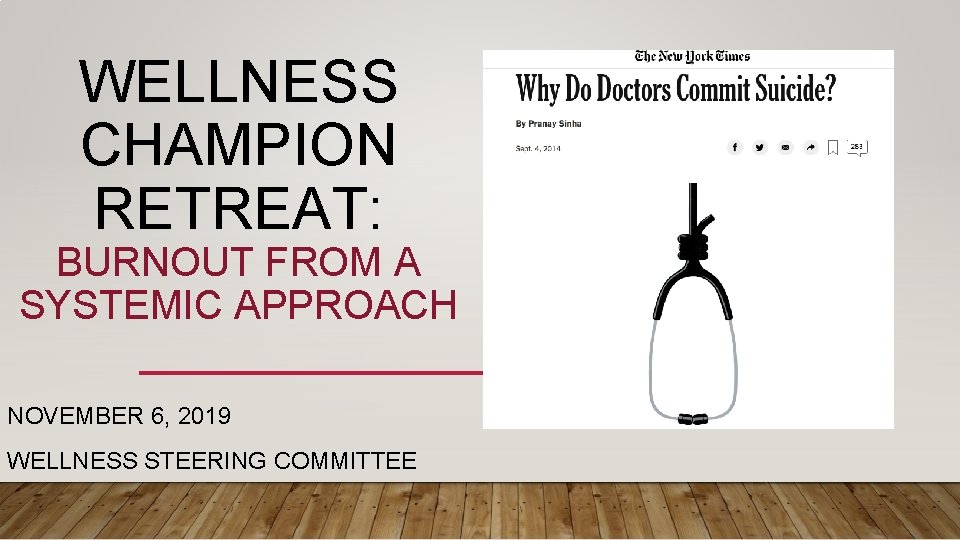
WELLNESS CHAMPION RETREAT: BURNOUT FROM A SYSTEMIC APPROACH NOVEMBER 6, 2019 WELLNESS STEERING COMMITTEE SAINT LOUIS UNIVERSITY SCHOOL OF MEDICINE GME
WELLNESS CHAMPION MISSION STATEMENT • Mission: Psychological, emotional, spiritual and physical well-being are critical for a competent, caring, and resilient health care professional. Saint Louis University School of Medicine will foster a culture of well-being and self-care through its Wellness Champion Program. • Vision: The Wellness Champion Program will facilitate wellness activities in Graduate Medical and Graduate Research Education through the personal and collaborative activities of the Wellness Champions and will support the development of wellness initiatives within programs at the School of Medicine.
AGENDA • Reflection • Why focus on the system? • Discussion • Personal writing exercise
REFLECTION: PASTORAL CARE
WELLNESS & WELL-BEING DEFINED wellness noun well·ness | ˈwelnəs Definition of wellness : the quality or state of being in good health especially as an actively sought goal well-being noun well-be·ing | ˈwel-ˈbē-iŋ Definition of well-being : the state of being happy, healthy, or prosperous
BURNOUT DEFINED • ”Loss of enthusiasm for work, feelings of cynicism, and a low sense of personal accomplishment" • As defined by Mayo Clinic/AMA study • A syndrome of emotional exhaustion, depersonalization, and feelings of decreased personal accomplishment
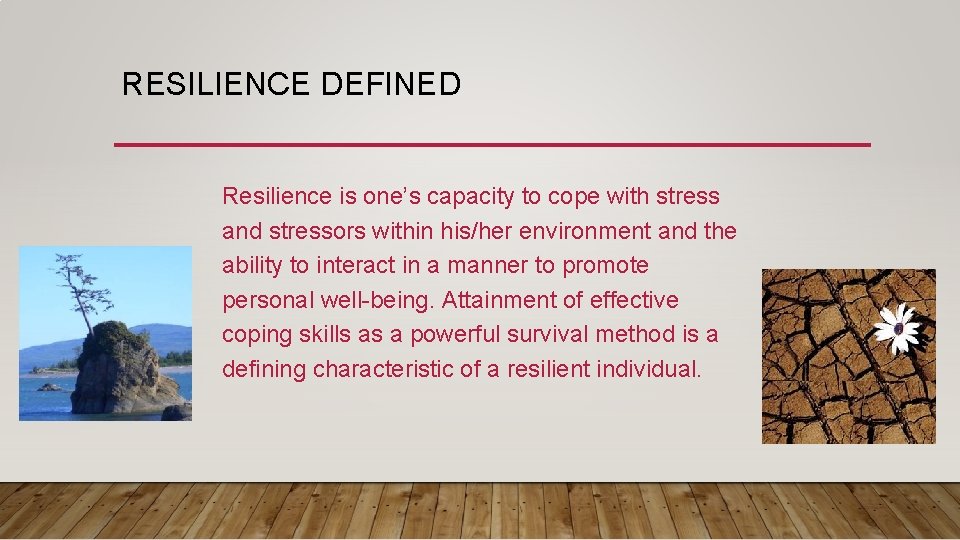
RESILIENCE DEFINED Resilience is one’s capacity to cope with stress and stressors within his/her environment and the ability to interact in a manner to promote personal well-being. Attainment of effective coping skills as a powerful survival method is a defining characteristic of a resilient individual.
Feeling stressed? Overloaded? There's an app to help with that. Sara Berg, AMA. OCTOBER 14, 2019 • “When we talk about individual-level psychological interventions like Headspace, we’re really putting the onus on the person to reduce their stress levels, ” said Crosswell. “A lot of times the conversation ignores the fact that there are systemic changes that need to happen—in particular in the medical community—that reduces stress levels for everyone. ”
BURNOUT CONTRIBUTORS • Change in work environment • Rapid changes in knowledge and technology • Production pressure • Work compression • Financial pressure • EHR Kuhn, C. M. & Flanagan, E. M. Can J Anesth/J Can Anesth (2017) 64: 158. • Study found each intern spent: < eight minutes with each patient per day • Total work time with direct patient contact: 12% • indirect patient care activities (orders, communicating with other physicians, and writing/reading progress notes): 66%
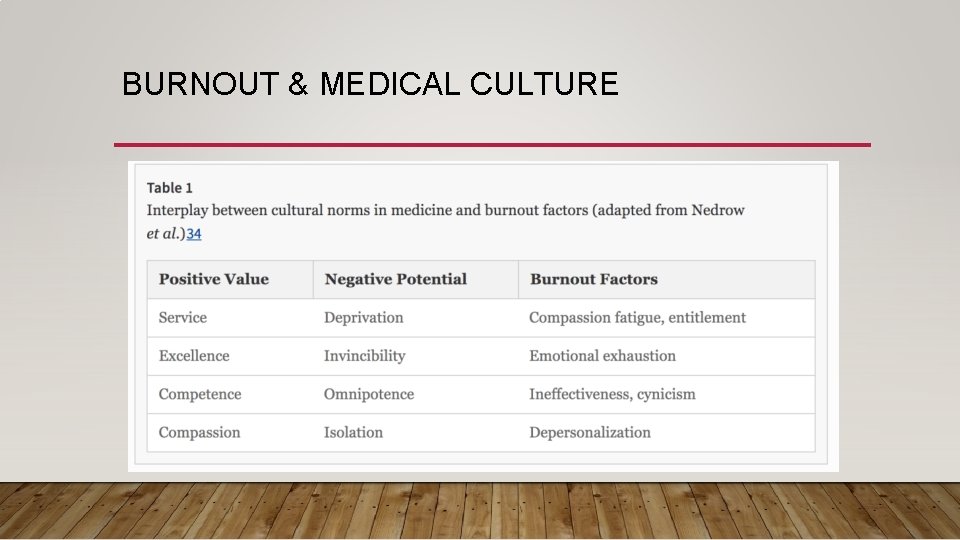
BURNOUT & MEDICAL CULTURE
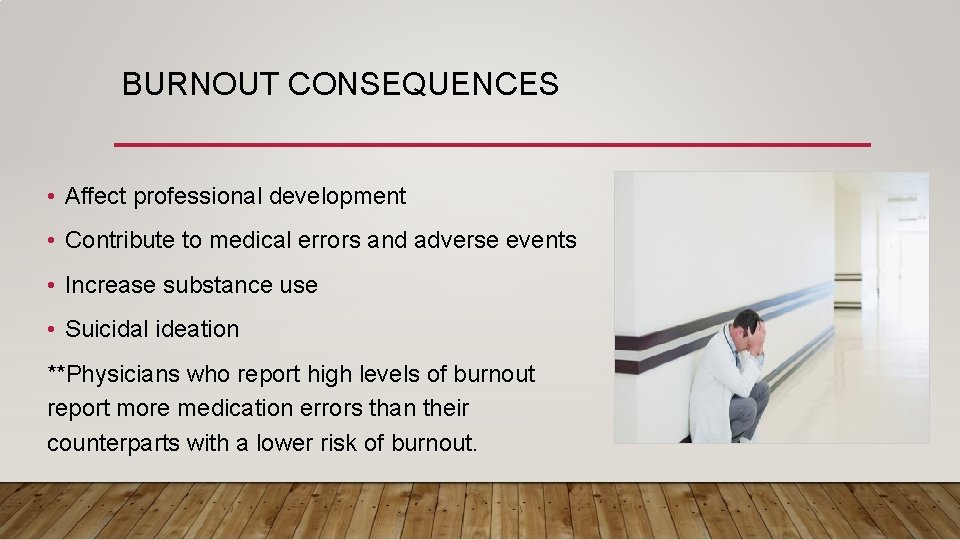
BURNOUT CONSEQUENCES • Affect professional development • Contribute to medical errors and adverse events • Increase substance use • Suicidal ideation **Physicians who report high levels of burnout report more medication errors than their counterparts with a lower risk of burnout.
DEPRESSION IN PHYSICIANS • Medical student/resident depression rates are 15 -30% despite equal prevalence at the beginning of med school. • Overall, depression rates are 12% in male and 19. 5% in female physicians, similar to general population. Bright & Krahn, 2011 Suicidal ideation pre-intern year 4% Suicidal ideation intern year 25% Sen, et al 2010
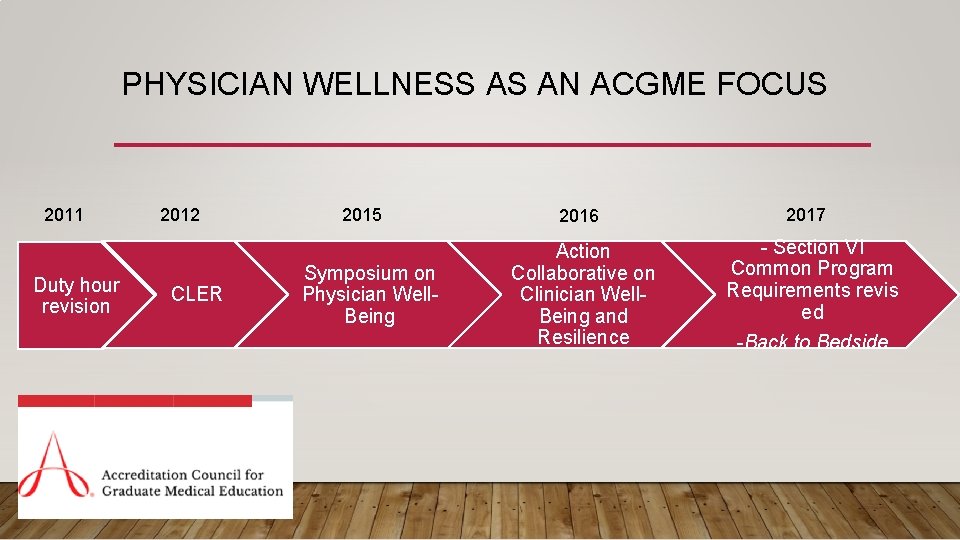
PHYSICIAN WELLNESS AS AN ACGME FOCUS 2011 Duty hour revision 2012 CLER 2015 Symposium on Physician Well. Being 2016 Action Collaborative on Clinician Well. Being and Resilience 2017 - Section VI Common Program Requirements revis ed -Back to Bedside
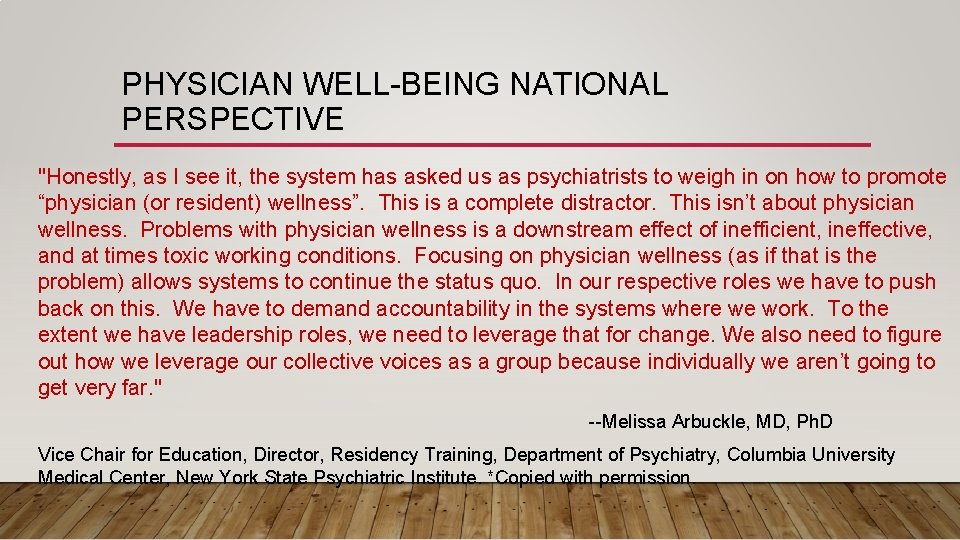
PHYSICIAN WELL-BEING NATIONAL PERSPECTIVE "Honestly, as I see it, the system has asked us as psychiatrists to weigh in on how to promote “physician (or resident) wellness”. This is a complete distractor. This isn’t about physician wellness. Problems with physician wellness is a downstream effect of inefficient, ineffective, and at times toxic working conditions. Focusing on physician wellness (as if that is the problem) allows systems to continue the status quo. In our respective roles we have to push back on this. We have to demand accountability in the systems where we work. To the extent we have leadership roles, we need to leverage that for change. We also need to figure out how we leverage our collective voices as a group because individually we aren’t going to get very far. " --Melissa Arbuckle, MD, Ph. D Vice Chair for Education, Director, Residency Training, Department of Psychiatry, Columbia University Medical Center, New York State Psychiatric Institute. *Copied with permission.
STRATEGY FOR IMPROVING WELLNESS IN PHYSICIANS 1. Attention to the physician as an individual 2. Address the stressors of the particular work setting (e. g. , clinical unit or department) 3. Institutional approaches 4. National policies and strategies addressing physician wellness Kuhn, C. M. & Flanagan, E. M. Can J Anesth/J Can Anesth (2017) 64: 158.
REFLECTION • We are creative, resilient individuals. How can we lead in our department, institution, system, nationally?
SUMMARY • Physicians complete suicide at alarming rates, more so than any other profession • Strategies to improve physician well-being are going to requires us to look at: • Individual resilience, burnout, identification and treatment of depression/mental illness • Department- and institution-level strategies to improve work-life balance and work environment/expectations • National advocacy with physician representation in the business of healthcare
DISCUSSION • Small groups • What have you done to make change at SLU? • What are the reasonable goals for small change in your everyday culture? Larger goals from an institution level?
GOALS • Writing exercise
THANK YOU CONFIDENTIAL Behavioral Health Program 314. 977. 1066 Appointment Scheduling/ 24 -hour Clinician On-Call National Suicide Prevention Lifeline Call 1 -800 -273 -8255 Available 24 hours everyday
- Slides: 20