
WELLCOME TO MY PRESENTATION Presented By Md Ashraful
WELLCOME TO MY PRESENTATION Presented By Md. Ashraful Hoque Junior Instructor (Tech/Mechanical) Mechanical Technology Dhaka Polytechnic Institute
Subject : Strength of Materials Sub: Code: 67064 Chapter -03 • Topics: Understand thermal stresses and strains
After the end of this lesson students will able to; • Define thermal stresses and strains. • Explain the method of thermal stresses in simple bars, circular tapering section and bars of varying section. • Explain thermal stresses in composite bar. • Superposition of thermal stresses. • Solve problems related to thermal stresses.
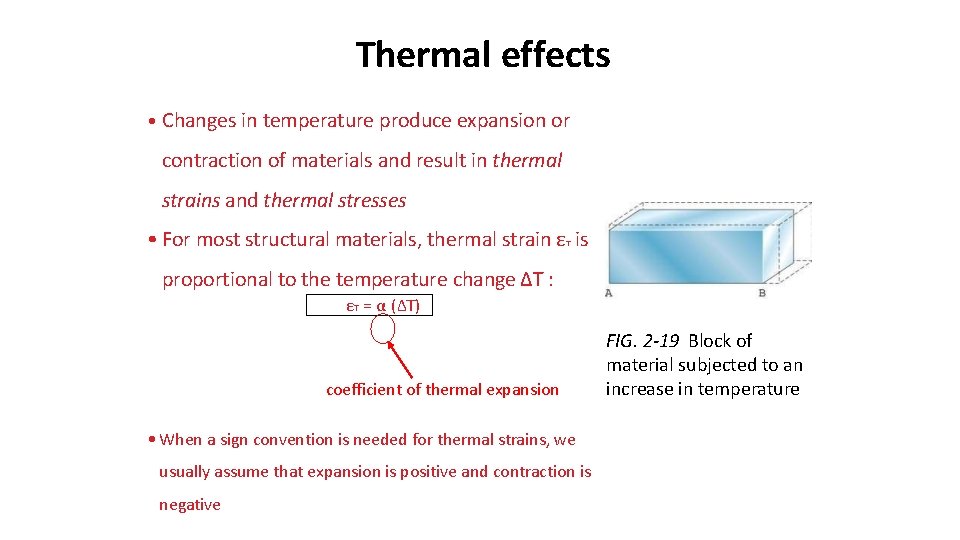
Thermal effects • Changes in temperature produce expansion or contraction of materials and result in thermal strains and thermal stresses • For most structural materials, thermal strain ε is T proportional to the temperature change ΔT : εT = α (ΔT) coefficient of thermal expansion • When a sign convention is needed for thermal strains, we usually assume that expansion is positive and contraction is negative FIG. 2 -19 Block of material subjected to an increase in temperature
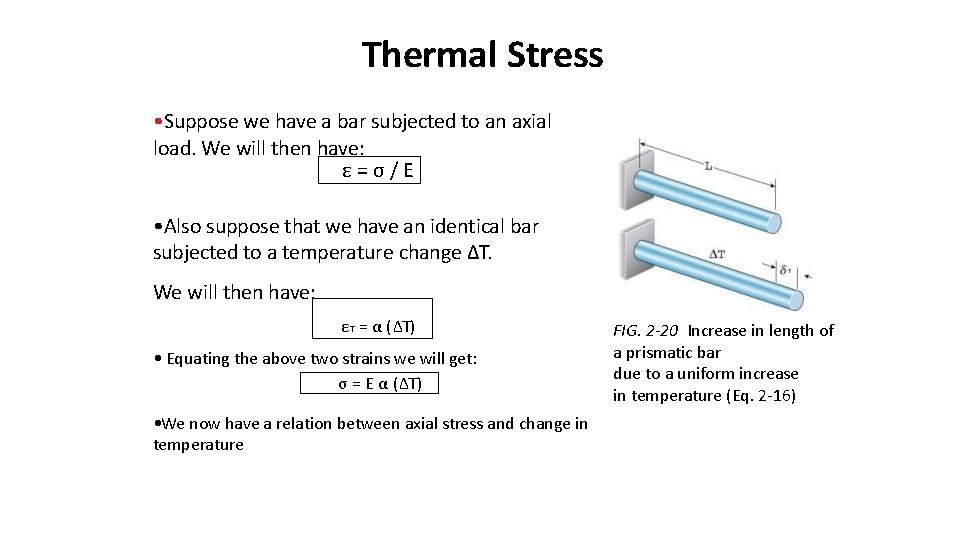
Thermal Stress • Suppose we have a bar subjected to an axial load. We will then have: ε=σ/E • Also suppose that we have an identical bar subjected to a temperature change ΔT. We will then have: εT = α (ΔT) • Equating the above two strains we will get: σ = E α (ΔT) • We now have a relation between axial stress and change in temperature FIG. 2 -20 Increase in length of a prismatic bar due to a uniform increase in temperature (Eq. 2 -16)
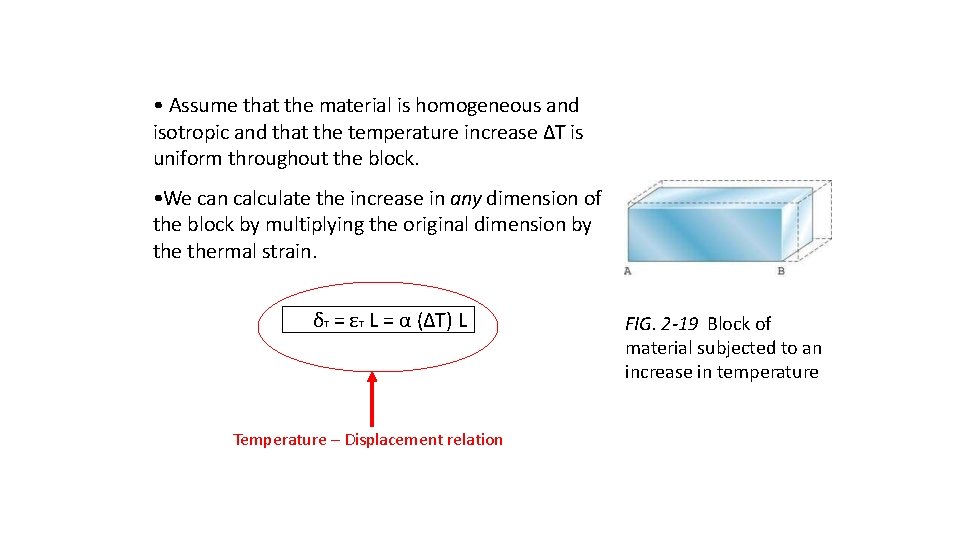
• Assume that the material is homogeneous and isotropic and that the temperature increase ΔT is uniform throughout the block. • We can calculate the increase in any dimension of the block by multiplying the original dimension by thermal strain. δT = εT L = α (ΔT) L Temperature – Displacement relation FIG. 2 -19 Block of material subjected to an increase in temperature
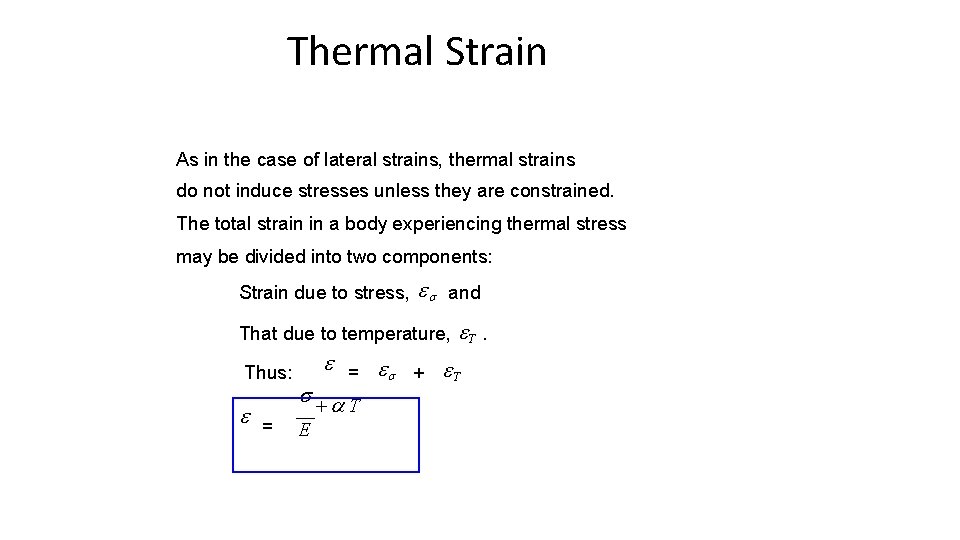
Thermal Strain As in the case of lateral strains, thermal strains do not induce stresses unless they are constrained. The total strain in a body experiencing thermal stress may be divided into two components: Strain due to stress, and That due to temperature, Thus: = T. = + T T E
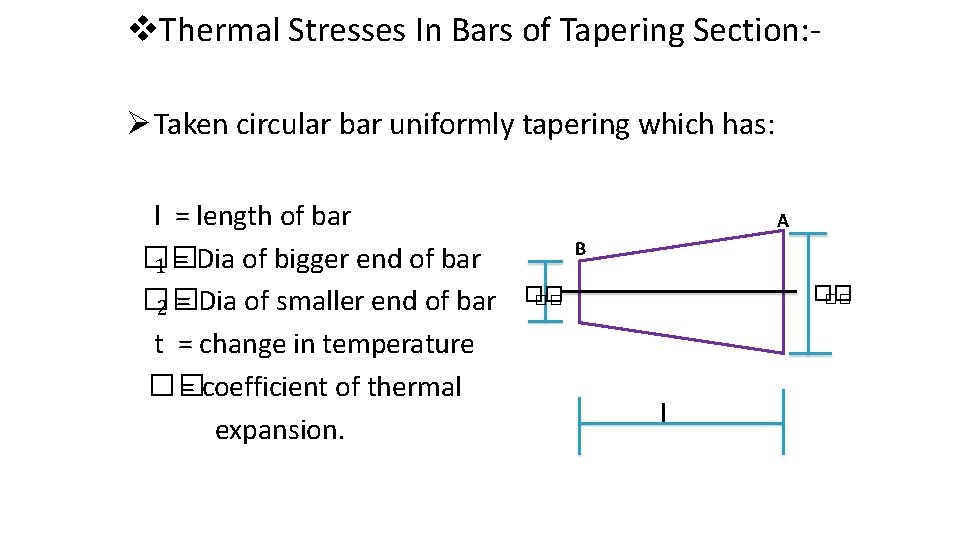
Thermal Stresses In Bars of Tapering Section: Taken circular bar uniformly tapering which has: l = length of bar �� 1 = Dia of bigger end of bar �� 2 = Dia of smaller end of bar t = change in temperature �� = coefficient of thermal expansion. A B �� �� l
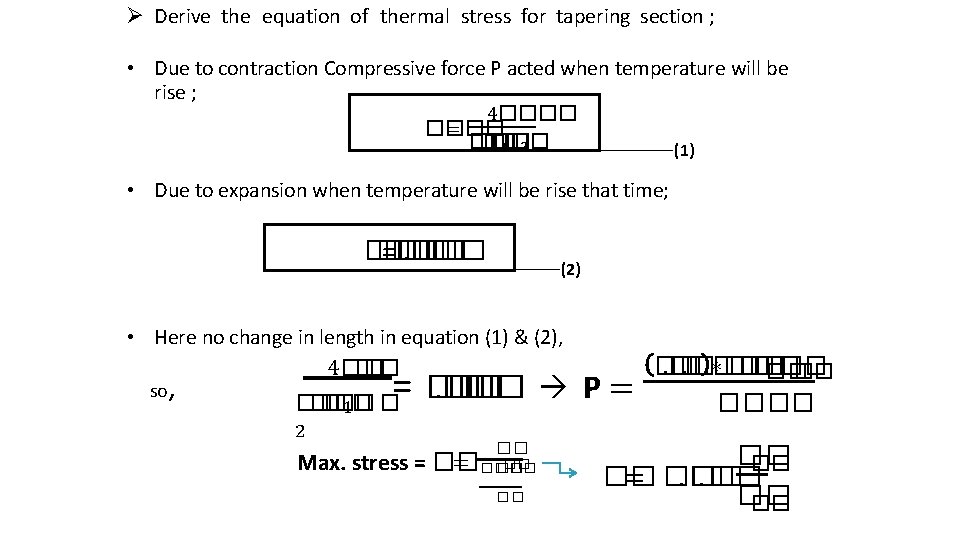
Derive the equation of thermal stress for tapering section ; • Due to contraction Compressive force P acted when temperature will be rise ; 4���� = �� �� �� 1 �� 2 (1) • Due to expansion when temperature will be rise that time; �� �� =��. �� (2) • Here no change in length in equation (1) & (2), 4�� �� so, = �� � 1 �� 2 ��. �� P = �� �� Max. stress = ���� ��. �� ∗�� ���� �� = ��. �� �� ��
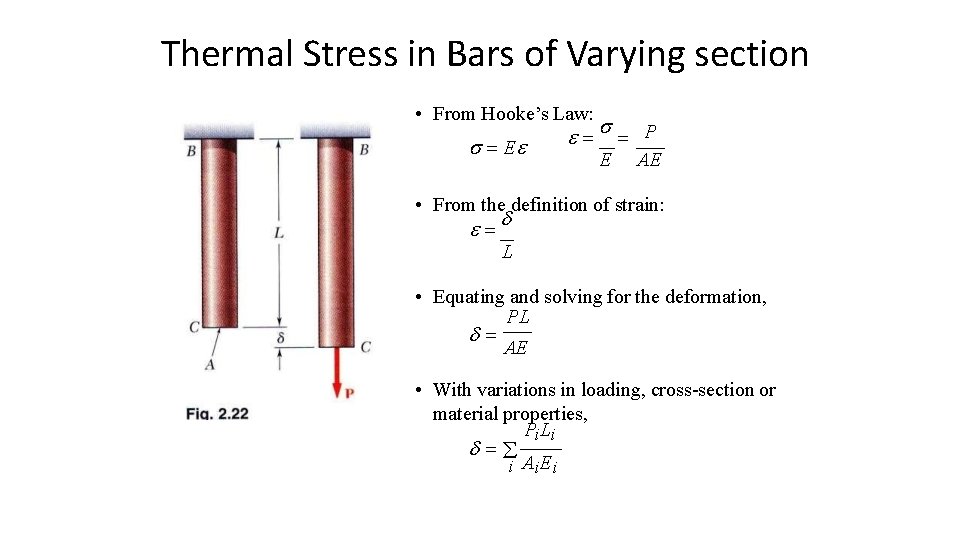
Thermal Stress in Bars of Varying section • From Hooke’s Law: P E E AE • From the definition of strain: L • Equating and solving for the deformation, PL AE • With variations in loading, cross-section or material properties, Pi Li i Ai Ei
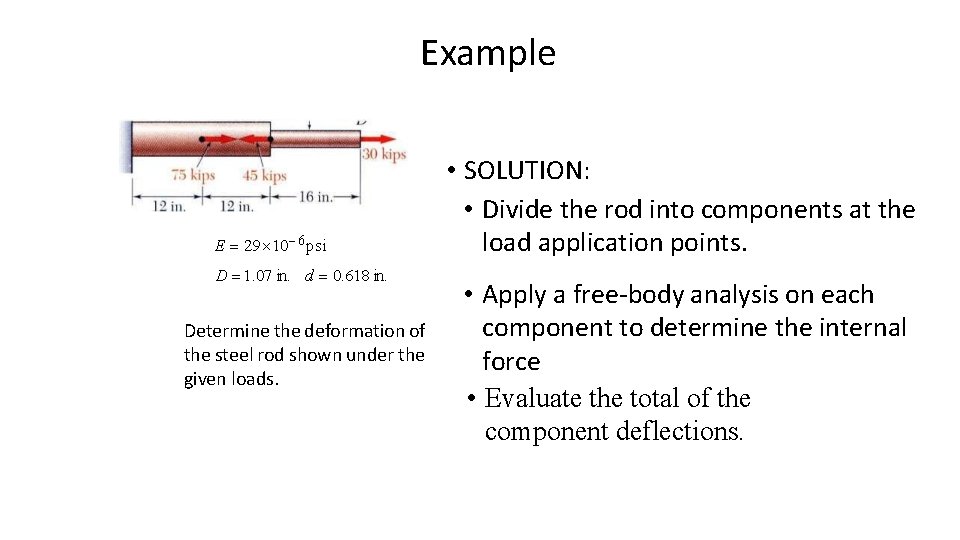
Example E 29 10 6 psi D 1. 07 in. d 0. 618 in. Determine the deformation of the steel rod shown under the given loads. • SOLUTION: • Divide the rod into components at the load application points. • Apply a free-body analysis on each component to determine the internal force • Evaluate the total of the component deflections.
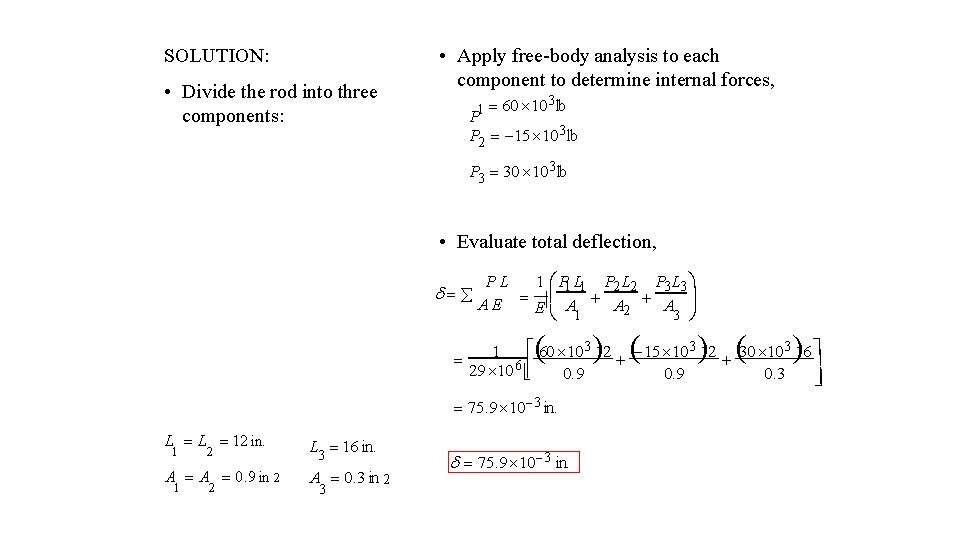
SOLUTION: • Divide the rod into three components: • Apply free-body analysis to each component to determine internal forces, 1 60 10 3 lb P P 2 15 10 3 lb P 3 30 10 3 lb • Evaluate total deflection, 1 P 1 L 1 P 2 L 2 P 3 L 3 PL A E E A A 2 A 1 3 60 103 12 15 10 3 12 30 103 16 1 29 10 6 0. 9 0. 3 75. 9 10 3 in. L L 12 in. L 3 16 in. A A 0. 9 in 2 A 0. 3 in 2 1 1 2 2 3 75. 9 10 3 in.
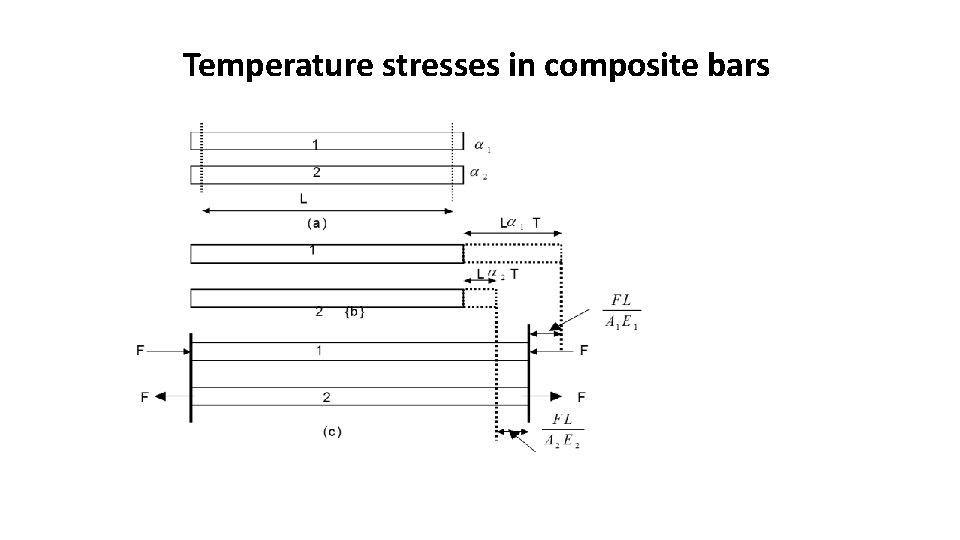
Temperature stresses in composite bars
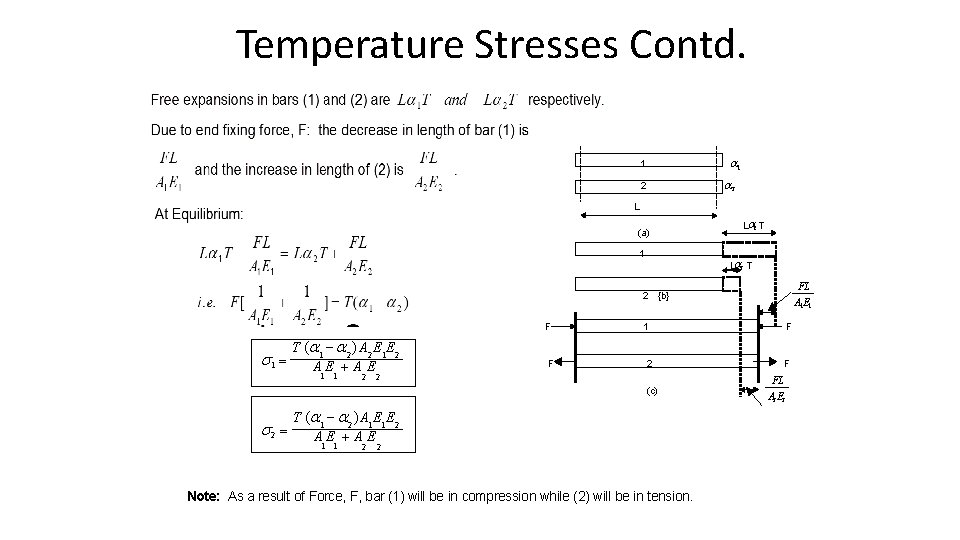
Temperature Stresses Contd. 1 1 2 2 L (a) 1 L 1 T L 2 T FL A 1 E 1 2 {b} F 1 T ( 1 2 ) A 2 E 1 E 2 AE A E 1 1 2 F 1 2 2 (c) 2 T ( 1 2 ) A 1 E 1 E 2 AE A E 1 1 2 2 Note: As a result of Force, F, bar (1) will be in compression while (2) will be in tension. F F FL A 2 E 2

Any Questions ?
Thank you 16
- Slides: 16