
Wellbeing measuring what matters Ingrid Abreu Scherer Wellbeing
Wellbeing: measuring what matters Ingrid Abreu Scherer Wellbeing and Civil Society Lead 2 July 2019
Wellbeing: ‘how do you know what works? 1. What is wellbeing, and what matters? 2. What does the evidence look like? 3. How do we know? – the evaluation tools 4. Practical exercise: wellbeing in your project 5. Feedback, discussion and questions
What Works Centre for Wellbeing An independent collaborative organisation set up to bring together and share robust, accessible and useful evidence about wellbeing
1. What is wellbeing and what matters?
What is wellbeing? Wellbeing is ‘how we’re doing’: • how we feel in ourselves and how we experience life as a whole • quality of life, good physical and mental health, relationships, and being part of our communities • how external conditions affect our lives and how we function in society • it’s different for different people
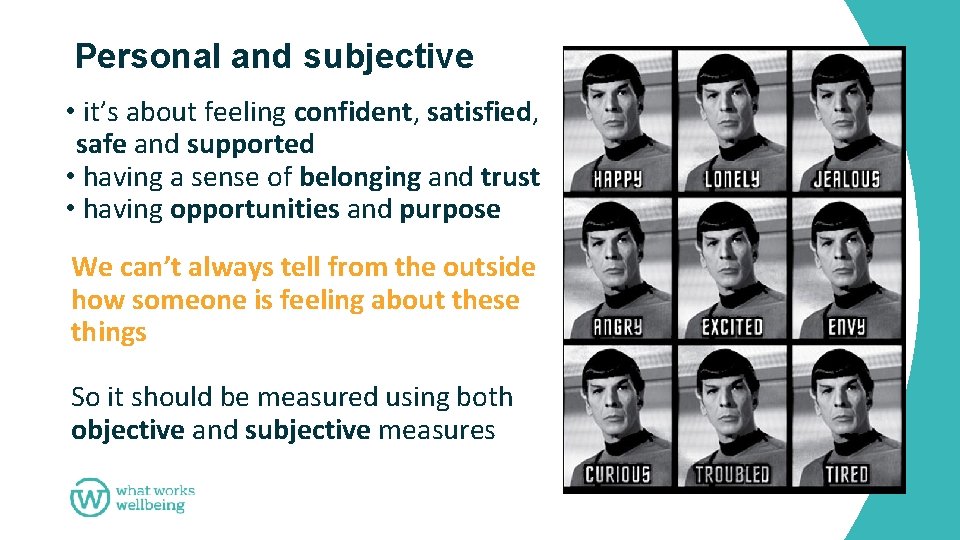
Personal and subjective • it’s about feeling confident, satisfied, safe and supported • having a sense of belonging and trust • having opportunities and purpose We can’t always tell from the outside how someone is feeling about these things So it should be measured using both objective and subjective measures
Genes Childhood experiences Our genes can explain between 30% and 50% of the difference in wellbeing between people including emotional health, family conditions & schooling affect us throughout our lives
Health mental and physical health, disability and resilience to changes in health What we do employment (especially good work), how we use our leisure time - including volunteering
Security Autonomy, participation and control including financial security and feelings of safety the ability to influence things that matter to us
Relationships Trust and belonging especially having someone to rely on, but also strong social networks how we feel about our neighbours and our place in our communities
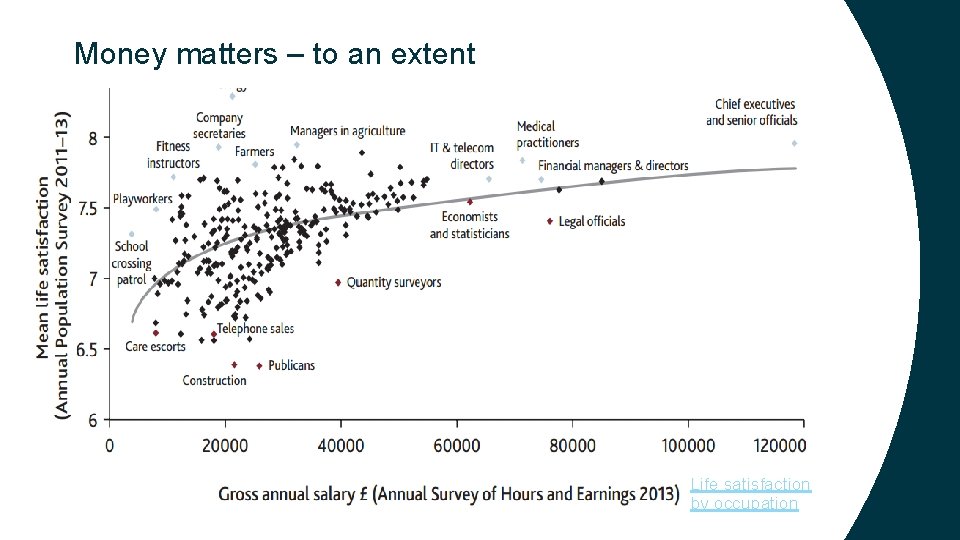
Money matters – to an extent Life satisfaction by occupation
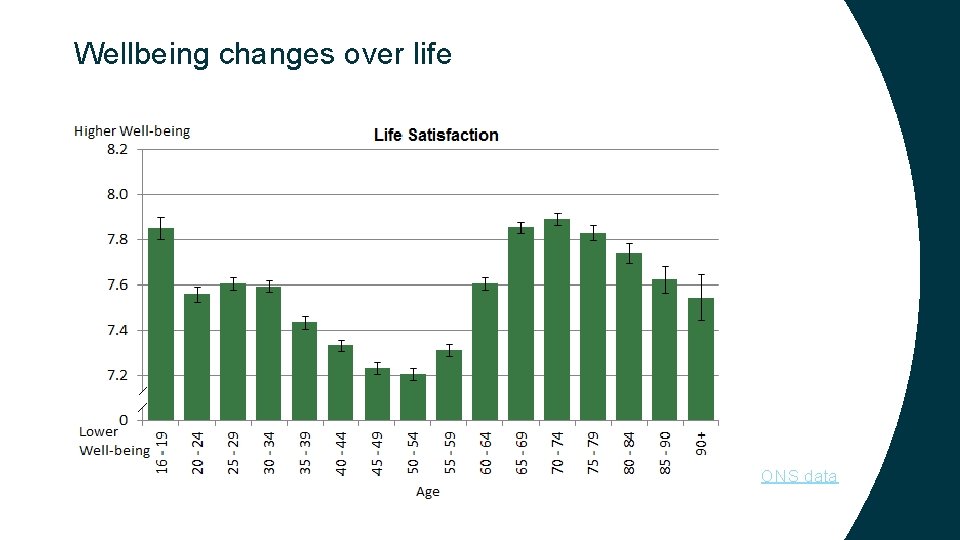
Wellbeing changes over life ONS data
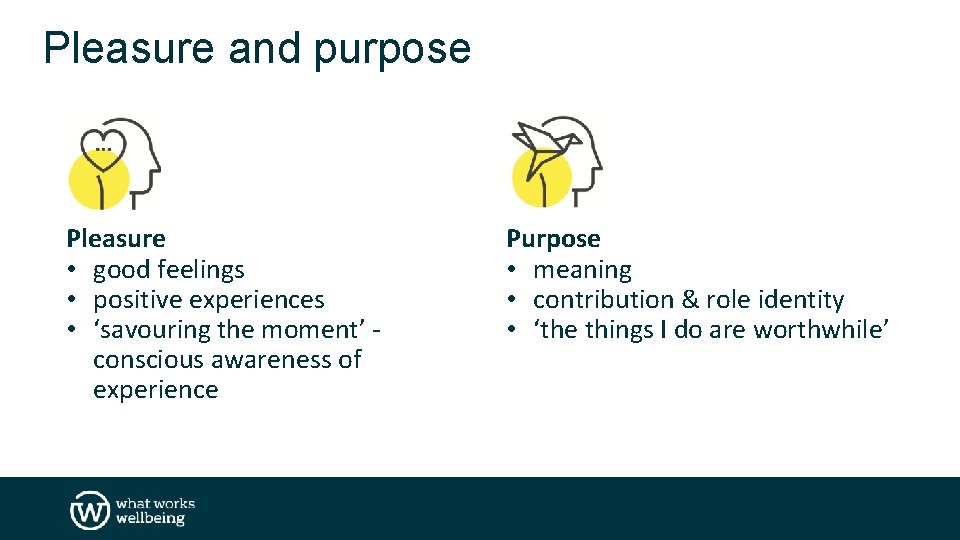
Pleasure and purpose Pleasure • good feelings • positive experiences • ‘savouring the moment’ conscious awareness of experience Purpose • meaning • contribution & role identity • ‘the things I do are worthwhile’
Who has the lowest wellbeing? Around 1% of people in the UK (over half a million people) were estimated to report low wellbeing People with the poorest personal wellbeing are most likely to have at least one of the following characteristics or circumstances: • • • self-report very bad or bad health be economically inactive with long-term illness or disability be middle-aged be single, separated, widowed or divorced be renters have no or basic education https: //www. ons. gov. uk/peoplepopulationandcommunity/wellbeing/articles/understan dingwellbeinginequalitieswhohasthepoorestpersonalwellbeing/2018 -07 -11

2. What does the evidence look like?
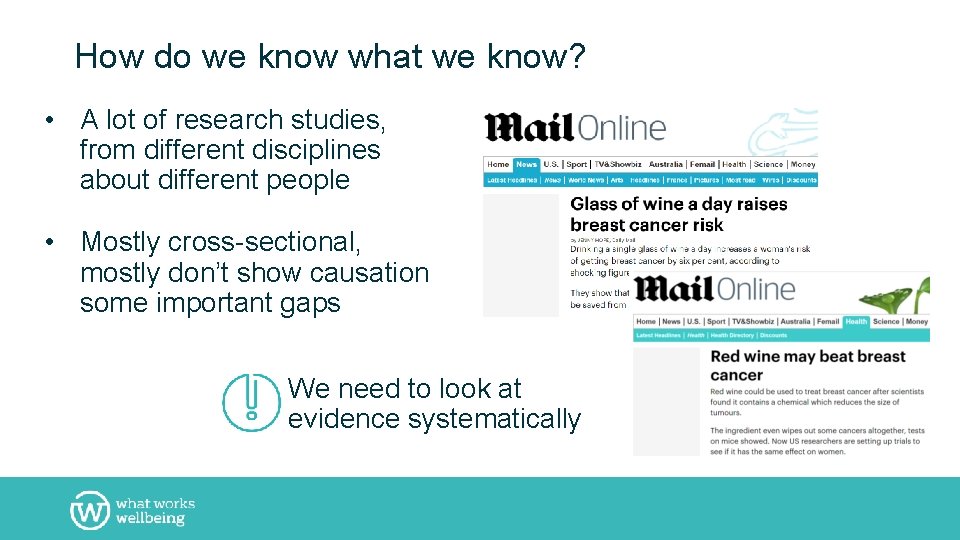
How do we know what we know? • A lot of research studies, from different disciplines about different people • Mostly cross-sectional, mostly don’t show causation some important gaps We need to look at evidence systematically
Our research covers… • Visual arts and wellbeing of people with mental health conditions • Music and singing for wellbeing • Sport and dance for young people’s wellbeing • The effect of places and spaces on community wellbeing • Heritage activities and wellbeing • What works to reduce loneliness?
3 How can we measure changes in wellbeing?
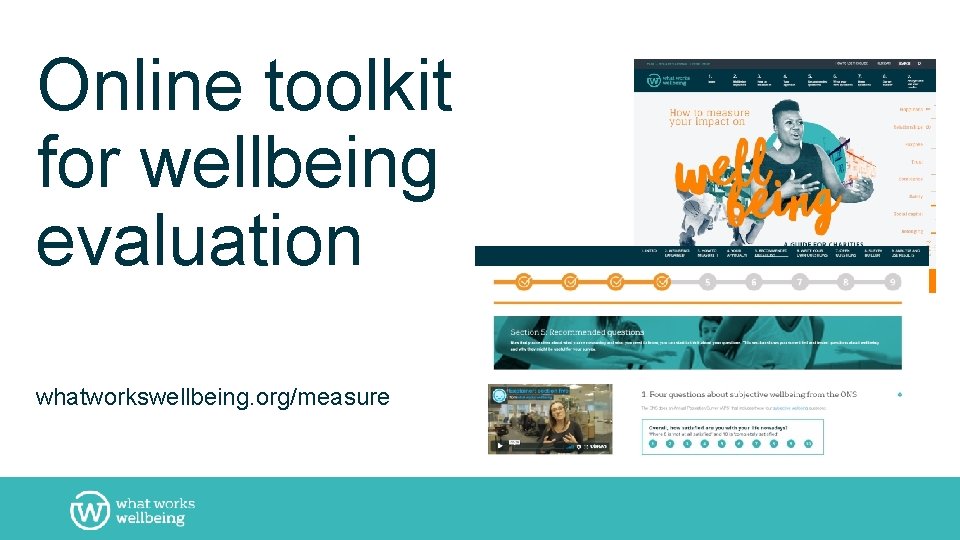
Online toolkit for wellbeing evaluation whatworkswellbeing. org/measure
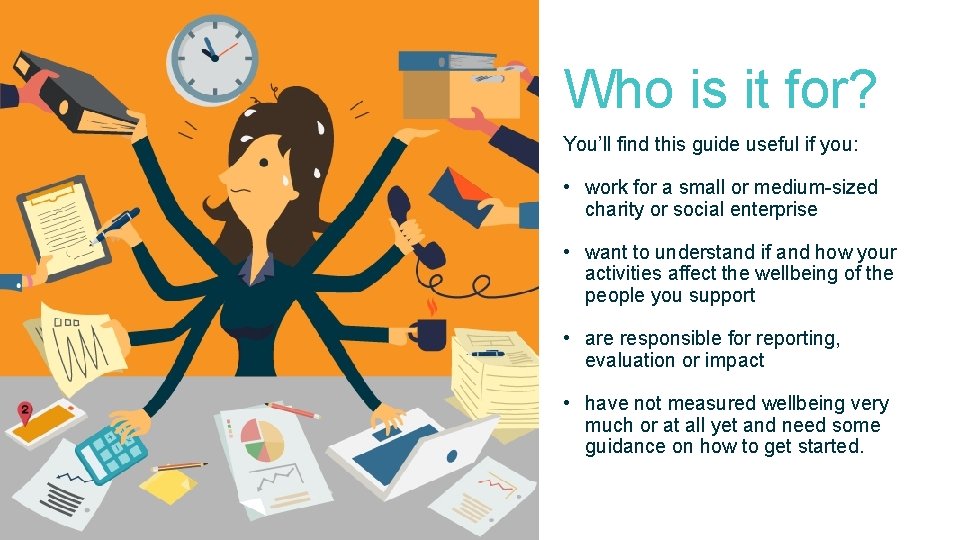
Who is it for? You’ll find this guide useful if you: • work for a small or medium-sized charity or social enterprise • want to understand if and how your activities affect the wellbeing of the people you support • are responsible for reporting, evaluation or impact • have not measured wellbeing very much or at all yet and need some guidance on how to get started.
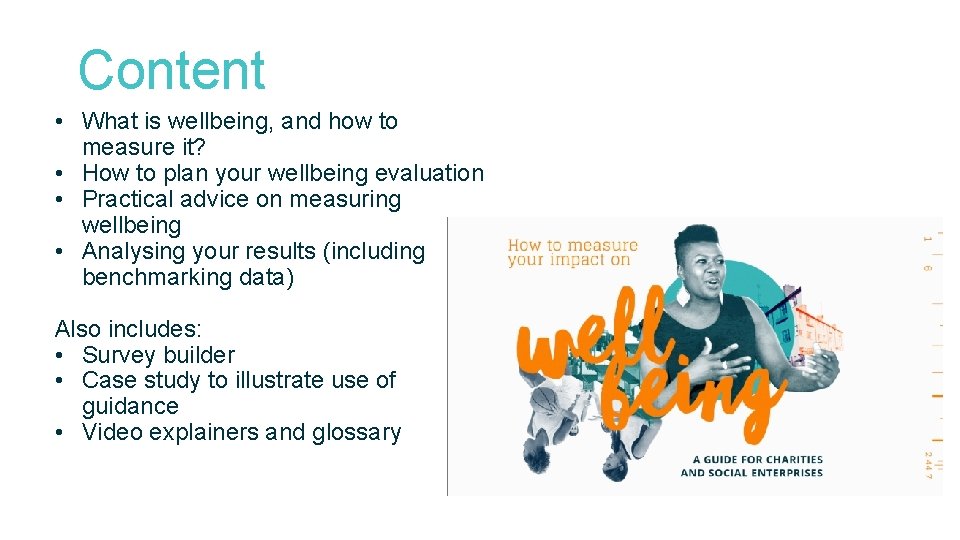
Content • What is wellbeing, and how to measure it? • How to plan your wellbeing evaluation • Practical advice on measuring wellbeing • Analysing your results (including benchmarking data) Also includes: • Survey builder • Case study to illustrate use of guidance • Video explainers and glossary
Quantitative data • Multiple choice question on a survey, observation and administrative data • Useful for finding out if wellbeing outcomes are achieved – and for whom • Useful ‘common currency’ to compare impacts of different projects Qualitative data • Open-ended questions in a survey, interviews, focus groups, photographs, creative approaches • Useful for finding out why and how wellbeing outcomes are achieved - the pathways and mechanisms of change
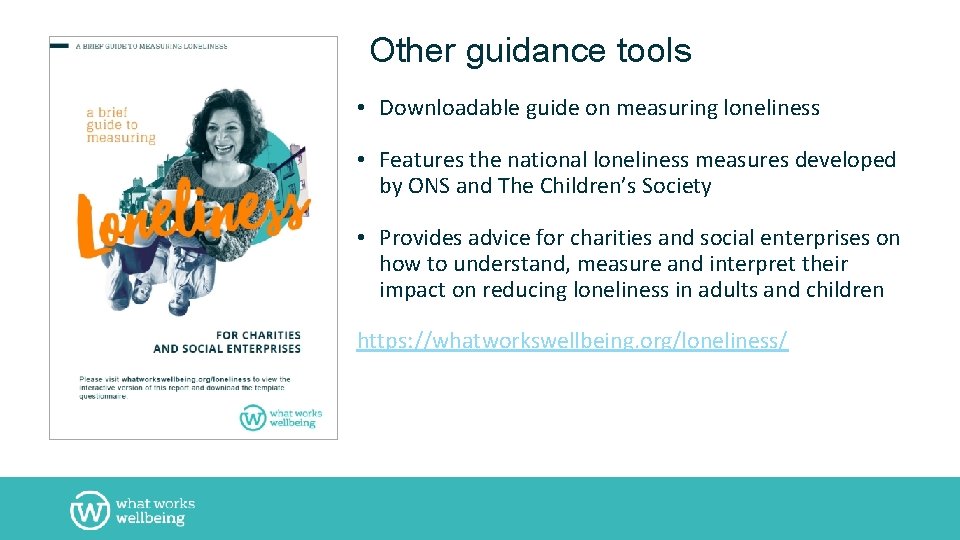
Other guidance tools • Downloadable guide on measuring loneliness • Features the national loneliness measures developed by ONS and The Children’s Society • Provides advice for charities and social enterprises on how to understand, measure and interpret their impact on reducing loneliness in adults and children https: //whatworkswellbeing. org/loneliness/
Three things to bear in mind 1. Wellbeing is a good outcome to aim for – but it will look different for different contexts, projects and people 2. Having positive experiences and feelings is important for wellbeing – you can do this in events and light-touch engagement activities 3. Making a meaningful change to someone’s life is also possible – especially through sustained, targeted engagement and volunteering
How do I use the research? 1. Think about your target population – what is their wellbeing currently, and what’s your role in improving it? 2. What motivates them (pleasure, purpose, learning, social connections) – how can you use this knowledge to design activities? 3. What resources and assets do you have that can be used to improve wellbeing? (spaces, networks, trust) 4. Rather than starting something new, what can you tweak in your current programme to add wellbeing value?
Exercise – in groups • Whose wellbeing do you care about? • Which aspect of wellbeing does your project impact? • How do you (or could you) measure it? 15 mins
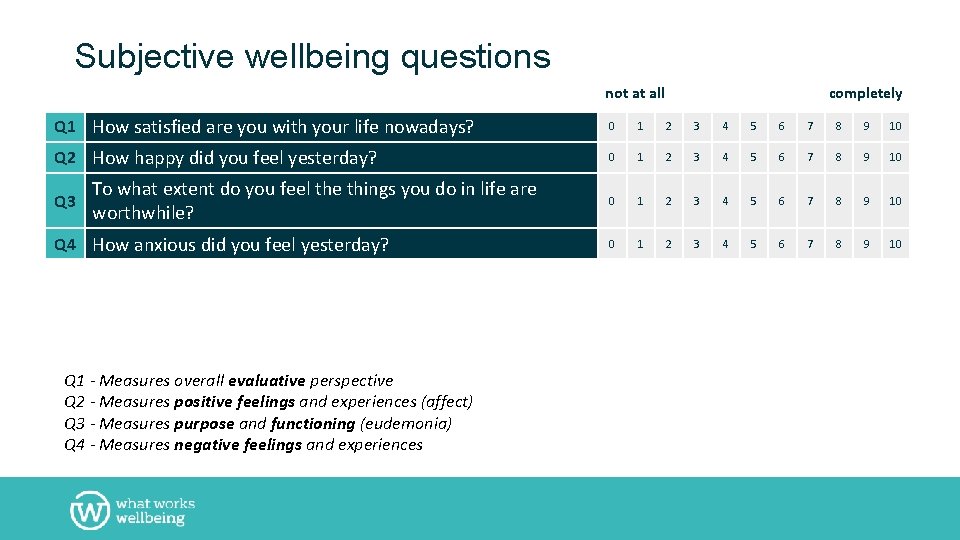
Subjective wellbeing questions not at all completely Q 1 How satisfied are you with your life nowadays? 0 1 2 3 4 5 6 7 8 9 10 Q 2 How happy did you feel yesterday? 0 1 2 3 4 5 6 7 8 9 10 Q 3 To what extent do you feel the things you do in life are worthwhile? Q 4 How anxious did you feel yesterday? Q 1 - Measures overall evaluative perspective Q 2 - Measures positive feelings and experiences (affect) Q 3 - Measures purpose and functioning (eudemonia) Q 4 - Measures negative feelings and experiences
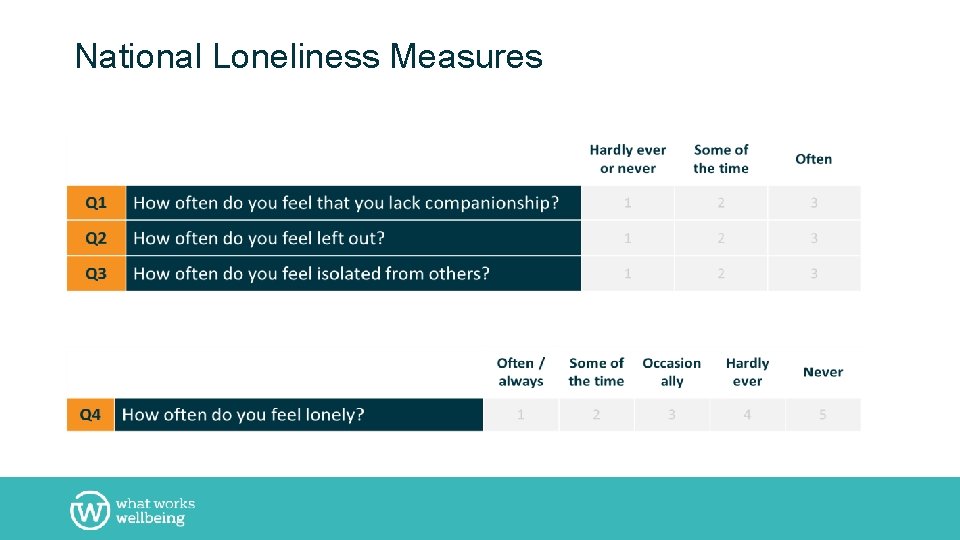
National Loneliness Measures
Thank you ingrid@whatworkswellbeing. org @What. Works. WB
- Slides: 29